
2027 Manufacturing Industry Outlook
Greater speed and agility across operations and talent could help US manufacturers capture growth as markets evolve
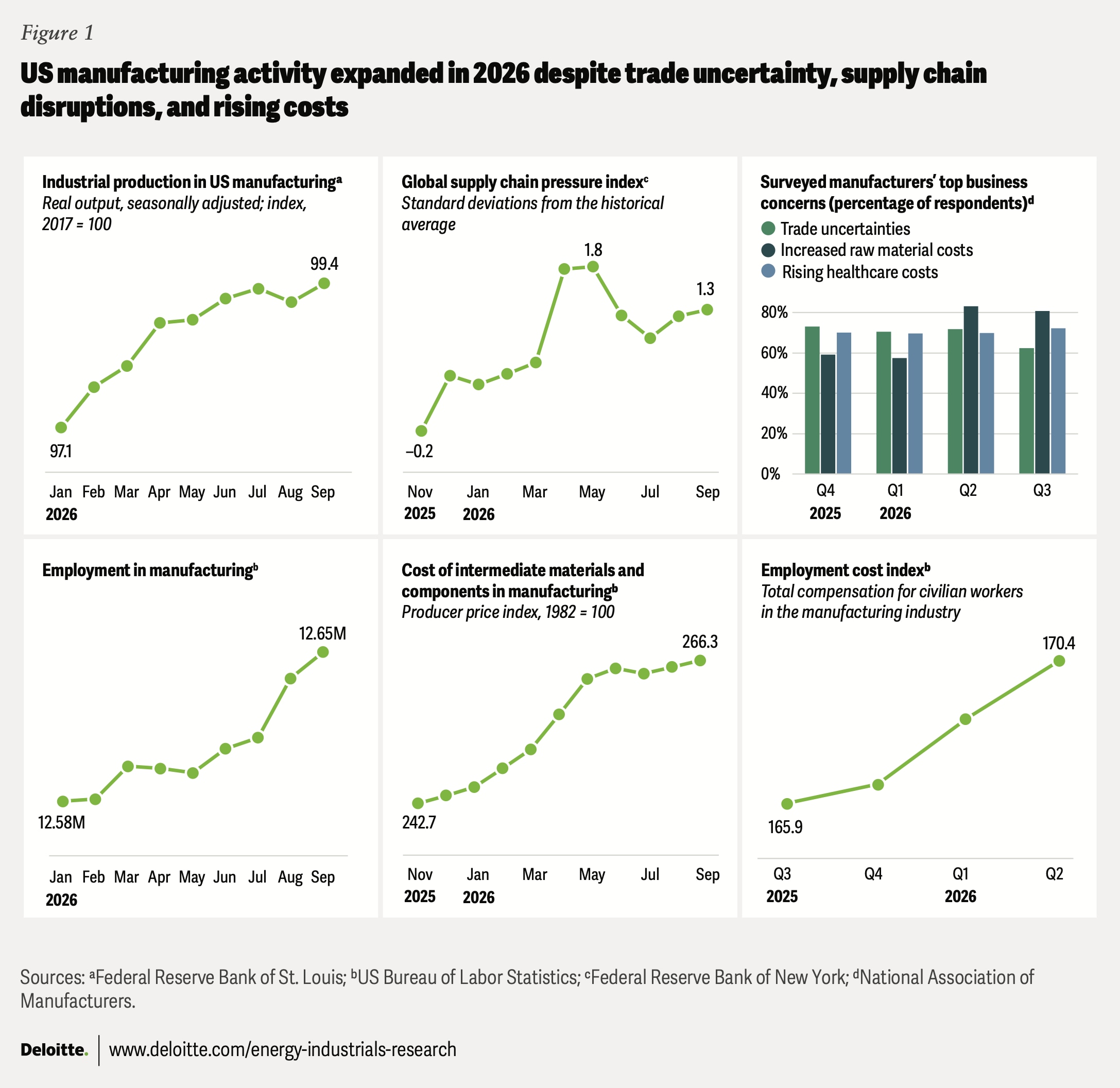
US manufacturing gained momentum in 2026 despite headwinds from trade uncertainty, supply chain disruptions, and rising costs (figure 1). Industrial production rose, and employment stabilized. Moreover, the Institute for Supply Management’s purchasing managers’ index remained above 50 for ten consecutive months amid growth in new orders and backlogs,1 marking its longest expansion streak since the 29-month run through October 2022.2
Looking ahead, trade developments and geopolitical dynamics could continue to create uncertainty in 2027. If inflation remains elevated, the Federal Reserve could keep interest rates high or raise them further, which could weigh on capital investment, consumer spending, and domestic demand.3 Slower working-age population growth4 could further strain the manufacturing talent pool, including the skilled workforce that modern manufacturing environments increasingly demand. However, artificial intelligence-related investment is expected to remain an important driver of economic growth,5 fueling demand for manufactured products alongside increased defense spending.6 Given this backdrop, five factors are likely to shape the 2027 manufacturing industry landscape:
- Growth markets: AI infrastructure and defense investment could boost US manufacturing demand
- Smart operations: Manufacturers may need to evolve their operating models as AI adoption shifts from experimentation toward scale
- Supply chain: Ongoing geopolitical and trade uncertainty may require targeted investments
- Cybersecurity: AI-enabled threats increasingly call for AI-enabled defenses
- Talent: Advanced operations and AI may reshape manufacturing roles and skills
1. Growth markets: AI infrastructure and defense investment could boost US manufacturing demand
Evolving markets are contributing to increased demand, reshaping capacity decisions, and raising expectations for speed and efficiency among US manufacturers. New orders in defense equipment, as well as sectors producing AI infrastructure and electrification components, including power generation and transmission equipment, cooling systems, and computers and electronics, have outpaced total manufacturing orders in recent years (figure 2).7
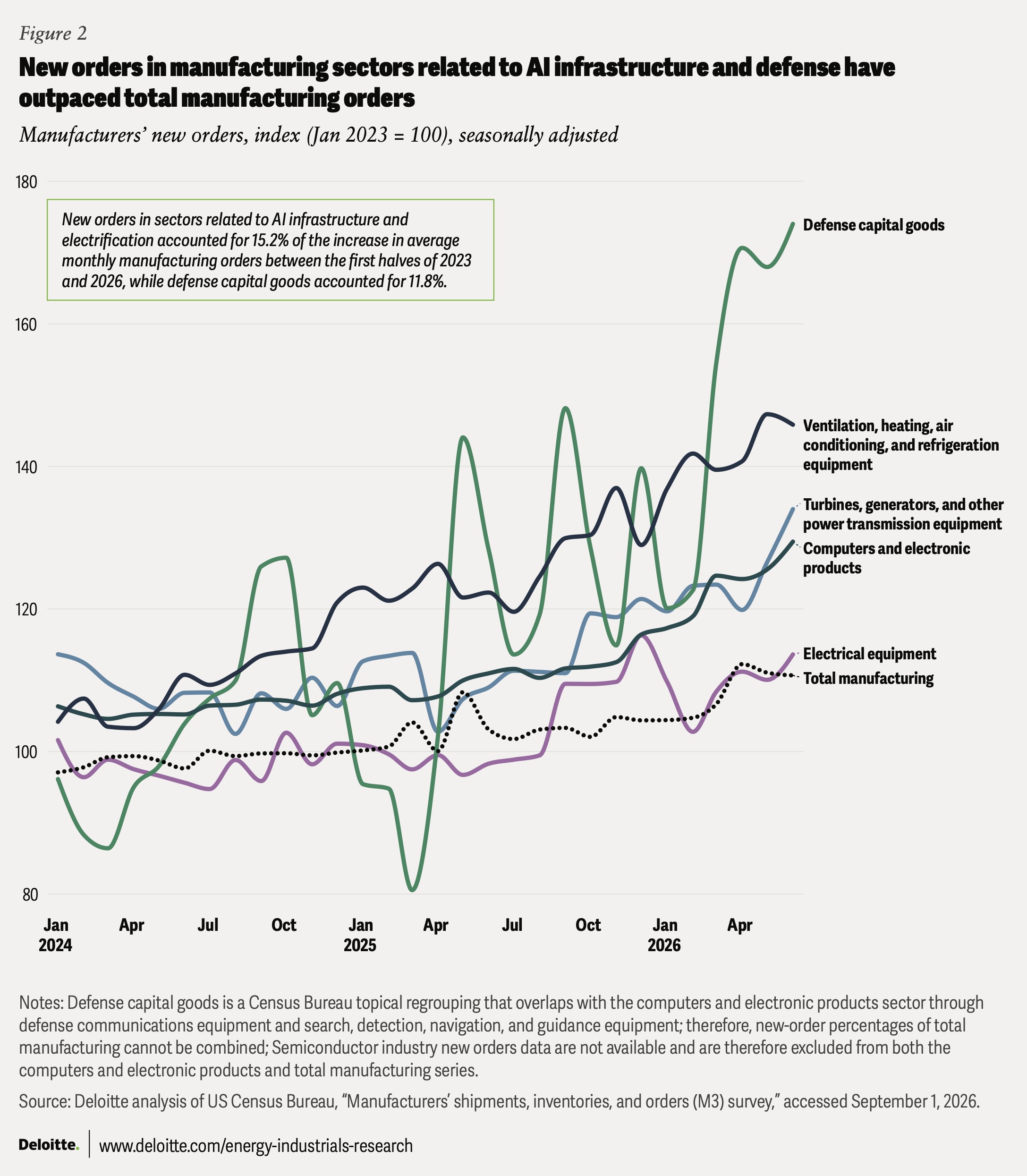
Through August 2026, unfilled orders in AI infrastructure- and electrification-related sectors increased 6.1% year to date to approximately US$248 billion, while unfilled orders for defense capital goods increased 8% to approximately $229 billion.8 Demand could remain strong in 2027 if AI investment continues to support economic growth9 and expanding domestic defense manufacturing capacity remains a focus of US policy actions and investments.10
To pursue these opportunities, manufacturers can assess how potential markets align with their existing products, capabilities, customer relationships, and competitive position, and then consider several approaches:
- Boost existing capacity where products and capabilities already align with emerging demand. For instance, Caterpillar repurposed a 250,000-square-foot US facility in under 12 months to package and ship power-generation equipment for AI infrastructure.11 Corning plans to build three new manufacturing facilities as part of an expansion intended to increase its US optical-connectivity production capacity.12
- Expand product portfolios by leveraging existing capabilities to develop adjacent products, retool production, and create new capacity. Three automotive manufacturers were recently awarded contracts to develop prototypes for the US Army’s Infantry Squad Vehicle-Heavy program, applying commercial capabilities to potentially expand into defense markets.13
- Leverage mergers, acquisitions, and joint ventures to accelerate access to capabilities, capacity, technology, and talent. For example, Eaton acquired Boyd Thermal to add liquid cooling technology for high-power computing environments, along with thermal components and ruggedized thermal systems.14 Deloitte analysis identified 25 manufacturer-led acquisitions related to AI infrastructure completed between January 2025 and October 2026, with disclosed deal values for nine transactions totaling $17.9 billion.15
- Invest in smart operations and AI to connect and act on data across product development, manufacturing, and supply chain operations. This can increase productivity, flexibility, and speed to market when developing new products, expanding existing facilities, or building new capacity.16
2. Smart operations: Manufacturers may need to evolve their operating models as AI adoption shifts from experimentation toward scale
Artificial intelligence is shaping the smart operations conversation, as investment increasingly moves beyond pilots toward production and scale17 and companies seek to address elevated costs, disruptions, and the need for greater agility.18 In a 2026 Manufacturing Leadership Council study, more than 70% of surveyed manufacturers reported using generative AI, and 66% reported using or planning to use agentic AI.19 Physical AI is also gaining adoption in some industrial operations. A recent Deloitte survey found that 72% of energy, resources, and industrials companies,20 including industrial products manufacturers, already use physical AI21 to some extent, with adoption projected to reach 91% within two years.22
Manufacturers can consider several actions to help scale AI investments in 2027:
- Redesign the enterprise operating model to support AI strategy execution at scale. Nearly 75% of technology leaders surveyed by Deloitte say their operating models will need to change within the next 12 to 18 months to derive greater value from AI.23 Manufacturers can respond by clarifying decision rights and accountability, and coordinating leadership, funding, work, risk, and external partners.24 Structures such as AI centers of excellence can help coordinate investments, establish standards, create reusable platforms, and align bottom-up experimentation with enterprise priorities.25
- Evaluate AI investments as part of an enterprise portfolio, not isolated use cases. This includes considering initial investment, data architecture, technology modernization, governance, trust, security, workflow transformation, and, increasingly, token costs.26 Manufacturers should also consider how individual use cases contribute to the end-to-end transformation of priority business domains and workflows with AI.27
- Address foundational gaps in digital and data preparedness. More than 60% of manufacturers surveyed by the Manufacturing Leadership Council cited data issues as a leading AI adoption challenge, particularly poor data quality and contextualization.28 However, perfect data isn’t a prerequisite to begin the AI journey. Companies can start with the business problem, identify the data needed for priority domains and workflows, improve and connect it incrementally, and use AI where appropriate to cleanse and prepare the data.29 Manufacturers that are earlier in their digital journeys may now have greater incentive to invest in their digital foundation, such as manufacturing execution systems, to support future AI adoption.30
3. Supply chain: Ongoing geopolitical and trade uncertainty may require targeted investments
Manufacturers have reported continued growth in 2026, alongside rising input costs and longer supplier delivery times, citing trade measures and geopolitical developments among the contributing factors.31 These challenges could continue in 2027, and broader global economic and geopolitical uncertainty may pressure trade and supply chains through 2028.32
Against this backdrop, some manufacturers are shifting regional sourcing, managing compliance, diversifying their supply bases, and focusing on recovering costs.33 A January 2026 survey conducted by Manufacturers Alliance found that 77% of respondents had implemented physical changes to their supply chains, up from 56% in April 2025.34 Separately, the share reporting acute tariff-related disruption fell from 36% to 17%, which may indicate early adaptation.35
Given this environment, manufacturers could consider the following actions in 2027:
- Prioritizing flexibility in capacity and sourcing decisions as market and supply conditions evolve. According to the National Association of Manufacturers’ third-quarter 2026 outlook survey, 89.6% of respondents expect input costs to rise over the next year, with an average forecast increase of 5%.36 Supply chain disruptions could also constrain growth if they limit the availability of critical components and production inputs.37 Manufacturers can assess and mitigate the potential impacts on operations and growth investments while preserving flexibility in capacity and sourcing to capture new opportunities.38
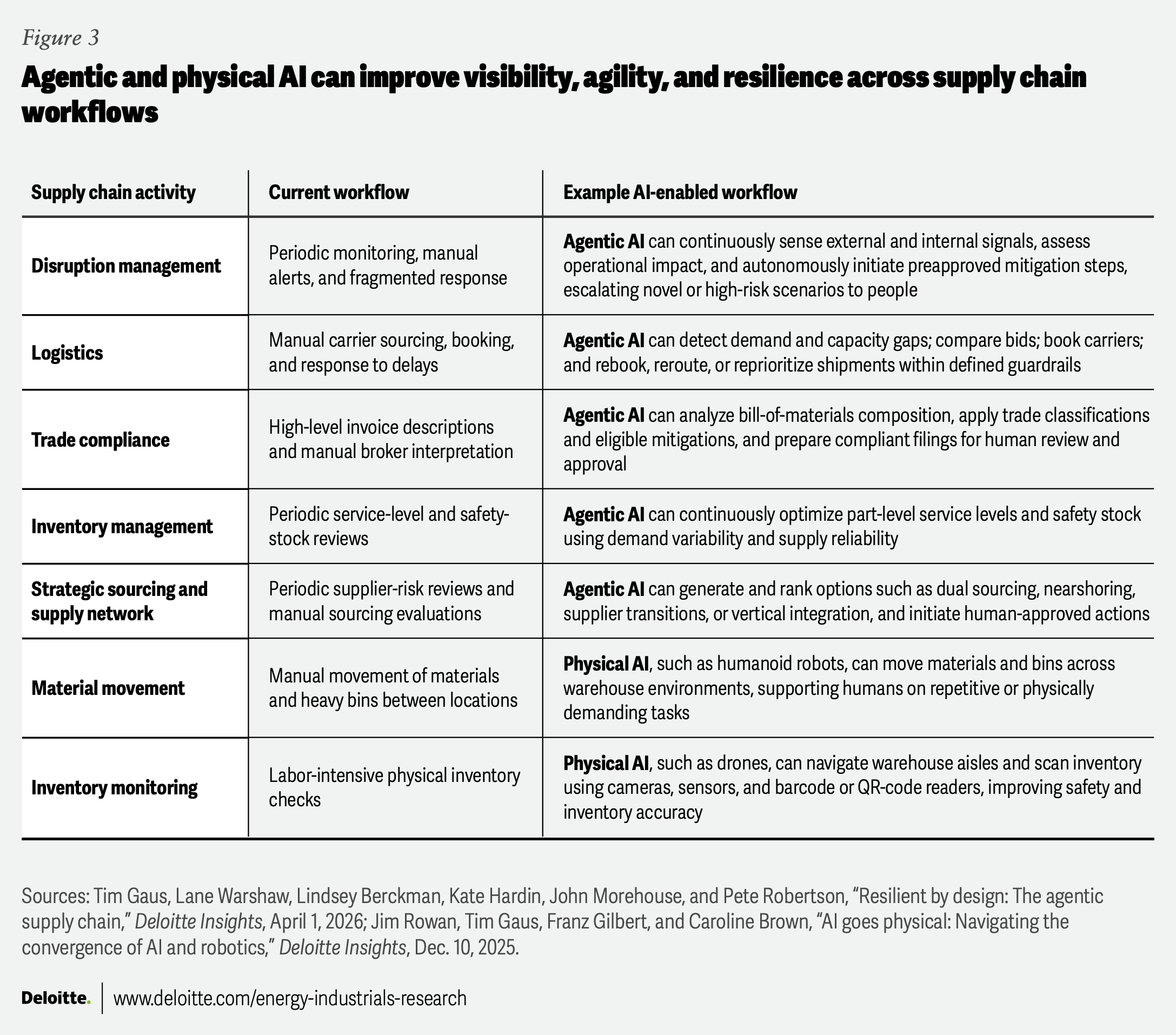
- Targeting AI investments that improve supply chain visibility, agility, and resilience. Agentic AI can continuously monitor disruptions, evaluate sourcing alternatives, and autonomously initiate governed mitigation actions,39 while physical AI can help improve material movement and inventory monitoring (figure 3).40
4. Cybersecurity: AI-enabled threats increasingly call for AI-enabled defenses
Manufacturers remain targets for cyberattacks, as increasingly connected operations and reliance on legacy information technology (IT) and operational technology (OT) can create vulnerabilities. A recent Rockwell Automation study highlighted that 46% of surveyed manufacturers experienced a cyber incident in the past year.41 Meanwhile, the number of active AI agents in enterprise environments grew 466.7% in one year, according to one study.42 AI agents can interact across enterprise systems and may be granted or inherit elevated privileges, sometimes without centralized governance or visibility, thereby expanding the attack surface.43 AI agents are also being used by threat actors to automate portions of cyberattacks, including ransomware.44 Beyond this automation, AI can lower some barriers to entry across cybercrime-as-a-service markets by making certain tools and capabilities easier to develop and deploy.45 Vulnerabilities once considered less likely to be targeted because of the human effort or specialized expertise required are now more accessible and consequential in today’s AI-driven threat landscape.46 Together, these trends could expand the pool of threat actors and allow them to exploit a broader range of vulnerabilities more quickly.
Manufacturers can consider the following actions in the coming year:
- Modernize cyber defenses for an increasingly “AI versus AI” environment. Reassess IT and OT systems and connected assets, especially legacy systems that may now pose greater risk. AI-enabled capabilities can help identify vulnerabilities, prioritize risk, accelerate remediation, and potentially automate patching and other responses.47 IDC projects that by 2029, 75% of large manufacturers will deploy AI-enabled OT cyber defenses, including autonomous flagging of to lower-level threats, with detection times falling by 60%.48
- Build security and governance into AI implementations by design, starting at the pilot phase. This includes data loss prevention, AI agent identity and access management, and controls to monitor and govern what agents can access and do.49 Agents can traverse and integrate information across diverse data sets at scale, potentially undermining traditional assumptions about data segregation rooted in human limitations. Accordingly, manufacturers may need to refocus on the basics, including data classification, tagging, metadata management, and access controls, as well as policies governing agent activity.50
5. Talent: Advanced operations and AI may reshape manufacturing roles and skills
Advanced manufacturing operations can help companies respond quickly to market shifts and capture new growth opportunities, but they increasingly require an agile workforce51 with more specialized skills and knowledge (figure 4). For instance, the employment of multiskilled industrial machinery mechanics52 is projected to grow by more than 19% from 2025 to 2035, making it one of the fastest-growing occupations in manufacturing.53
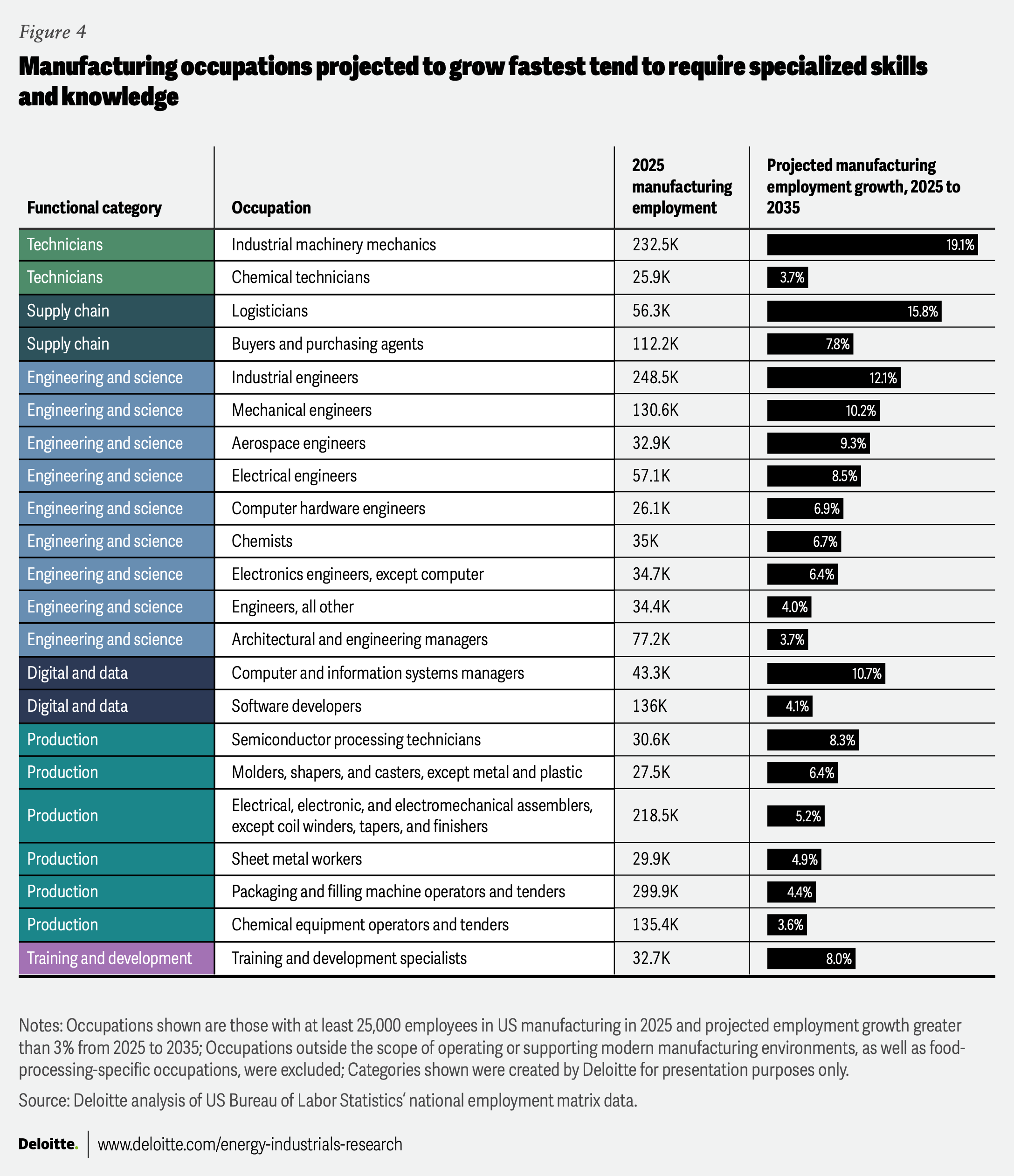
Yet applicant shortages and skills gaps persist. According to a 2026 survey of manufacturers conducted by the Reshoring Initiative and Regions Recruiting, 66% of respondents rated technicians and skilled production roles54 as very difficult to fill, followed by maintenance and repair technicians (60%) and engineers (49%).55
In 2027, manufacturers can consider several actions to build the workforce they need:
- Reassess the occupational mix and skills required for existing operations, new products and capacity, and increasingly advanced facilities. Evaluate how potential investments could shift demand across key roles, such as skilled production, engineering, and supply chain, and identify where talent availability or time to proficiency could create operational bottlenecks.
- Strengthen targeted talent pipelines by mapping internal and regional talent pools, assessing competition for the same workers, and strengthening the employee value proposition.56 In a recent study, Deloitte and The Manufacturing Institute found that, to help meet the growing demand for technicians, manufacturers could broaden the talent pool by increasing internal mobility and considering workers from adjacent industries, such as construction and retail, especially when supported by AI-enabled training and workflows.57
- Redesign workflows, training, and career pathways to derive value from AI investments, including physical AI. According to a recent Deloitte study, companies that redesign workflows around human-AI collaboration rather than layer AI into existing processes are twice as likely to report outperforming on their AI-related return-on-investment expectations.58 By embedding human expertise into workflows, AI can lower barriers to entry, accelerate time to proficiency, and enhance the appeal of manufacturing roles to a broader range of workers.59 Physical AI can help take on repetitive or physically demanding tasks, potentially making work safer and easier.60 Meanwhile, workers in AI-enabled roles may need new skills in AI oversight and orchestration, critical thinking, and strategic and ethical decision-making to validate AI-generated outputs and safely manage increasingly autonomous systems.61
Prioritizing speed and agility for growth
Some US manufacturers are entering 2027 with opportunities for growth, despite continued uncertainty in trade, demand, costs, and geopolitics. Capturing these opportunities as market conditions evolve will likely require speed, agility, and resilience. Smart operations and AI could play increasingly important roles, with the potential to improve productivity and decision-making, augment workers, strengthen supply chain resilience, and help manufacturers adapt more quickly. At the same time, growing digital connectivity and broader AI adoption are likely to heighten the importance of cybersecurity and governance. Manufacturers that can align capital, technology, and talent investments with evolving opportunities while managing risk in tandem may be well positioned to gain a competitive edge in 2027 and beyond.
Continue the conversation
Meet the industry leaders
Steve Shepley
Kate Hardin
BY
Steve Shepley
Kate Hardin
John Morehouse
Deloitte Advisory Board:
Tim Gaus, Michael Schlotterbeck, Victor Reyes, Brian Wolfe, Pete Robertson, and Alan Brady
The authors would like to thank Kruttika Dwivedi for her general project support and creation of derivative materials.
The authors would like to acknowledge the support of Clayton Wilkerson for orchestrating resources related to the report; Kimberly Prauda and Neelu Rajput, who drove the marketing strategy and related assets to bring the story to life; Mariel Balaban and Kaitlin Pellerin for their leadership and support in public relations; and Rithu Thomas and Aparna Prusty from the Deloitte Insights team who supported the report’s publication; and Harry Wedel for the visual design.
Editorial (including production and copyediting): Rithu Thomas, Pubali Dey, Aparna Prusty, and Anu Augustine
Design: Harry Wedel
Cover image by: Tushar Barman and Sanaa Saifi; Adobe Stock
Knowledge services: Agni Wagh
Visit the Deloitte Center for Energy & Industrials
Access more insights for the aerospace and defense, chemicals and specialty materials, engineering and construction, industrial manufacturing, mining and metals, oil and gas, power and utilities, and renewable energy sectors.