
The agentic reality check: Preparing for a silicon-based workforce
Despite its promise, many agentic AI implementations are failing. But leading organizations that are reimagining operations and managing agents as workers are finding success.
Enterprises are moving quickly toward agentic AI, but many are hitting a wall. They’re trying to automate existing processes—tasks designed by and for human workers—without reimagining how the work should actually be done.
Leading organizations are discovering something different: True value comes from redesigning operations, not just layering agents onto old workflows. This means building agent-compatible architectures, implementing robust orchestration frameworks, and developing new management approaches for digital workers.
It also means rethinking work itself. As organizations embrace the full potential of agents, not only are their processes likely to change but so will their definition of a worker. Agents may come to be seen as a silicon-based workforce that complements and enhances the human workforce. Getting the fundamentals right—from microservice-based agent architectures to silicon-workforce management—can prepare enterprises for whatever shape the future of workflow automation takes and position them to compete effectively in an agent-native business environment.
Henry Ford put it perfectly: “Many people are busy trying to find better ways of doing things that should not have to be done at all. There is no progress in merely finding a better way to do a useless thing.”1 He was writing about building automobiles in 1922, but he could just as easily have been describing enterprise AI in 2025.
The agent reality check
Agentic AI has captured the attention of enterprises with its compelling promises of autonomous operation and intelligent execution. The momentum is undeniable: Gartner predicts that 15% of day-to-day work decisions will be made autonomously through agentic AI by 2028, up from none in 2024, while 33% of enterprise software applications will include agentic AI by the same timeframe, compared with less than 1% today (figure 1).2
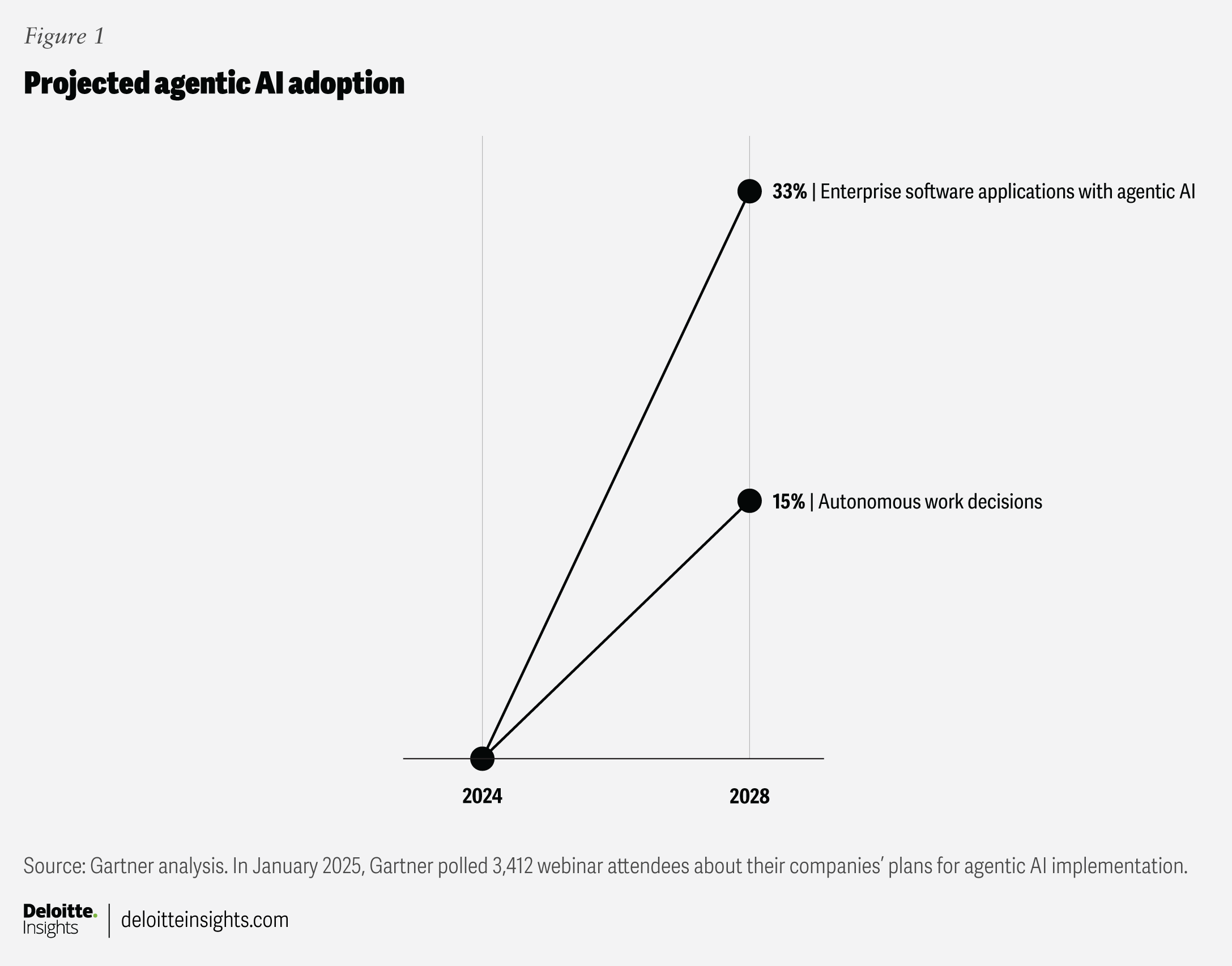
Yet despite this enthusiasm, enterprises are encountering significant obstacles in translating agentic pilots into production-ready solutions. Deloitte’s 2025 Emerging Technology Trends study notes that while 30% of surveyed organizations are exploring agentic options and 38% are piloting solutions, only 14% have solutions that are ready to be deployed and a mere 11% are actively using these systems in production. Furthermore, 42% of organizations report they are still developing their agentic strategy road map, with 35% having no formal strategy at all.3
The agentic reality gap
Three fundamental infrastructure obstacles may prevent organizations from realizing the full potential of agentic AI.
Legacy system integration: Traditional enterprise systems weren’t designed for agentic interactions. Most agents still rely on application programming interfaces (APIs) and conventional data pipelines to access enterprise systems, which creates bottlenecks and limits their autonomous capabilities. Gartner predicts that over 40% of agentic AI projects will fail by 2027 because legacy systems can’t support modern AI execution demands. These systems lack the real-time execution capability, modern APIs, modular architectures, and secure identity management needed for true agentic integration.4
Data architecture constraints: Current enterprise data architectures, built around extract, transform, load (ETL) processes and data warehouses, create friction for agent deployment. The fundamental issue is that most organizational data isn’t positioned to be consumed by agents that need to understand business context and make decisions. In a 2025 Deloitte survey, nearly half of organizations cited searchability of data (48%) and reusability of data (47%) as challenges to their AI automation strategy.5
The solution involves a paradigm shift from traditional data pipelines to what can be described as enterprise search and indexing—similar to how Google made the World Wide Web discoverable. This approach involves contextualizing enterprise data through content and index stores built on knowledge graphs, making information discoverable without requiring extensive ETL processes.
Governance and control frameworks: Enterprises struggle to establish appropriate oversight mechanisms for systems designed to operate autonomously. Traditional IT governance models don’t account for AI systems that make independent decisions and take actions. The challenge extends beyond technical control to fundamental questions about process redesign: Many organizations attempt to automate current processes rather than reimagine workflows for an agentic environment.
Additionally, many so-called agentic initiatives are actually automation use cases in disguise. Enterprises often apply agents where simpler tools would suffice, resulting in poor ROI. This “agent washing” compounds the problem, with vendors rebranding existing automation capabilities as “agents.”6 Furthermore, poorly designed agentic applications can actually add work to a process, with some enterprises finding agentic “workslop” can make processes even less efficient.7
At their core, AI agents represent a new paradigm in how work gets done, but most enterprises today simply aren’t set up to take advantage of the opportunities for automation that agents present. However, we’re starting to see signs at leading organizations that these challenges can be surmounted through strategic process redesign, architectural modernization, and new governance frameworks.
The architecture of autonomous operations
Forward-thinking organizations are moving beyond pilot projects to implement systematic approaches for agentic transformation. Their success stems from recognizing that effective agentic AI requires more than deploying individual agents. Instead, it requires thoughtful approaches to integrating agents into systems and workflows, and carefully managing agents once they’re rolled out.
Redesigning processes to be agent-native
Leading enterprises don’t simply layer agents onto existing workflows. Instead, they redesign processes to leverage the unique strengths of agents. This requires taking a step back and examining end-to-end processes rather than finding automation opportunities within current operations. Agents can handle a range of transactions, communicate with each other, and collaborate to achieve a business outcome, but only when the underlying processes are structured to support these capabilities.
“Now is an ideal time to conduct value stream mapping to understand how workflows should work versus the way they do work,” says Brent Collins, head of global SI alliances and former vice president of AI strategy at Intel. “Don’t simply pave the cow path. Instead, take advantage of this AI evolution to reimagine how agents can best collaborate, support, and optimize operations for the business.”8
Most businesses’ existing processes were designed around human staff. Agents operate differently. They don’t need breaks or weekends. They can complete a high volume of tasks continually. When organizations realize this, the opportunities for process redesign become compelling. That’s why enterprises that are succeeding with agentic AI are looking at their processes from end to end.
Enterprise software and services company HPE is developing an AI agent with exactly this kind of process redesign in mind. “We wanted to select an end-to-end process where we could truly transform rather than just solve for a single pain point. We wanted to operate differently,” says Marie Myers, executive vice president and chief financial officer.9
Her team led the creation of an AI agent called Alfred that helps complete internal operational performance reviews. Myers says the process of conducting the review is very time-consuming, but it’s also developed from large data sets, making it ripe for agentic automation. The agent developed by the team consists of an agentic front-end user interface that works with four separate underlying agents. These agents break down queries into multiple elements for processing, conduct data analysis on SQL data, build charts and graphs to present data, and translate AI insights into user-friendly structured reports. The agents pull data from the company’s data warehouse, which sits on top of its enterprise resourcing planning and customer relationship management systems.
Myers says she believes the project holds lessons for those outside of her team and even beyond HPE: “That’s why we chose this use case, because it applies across functions and industries. We wanted to be able to drive change across the various levels of the organization.”
Legacy system replacement
When an organization examines its end-to-end processes, it will likely discover workflows that span multiple systems, including legacy software. This has implications for core modernization strategies. As we discussed in last year’s Tech Trends report, AI is increasingly able to learn and understand the essential business rules and workflows that define a business’ operations. Organizations should carefully consider what constitutes their true core systems and determine whether to use traditional application modernization when agents can effectively bridge legacy system gaps.
At Toyota, teams are using an agentic tool to gain better visibility into the estimated time of arrival of vehicles at dealerships and will soon start using agents to resolve supply issues. The process used to involve 50 to 100 mainframe screens and significant hands-on work from supply chain team members. Now, an agent delivers real-time information to staff on vehicles from pre-manufacturing through delivery to the dealership, all without anyone having to interact with the mainframe.
Going forward, the team plans to empower agents to identify delays in vehicle shipments and draft emails to try to resolve the issue.
“The agent can do all these things before the team member even comes in in the morning,” says Jason Ballard, vice president of digital innovations at Toyota. “We’ve made that critical decision to just go ahead and invest in this area a bit further. We feel like that’s where the differentiator is going to be going forward.”11
Managing the mixed silicon- and carbon-based workforce
Perhaps the most significant shift when implementing AI agents involves recognizing that agents represent a new form of labor, one that may share some similarities with the human (or carbon-based) workforce. Some organizations are beginning to think beyond using agents as simple automation tools and are starting to explore ways to integrate them with their human workforce.
This evolution represents a fundamental reimagining of what work means, how it’s performed, and who performs it. At the heart of this shift is a recognition that AI agents and human workers have different skill sets. While agents excel at defined processes, humans remain essential for navigating the shifting ground of business requirements and complex problem-solving scenarios.
This transformation creates two primary areas that human workers are moving toward.
- Compliance and governance: Humans increasingly focus on validation, oversight, and building guardrails for agent operations.
- Growth and innovation: They also concentrate on reimagining operations and identifying new opportunities that emerge from agent capabilities.
At insurance company Mapfre, AI agents are used across the organization, including in claims management, where agents handle routine administrative tasks like damage assessments. And when it comes to more sensitive tasks like customer communication, a person is always in the loop. Maribel Solanas Gonzalez, Mapfre’s group chief data officer, says she carefully considers which tasks to delegate to agents, ensuring that they are tasks that agents can complete safely and efficiently. Anything that may carry risk still goes through a human worker. This is beginning to change the nature of jobs. The company has published an AI manifesto that prioritizes well-governed, respectful, and safe AI.
“It’s hybrid by design,” she says. “With the high level of autonomy of these agents, it’s not going to substitute for people, but it’s going to change what [human workers] do today, allowing them to invest their time on more valuable work.”12
Other enterprises are going even further. Biotech company Moderna recently named its first chief people and digital technology officer, essentially combining its technology and HR functions. The move was a strategic step to evolve Moderna’s operating model by integrating people and technology to accelerate how work gets done.
“The HR organization does workforce planning really well, and the IT function does technology planning really well. We need to think about work planning, regardless of if it’s a person or a technology,” says Tracey Franklin, chief people and digital technology officer at Moderna.13
Specialized vs. broad automation
Successful deployments focus on specific, well-defined domains rather than attempting enterprise-wide automation. Broad automation remains possible but requires multiple specialized agents working in an orchestrated fashion rather than single, monolithic solutions.
Organizations face critical build-versus-buy decisions that often depend on technical maturity and specific use case requirements. Research indicates that pilots built through strategic partnerships are twice as likely to reach full deployment compared to those built internally, with employee usage rates nearly double for externally built tools.14
Multiagent orchestration
The first wave of generative AI in the enterprise consisted largely of general-purpose chatbots, which, while useful as productivity tools, often don’t deliver the kind of opportunities to automate that businesses need to drive new efficiencies. With AI agents, organizations can develop highly specialized tools that automatically execute specific tasks. When these specialists are deployed in an orchestrated manner, they can automate entire workflows. This approach is enabled by evolving standards and protocols that facilitate agent interaction.
Model Context Protocol (MCP): Developed by Anthropic, MCP standardizes how AI systems connect to data sources and tools, providing a universal interface for agents to access enterprise resources.15 While promising, MCP faces limitations in handling complex enterprise security requirements and integrating legacy systems.
Agent-to-Agent Protocol (A2A): Google’s protocol enables direct communication between different AI agents across platforms, handling agent discovery, task delegation, and collaborative workflow.16
Agent Communication Protocol (ACP): This is an open protocol that enables agents to communicate with each other through a RESTful API, allowing agents to collaborate regardless of the environment in which they were built.17 ACP may face hurdles due to limitations on the number of agents that can coordinate in a single network and the complexity of integrating with existing enterprise tools.18
These protocols represent the foundational layer for what experts describe as a “microservices approach to AI”: deploying numerous smaller, specialized agents across various platforms closer to where workflow instructions and data reside. This approach offers several advantages, such as reduced complexity (because smaller agents are easier to debug, test, and maintain); scalable orchestration, where multiple specialized agents can be combined for complex tasks; and platform flexibility that allows agents to run on different systems while maintaining interoperability.
FinOps for agents
As agents operate continuously, poorly configured agent interactions can trigger cascading actions like unpredictable resource consumption and ballooning costs, making cost management critical. Organizations need specialized financial operations frameworks (or FinOps) to monitor and control agent-driven expenses and account for token-based pricing models. These frameworks help track costs in detail through resource tagging, real-time monitoring, automated resource management including autoscaling and rightsizing, and strong governance frameworks to manage AI-specific expenditures.19
Five questions to drive agentic AI implementations
As organizations begin their agentic journey, they can consider five strategic questions to help drive their adoption, both now and into the future.
- What agents will be deployed, and what functions will they perform?
- What are the cost profiles relative to human employees?
- Which processes will be automated and at what level of efficiency?
- What will be the optimal mix of human and digital workforce over the next four years?
- Will agents eventually take over entire operational areas beyond the five-year horizon?
Most enterprises ready to implement AI agents today are likely to have prepared answers for the first three questions. However, things get hazier as they consider the latter two. A lot depends on how agentic technology and the underlying generative AI models develop in the future and how this development drives changes in workforce makeup and operational priorities.
Human-digital collaboration drives differentiation
The future enterprise is likely to experience significant changes in the fundamental nature of work, extending beyond traditional carbon-based workforces to include digital agents that autonomously handle entire job functions. As we discussed, companies are already beginning to develop hybrid human-digital workforces. If organizations get this balance right, it may become the primary competitive differentiator in most industries going forward.
The autonomy spectrum
Organizations should define clear boundaries for agent decision-making through graduated autonomy levels, with appropriate human oversight triggers. The autonomy spectrum progresses through three distinct phases.
- Augmentation: Today’s reality where agents enhance human worker capabilities
- Automation: An emerging capability where agents automate tasks within processes defined by humans
- True autonomy: A future state in which artificial general intelligence enables agents to work with minimal oversight
Success requires deploying “agent supervisors”—humans who enter workflows at intentionally designed points to handle exceptions requiring their judgment. This isn’t simply about checking agents’ work, but about strategic handoffs of work at critical decision points. Over the coming years, as AI technology improves, potentially to the point of reaching artificial general intelligence, organizations should be able to let agents work more independently. Leaders should continually assess the state of AI capabilities to ensure they are delegating responsibilities that agents are suited to handle.
HR for agents
As agents mature within job functions, organizations will need equally mature approaches to managing them. This will likely require an entirely new framework for managing agents that not only leans on traditional human resource management concepts for areas where agents share similarities with human workers, but also diverges to account for their unique characteristics. Some areas of focus for HR, such as workplace culture, employee loyalty, and worker motivation, won’t be applicable to agents but will remain key pillars of how organizations manage their human staff. Other features of worker management can be extended to apply to agents, even if they look slightly different.
Onboarding: Just as with human workers, agents will require onboarding processes that train them in the enterprise’s unique data and operations. At the same time, the human supervisor of the agent should receive training and education on how to leverage the new agents. This will require a new two-pronged approach to onboarding digital labor that prepares both the agent and the human staff for collaboration.
Performance management: This may be one of the areas where managing agents diverges most from traditional human resource management. Organizations will need systems to prove what agents did, why they made specific decisions, and under whose authority they acted. This requires digital identity systems, cryptographic receipts for transactions, and immutable logs for every agent action. As agents roll out across businesses’ operations, they will create too much data for human managers to evaluate, which may drive a need for additional agents that manage performance.
Life cycle management: Agents will require ongoing training updates, redeployment to priority areas, and potentially even retirement planning. Organizations are beginning to assign individual names to agents to track productivity contributions, recognizing that digital workers may eventually be subject to taxation similar to human employees.20
Zero trust architecture: Implementing ephemeral authentication systems ensures that agent actions are continuously verified and authorized, just as human workers must periodically complete authentication tasks to access enterprise resources.21
When calibrated properly, the framework for managing agents will drive strong collaboration between human and digital workers. However, taking the analogy of agents as digital workers too literally may limit the potential of agents. Holding them to standards developed for measuring human performance risks misaligning their activities to functions better left to human workers.
Data as digital exhaust
In an agent-driven environment, systems generate vast amounts of data describing actions taken and outcomes. Today, most agents do not train on their own output data, but in the future, this digital exhaust of silicon workers can become a valuable trove of insights that allow agents to learn and improve. Going forward, the key differentiation lies in how organizations channel this byproduct to reinforce agent learning and capabilities.
This represents a fundamental mindset shift. Every act of inference by agents generates tokens, and those tokens constitute data that can reinforce learning systems. What is likely to matter most in the future is the sophisticated use of this continuous data stream.
The agent-native future
Examining the future of system modernization, early evidence suggests that a hybrid approach is most likely to prevail, where agents extend the useful life of legacy systems, while organizations pursue the selective modernization of critical business processes. This approach allows organizations to realize immediate value from agentic capabilities while maintaining strategic flexibility for future technology decisions.
The transition to agentic AI represents more than technological evolution—it’s an organizational transformation that is likely to reshape how enterprises operate, compete, and create value. Organizations that master the foundational elements of agent-native process design, multiagent orchestration, and silicon workforce management will be positioned to thrive in an increasingly automated business environment.
The key to success lies in recognizing that agentic transformation is not about replacing humans with machines, but about creating new forms of human-AI collaboration that leverage the unique strengths of both human and silicon-based workers. The organizations that figure out how to drive this collaboration effectively will define the future of work itself.
by
Jim Rowan
Nitin Mittal
Parth Patwari
Ed Burns
The authors would like to thank executive sponsor Bill Briggs, as well as the Office of the CTO Tech Market Presence team, without whom this report would not be possible: Caroline Brown, Preetha Devan, Bri Henley, Dana Kublin, Makarand Kukade, Haley Gove Lamb, Heidi Morrow, Sarah Mortier, Abria Perry, Catarina Pires, and Kelly Raskovich.
Much gratitude goes to the many subject matter leaders across Deloitte who contributed to our research for the Information chapter: Jinlei Liu, Baris Sarer, Kate Fusillo Schmidt, Prakul Sharma, Akash Tayal, and Ashish Verma.
Additionally, the authors would like to acknowledge and thank Katarina Alaupovic, Allison Cizowski, Deanna Gorecki, Ben Hebbe, Mikaeli Robinson, and Madelyn Scott; Amanpreet Arora and Nidhi John; as well as the Deloitte Insights team, the Marketing Excellence team, the NExT team, and the Knowledge Services team.
Cover image by: Jim Slatton; Getty Images, Adobe Stock