
2026 Digital Media Trends: Capturing always-on fandom between releases and seasons
To boost retention and monetize fan engagement, owners of strong fandoms could host year-round social content, shopping, and exclusive experiences in their own environments
There are audiences, and there are fans. Fans represent a segment of consumers seeking long-term, consistent relationships with the intellectual property, artists, teams, and franchises they love.1 And while the media and entertainment industry is largely optimized around moments—blockbuster movie premieres, live sporting events, video game releases, and TV season launches—fandom isn’t experienced on the same schedule. Fans are willing to move across formats, platforms, and experiences during those big moments and in the “off-season,” in search of a continuity that they can’t experience otherwise. These fans may be signaling that the off-season isn’t a lull; it’s an opportunity.
This year’s Digital Media Trends research (based on a survey of 3,575 US consumers) focuses on self-identified fans—a subset of consumers who likely represent the industry’s most valuable and durable asset (see methodology). These fans and fan communities have already built connected, continuous ecosystems for themselves across multiple environments. But many say they’d prefer one environment that aggregates their favorite content, discussions, and experiences. If content providers and services want to capture more of those valuable interactions and remain central to the fan journey year-round, there may be an opportunity in orchestrating content and extending fandom experiences using nuanced knowledge about fans themselves. This integrated approach may be the key to retention and long-term return on investment for content providers.2 And generative AI may be the connective infrastructure that makes it possible.
Streamers, social, and more: Digital Media Trends metrics at a glance
Deloitte’s Digital Media Trends survey has explored how consumers engage with media and entertainment across streaming video, social media, music, video games, live events, and more for several years. Below are some key consumer insights. For a deeper dive into our longitudinal consumer data, visit the Digital Media Monitor.
- 6 hours – The number of hours per day the average consumer spends on media and entertainment activities
- 90% – US households that have a paid subscription video on demand (SVOD) service (and an average of four services)
- 41% – Consumers who have cancelled an SVOD service (churned) in the last six months
- 22% – Consumers who have churned and then returned to the same SVOD service in the last six months
- 32% – Consumers who say social media content is more relevant to them than traditional media content
- 33% – Consumers who say they feel a stronger personal connection to social media creators than to TV personalities or actors
Engagement strategies are shifting to prioritize fandom
The media and entertainment industry and its offerings continue to expand, giving consumers more options than ever across streaming video, gaming, social media, linear TV, music, podcasts, and more. But more choice has also led to increased fragmentation. Many consumers juggle multiple subscriptions and services, often paying for and using several just to access the content they want.3 As competition intensifies and consumer attention splinters, many media companies and content providers are looking for ways to grow their audiences, retain current users, and increase the time people spend within their environments.
In response, some media companies are broadening their offerings by introducing complementary podcasts and social videos, integrating chat and community features, or expanding their gaming or shopping capabilities4 to help drive more engagement within a single ecosystem. Deeper engagement, which can be measured by time spent, viewership numbers, breadth of content, interactions like shares, comments, and downloads, or in-app purchasing, can translate into higher advertising revenues, more consumer spending, and reduced churn.5
What makes fans so valuable
A majority of consumers (around 80%) are fans, categorized as those who self-identify as a fan of at least one entertainment category like TV shows, movies, gaming, sports, or music.6 Fans today follow creators, brands, and genres, and many have overlapping affinities.
Fans are a distinct and economically meaningful consumer segment. They spend 51 more minutes (16% more time) with media and entertainment daily than nonfans. Adoption of subscription video on demand (SVOD) services is higher among fans than nonfans (92% versus 77%), and fans subscribe to more services and spend more money on them. SVOD-subscribing fans spend US$71 per month for an average of four services, compared with US$56 per month among nonfans for an average of three services. Fans are also more likely than nonfans to be gamers (75% versus 52%) and to subscribe to paid gaming services (39% versus 11%). Engagement with music follows a similar pattern: Sixty-seven percent of fans subscribe to a paid music streaming service, compared with 40% of nonfans.
Respondents who say they are fans tend to skew younger: The average age is 44, compared with 58 for nonfans. Younger fans also demonstrate broader affinity: Generation Z and millennial fans report belonging to four (out of nine) distinct fandoms on average, compared with three among older generations.
Fans engage with and experience media differently
Fans don’t just spend more time and money; they experience media and entertainment as a continuous, multichannel journey.
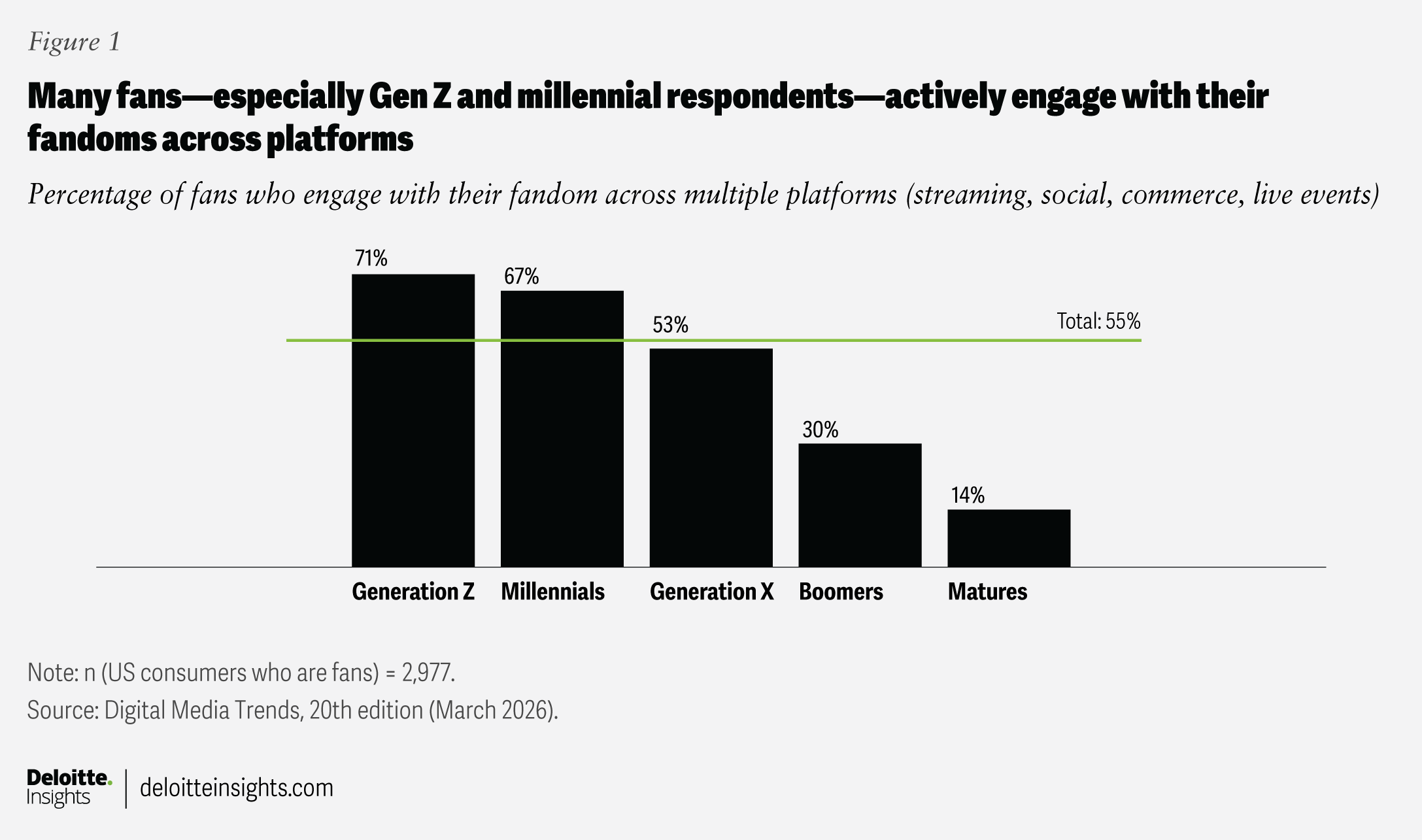
More than half of fans (55%) say that being a fan of a show, artist, or franchise often leads them to engage with it across multiple platforms, spanning streaming services, linear TV, social channels, merchandise, and live events (figure 1). That figure rises to roughly 70% among Gen Z and millennial fans. Creators on social media and online communities are also central to their fan activities: Nearly half (46%) seek out fandom-related content from creators, and the same share (46%) say they’re more likely to engage with entertainment content recommended by their fan community. Fans also report using more social networks (an average of six), compared with nonfans (who use an average of four).
Staying connected to fans beyond the big moments
These sentiments and behaviors suggest fans are highly connected, eager consumers of media and entertainment who are putting in the work to follow their fandoms, discover new content, and stay connected beyond major release moments. Yet most content providers tend to focus on marketing campaigns that hype new seasons, episodes, or movie premieres (for example, by hosting live events to tease upcoming episodes).7 SVOD services have notably experimented with different strategies,8 but for always-on fans looking to engage in the off-season, those release moments may not be enough. Once a premiere has passed, fans shift their attention to other formats and spaces that offer connection, community, and extended fan experiences that SVOD services are not designed to fully capture or serve.
This gap appears early in the engagement process (at the top of the funnel) with discovery. Around half of fans (52%) say that the primary way they discover new content—TV shows, movies, music, video games, or events—is through social media (figure 2). This figure jumps to 73% among Gen Z fans. Creators and user posts drive some of this discovery, but studios and streamers also fuel this trend by leaning on social media for marketing and promotions, as they know that’s where attention and audiences live.9
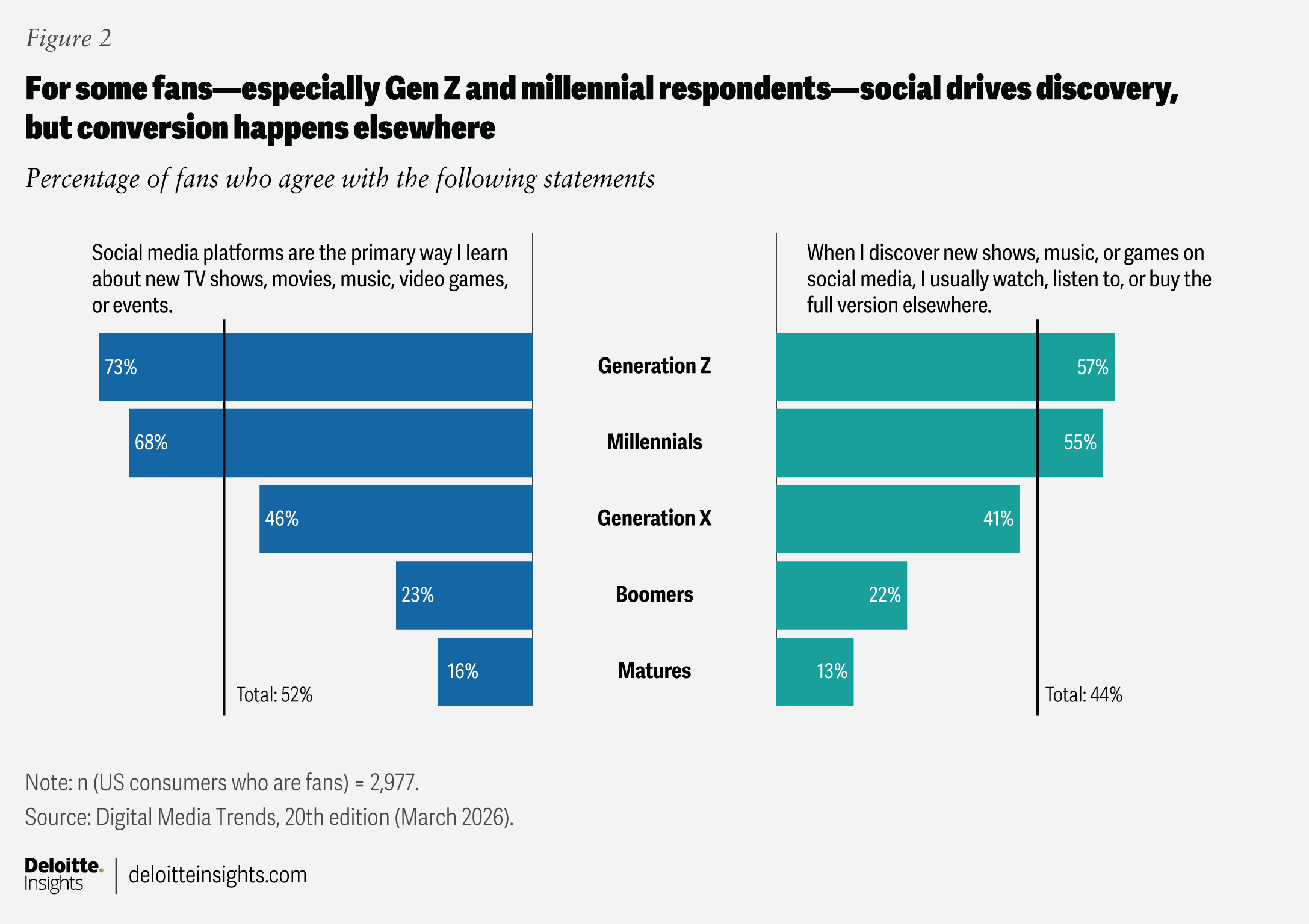
This approach can fragment monetization across multiple platforms. Forty-four percent of fans (and closer to 60% of Gen Z fans) say they discover content on social media—where engagement is monetized through advertising—and then go somewhere else to watch, listen to, or buy the full version. This path often exists as a “black box” for streaming services: They can lose visibility into fan intent and miss opportunities for personalization and cross-selling. Content providers that can bridge the gap between their known audiences and the unknown audiences that exist in these in-between spaces could see better reach and growth.
Audience retention also suffers in the off-season. If there’s nothing new to engage with, fans seek out fan-related content or make their own. Roughly half of fans overall say social media is the primary way they engage with their fandom year-round, and 36% lean on fan or companion podcasts between releases. Again, they’re leaving the primary intellectual property (IP) to extend their engagement.10
This creates a cost in the current model. Each new release requires significant marketing investment to rebuild momentum—often targeting audiences that were already engaged or active somewhere else in the ecosystem.11 Rather than restarting the hype cycle, providers could treat fandom as a distinct, high-value segment, investing in year-round touchpoints and content strategies that nurture fandom and deepen engagement within fan communities. Broad-based marketing can still drive reach, but a continuous, multiplatform fandom strategy could increase lifetime value, maximize monetization, and deliver stronger ROI across the fan base while giving fans more of what they love.
Facilitating fan experiences through aggregation
Media companies may not need to own every touchpoint in this model; however, they should have visibility and coordination across them. Rather than attempting to build new ecosystems, media companies could embed modular experiences like social feeds, podcasts, commerce, creator content, or interactive games alongside primary content or IP, even if they are powered by third parties.12 Rights portability systems (like blockchain) could support these cross-platform interactions and ensure monetization and attribution for original rights holders are preserved—all while keeping the fans engaged within a single environment.13
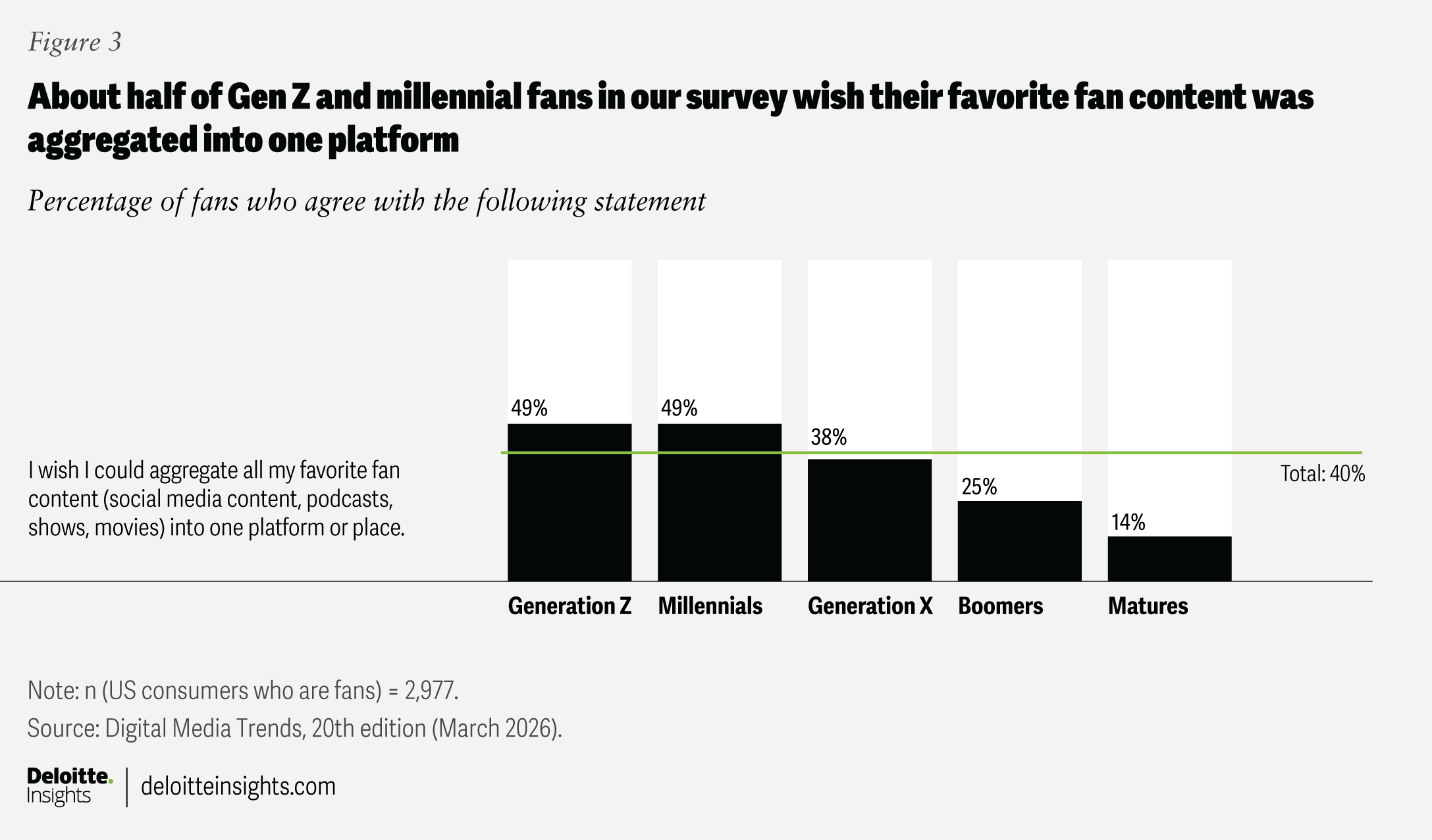
Some fans signal that this type of orchestration would be welcome: Forty percent of fans (49% of Gen Z and millennial fans) wish they could aggregate all the content related to their favorite IP into one place (figure 3).
The benefits for media and entertainment companies could be manifold: longer time spent, natural links to new content, merchandising, and live experiences, and a self-perpetuating community that adds richness and attracts new fans organically. Thirty percent of fans say they’ve purchased merchandise related to their fandom in the last six months—and among those who want fandom content aggregated, that figure increases to 37%, suggesting that this type of coordination could drive revenue. Uniquely tailored “fan bundles” could also expand partnerships by combining exclusive content, products, services, and experiences into bespoke subscriber or membership packages.
There are some early traces of this convergence appearing in the market, with music services like Spotify adding chat features and SVOD services like Disney+ and Netflix adding user-generated (or “vertical”) content to their homepages14 in hopes of driving more frequent engagement. But there are more opportunities for orchestration through enabling social features or embedding shopping capabilities, as mentioned. These modules could be toggled on or off depending on user preference—or the capability could be removed completely for the share of fan respondents who aren’t interested in this type of aggregation.
By keeping attention and action within a coordinated environment, media and entertainment providers can gain more access to first-party behavioral data, which can be used to deepen engagement, personalize experiences, and drive revenue. For example, imagine a sports fan watching a game on a streaming service and then posting about it on a social channel without leaving that interface. This fan may listen to a post-game podcast, watch a creator video featuring their favorite player, and then follow a link to purchase a jersey or bobblehead. The provider now has visibility across all those touchpoints, unlike the previous state, where each interaction happened in its own silo. Fans seem eager for providers to know them better: Data from Deloitte’s 2025 Connected Consumer Survey found that roughly 70% of Gen Zs and millennials say they’d be willing to share their browsing data, purchase history, and app usage data in exchange for a more useful, more personalized digital experience.15
With this increased intelligence, orchestration can allow providers to convert the off-season from a marketing lull into a sustained engagement opportunity.
How gen AI could fuel the off-season economy
Gen AI may enable media companies to deliver more and faster content (like highlight reels and summaries) and offer personalized and interactive experiences (like targeted ads and cocreation opportunities) at scale within their own environments. Gen AI could also drive engagement by surfacing related content more effectively and connecting fragmented interactions into a coherent entertainment destination.16
While AI has been powering predictive recommendations through machine learning for some time, what’s new is that gen AI can allow real-time feedback loops—dynamically testing and refining next-best actions and optimizing continuously.
Nearly 40% of fans say they would accept AI-created content on SVOD, social media, music services, and in video games if it is clearly labeled. This openness creates opportunities where AI-generated content could sustain fan engagement in off-season periods. For appointment-based content—like news and sports—gen AI could extend the life of can’t-miss moments by creating recaps or short-form clips to be viewed anytime. For episodic content or legacy IP, gen AI could generate storyline summaries or highlight reels based on a fan’s favorite characters or specific themes (for example, a mashup of clips from a show’s holiday episodes)—all with minimal human input or lag time.
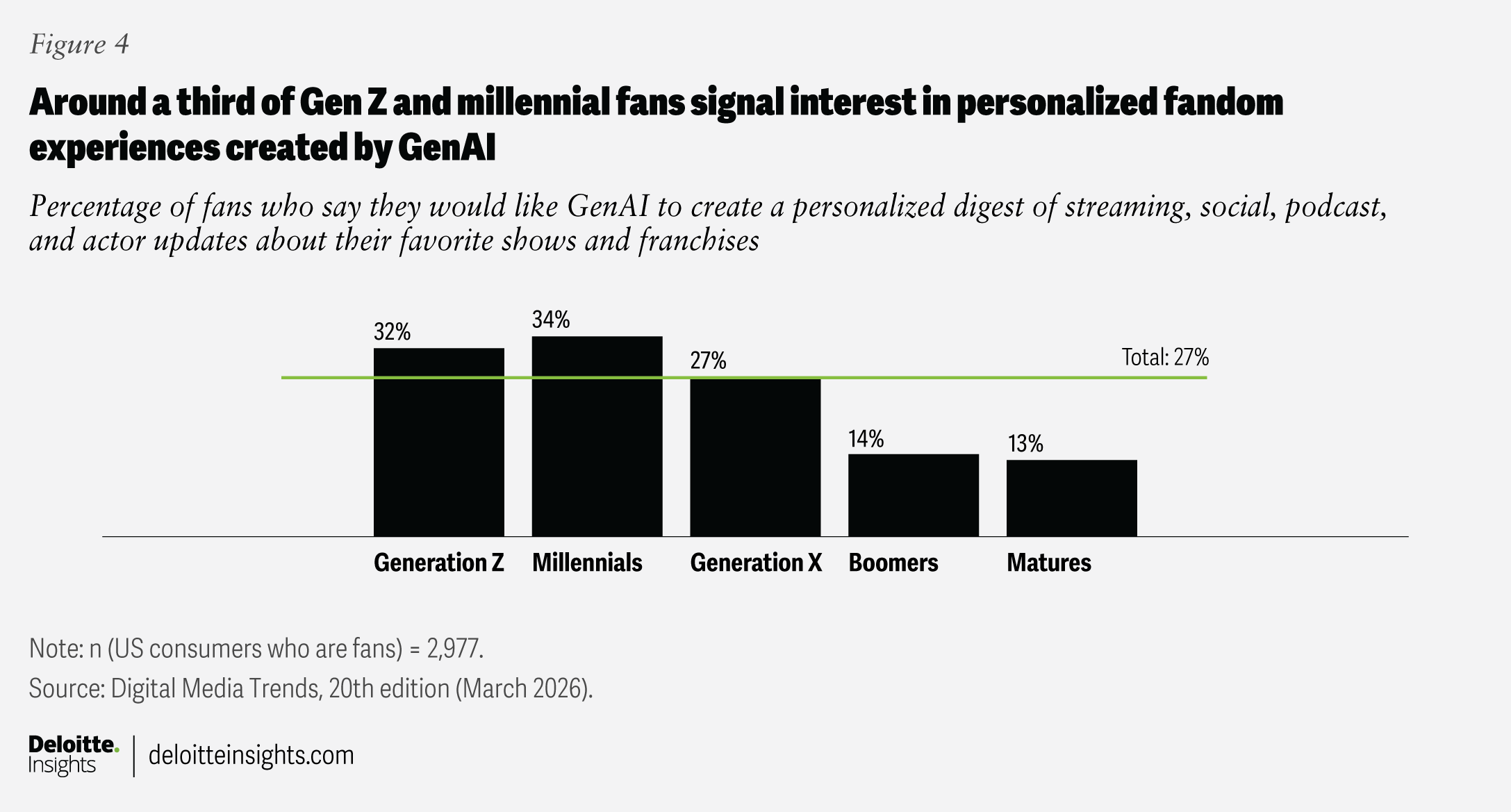
Early entrants, like Amazon Prime Video, are using gen AI to create recaps of their original content, complete with AI narration.17 Others, like the Major League Baseball (MLB), YouTube Live, and Fox One, are delivering similar highlight reels to users.18 And fans say they’re interested: Almost 30% of fans said they would like gen AI to create a personalized digest of streaming, social, podcast, and actor news updates about their favorite shows (figure 4). Similarly, 32% of sports fans would like personalized highlight reels and commentary based on their favorite teams and athletes.
AI could also help collect more and richer signals by enabling conversational interfaces for users, so fans can access social chatter, shopping, and creator content using voice commands through their remote control, for instance.19
In addition to augmenting the content experience for fans, AI can build unified fan profiles, assembling engagement signals from across orchestrated environments like identity, interactions, preferences, transactions, and service histories.20 Combining first-party behavioral data with appropriate third-party signals can provide a fuller picture of individual fans, identifying those who engage primarily as parents or genre enthusiasts, for example. Providers can then tailor content, messaging, and experiences accordingly.
A more orchestrated and robust approach to fan data could improve ad-targeting efforts and enable higher cost per milles (CPMs) as well.21 In our Digital Media Trends, Fall 2025 survey, for example, almost 50% of fans said ads would be more effective if they were personalized to their fandoms. It could also lower advertisers’ development and production costs. Some fans are open to AI-generated advertisements, with around a third saying they “don’t care” if ads are made by gen AI.
This approach might also drive deeper fan engagement: Twenty-two percent of fans say they’d use streaming video services more if the streamer used gen AI to make more personalized recommendations. As fan engagement becomes more cross-platform and always-on, media companies may need to rethink how success is measured—and whether their current metrics and infrastructure are able to maximize fan value.
With more fan intelligence, content providers can enable more creative and participatory interactions as well.22 Nearly a quarter of fans (24%) say they would like the option to cocreate content with gen AI, like developing alternative endings to shows or movies. A similar share also say they’d be willing to interact with virtual AI personalities if they were interesting or informative. There are early use cases emerging, as some content providers have considered how to leverage GenAI to allow consumers to create and share videos and images using their IP, and MLB players have agreed to allow AI characters of themselves that interact directly with fans.23 These capabilities can go beyond fan engagement to drive new revenue opportunities. IP holders could monetize premium brand integrations that would allow advertisers to embed characters, voices, and iconic settings into their promotions.
Gen AI can help turn consumers into lifelong fans
While opening access to IP through gen AI tools may seem risky, embedding this capability into brand-owned services may be a safe approach. By enforcing guardrails, developing terms of service, and tracking how cocreated content is generated and shared, creative rights holders can retain control while capturing value that might otherwise occur outside their governed ecosystems.
Implementing gen AI effectively is expected to require investments in time, operational models, and infrastructure, but these efforts have a significant potential upside, as fandom appears to enjoy longevity. Nearly half of fans (49%) say their engagement, measured in both time and money spent, has remained consistent across different phases of their lives. While intensity moderates with age, it does not disappear: 53% of Gen Zs and 56% of millennials report sustained engagement, along with 48% of Gen Xers, 39% of baby boomers, and 32% of matures.
Fandom evolves but persists, pointing toward a new metric: fandom lifetime value, which might serve to measure the long-term economic potential of an individual fan and fan communities.
Media providers have an opportunity to sustain long-term engagement. Fans are already doing the work—showing media companies what they want to engage with, and when, how, and where. Moving forward, media companies should consider how much of the fan life cycle they want to participate in, how connected they want to be to fan communities, and how much value they hope to deliver to their most coveted customers.
Methodology
These insights are based on an online survey of 3,575 US consumers conducted in October and November 2025. Throughout this report, we reference generations. Our generational definitions are as follows: Generation Z (1997–2011), millennials (1983–1996), Generation X (1966–1982), baby boomers (1947–1965), and matures (1946 and prior). The survey was fielded by an independent research firm, and all data is weighted back to the most recent Census to give a representative view of US consumers.
Continue the conversation
Meet the industry leaders
Daniel Ledger
Wenny Katzenstein
Stephanie Dolan
by
Doug Van Dyke
Daniel Ledger
Wenny Katzenstein
Stephanie Dolan
Brooke Auxier
The authors would like to thank Akash Rawat for his significant contributions to this project and the report. We would also like to thank Michael Steinhart, Jeff Loucks, Kevin Downs, Rohith Nandigiri, and Ankit Dhameja for their collaboration.
Editorial (including production and copyediting): Andy Bayites, Prodyut Borah, Sayanika Bordoloi, Anu Augustine, Cintia Cheong
Design: Molly Piersol
Cover image by: Jaime Austin; Adobe Stock
Knowledge Services: Vanapalli Viswa Teja
Visit the Deloitte Center for Technology, Media & Telecommunications
Access more insights for the technology, media, and entertainment; semiconductor; telecommunication; and sports sectors.