
Staying relevant in a world that won’t sit still
Real-time adaptability is emerging as a competitive differentiator. How can organizations build worker resilience on the fly?
Organizations and workers alike are striving to adapt to the ever-increasing pace of change. Change management and corporate training and learning initiatives have traditionally been the go-to tools for staying relevant in a quickly shifting competitive environment. The problem: These rarely evolve fast enough to keep pace with what workers actually need as their roles and realities shift.
Deloitte’s 2026 Global Human Capital Trends survey found that only 27% of respondents believe their organizations manage change effectively, and only 8% believe their organizations are highly effective at meeting the continuous, “always-on” learning needs of their workforce.
But AI is flipping the script, upending change management and forgoing the need for traditional, top-down change techniques. AI is also disrupting traditional approaches to learning: Instead of pushing out content to workers in hopes they’ll absorb it, AI is now enabling workers to sense, practice, and apply new ways of doing things directly in the flow of work itself.
Indeed, the words change management and training may now be outdated, no longer fit for purpose to drive human performance. We need an entirely new vocabulary focused on growth and adaptiveness to describe how organizations and workers can stay relevant at speed, where the pace of change only continues to accelerate. And we need to consider both change and learning together, given that both have the shared purpose of helping workers grow and adapt to stay relevant.
Without a new paradigm, organizations face stalled transformations that fail to meet their intended return on investment. They also face talent disengagement and a widening relevance gap that can threaten their very survival. Meanwhile, workers face the risk of skill misalignment, reduced employability, stagnant career growth, and feeling exhausted by change—or simply feeling left behind.
What marks an organization’s advantage today is how fluidly it can steer intent into action by developing adaptive capability in its workforce. Used well, AI can be a game changer: Embedded directly into the very core of the work itself, AI enables organizations and workers not just to operate and execute, but to adapt and grow.
Creating an adaptive experience for workers
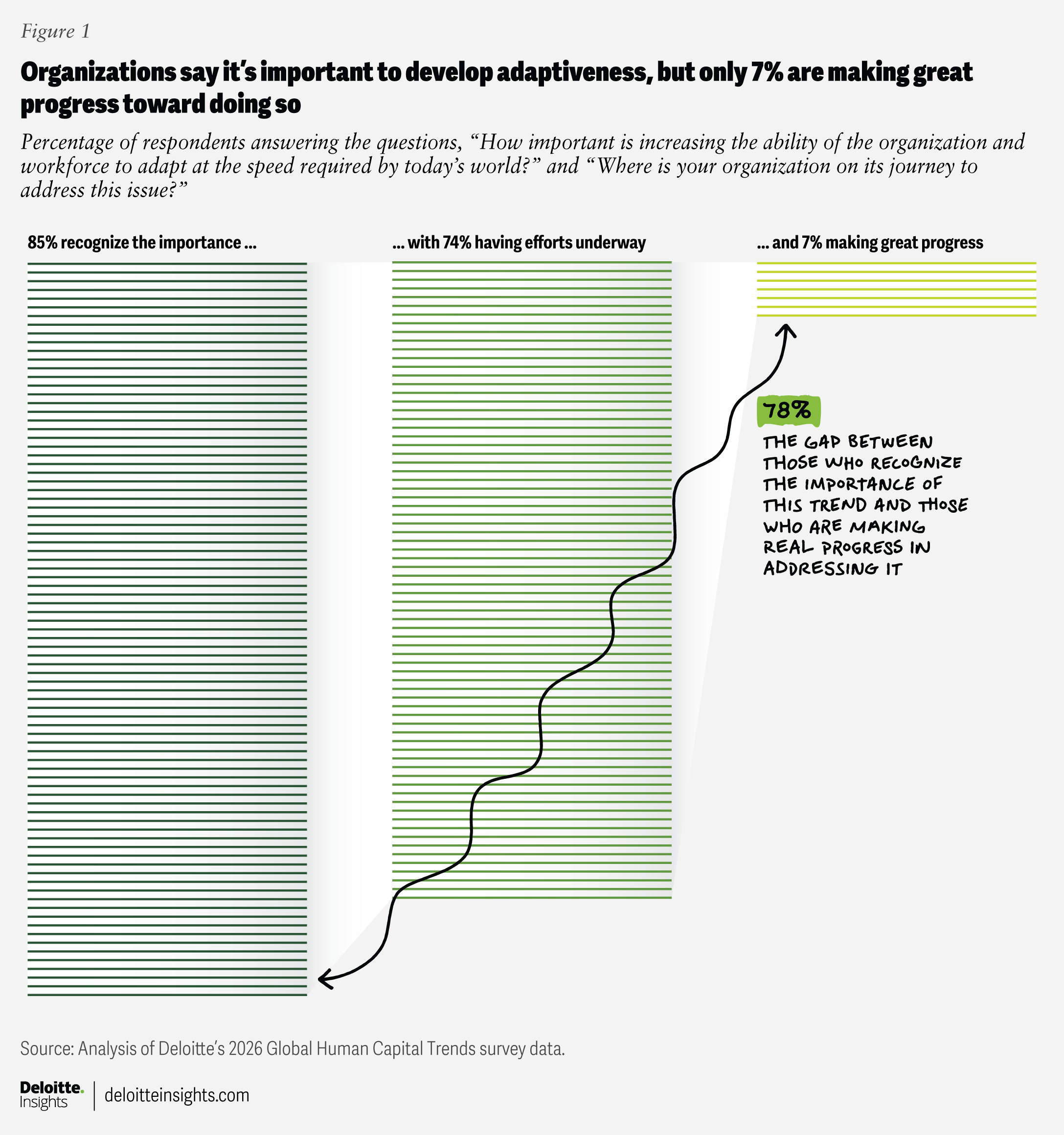
Creating an adaptive experience for workers is increasingly important. Respondents to our 2026 survey ranked it as the second most important trend this year, with 85% saying it is critical to develop the ability for the organization and the workforce to adapt at the speed required by today’s world. However, only 74% say they are making any kind of progress, and just 7% say they are leading in this area (figure 1).
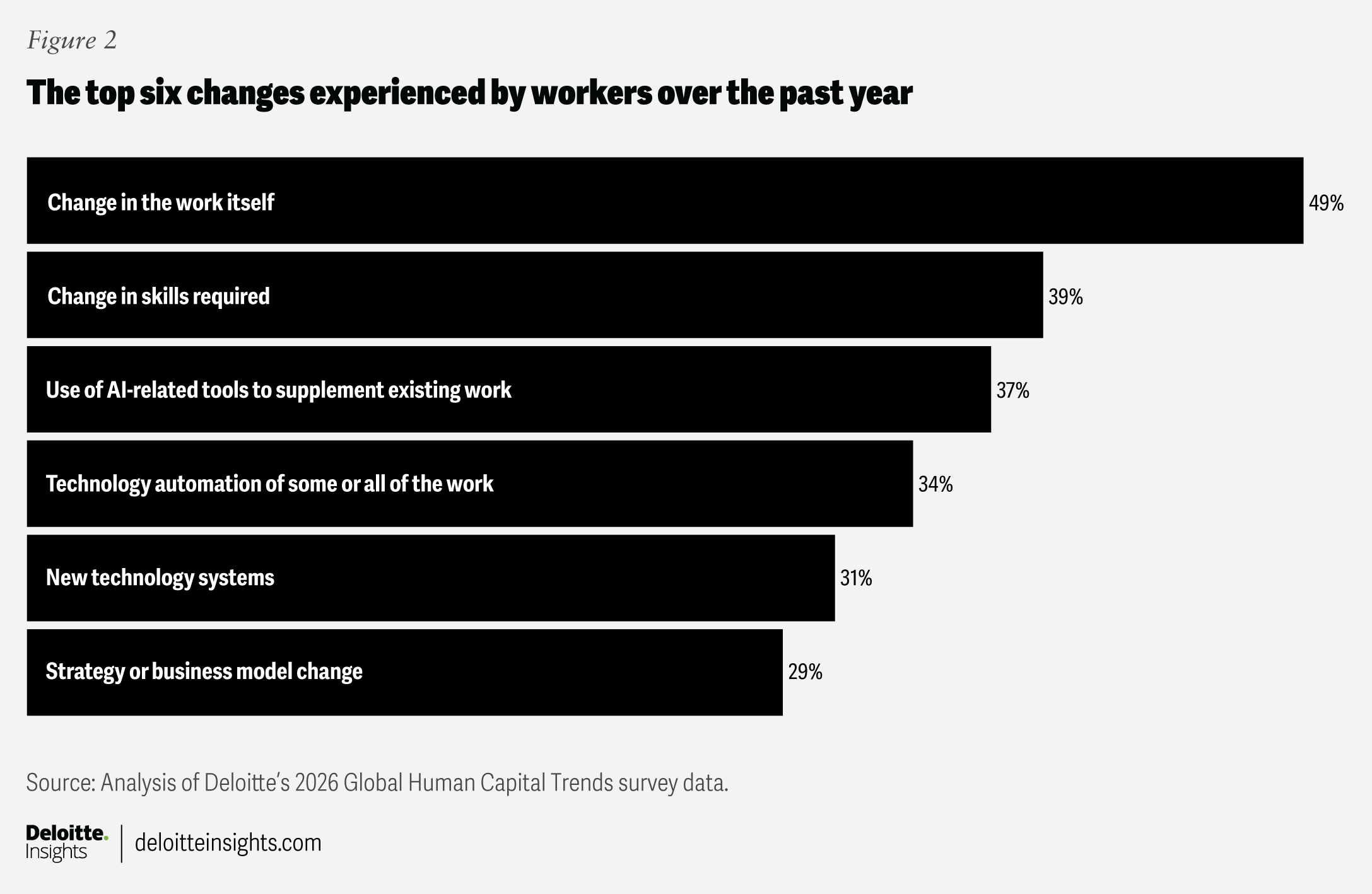
Workers are being asked to adapt to changes at a dizzying pace. Our 2026 survey found that one-third of workers experienced 15 major changes in the past year alone, from evolving customer expectations to shifts in strategy or business models. The most frequently cited changes involve the work itself and the skills required to do that work, followed by artificial intelligence and other technology disruptions (figure 2).
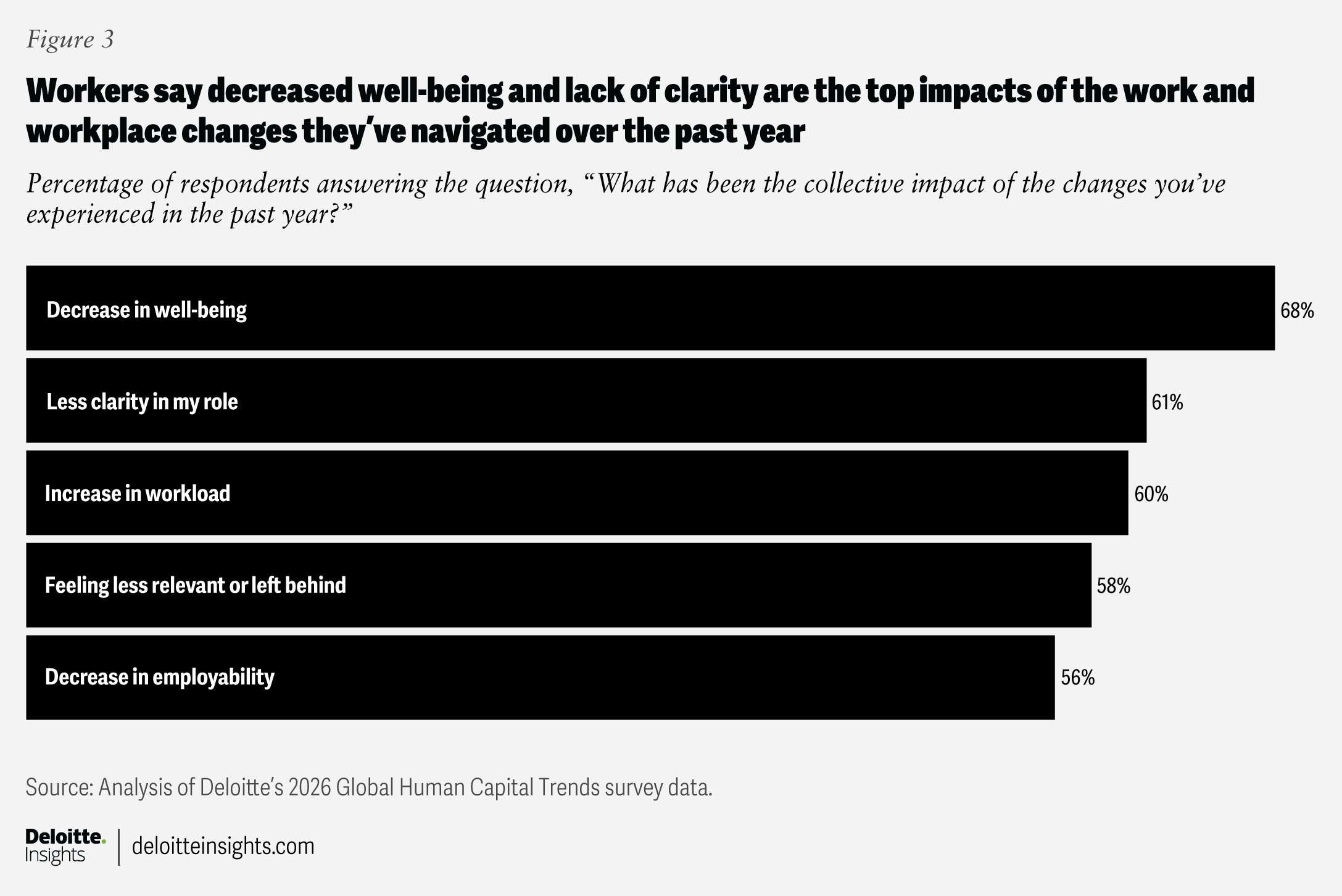
Any change will have an impact on workers. But as organizations respond to the accelerating pace of change through traditional approaches, the impact on workers can be negative. Our 2026 survey found that the steady cadence of organizational change has led to impacts such as decreased well-being (68%), increased workload (60%), and feeling less relevant or left behind (58%) (figure 3).
Changefulness goes beyond these traditional approaches and cultivates workers’ abilities to adapt, experiment, learn, and evolve as a daily muscle embedded in work, not as a disruption.
Clearly, an intentional, more empathetic approach is needed—one that changes the narrative from “change exhaustion” to “changefulness.” Change exhaustion stems from traditional top-down change and learning approaches. By contrast, changefulness goes beyond these traditional approaches and cultivates workers’ abilities to adapt, experiment, learn, and evolve as a daily muscle embedded in work, not as a disruption. As one chief human resources officer put it, “We don’t need more change frameworks or reskilling programs.”1
Doing so can pay off: Our 2026 survey analysis reveals that organizations that successfully cultivate this adaptive approach are 2.4 times more likely to report better financial results and provide more meaningful work to workers. Although organizations have long sought to achieve this level of adaptiveness, it has only now become possible at scale, thanks in large part to advancements in AI.
Leaders can consider the following four approaches to adaptiveness and growth.
Create a surround-sound system
Today’s workers increasingly expect change and growth to be a part of their work experience rather than an added obligation. However, in many organizations, they can still feel like something outside of daily responsibilities—activities that require stepping away from “real work.”
Instead, some leading organizations are adopting a strategy from their marketing playbook and creating an omnichannel experience for workers. This experience surrounds workers, meeting them where they are with a variety of adaptive experiences embedded in the work itself.
Organizations have been making progress with real-life experiences. These include optimizing the team mix so workers can learn from one another, peer coaching, and creating opportunities for hands-on practice and experimentation. But AI is changing the playing field, enabling far more opportunities to embed learning and change in the flow of work itself (figure 4).
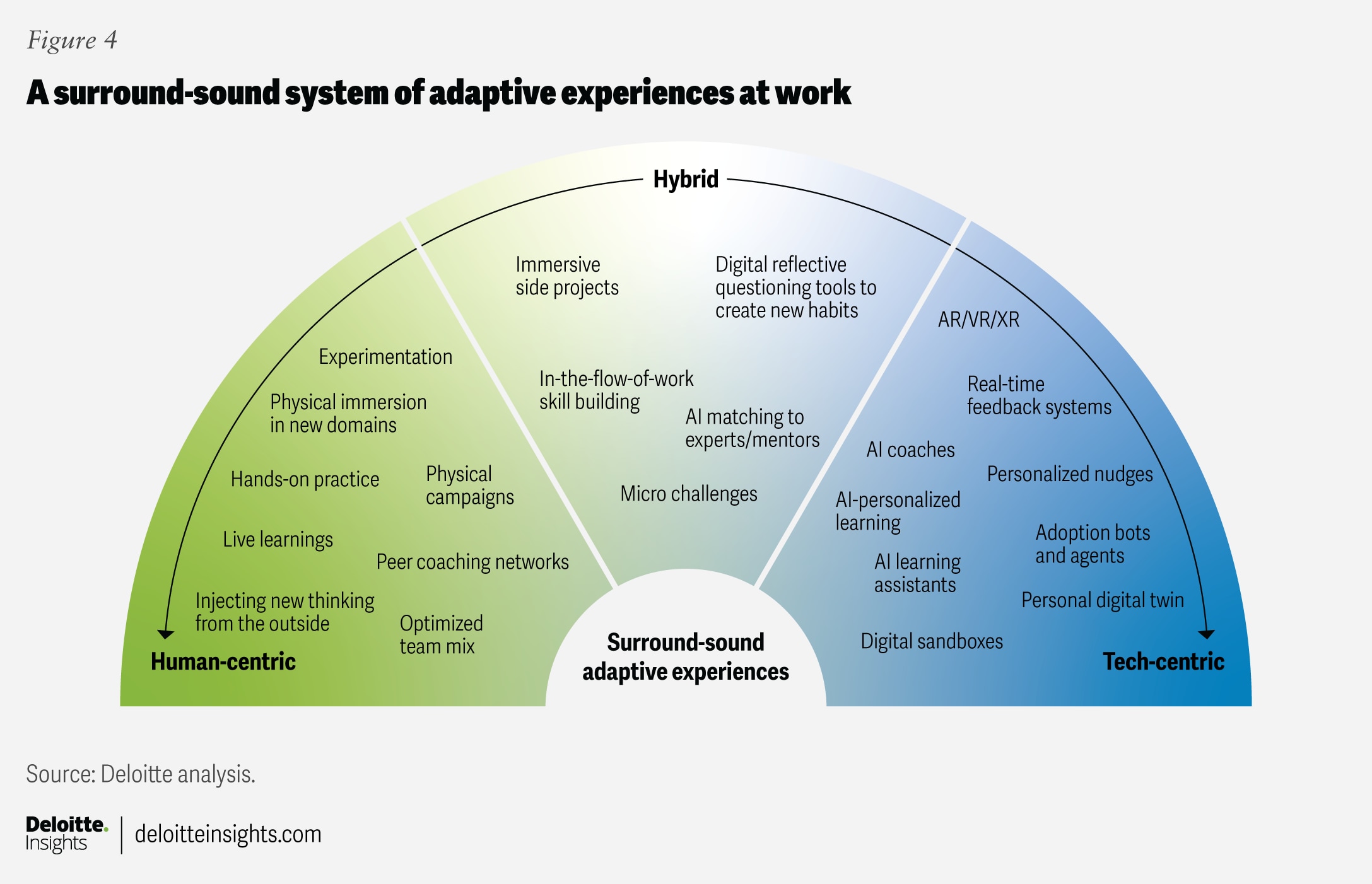
What might those experiences look like in practice? Instead of offering traditional training to sales professionals, for example, organizations can now embed AI into the flow of their work to provide real-time coaching based on specific behaviors. Or they can use AI to help them role-play with customers and offer AI-powered micro-challenges that help identify ways to practice new behaviors on a daily basis.
Workers say these types of experiences will help them adapt and learn in the flow of work (figure 5).
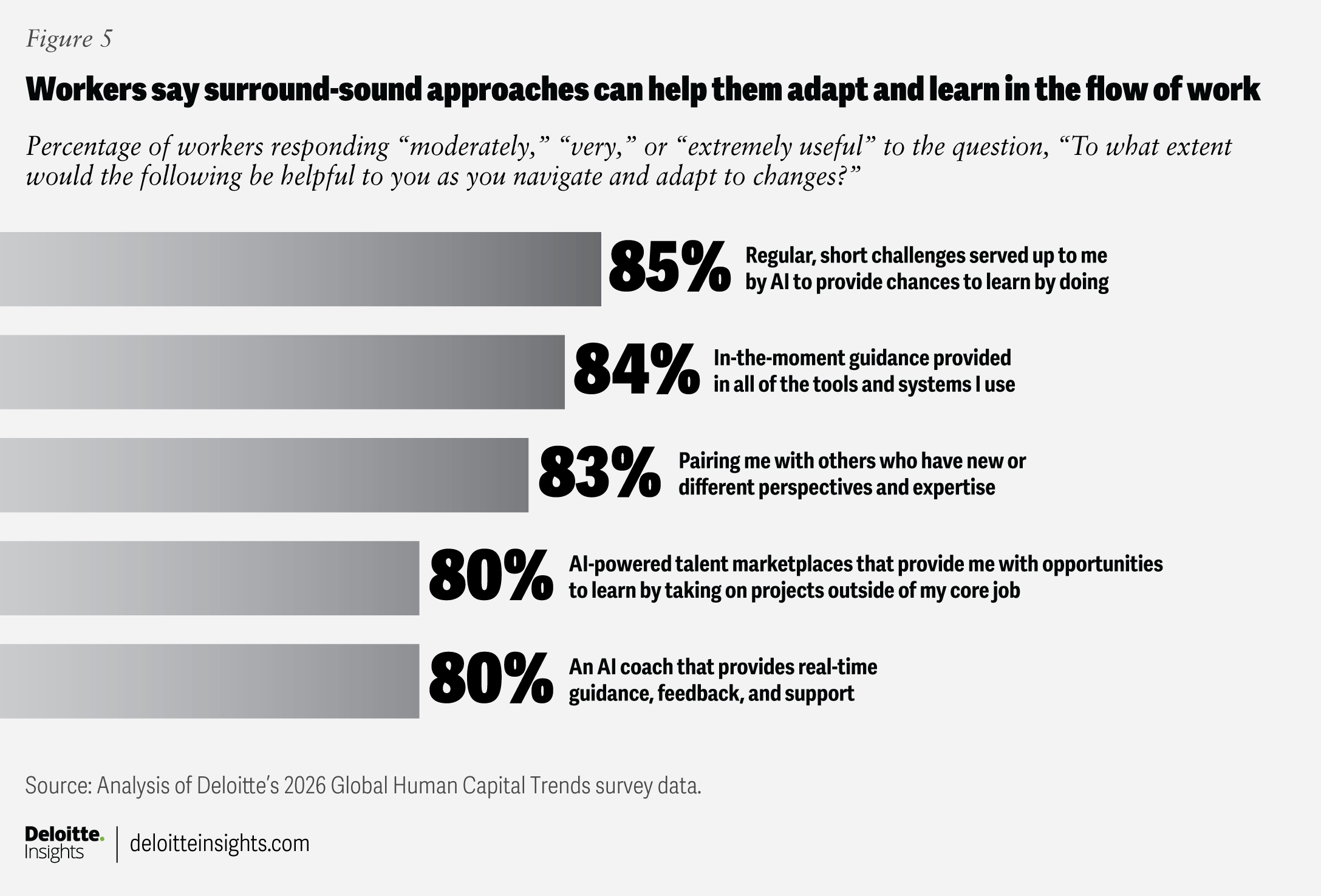
The marketing team at one multinational consumer goods company now uses an AI tool that provides context-aware digital assistance in the flow of work that, with permission from workers, will track their work and offer suggestions, insights, questions, and the names of colleagues working on similar challenges.2
Surround-sound approaches apply equally well to change and learning. The vice president of global talent strategy and succession at one multinational company says: “We used to push a lot of formal learning, but now we make support accessible in the natural flow of work so leaders and employees can get timely help. We’re shifting the focus from traditional workplace learning to AI-enabled tools and AI coaching that meet people where they are, making the process more tailored and interactive.”3
Consider how one global pharmaceutical organization is forgoing its traditional change management playbook altogether when implementing a new customer relationship management system. Instead, the organization uses a variety of approaches to help workers adapt to and learn new ways of working, including in-app guidance, AI-powered adoption agents, and behavioral nudges. For example, if a sales representative hesitates while entering data, an agent can prompt the next best action or share a short tip video, reducing time out of the field. Or an agent might notice that the worker had a customer meeting two days ago and ask if the worker would like the agent to put the meeting notes into the system and schedule a follow-up. AI-powered insights personalize learning and communication for each user, identifying what motivates them and how to reduce barriers to engagement. Digital learning sandboxes also provide hands-on practice and experimentation with the new system. With this approach, 95% of employees are expected to adopt the new system confidently without any formal training at all. The result is a seamless experience—embedded in the flow of work and tailored to each individual.4
Shift to change and learning at the unit of one
The conventional approach to change and learning focuses on consistency in processes, cycles, and models, but often ignores the human element. That one-size-fits-all approach is becoming outdated: It prioritizes homogeneity where there is complexity, and it does not always account for workers as individuals with differing motivations, work, emotions, needs, and preferences, or the neuroscience of how workers process what happens around them in different ways. Contextualizing at the unit of one—the individual—is the last mile of growth and adaptiveness.
AI can now help close the gap. With AI, organizations can localize and hyper-personalize their initiatives. It can embed the ability to adapt into individuals’ daily work by:
- Identifying and influencing specific behaviors that drive performance and growth
- Modeling the impact of changes on specific workforce segments
- Providing real-time individual feedback
- Tailoring approaches to each worker’s motivations to change or learn
- Pacing changes and learning to each worker’s personal bandwidth
- Customizing communications or content for each individual
- Contextualizing what the change or learning means for the individual—and for their work
- Identifying and influencing emotions and sentiment
Georgia-Pacific uses digital adoption platforms and AI to personalize its change communications related to a new systems implementation. One way is through personalized videos that can be customized at the touch of a button to change the content, script, and even the speaker’s tone and dialect to better engage each individual viewer. Emails about the new system are personalized and sent by their individual senior leader. AI will be used in the future to track individual engagement and tailor ongoing communications. In addition to the AI solutions, a digital adoption platform generates in-app guidance to support end users at the point of need. The result, explains change leadership director Melissa Collier, is “the ability to make changes more quickly—in minutes rather than days—and greater confidence in team members using the tools to effectively execute their work.”5
Other advancements are also enabling organizations to contextualize change. Plum, for example, now offers an AI tool that enables managers to predict how a team will react to a new change based on each individual’s level of agility and personal adaptiveness. In turn, managers are able to create personalized change plans.6 Other AI systems can identify an individual’s personal influencers and have them reach out to that person to bring them along with the change.
Workers say personalization will help them resolve some of the barriers that get in the way of adapting to change (figure 6). The top challenge cited by leaders and managers in our 2026 survey? Change not seeming directly relevant or personalized to the individual, cited by 44%. Barriers for workers include a lack of understanding of how the change relates to them (30% of respondents) and a lack of personal motivation to address the change (21%). Both of these barriers can be resolved when change is tailored to an individual’s work and motivations.
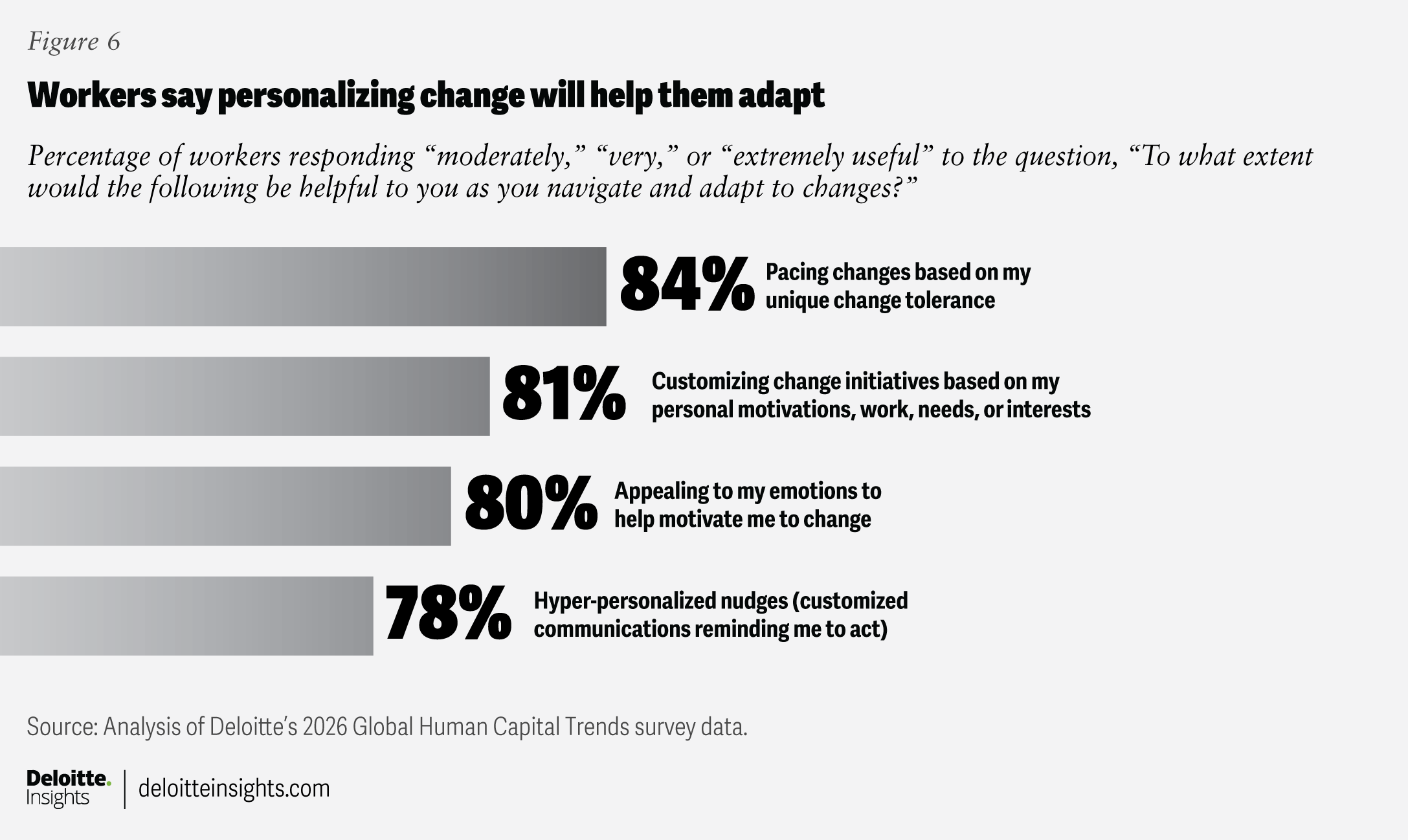
Personalization is a fundamentally human-centric approach, which Deloitte research has shown pays off. Organizations taking such an approach are nearly three times as likely to report better business and human outcomes.7
Create continuous feedback loops
Seeing what people do, what they ignore, or what they revisit provides crucial information to drive progress. Real-time data and feedback loops are critical to those efforts. Understanding and encouraging behaviors is a science, and organic feedback and data-backed loops can pinpoint what is—and isn’t—working.
Consider one pharmaceutical organization that shifted from thinking of change in terms of neat, episodic phases to embracing a nonlinear approach of constant adaptation through continuous feedback loops. Rather than relying on static key performance indicators and sequential rollouts, it used AI to surface real-time insights from employee sentiment, social media behavior, and internal feedback loops. This information helped create tailored interventions for specific workforce segments that could be adjusted instantly based on how employees are actually working and feeling.8
Likewise, at Nike, data analytics is used to identify adoption barriers and inform targeted interventions, which in turn has helped the company act on real-time behavioral signals and improve change outcomes.9 And at Toyota Memorial Hospital in Japan, frontline staff are provided with real-time data and feedback loops that link learning and continuous improvement (known as Kaizen) directly to care outcomes.10
Empower workers to sense and respond
Traditional change management is often top-down: Leaders decide the direction, and workers are told what to do as the recipients of change. Many learning programs are the same. But what if workers are empowered with data and AI to sense and respond when signals in markets and customers are first seen? That marks a shift from managing change to providing workers with the autonomy to be co-creators and innovators of adaptiveness, helping shape how the organization evolves in real time. Organizations get to adapt, and workers get to continuously learn.
One senior vice president explains, “Enabling people to experiment where possible becomes a hallmark of resilient organizations. People need permission and support to build new things, explore, and adapt.”11 Workers agree: Eighty-seven percent of workers in our 2026 survey say that providing what we call digital playgrounds—safe, digital spaces to practice and learn new things—will help them better adapt to change.
When leaders set transformation targets and rely on lower levels of the organization to meet them, it rarely produces lasting results. Why? Because transformation requires changes in both the work being done and how it is accomplished, and leaders often are too removed from day-to-day operations to understand what truly needs to evolve. Empowering workers to adapt on the fly builds trust and positivity; our research shows that workers are twice as likely to feel negatively about an employer-imposed change as a self-imposed change.
Consider how AI can help workers experiment at scale and adjust in real time. Walmart uses AI to empower associates to test different stocking and staffing models to optimize operations, adjusting based on local conditions where change happens first.12 At Unilever, AI labs give workers opportunities to experiment with product formulations and marketing strategies.13 AI can also analyze how work is performed and suggest changes to the people doing it in real time, creating emergent processes that continuously adapt based on changing conditions.
Empowering workers to adapt and grow requires organizations to rethink their leadership and management layers. For instance, that may mean a shift from hierarchical management to networked decision-making driven by AI’s real-time insights. One multinational technology company does this by encouraging workers to be “positive pivoters,” embracing change as a constant and empowering employees to actively shape it rather than simply adapt. This shift calls for moving away from top-down management and rigid hierarchies toward agile, networked teams.14
A path through uncertainty
In an environment where change and disruption are the rules rather than the exceptions, the greatest source of competitive advantage may just be the ability to organically adapt in real time. Change and learning, especially today, don’t happen in neat phases. They are unpredictable and require constant adaptation. Competitive advantage is built not by how quickly you move humans through programs, but by how organizations and workers can be rewired to rewrite themselves in real time.
While AI is one of many disruptors facing organizations today, it also offers the chance to redefine how organizations adapt, shifting from static playbooks to dynamic, data-driven models that mirror human adaptability. Organizations should shift focus from control to curiosity, from training to experimentation, and toward a deeper recognition that adaptability isn’t new at all. It’s hardwired into us—a survival instinct that has always helped humans navigate change and uncertainty.
by
Sue Cantrell
Chloe Domergue
Allyson Dake
Jeroen Van Eeghem
Matt Stevens
Ishani Purohit
The authors would like to recognize the expertise of Stefano Besana, Ben Fish, Chris Norman, Zhdan Shakirov, Meagan Lettau, and Christina Bieniek, whose insights, perspectives, thoughtful analysis, and creative vision meaningfully enriched our exploration and strengthened the storyline.
A special note of thanks is reserved for Tori Sundholm, Jessica Murphy, Julia Guttery, and Elyse Donohue for their support and coordination, which proved invaluable to completing this work.
Editorial: Corrie Commisso, Hannah Bachman, Pubali Dey, Cintia Cheong, Anu Augustine, and Stacy Wagner-Kinnear
Design: Molly Piersol, Alexis Werbeck, Govindh Raj, Guido Agüero Gonzalez, and Sylvia Chang
Audience development: Atira Anderson and Maria Martin Cirujano
Knowledge Services: Vanapalli Viswa Teja