
Resilient by design: The agentic supply chain
As global supply chain complexity grows, agentic AI may offer manufacturers transformative ways to manage risk and capture new value
Global supply chains have faced disruption in recent years—and uncertainty is likely to persist. The United Nations’ 2025 “Trade and development foresights” report notes that policy unpredictability is at historic highs, affecting business decisions and investment planning globally.1 Ongoing geopolitical events and evolving trade policies across major economies are increasing supply chain complexity, raising input costs, and disrupting investment and logistics.2
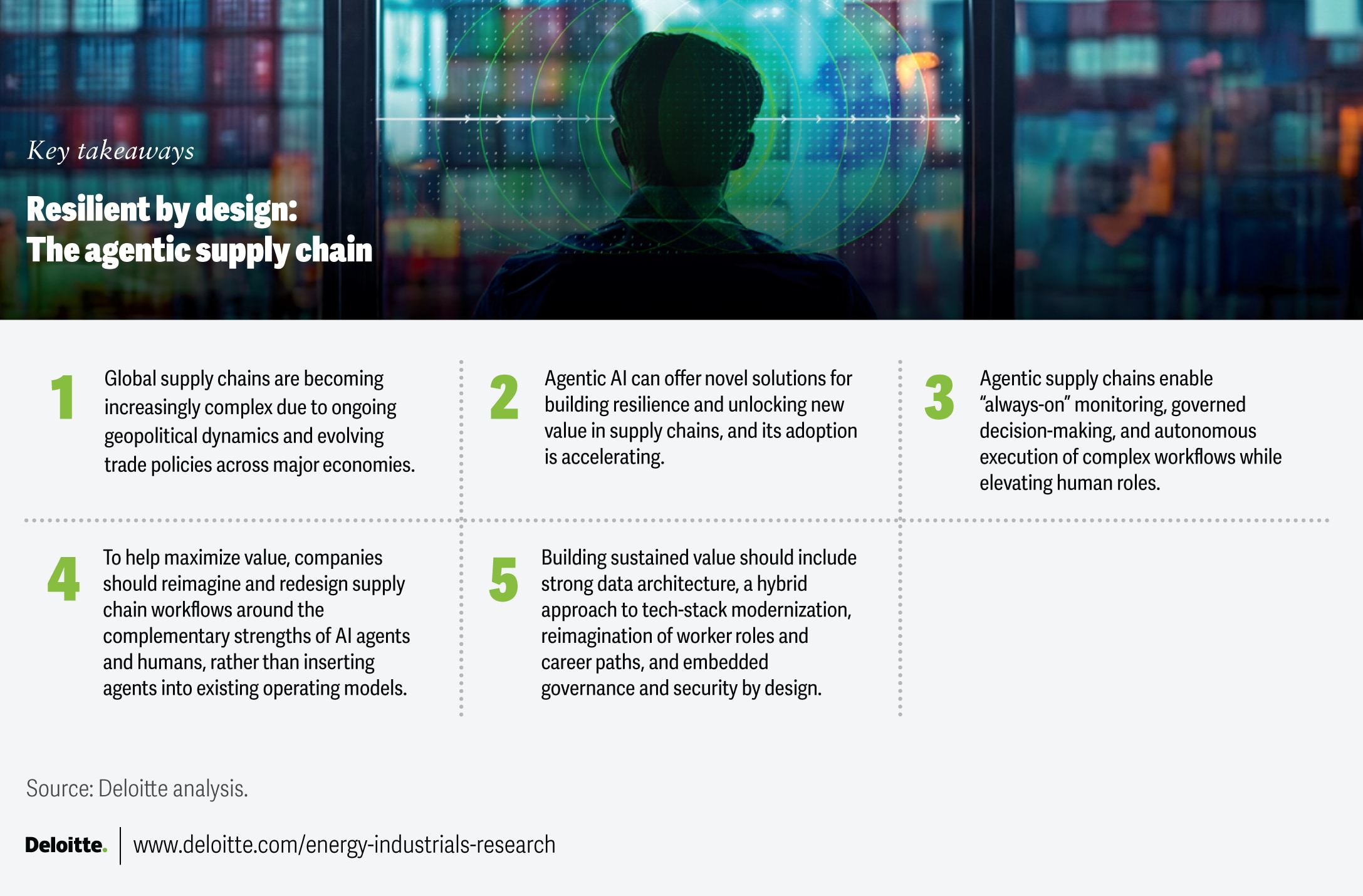
In this environment, manufacturers should have new tools to help manage risk and remain competitive. Agentic AI—that is, artificial intelligence systems that can reason, plan, and act with autonomy3—can offer companies transformative solutions for building more resilient, responsive supply chains and unlocking new sources of value. Adoption is already accelerating: A recent study indicates that more than half of surveyed supply chain executives report deploying AI agents to automate workflows.4 According to Gartner®, “by 2030, 50% of cross-functional supply chain management solutions will use intelligent agents to autonomously execute decisions in the ecosystem.”5 The company also states that “40% of enterprise applications will be integrated with task-specific AI agents by the end of 2026, up from less than 5% today.”6
Reimagining supply chains with AI agents
Many supply chain processes today have been designed around human constraints, with sequential decision-making, manual handoffs, and limited visibility. Agentic AI has the potential to revolutionize the status quo. AI agents possess short- and long-term memory, access a wide variety of tools, and can reason, plan, and act autonomously to achieve specific objectives.7 Unbound by human bandwidth, they can continuously coordinate decisions and actions across suppliers, plants, logistics partners, and planning functions, creating value in three ways:
- Autonomously executing end-to-end operational workflows while elevating human roles by performing routine and coordination-intensive activities within defined guardrails, thereby reducing cycle times, improving accuracy, and enabling humans to focus on higher-value analysis, judgment, and strategic decision-making
- Enabling always-on, high-frequency monitoring, decision-making, and response by continuously sensing changes, evaluating impact, and taking bounded action in real time, unconstrained by human schedules or review cycles
- Scaling activities beyond human limits by continuously applying consistent logic and analysis across millions of parts, suppliers, transportation lanes, policies, or scenarios, thereby expanding coverage and depth far beyond what human teams alone can manage
To maximize this value, however, companies should reimagine and redesign supply chain workflows around the unique strengths of humans and agents rather than simply inserting AI agents into existing operating models.8
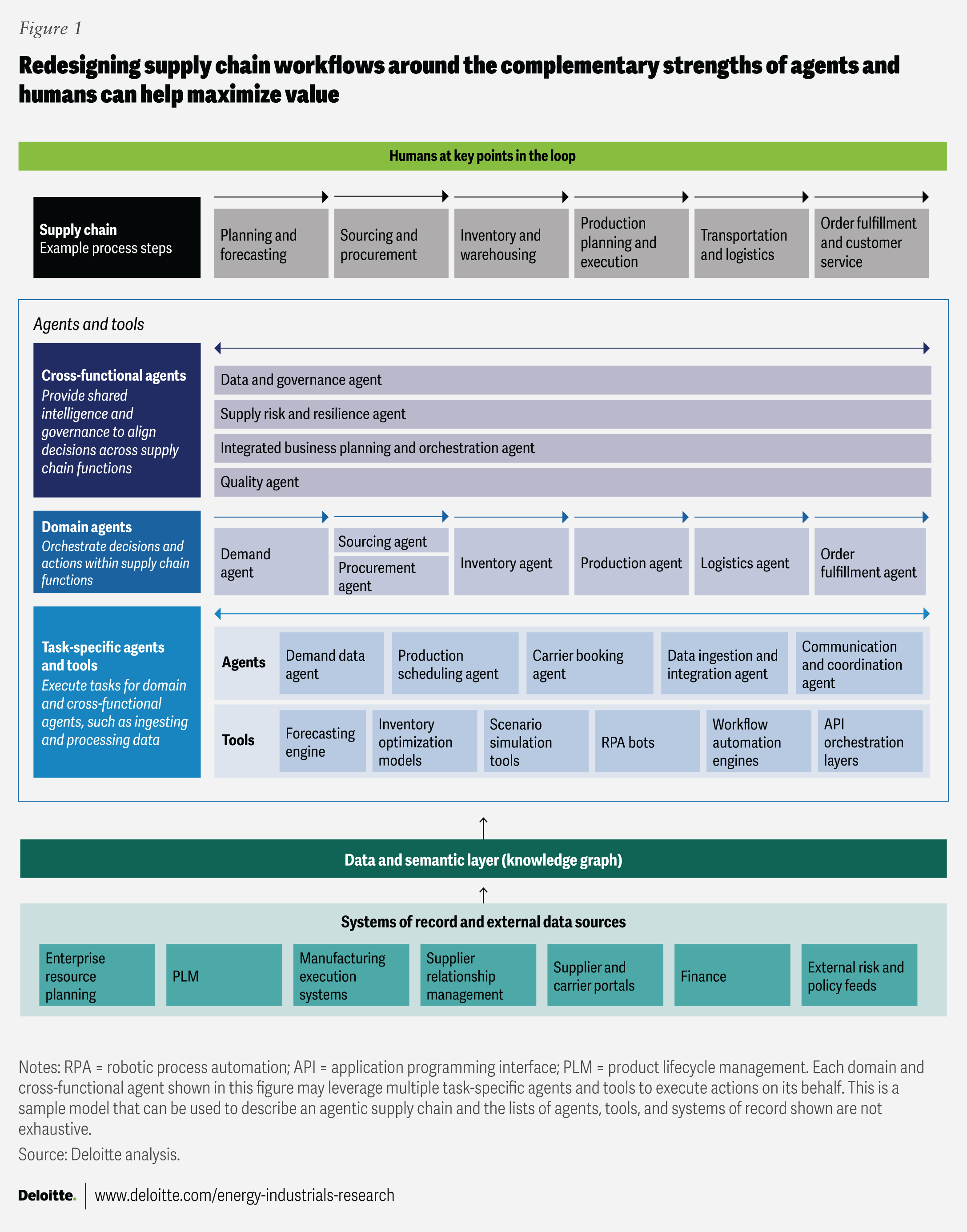
To accomplish this goal, business and technology leaders, solution providers, and process experts, including process owners and stakeholders, should partner to identify where agents can be leveraged across supply chain operations.9 Software tools can help teams identify repetitive, rules-based, or coordination-intensive activities that are strong candidates for automation. The redesign effort can then focus on developing coordinated, cross-functional, and cross-system workflows that enable governed, real-time sensing, decision-making, and execution.
In a reimagined agentic supply chain (figure 1), domain agents serve as orchestration layers and outcome owners, enforcing policies and guardrails to accomplish defined objectives. They coordinate task-specific agents and tools—including robotic process automation bots and other intelligent automation—that retrieve and structure data, perform bounded analysis, and execute governed actions across existing systems of record and external platforms. Cross-functional agents provide enterprisewide risk intelligence and shared governance across planning, finance, and operations to help ensure decisions remain aligned and compliant, and maximize business value.
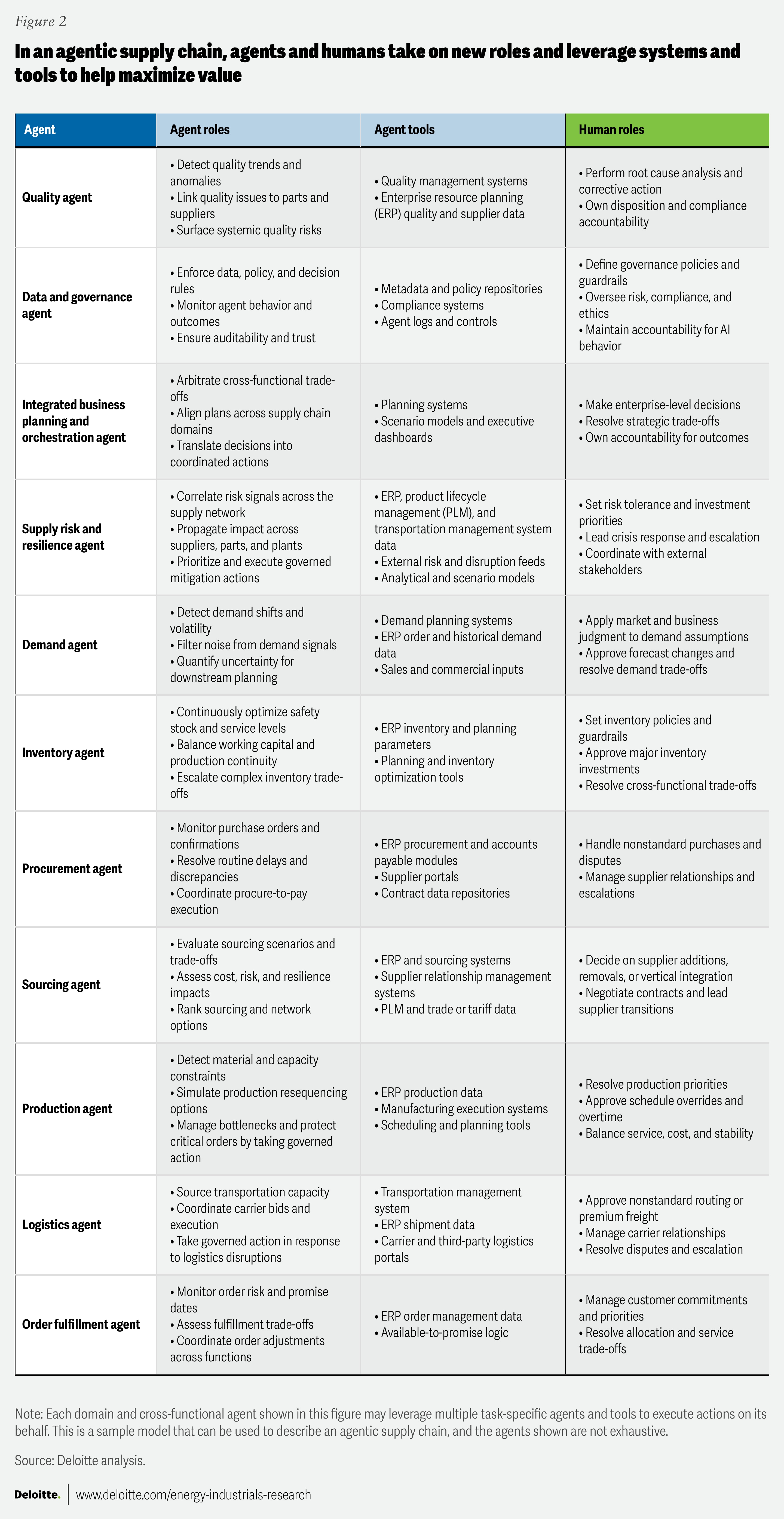
While agents focus on “always-on” sensing, analysis, and governed action (figure 2), human roles shift from routine execution toward oversight, orchestration, and ethical and strategic judgment.10 Humans and agents interact across multiple modes—including embedded copilots, conversational chat, messaging and email tools, and automated voice interactions—moving beyond static dashboards to more dynamic, real-time collaboration.
Agentic supply chain use cases: Value creation through disruption
From disruptive approaches to supply chain planning and inventory management to formulating agile, data-driven sourcing strategies amid ongoing supply chain uncertainty and complexity, the use cases below highlight the potential of agentic supply chains.
Always-on detection and resolution of supply chain disruptions
Disruption monitoring in supply chains is often episodic, siloed, and reactive, relying on periodic reviews, manual alerts, fragmented visibility, and uncoordinated responses across systems. Led by the Supply Risk and Resilience Agent, an agentic supply chain can continuously monitor external events, such as weather, labor actions, and geopolitical shocks, alongside internal execution signals and real-time supplier performance data, through specialized monitoring and analytics agents. By linking these signals to production schedules and material requirements, the agent can proactively assess the impact of potential disruptions based on timing and operational criticality. It can autonomously execute preapproved mitigation actions, such as resequencing production or communicating with suppliers through messaging or voice channels, while escalating only novel or high-risk scenarios to humans before disruptions cascade into downtime or missed customer commitments. The potential impact: a step-change improvement in predictability, agility, and resilience.
Autonomous trucking brokerage and logistics coordination
Logistics execution is often dominated by manual coordination of unconnected activities—soliciting carrier bids, confirming availability, reconciling rates, and reacting to delays. Led by the Logistics Agent, which orchestrates booking, communication, and other specialized task agents, an agentic supply chain can detect shipment demand and capacity gaps in real time, solicit and compare carrier bids, validate contractual and policy compliance, and autonomously book carriers and update logistics systems within defined guardrails. It can also confirm availability via messaging apps, email, or automated voice when required. When disruptions, such as weather events, port congestion, or traffic delays occur, agents can automatically rebook, reroute, or reprioritize shipments, escalating premium freight decisions or dispute resolution to humans. The potential impact: consistent capacity coverage, reduced freight variability, and improved logistics efficiency and agility.
Continuous service-level and safety stock optimization
Many organizations still rely on static service-level policies that are reviewed periodically and applied to a limited set of critical parts. An Inventory Agent can continuously optimize service levels and safety stock at the part level based on demand variability and supply reliability. It can achieve this by leveraging simulation, forecasting, and other specialized task agents to optimize holding cost and stockout risk trade-offs. This continuous, data-driven approach, which could be applied across thousands of parts rather than a select few, frees working capital while reducing downtime risk and improving cost performance, resilience, and predictability.
Procurement automation and exception resolution
Procurement involves manual activities, such as status checks, follow-ups, and invoice reconciliation, which consume substantial human time and effort. A Procurement Agent can autonomously execute routine procure-to-pay activities end-to-end through transaction, reconciliation, and communication agents, while also supporting upstream sourcing decisions, monitoring purchase orders, and resolving common exceptions. This can reduce coordination friction and cycle times while allowing procurement teams to improve efficiency and long-term performance by focusing on higher-value activities, such as supplier strategy, complex negotiations, and high-level decision-making.
Building the foundation for sustained value
In addition to taking a holistic approach to preparing for a future with agentic AI, organizations should pay particular attention to a few critical elements to enable sustained value realization when agentifying their supply chains (figure 3).
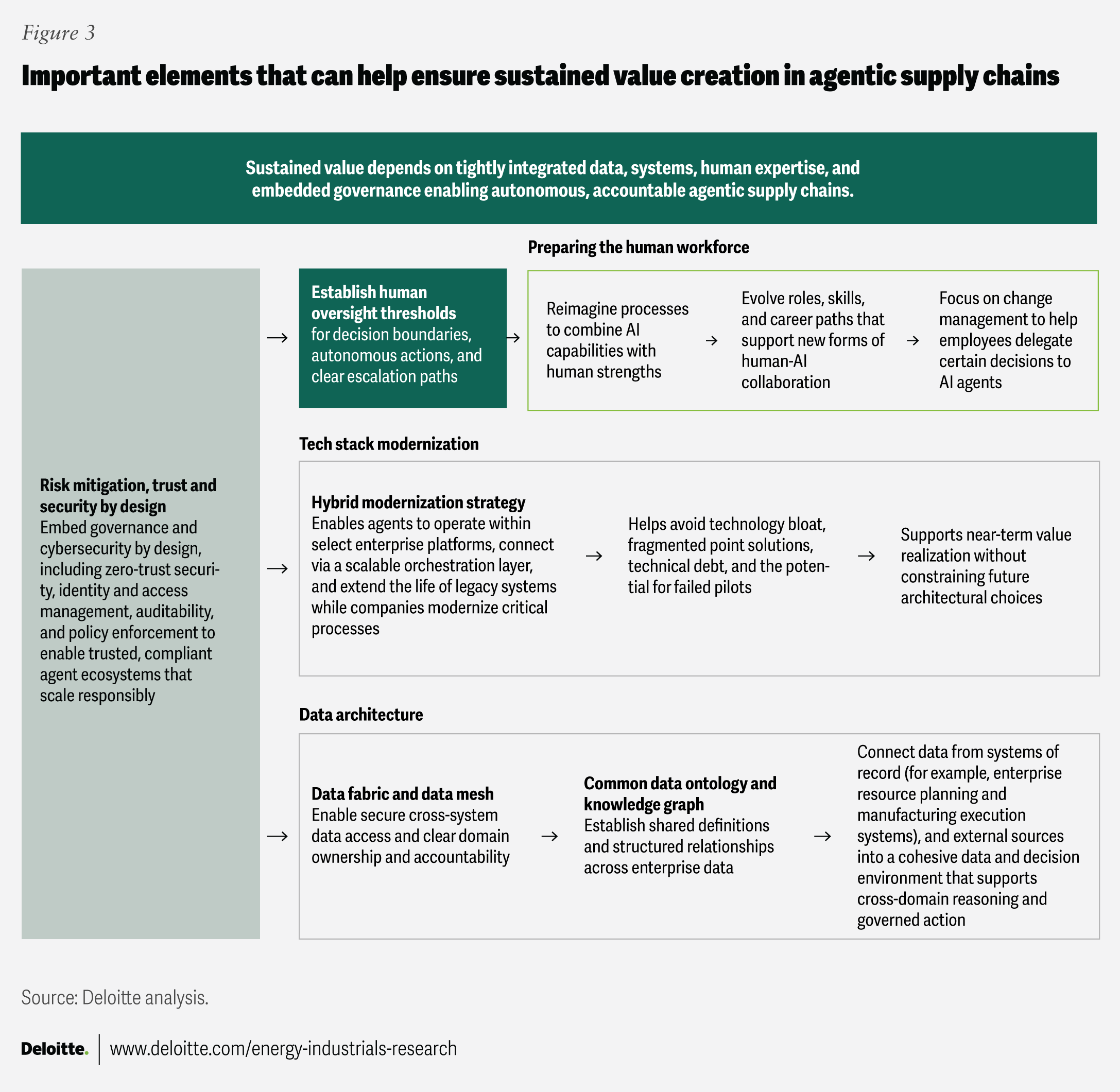
- Data architecture: AI agents depend on a data foundation that supports consistent interpretation, cross-domain reasoning, and governed action.11 Agentic supply chains build on existing systems of record and external data sources by connecting them into a cohesive data and decision environment. A data fabric12 enables agents to securely access and combine data across systems, while data mesh13 principles assign ownership and accountability to supply chain domains, such as inventory and logistics. A common data ontology14 and knowledge graph15 are important components that establish shared meaning and structured relationships across data. While perfect data harmonization is not a prerequisite, agents depend on consistent definitions, clear ownership, and sufficient semantic structure to support effective cross-domain reasoning.16
- Tech stack modernization: Without a disciplined, holistic approach to tech stack modernization that pairs deep knowledge of supply chain processes with technology know-how and solutions—and considers the interoperability of legacy and future systems—companies risk technology bloat, technical debt from fragmented point solutions, and potentially failed pilots.17 A hybrid modernization strategy, where agents extend the useful life of legacy systems, operate natively within select enterprise platforms, and are integrated through a scalable data and orchestration layer as companies modernize critical processes, can support near-term value realization without constraining future architectural choices.18
- Preparing the human workforce: Agentic supply chains are expected to reshape human roles. According to a recent Deloitte report, leading organizations are reimagining their processes to maximize the complementary strengths of AI agents and human workers, while evolving roles, skills, and career paths to support new forms of human-AI collaboration.19 Adoption should also include deliberate change management, as supply chain professionals who often rely on experience, relationships, and nuanced judgment may hesitate to delegate certain decisions to autonomous agents.20
- Risk mitigation, trust, and security by design: As agentic supply chains operate in always-connected environments and execute increasingly autonomous actions, governance and security should be embedded by design, including strict controls over how agents access and interact with enterprise systems. This includes zero-trust security, identity and access management, auditability, policy enforcement, and clearly defined human-in-the-loop thresholds.21 Effective oversight can help ensure that agents operate within established parameters, mitigating risks such as misuse, data leakage, or misalignment with organizational strategy.22 Along with robust cybersecurity blueprints, these controls enable trusted, compliant agent ecosystems that scale responsibly.23
Together, these elements can help position organizations to move beyond isolated automation toward truly agentic supply chains capable of continuous sensing, coordinated decision-making, and governed execution at scale. The companies that redesign workflows and operating models around the complementary strengths of agents and humans—rather than layering agents onto existing processes—may be best positioned to navigate complex supply chain challenges, build resilience, and create sustained competitive advantage.
Continue the conversation
Meet the industry leaders
Kate Hardin
Steve Shepley
By
Pete Robertson
Tim Gaus
Lane Warshaw
Lindsey Berckman
Kate Hardin
John Morehouse
The authors would like to thank Kruttika Dwivedi and Vrinda Garg for their key contributions to this report, including research, analysis, and writing.
Deloitte Advisory Board:
Sami Alami, Michael Schlotterbeck, and Victor Reyes
The authors would like to acknowledge the support of Clayton Wilkerson for orchestrating resources related to the report; Kimberly Prauda and Neelu Rajput, who drove the marketing strategy and related assets to bring the story to life; Courtney Flaherty for her leadership in public relations; and Rithu Thomas and Aparna Prusty from the Deloitte Insights team, who supported the report’s publication.
Cover image by: Pooja
Knowledge Services: Agni Wagh
Visit the Deloitte Center for Energy & Industrials
Access more insights for the aerospace and defense, chemicals and specialty materials, engineering and construction, industrial manufacturing, mining and metals, oil and gas, power and utilities, and renewable energy sectors.