
The great rebuild: How AI is re-architecting the tech organization
What will define tomorrow’s tech org—and how can leaders start building it today?
The era of incremental technology change is over. In the span of a few years, artificial intelligence has leapt from automating tasks to dismantling and rebuilding the very structure of the technology organization.1 Consider that 78% of tech leaders anticipate broad, targeted, or transformational integration of AI agents into architecture workflows over the next five years, according to Deloitte’s 2025 Horizon Architecture Survey.2
Yet this is more than a shift in tools and headcount. AI is reengineering how technology teams are structured, governed, and led. Tomorrow’s model will likely be leaner, faster, and infused with AI at every layer—from architecture to delivery—transforming the tech organization into a dynamic engine that continuously learns and optimizes.
“Agents and people will soon be completely integrated in terms of how work gets done, and it’s going to happen really fast—faster than most companies are ready for,” says Tracey Franklin, chief people and digital technology officer at Moderna. “Companies need to get better at constant road mapping and iteration because the era of 'build it once and forget it' is over.”3
While there’s no single, definitive blueprint for structuring a tech organization for an AI-driven world, the path forward is coming into view. Tomorrow’s high performers won’t just keep pace with AI, they’ll let it propel them into entirely new terrain. The question for every leader today is not whether AI will transform the tech org, but how quickly they can harness its full potential.
How AI is reshaping the tech organization
Deloitte’s Tech Spending Outlook finds that 64% of surveyed organizations plan to increase AI investments over the next two years4—a clear sign that leaders recognize the substantial value and transformative potential AI can deliver across the enterprise. While most acknowledge they’re still in the exploratory phases of generative and agentic AI (figure 1), data shows how AI is reshaping the tech organization in many ways, from priorities and people to purpose.
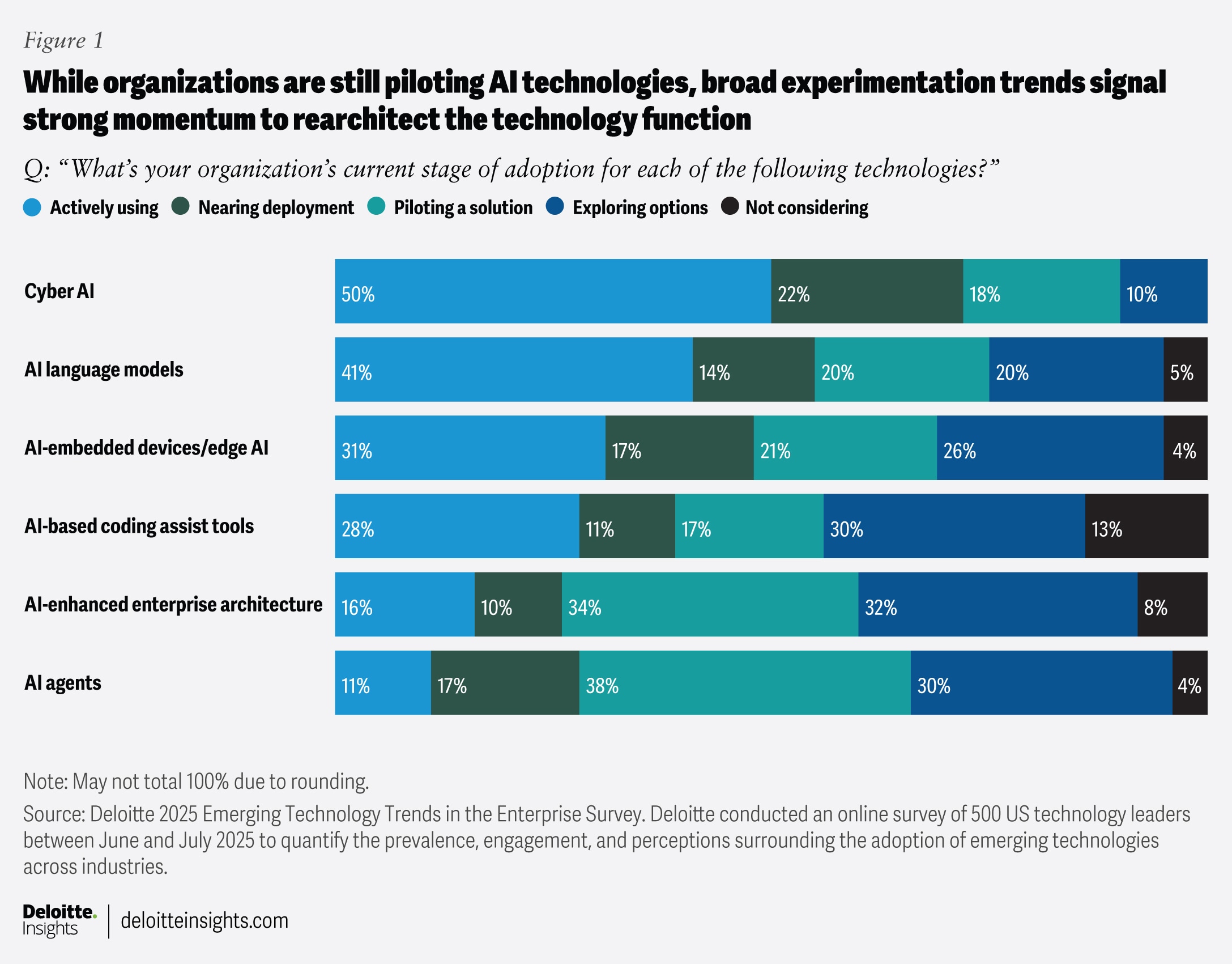
Priorities. Chief information officers (CIOs) in Deloitte’s 2025 Tech Executive Survey singled out harnessing the full potential of AI, data, and analytics as the area where they’re spending most of their time and energy.5 While AI has been top of mind for many executives in the past, generative and agentic AI have placed it at the top of the tech organization’s agenda—and they’re investing accordingly. The percentage of tech budgets allocated to AI is expected to rise significantly over the next two years, from 8% to 13% on average, highlighting how AI is moving from experimentation to core strategy.6
People. Nearly 70% of tech leaders from the same survey plan to grow their teams in direct response to gen AI7—a clear shift from fears of job loss to a strategy of augmentation and specialization. AI’s continued momentum is also creating new roles, like the chief people and digital technology officer at Moderna and forward-deployed engineers, as well as increasing the presence of others.8 For instance, the number of AI architect roles is expected to almost double, from 30% today to 58% in the next two years.9 AI is driving new ways of working and is no longer a “plug-and-play” tool but a technology that requires thoughtful design, integration, and governance—tasks that demand specialized expertise.
Purpose. As AI plays a key role in CEOs’ current and future strategies,10 the mandate of the tech organization is changing. CEOs today look to tech leaders to drive business strategy, not just run IT. Most large enterprises (66% in the Tech Exec Survey) view their tech org as a revenue generator rather than a service center, and when asked what the tech org’s role is in shaping the business, the top response from Deloitte’s Tech Spending Outlook was “strategic leader: enabling the overall business strategy with a focus on technology.”11 The increasing number of CIOs reporting directly to CEOs (65% in 202512 versus 41% in 201513) further signals that technology and AI are not just operational concerns—they’re central to growth, innovation, and competitive positioning. The purpose of the tech organization is expanding from “keep the lights on” to “light the way forward.”
Strategies to prepare for an AI-powered future
Organizations are actively assessing their tech operating models as AI gains momentum. In fact, when asked how they’re evolving their tech op models to meet evolving business demands, just 1% of surveyed IT decision-makers said they had no major changes underway.14
The journey to preparing for an AI-driven future will vary depending on organizational maturity and priorities, among other factors, and will likely start with increasing the adoption of AI and automation. Beyond that, here’s how organizations are planning for an AI-driven future, today.
Modernization starts with business problems, not technology
Seventy-one percent of surveyed organizations are currently modernizing core infrastructure to support AI implementation, and 23% are investing 6% to 10% of annual revenue in modernizing core enterprise systems.15 But recognition isn’t enough; the key is solving real business problems, not just upgrading technology.
“Modernization is not about technology for technology’s sake; it’s about addressing fundamental business problems like costs, go-to-market issues, and so on,” says Alan Davidson, CIO of Broadcom. “AI is a good example. The technology is evolving at such a rate that conversations taking place about AI today are very different from those that happened six months ago, so it’s important to have a tactical plan. Without focusing on a specific business problem and the value you want to derive, it could be easy to invest in AI and receive no return.”16
Architectures designed for modularity and observability
The AI-driven, future-ready enterprise can’t be built on legacy platforms patched together for survival, which may explain why 66% of surveyed organizations are piloting or exploring options around AI-enhanced enterprise architecture.17 When emerging technologies are used in conjunction with an end-to-end enterprise focus, they can deliver amplified value. New architectures can be designed for modularity and observability,18 which, at its core, is the ability to see, understand, and optimize a system by analyzing its external outputs.
“At Western Digital, we’re developing an observability architecture to help us take a holistic approach to managing our tech landscape,” says Sesh Tirumala, CIO of Western Digital. “We’re not waiting for perfect AI solutions; we’d rather fail fast on small pilots than miss the wave entirely.”19
The Coca-Cola Company is also prioritizing a modular approach. “For global organizations, one size rarely fits all. Ways of working are not the same everywhere throughout the world. Our approach has been to build a modular architecture and a set of guiding core principles supported by an agile team able to operate at speed while localizing as needed,” says senior vice president and CIO Neeraj Tolmare.20
Human–machine collaboration at the heart of tech talent strategy
Recent Deloitte research highlights the rapid evolution of the tech talent landscape. As organizations adopt emerging technologies, the most anticipated new roles include:
- Human-AI collaboration designers, responsible for crafting seamless interactions between people and intelligent systems
- Edge AI and embedded systems engineers, who bring AI capabilities directly to devices and connected infrastructure
- Data quality specialists for synthetic data, ensuring that the training data fueling AI systems is trustworthy and representative
- AI prompt engineers and model trainers, optimizing AI outputs and tailoring models to specific business needs21
To make AI work in practice, consider how it can be both an upskilling engine and a tool to bridge knowledge gaps. “Even if you’re not a JavaScript expert or a product manager expert, AI can help bridge that gap, or even fill that gap,” says Gene Kim, researcher and coauthor of The Phoenix Project and the newly released book, Vibe Coding.22 As organizations reconsider their tech talent strategy, it’s helpful to think about what degree of functional expertise they’ll need on their teams given what AI can do, he adds. That can help illuminate where to focus any upskilling or reskilling efforts. (See sidebar for the full Q&A.)
While AI can democratize capabilities and expertise, tomorrow’s competitive edge will likely not simply come from adopting AI tools but from building teams that can design, manage, and evolve the way humans and machines work together. The future isn’t human or machine, but rather human and machine.23
Governance that enables speed while managing emerging risks
While this is not an easy feat, Vince Campisi, chief digital officer and leader of the enterprise services division at aerospace and defense company RTX, shares his strategy for adapting governance in the age of AI: “Break governance down into three M’s: map, measure, and monitor. This means teams can map activities to keep tabs on progress, measure results to see if they’re achieving the outcomes they want, and monitor quality to make sure the initial goals are realized. Next, focus on tactics designed to maintain alignment with strategic intent. As AI becomes more agentic, organizations can establish governance that starts with leadership’s intent and builds in explainability and auditability so humans can verify and trust the results.”24
Bold ambition prioritizing reimagination over incremental change
Transforming the tech org demands more than a series of small, safe steps—it requires a courageous vision that reimagines what’s possible. Organizations that set bold ambitions harness AI far beyond tactical automation, radically reshaping how technology, talent, and strategy intersect.
“Rather than getting stuck in a cycle of perpetual proofs of concept, consider attacking your biggest problem and go for a big outcome,” says Daniel Dines, UiPath CEO and executive chairman. “With a significant success in hand, you can then prove that there are not just opportunities to rethink business processes but also potential productivity enhancements and opportunities to uncover new revenue streams. The sooner you get started, the better your position can be in the journey toward those ends.”25
Redefining the CIO role
As AI takes hold, the CIO’s mandate is expanding from tech strategist to AI evangelist. In fact, 70% of CIOs from the Tech Executive Survey say their primary role with gen AI at their organizations is either implementing gen AI across the enterprise or serving as an evangelist, helping teams see the possibilities of the technology.26 As AI-enabled capabilities are embedded across organizations and IT is less centralized, CIOs become orchestrators and integrators rather than owners of infrastructure. In fact, almost a third of CIOs say that orchestrating fellow tech leaders is essential in the next 18 months.27 The role now requires deeper integration with business strategy and enterprisewide transformation, making the CIO both a change agent and a responsible gatekeeper.
“CIOs were once more like chief integration officers because much of their remit was making sure SaaS and other applications worked together effectively. Today, I consider my role a combination of the traditional CIO plus chief data officer, chief AI officer, and chief digital officer,” adds Western Digital’s Tirumala. “This era is an opportunity for technology leaders to step up. We understand the technology, the data, and the processes. Don’t wait for permission—lean in as a partner. Articulate a strong digital ambition and develop a road map for enabling top-line growth and business model shifts, along with a strategy for managing the risks. Focus on speed, agility, outcomes, and value. With the right approach, there won’t be any need to ask for forgiveness later on.”28
The markers of an AI-powered tech organization
Every enterprise’s AI journey will be distinct, but successful AI-powered tech organizations share common characteristics. These markers represent the new standard for tech organizations that thrive in an AI-driven world.
AI as a core collaborator
Tomorrow’s tech operating models elevate AI from an add-on tool or efficiency play to an embedded collaborator at every layer—from decision-making and operations to product development. As a co-creator, AI can accelerate road mapping, automate feedback loops, and reprioritize work in real time. Much like the revolutions of cloud and mobile before it, this shift positions AI as the next core capability for competitive advantage.
Delivering this vision requires cloud-native, platform-powered foundations. Forty-eight percent of organizations surveyed in the Tech Spending Outlook say they’re currently expanding cloud-native and DevOps practices to better align tech with business needs.29 Cloud is no longer just infrastructure. It’s the engine of speed, flexibility, and innovation. Modular, API-first, self-service platforms enable rapid scaling while reducing infrastructure overhead; platform engineering and orchestration ensure consistency, governance, and reuse across product lines. In this model, the tech organization becomes the architect for enterprise AI, providing standardized, secure, and scalable building blocks so teams can adopt AI confidently and consistently.
Work reimagined for speed
In the years ahead, traditional project teams will likely shift into lean, cross-functional squads aligned to products and value streams—tightening the loop from concept to customer and hardwiring ownership of outcomes. Fifty-seven percent of organizations report that they’re already shifting from project to product models to bring business and IT closer together.30 In this model, product lines deliver user-focused features via shared, customer-facing platforms; agile pods govern ways of working and tool choices; and forward-deployed engineers work alongside product or customer teams to shorten the path to value.31 The result is stronger ownership, faster iteration, and a clearer line of sight to real-world impact.
AI, cognitive tools, and robotics can amplify this structure by embedding continuous planning, delivery, and experimentation into daily work. Predictive models and smart automation can replace manual handoffs, while roles like AIOps lead emerge and traditional project management fades. Organizational agility can expand beyond IT, creating an operating model that continually adapts to shifting priorities while preserving speed and accountability at the team level.
Human-agent teams at scale
The future workforce fuses human ingenuity with machine intelligence. Two-thirds of organizations are piloting, actively using, or close to deploying AI agents.32 These future teams will likely be a seamless blend of humans, AI agents, and orchestrators, where humans contribute creativity, oversight, and ethical judgment, and AI brings speed, precision, and pattern recognition. This model fuels perpetual experimentation, rapid prototyping, and scalable innovation across products, services, and operations. As AI agents assume more complex tasks, digital fluency becomes a core skill for every role. The tech organization’s future success will likely hinge on orchestrating this collaboration, ensuring that humans and machines learn and evolve together.
Embedded governance
Modern tech organizations are replacing slow, point-in-time oversight with adaptive governance cycles: continuous, AI-assisted mechanisms that protect speed without sacrificing safety. Predictive models and real-time signals are transforming decision-making from subjective, opinion-based guesswork to objective, fact-based choices, surfacing risks before they escalate and informing priorities as conditions change. Policies, processes, and controls become living assets—codified, monitored automatically, and iterated in short cycles to keep pace with emerging technologies—so compliance, security, and ethics are embedded in the flow of work rather than bolted on.
Delivering this at scale requires strong collaboration among leaders. AI outcomes won’t emerge from siloed innovation; they’re unlocked when the CIO, chief financial officer (CFO), and chief strategy officer (CSO) operate as a cohesive triumvirate, balancing vision, execution, and value realization. In this dynamic, the CIO drives technology integration, the CFO ensures investments deliver measurable ROI, and the CSO aligns strategy with enterprise priorities.33 Together, they create the connective tissue between innovation and business outcomes, demonstrating that AI success is as much about shared leadership as it is about advanced technology.
Orchestrating ecosystems
The tech organization will likely evolve from service provider to ecosystem orchestrator, coordinating across startups, hyperscalers, regulators, and academia to accelerate innovation. As digital capabilities diffuse across the enterprise and tech-fluent roles become the norm, the boundaries between IT and the business may dissolve. In the years ahead, enterprises will likely operate in fluid innovation networks, running a portfolio of bets and building on what works. Success will depend less on owning all the technology and more on orchestrating an adaptive ecosystem—one that experiments continuously and embraces a “fail fast, learn faster” culture.
Continuously evolving: Always beta by design
The defining trait of tomorrow’s tech orgs is perpetual evolution, where change becomes a core capability, not a one-time event. Embedding adaptability and an always-beta mindset into their structure, culture, and strategy creates organizations that learn as fast as the technology they harness.
“The way you’ve always done things doesn’t have to be the way you do them tomorrow,” says Kim. “Leverage everything you can get out of AI right now because even if performance levels freeze, what AI can do today for your organization and your teams is still miraculous. There’s no time to wait. The time to jump is now.”
By
Lou DiLorenzo Jr.
Anjali Shaikh
Michael Caplan
Erika Maguire
The authors would like to thank executive sponsor Bill Briggs, as well as the Office of the CTO Tech Market Presence team, without whom this report would not be possible: Ed Burns, Caroline Brown, Preetha Devan, Bri Henley, Dana Kublin, Makarand Kukade, Haley Gove Lamb, Heidi Morrow, Sarah Mortier, Abria Perry, Catarina Pires, and Kelly Raskovich.
Much gratitude goes to the many subject matter leaders across Deloitte who contributed to our research for the Business of Technology chapter: Ryan Casden, Nate Paynter, Tarun Sharma, Tim Smith, and Michael Wilson.
Additionally, the authors would like to acknowledge and thank Katarina Alaupovic, Allison Cizowski, Deanna Gorecki, Ben Hebbe, Mikaeli Robinson, and Madelyn Scott; Amanpreet Arora and Nidhi John; as well as the Deloitte Insights team, the Marketing Excellence team, the NExT team, and the Knowledge Services team.
Cover image by: Jim Slatton; Getty Images, Adobe Stock