
Rewiring the enterprise operating model for AI scale
Organizations may be confident in deploying AI, but scaling it will likely mean redesigning how the enterprise makes decisions, allocates capital, governs risk, and gets work done
Organizations are moving from AI experimentation to operationalizing AI as a core enterprise capability. Deloitte’s 2026 Global Technology Leadership Study surveyed more than 660 technology executives globally (see methodology) and found that a majority (58%) say they are prepared or fully prepared to modernize platforms and build AI capabilities.
But that confidence masks a structural readiness gap. Most executives surveyed (81%) say they can deploy and govern AI at scale today. Yet nearly 75% acknowledge that their operating model will need to change in the next 12 to 18 months to sustain progress. This highlights a critical gap for the next phase of AI transformation: Scaling AI is no longer a technology challenge but an enterprise operating model challenge.
Scaling AI will likely require rewiring how the enterprise works. Leaders won’t be able to scale AI using operating models designed for an earlier era when technology was largely a support function, decisions moved hierarchically, and funding was project based. The market is moving toward a new AI operating model characterized less by control and more by continuous coordination.1 As AI becomes embedded across workflows, decision-making, customer experiences, and enterprise systems, organizations will need new ways to coordinate leadership, funding, work, risk, and external partners.
Any one of these shifts alone would be significant. Together, they might require a fundamental rewiring of the enterprise operating model, including decision rights, funding mechanisms, governance, workforce design, and accountability structures.
From control to continuous coordination: Five operating model shifts for scaling AI
Where organizations once relied on centralized oversight and sequential execution, AI demands distributed decision-making, real-time alignment, and continuous coordination across business functions and ecosystems.
Five shifts are likely to shape the operating model of the future: more integrated technology leadership, work redesigned across humans and AI agents, more dynamic funding models, deeper ecosystem partnerships, and more frequent operating model redesign.
1. Integrated tech leadership
AI scale depends on leadership that can coordinate across data, cyber, operations, product development, engineering, risk, and the business, but many organizations still have fragmented leadership structures.
In our study, 71% of tech executives report their organization has five or more C-suite tech leaders. Their remit cuts across data, cyber, operations, product development, and engineering. That proliferation can bring specialized expertise closer to the business. But without clear decision rights, coordination mechanisms, and shared governance, it can also make AI harder to scale.
As technology leadership expands, traditional role boundaries are blurring. In one example, HSBC appointed its former chief operating officer as the first chief AI officer to deploy AI at scale.2 As roles evolve, leaders will need mechanisms for deciding who owns AI strategy, who governs risk, who manages data and platforms, and how business leaders will be involved in those decisions.3
Reporting relationships offer one signal of the integration work that lies ahead. On average, 38% of surveyed technology leaders report to the CEO, though that number is much higher for chief information officers (CIOs) based in the United States (63%). At the same time, reporting lines across the technology C-suite remain fragmented: Chief technology officers report into a mix of CEOs, CIOs, and chief operating officers, while chief data and analytics officers (CDAOs) are similarly split across CEOs, CTOs, and CIOs (figure 1). The implication for technology leaders is clear: Reporting relationships alone will not determine whether AI scales successfully. Organizations will need clear decision rights, robust governance mechanisms, and shared accountability that connect business, technology, risk, and data leaders around common business outcomes.
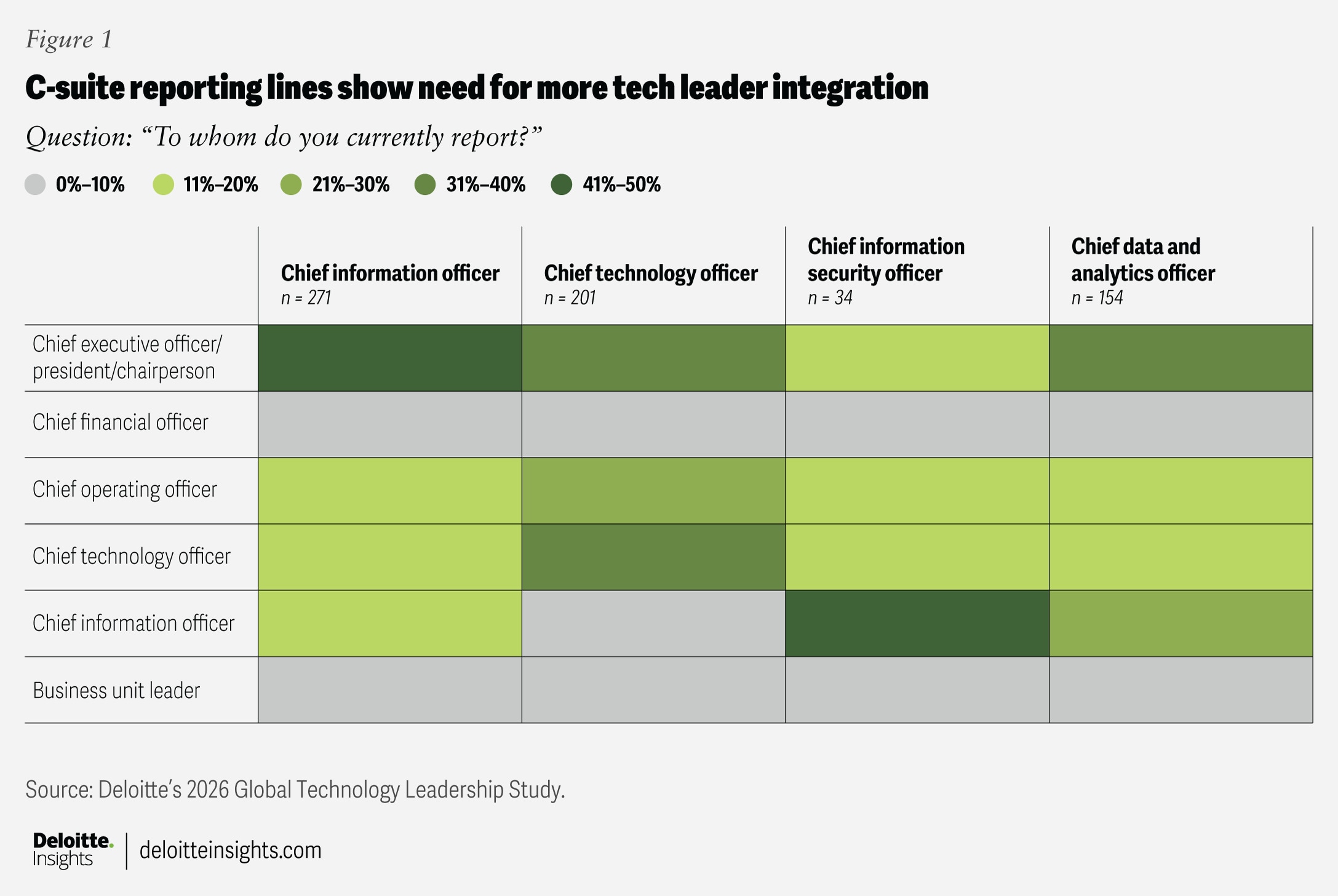
In an AI-native environment, where technology, risk, resilience, and business strategy are tightly connected, this fragmentation can create disconnects where integration matters most. Emerging leadership roles, such as the chief data analytics officers, are beginning to serve as connective tissue across these domains, with a growing emphasis on aligning data, technology, and business priorities.
The need for alignment is clear: Seventy-four percent of CTOs and chief information security officers, and 69% of CDAOs in our survey say close collaboration across technology leadership is critical, compared to 68% of CIOs. The data highlights both the need for alignment and the work still ahead. As organizations scale AI, the operating model should evolve to reduce fragmentation, clarify decision rights, and enable more integrated leadership across business, technology, and risk functions.
2. Human-AI work orchestration
Digital workers add another layer of complexity to already complicated leadership structures. AI agents are increasingly operating as collaborators in enterprise workflows.4 Forty-two percent of surveyed leaders believe more than 40% of organizational processes will be automated or AI-enabled by 2028, up from just 6% today—a sevenfold increase.
This signals a shift from isolated AI use cases to enterprisewide multiagent solutions. Agents are being embedded across workflows, user interfaces, and systems of record, requiring leaders to work across data, architecture, and business functions to build the right solutions and govern them efficiently.
At the core of the AI-native operating model is a shift from managing people to orchestrating work across humans and AI agents.5 Leadership shifts as work—not jobs or functions—becomes the unit of management. Managers will need to coordinate workflows, decision rights, and interactions across human and digital workers, while designing systems that dynamically allocate work, govern decisions, and improve outcomes. Rather than organizing around static roles like analyst, manager, or specialist, organizations can break work into tasks and decision points and assign them across humans (for judgment, ambiguity, or relationship-driven work), AI agents (for repeatable, data-intensive, or autonomous tasks), and hybrid loops (where AI acts and humans review or override).6 This lets organizations build orchestration layers in enterprise resource planning, customer relationship management, and data platforms to route tasks, manage AI-to-human handoffs, and create feedback loops that improve outputs.
The result should be a dynamic, adaptive system where work can be reassigned in real time based on context, performance, and risk rather than locked into a static process. But this system will also need clear governance and accountability. Organizations will need to define who owns AI-driven decisions, where human oversight is nonnegotiable, and how auditability is built into workflows through decision logs, model traceability, and explainability.
For instance, an operating model for a retailer could integrate AI agents that are governed by human decision gates. Together, they help sense demand, inform product design and merchandise planning, optimize inventory, manage returns, and track performance—while keeping human leaders involved where brand, strategy, risk, finance, and customer judgment matter most (figure 2).
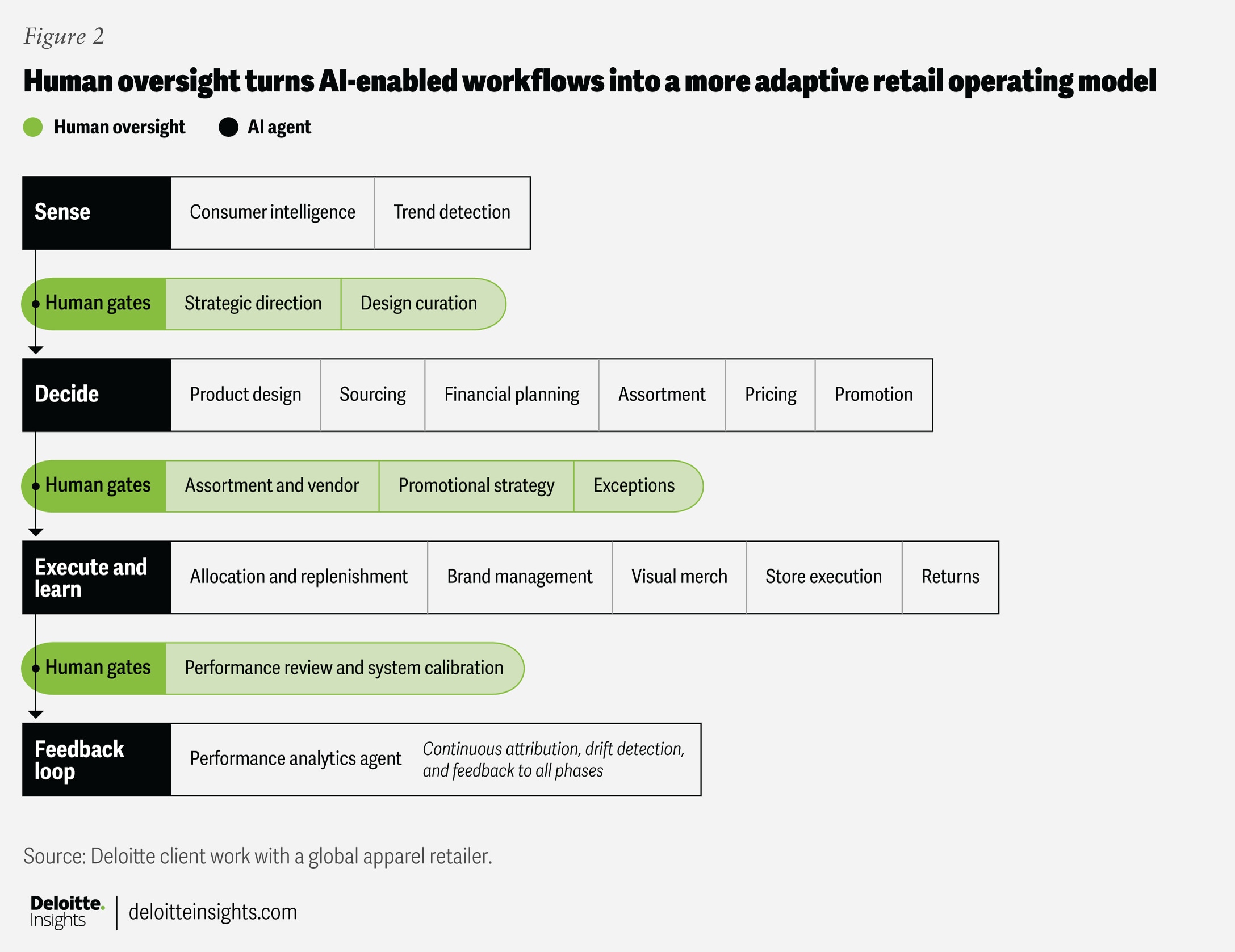
The key takeaway here is not the performance of the agents themselves but the governance structure surrounding them. The model shows how AI can change the way decisions move through the organization. Human decision gates can establish accountability for strategic, financial, risk, and customer decisions, while AI agents can accelerate sensing, planning, and execution. Performance gains will likely emerge because the operating model clearly defines where machines act, where humans decide, and how feedback flows between them. Deloitte analysis of this model suggests that agents should be able to predict trend trajectories with about 91% accuracy up to 24 months ahead, reduce stockouts by up to 50%, and reduce returns by up to 20%.7
3. Portfolio-based funding
Traditional project-based funding is often too rigid for AI because that approach is often designed for predictable technology investments. AI can introduce variable consumption costs, rapid experimentation cycles, evolving vendor economics, and uncertain value realization timelines. As a result, the challenge is not simply funding AI but creating capital allocation mechanisms that can adapt as AI economics change, including variable spend, evolving pricing models, use cases, and inferencing options (for example, software as a service, cloud, and self-hosted solutions).8
Static funding models should be giving way to more dynamic capital allocation. On average, our survey results show that organizations are now balancing budgets almost evenly across “run,” “grow,” and “transform” investments. That balance could create stress as IT budgets only grew by 2% of revenue year over year.
The most confident operators—those who said they were confident or very confident about their operating models—have slightly higher IT budgets, at 7.8% of revenue compared to 6.5%. They also focus more on growth and transformation. Less confident operators focus more on operations and efficiency, with about 53% of their budget attributed to “running” the organization.9
As AI becomes more embedded in the enterprise, organizations will need funding models that can adjust as use cases mature, costs change, risks emerge, and value becomes clearer.
Funding also should be tied more directly to measurable outcomes. Sandra Marchand, chief marketing officer for Advanced Technology Services, explained in an interview with Deloitte that her organization measures digital investments against their return: “We hold ourselves to at least a 4:1 return, meaning every digital investment dollar generates US$4 in profitable revenue. It’s our core accountability metric, ensuring we invest deliberately, align stakeholders, and focus not just on pipeline and revenue, but on margin-driven growth.”10
That kind of discipline can help organizations move beyond experimentation and toward a more durable AI investment model that balances innovation, efficiency, risk, and measurable value.
4. Ecosystem co-innovation
As AI scale places new demands on the enterprise, organizations might increasingly rely on partners to modernize capabilities, manage cyber risk, and access skills they cannot build fast enough internally. Many vendors are becoming part of the operating model itself, influencing how AI capabilities are built, governed, and scaled.
Surveyed leaders with low confidence in their operating model tend to work with vendors to enable core technology function capability needs. By contrast, leaders reporting higher confidence in their operating model are more focused outward, preparing for future technological change and cyber-related risks.
Across both groups, reliance on external technology partners is rising. Sixty-three percent of respondents say their reliance on external technology partners has increased in the past 12 months, and 62% expect it to continue increasing.
This is more than a procurement trend; AI scale increasingly requires partners for speed, specialized skills, and co-development. Our survey suggests this operational shift is already underway: Organizations expect their use of co-innovation approaches when selecting AI vendors to double from the current contract cycle to the next.
Vendors are not just suppliers of platforms or services; they are becoming part of the operating model, influencing how AI capabilities are built, governed, and scaled. That often requires clearer ownership, stronger risk management, and better coordination across internal and external teams, with ecosystem governance becoming an operating model capability rather than just a procurement activity.
5. Continuous operating model refreshes
The AI operating model shouldn’t be redesigned once and then left alone, but should be continuously evolving.
Survey responses indicate a wide range in how often organizations reassess their technology operating models. While some refresh annually or semiannually, the most common cadence is quarterly (36%). Others rely on continuous, dynamic, or ad-hoc reviews, and some have no formal review process.
While 75% of surveyed leaders agree they need to change their operating models within the next 12 to 18 months to drive greater value, only about a quarter report doing so on a continuous or dynamic basis.
Notably, surveyed leaders reporting lower confidence in their current operating model are more likely to rely on ad-hoc adjustments rather than structured review cycles, suggesting a reactive rather than strategic posture. More frequent and structured reviews can provide leaders with an opportunity to realign with their peers, revisit strategic priorities, and steer the organization more collectively.
Leaders should consider a phased approach for operating model refreshes. Incremental or adjacent adjustments can be incorporated through quarterly refresh cycles, while more structural or foundational shifts can be sequenced over a longer 12- to 18-month horizon. This gives organizations a way to ensure stability while keeping pace with rapid changes in AI, regulatory, workforce, and technology changes.
AI can also help leaders redesign and implement the operating model itself. For example, digital twins—virtual representations of the organization’s processes, structures, and performance drivers—can allow leaders to simulate different operating model scenarios before making changes.11 AI-supported design tools can synthesize large volumes of enterprise data across processes, workforce, finance, and customers to identify inefficiencies and recommend better design choices. Used well, these tools can move operating model evolution from a reactive discipline to a proactive, precision-guided capability.
Rewiring the enterprise operating model for the future
These shifts suggest that the future operating model is less about organizational structure and more about coordination. The defining challenge is not where functions sit on an organizational chart, but how leadership, work, capital, risk, and ecosystem relationships are coordinated in service of core business outcomes (figure 3).
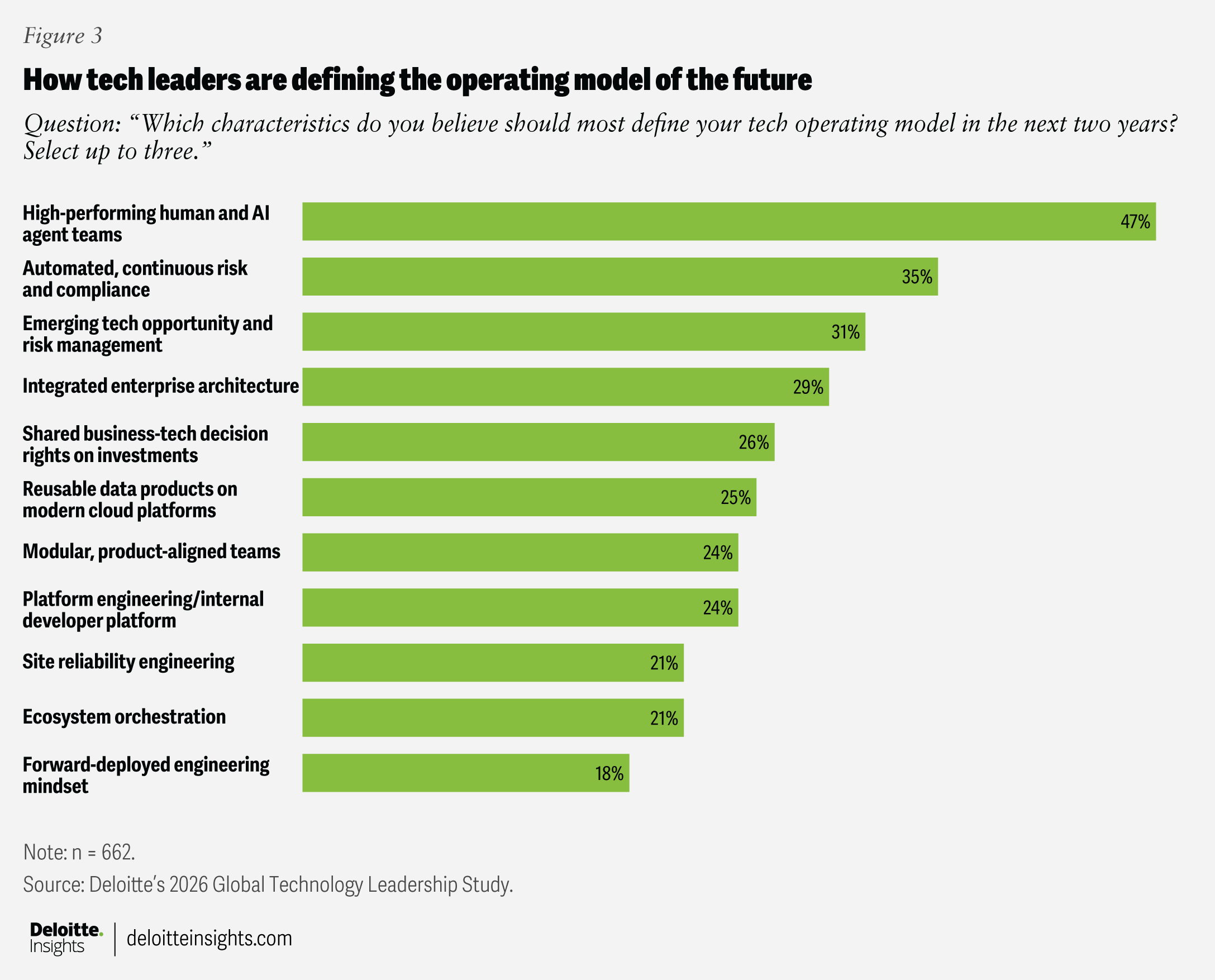
Getting there will likely require more than modernizing the tech stack. It might require redesigning how the enterprise operates: how decisions are made, how capital is allocated, how work moves across humans and AI agents, how risk is governed, how partners are managed, and how accountability is structured across the enterprise. Importantly, AI transformation is not just top-down. It also requires bottom-up redesign by the people who know which processes should be preserved and where AI can create value. This can help build true human-AI teams across value chains, improving adoption and guiding cost-conscious behaviors through process redesign.
Operating model redesign might be the defining leadership challenge for the next phase of AI transformation. Organizations that scale AI successfully will likely be those that treat the operating model itself as a design challenge, a living system that evolves as AI becomes a part of how the enterprise works.
Continue the conversation
Meet the industry leaders
Anjali Shaikh
by
Michael Wilson
Anjali Shaikh
Michael Caplan
Monika Mahto
The authors would like to thank Diana Kearns Manolatos and Erika Maguire for their significant contributions to the research and development of this article.
We’d like to thank Fay Chen, Eric Jensen, Courtney Schulz, Ryan Casden, and Ari Cobb, for their thoughtful review and input based on the impactful work they’re driving in the market.
We extend our appreciation to Ayush Kumar for his support in data analysis, and to Angelle Peterson for her involvement in the insights development, as well as to the marketing team—Jennifer Rood, Saurabh Rijhwani, Akshay Poojari, Jennifer Popovich, and Pratyusha Peddasomayajula for their support in amplifying the impact of these insights.
Editorial (including production and copyediting): Corrie Commisso, Shyamili M, Pubali Dey, and Anu Augustine
Design: Molly Piersol and Sonya Vasilieff
Cover image by: Sonya Vasilieff, Manya Kuzemchenko
Knowledge services: Vanapalli Viswa Teja
Visit the Deloitte Center for Integrated Research
Access more insights on some of the most complex issues facing businesses today.