
4 shifts are shaping technology infrastructure. How can leaders avoid creating systems they can’t change?
When technology modernization happens in pieces, leaders risk creating the next legacy system—locking into new constraints that limit what technology can do next
Article
•
8-min read
•
01 June 2026
•
Deloitte Center for Integrated Research
Enterprises are modernizing infrastructure at speed—but the results might not be what they expect. Efforts meant to increase flexibility and adaptability across providers, architectures, and operating models may instead be creating new constraints that limit how systems can be modified over time.
Much of today’s tech transformation is happening one layer at a time. Cloud, data, applications, and interfaces are often being redesigned independently, each optimized for local performance. The result is not modernization, but misalignment. Leaders risk engineering the next legacy tech stack—the systems, data, and infrastructure that power the organization—and locking the enterprise into what we call “architected disadvantage.”
The warning signs are visible. A concentrated set of providers underpins much of today’s digital infrastructure, and recent outages have shown how quickly localized failures can cascade across systems. But resilience risk is only part of the story. The deeper issue is structural: Multiple shifts appear to be reshaping the tech stack simultaneously, without coordination across layers.
Many enterprises have operated under a clear expectation that infrastructure would become easier to change and integrate. That assumption is now breaking down. Instead of a clean transition, new capabilities are often being layered onto existing systems without a foundational redesign, amplifying complexity and deepening dependencies.
These constraints often surface under stress when systems are pushed. For example, infrastructure readiness is a prerequisite for strong and adaptive systems. But readiness can be constrained by power or computing availability. Opportunities and constraints aren’t driven by a single change, but by a set of shifts unfolding across how systems are built, connected, experienced, and governed—each advancing on its own timeline, but increasingly dependent on the others.
This is how architected disadvantage can take hold: not through a single decision, but through a series of well-intentioned choices that end up making it more difficult for the enterprise to change. Understanding where these shifts emerge and how they interact could be key to avoiding that disadvantage.
The tech stack feels stable, but four shifts are putting infrastructure under strain
The tech stack is being redesigned in place. Infrastructure is concentrating and diversifying at the same time. Discovery is shifting from human search to agent mediation. Trust models are under regulatory and technological pressure. Interfaces are consolidating around mobile even as spatial and quantum layers advance in parallel.
These shifts are embedding new dependencies across the tech stack. Systems continue to function but become more complex to coordinate and more difficult to change. This is why the stack can feel stable even as constraints are building beneath the surface.
Individually, these shifts might appear manageable. But they’re reshaping the tech stack in ways that might require a more integrated approach to achieve resilience. Four developments appear to be driving this transformation.
1. The hybrid future might be more converged (and more constrained) than it appears
While organizations are planning for multicloud, multimodal, and multiagent environments, the number of potential paths forward is expanding faster than the architectures designed to support them.
This spans everything from the infrastructure layer to the application layer to the power and hardware required to scale.1 As workloads spread across cloud, edge, and emerging models such as self-hosted AI factories, some applications become disaggregated into systems of agents. Data and storage become a first-order constraint, while networking strategy, speed, and control become critical points of coordination.
While modern technology infrastructure might seem highly distributed in that it connects information across the world, it is actually highly centralized, with just a few vendors running most internet services.2 When one layer3 fails, consequences can cascade, raising resilience challenges and concentration risk concerns that are driving many enterprises to implement hybrid infrastructure strategies.
Despite talk of decentralization, the biggest tech players and dominant platforms aren’t giving up their influence. Instead, partnerships among hyperscalers increasingly reflect shared AI workloads, cross-platform interoperability, and embedded services across ecosystems. For organizations, multicloud is shifting from a way to manage risk to an architectural baseline.4 Amazon, for example, recently announced an emerging content marketplace model in an effort to return traffic to origin sites and explore new content models.5
2. As agentic systems scale, the systems that coordinate them will likely become the new control layer
If infrastructure is under strain from below, the discovery layer is being rewritten from above. Modern infrastructures are often built across cloud systems and search capabilities: keyword queries, ranked links, and ad-driven traffic flows.
The most profound structural shift might be the emergence of agentic systems refining application protocols, interoperability, and the digital control plane for a new age. Instead of navigating platforms manually, users are increasingly delegating tasks to AI assistants that search, compare, transact, and coordinate on their behalf. In this model, digital engagement becomes algorithmically mediated.
An “Internet of Agents” envisions autonomous systems discovering, negotiating, and executing across platforms without direct human intervention.6 This shift alters the structure of the information superhighway and the supporting infrastructure as we have come to know it.7
While nearly every technology provider has an AI agent capability, standards will guide engineering principles. Google's A2A was an early effort to define inter-agent interoperability standards and was subsequently donated to the Linux Foundation to advance open and secure agent-to-agent communication.8 Cisco has proposed an “Internet of Cognition” architecture designed to enable shared context, common goal states, and cross-agent learning—laying the groundwork for more coherent, scalable multiagent collaboration.9
The rise of agentic systems is not just a shift in interaction but a restructuring of data architecture. True multiagent coordination also requires persistent memory, common goal states, and interoperable trust frameworks.10 Efforts such as MIT’s Project NANDA, which focuses on decentralized agent coordination, are exploring decentralized discovery, identity, and trust frameworks so agents can verify capabilities and coordinate without centralized bottlenecks.11 This elevates data from a passive asset to an actively orchestrated layer of the tech stack. As a result, vector databases, retrieval pipelines, and data permissioning systems are becoming as critical as computing infrastructure itself.
While enterprises are focused on the interaction between data and applications, they’re less focused on how application decisions and infrastructure decisions coexist. Agentic orchestration and hybrid infrastructure planning are often happening in silos, even as their dependencies deepen.
Orchestrating across AI agents that operate on shared protocols can unlock new efficiencies, allowing organizations to focus engineering resources instead on next-level challenges such as contextual engineering, process redesign, and human-in-the-loop governance.
Forward-deployed engineering—an operating model where technology engineers are embedded directly in a customer’s environment to build, customize, and deploy solutions in real time—can support this shift. These teams can partner with process owners to define measurable outcomes, pressure-test protocols, and build in governance early so multiagent systems can scale from pilots into enterprise-ready systems.12
3. Interfaces are moving into the real world, so network performance becomes user experience
Enterprise investment is shifting away from fully immersive environments toward lightweight, persistent interfaces embedded in the physical world. Capital is moving from metaverse platforms to spatial computing, smart glasses, and ambient AI—signaling that the next interface won’t replace mobile but extend it into everyday environments.13 This shift puts new pressure on network performance, edge computing, and real-time data synchronization as core infrastructure requirements.
Growth in smart-glasses adoption suggests the real opportunity is persistent, real-world context—placing information directly in a user’s field of vision. Counterpoint Research reports that the smart-glasses category accelerated sharply in the second half of 2025, with shipments up 139% year over year.14 This could mean new capabilities are necessary, from building for augmented reality glasses and omniverse platforms to working with physical spatial data, hologram technology, or even the “invisible” interface of voice for interacting with the world around us.
As a result, the invisible network—Wi‑Fi 6/6E/7, private 5G, and edge connectivity—becomes more important, as it determines speed, reliability, and safety for real-world use cases. As virtual agents extend into physical and spatial AI through sensors, geolocation, or robotics, the interface shift becomes inseparable from network design and data pipelines.
4. Quantum is not a future layer but a breaking point for today’s trust architecture
Post-quantum encryption, quantum networking, and advances in photonic transmission are already forcing organizations to reassess how identity, security, and data integrity are designed across hybrid environments. The issue is architectural exposure. Systems being built today may not be resilient to the cryptographic standards of tomorrow, embedding long-term risk directly into infrastructure decisions.
If agents are going to operate with real autonomy across systems, organizations will likely need new ways to assign identity, define permissions, govern behavior, and ensure the integrity of the transactions those agents carry out. This points to a more adaptive control layer that can monitor and manage systems of agents in real time.
Trust architectures such as distributed ledgers and immutable records could also play an important role in strengthening accountability, verification, and auditability as autonomous activity scales. At the same time, standards are beginning to evolve. The World Wide Web Consortium is advancing decentralized identity and verifiable credential standards,15 including decentralized identifiers.16 Google, is planning to complete its post‑quantum cryptography migration by 2029.17
Yet, quantum and cyber remain an X factor. Reliable solutions are needed, but only 38% of global cyber decision-makers anticipate a transition to post-quantum encryption within the next three to four years, according to Deloitte’s Global Future of Cyber study. The study similarly suggests that adversarial AI is a top concern among cyber leaders, reinforcing the need for new approaches for data security, sovereignty, and encryption. Meanwhile, advancements in photonic integration and fiber-based quantum state transmission are creating testbeds for new forms of networking.18
Designing the tech stack for what’s possible
For enterprises, designing an adaptable tech stack is less about prediction and more about architecture and engineering principles.
One way to understand the shift is through how the internet itself is evolving. A recent IEEE Spectrum19 article outlines a progression from early connectivity to today’s inflection point, and where we could be headed (figure 1).
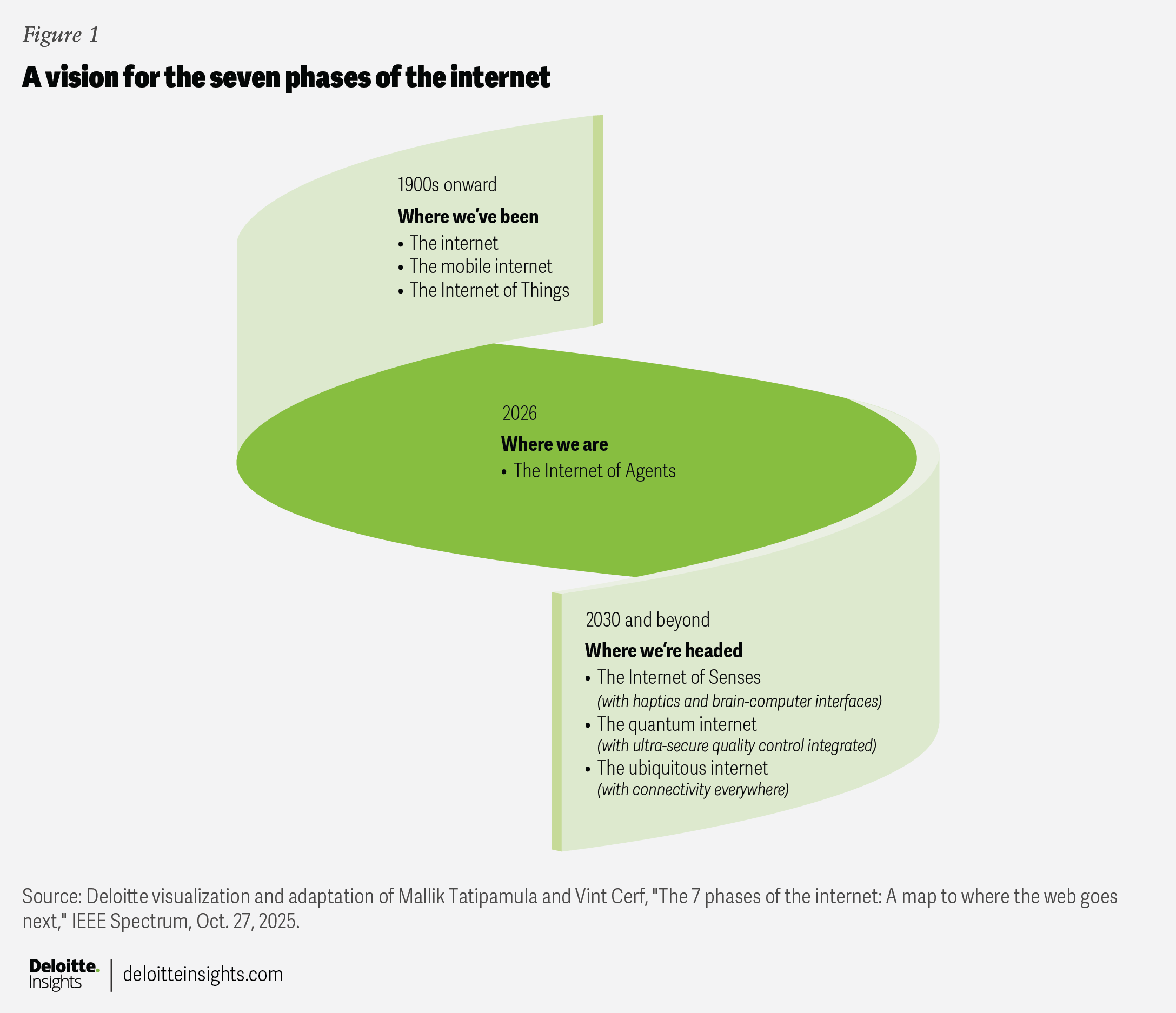
We’re at a transition point—from an internet we navigate to an internet that acts on our behalf—and what comes next may expand beyond screens into the physical and sensory world. This shift is more than a change in how users interact. It changes how systems will likely need to be designed, connected, and governed. These decisions raise a set of architectural questions for organizations to consider.
- Which approach is right for your organization: centralized hyperscale platforms or distributed resilience models?
- What are the primary and secondary interfaces to optimize for business-to-business and business-to-consumer strategies?
- Where do you anchor data? How do you best network and secure it across the evolving information ecosystem?
- How do you reimagine business processes for human-centric navigation and agent interoperability?
- What legacy encryption, security, controls, and governance standards or assumptions might be impacted?
- Where might you have platform dependence or ecosystem optionality?
The decisions that enterprises, consumers, and technology providers make today on where to invest, what to adopt, and how to transform are likely to shape the next decade of infrastructure.
Rethink the tech stack before it locks you in
The question for organizations is no longer whether disruption is coming. It’s how the market is changing, and what that means for how systems are built.
What’s clear is that the underlying shifts aren’t happening in isolation. They operate across every layer of the tech stack: computing, coordination across agents and data, interaction across interfaces and both visible and invisible networks, and trust.
The protocol choices, interface bets, data anchoring, and trust architecture decisions that technology leaders make today will reshape the tech stack from the ground up. Those decisions will determine what the organization is able to do next.
Right now, that future is coming together piecemeal—one application, one modernization effort, one architecture decision at a time. But the system is changing simultaneously in every layer at the same time.
The challenge for organizations, then, isn’t just to modernize, but to design systems they won’t have to undo.
Continue the conversation
Meet the industry leaders
Faruk Muratovic
Principal | US AI and engineering strategy and services leader | Deloitte Consulting LLP
Deloitte United States
Chris Thomas
Principal, Hybrid cloud infrastructure offering leader | Deloitte Consulting LLP
Deloitte United States
Gopal Srinivasan
Principal | Global AI and data lead | Deloitte Consulting LLP
Deloitte United States
Diana Kearns-Manolatos
Senior manager, Subject matter specialist | Deloitte Services LP
Deloitte United States
Oniel Cross
Principal | Government and public sector hybrid cloud infrastructure offering leader | Deloitte Consulting LLP
Deloitte United States
by
Faruk Muratovic
Deloitte United States
Chris Thomas
Deloitte United States
Gopal Srinivasan
Deloitte United States
Diana Kearns-Manolatos
Deloitte United States
Oniel Cross
Deloitte United States
Iram Parveen
Deloitte India
We would like to thank the marketing and public relations team—Cindy Chang, Ireen Jose, Nassim Geraili, Nicole Bostock, Rachel Freya Rosenberg, Saurabh Rijhwani, and Tafline Laylin—for their guidance and leadership in extending the impact of these insights.
Editorial (including production and copyediting): Corrie Commisso, Shyamili M, Arpan Saha, and Pubali Dey
Design: Natalie Pfaff, Harry Wedel, and Sonya Vasilieff
Audience development: Pooja Boopathy
Cover image by: Jim Slatton, Sonya Vasilieff
Knowledge services: Rishitha Bichapogu
Visit the Deloitte Center for Integrated Research
Access more insights on some of the most complex issues facing businesses today.