
Getting human and machine relationships right
To multiply human potential with AI, organizations can deliberately design human and machine interactions
Nearly 60% of workers now use artificial intelligence intentionally at work, according to a recent study by the Melbourne Business School, yet few organizations are intentionally designing for how humans and machines actually interact.1 Organizations routinely design human-to-human relationships, and increasingly machine-to-machine workflows as well. But many are still designing work for people and technology separately, rather than designing for both together.
This lack of intentionality is leaving many organizations struggling to realize value from AI. While some organizations are seeing results, most aren’t realizing a return on their investments at the speed they need.2 Organizations can’t count on cohesive human-AI interactions to happen organically, considering that only 14% of leaders responding to our 2026 Global Human Capital Trends survey say they are adept at shaping those interactions.
The problem, according to recent Deloitte research, is that most organizations (59%) are taking a tech-focused approach to AI.3 They layer AI onto legacy systems and processes, rather than reimagining how humans and AI interact, collaborate, and make decisions. This is similar to the way historic cities are often forced to add new infrastructure onto old foundations rather than redesigning for flow and connection from the ground up.
But in a world where access to AI is rapidly democratizing, technology alone no longer sets organizations apart—people do. It’s how people interact with AI through intentional design that can make the difference.
Deloitte research shows that organizations are twice as likely to exceed their return on investment expectations for AI when they prioritize work design, thoughtfully redesigning human and machine interactions and roles.4 Consider the results when one European telecommunications company added an AI “expert” to customer service without changing roles or workflow and saw a small 5% productivity lift. But dedicating 90% of the full rollout budget to redesigning human-AI interactions—new workflows, trust thresholds, escalation paths, and robust training—unlocked a 30% productivity increase, as agents learned to partner with AI.5
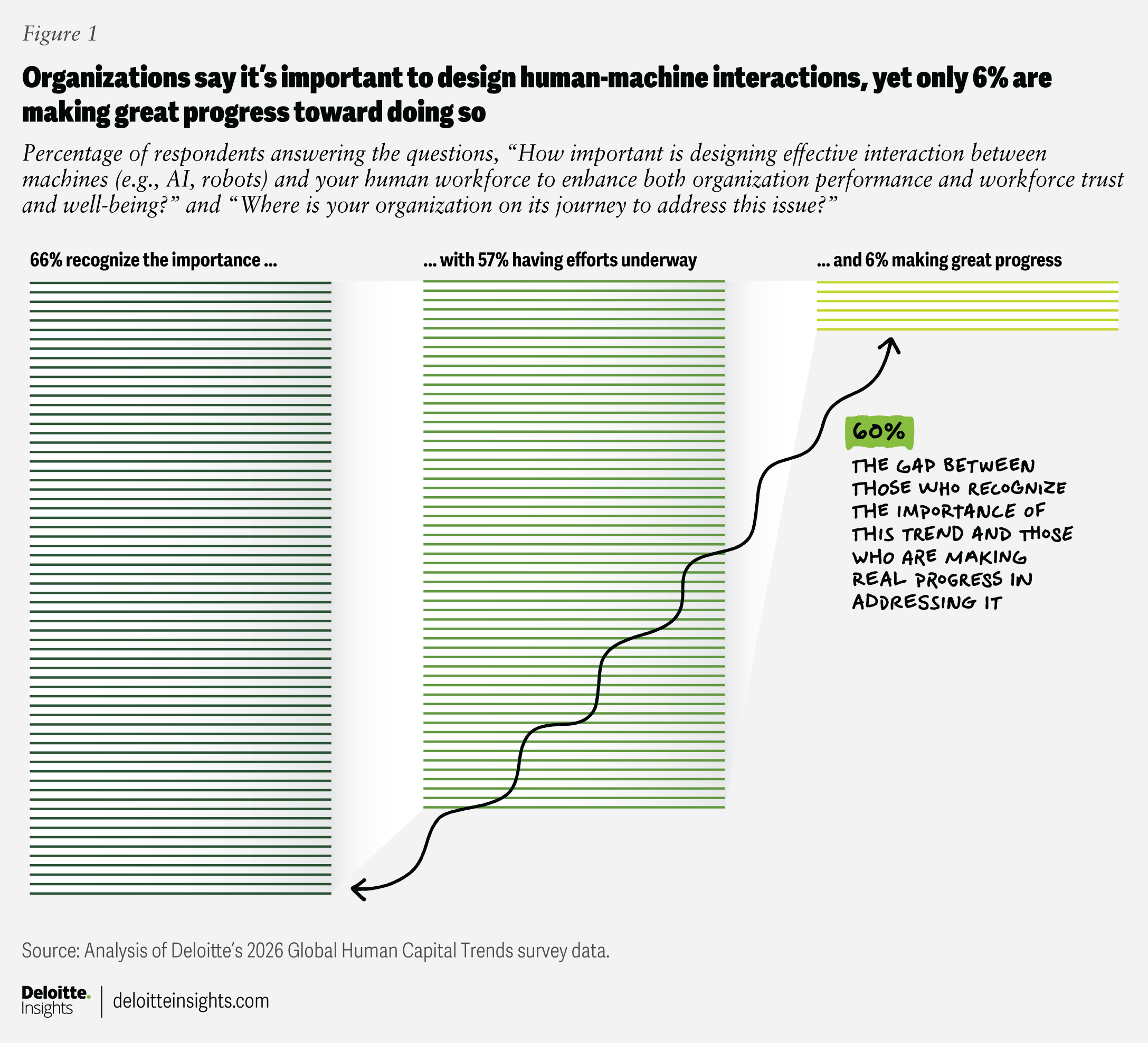
Leaders increasingly recognize what’s at stake: Sixty-six percent acknowledge that the intentional design of human-AI interaction is important to organizational success. Yet only 6% say they’re leading in this area (figure 1). Our analysis shows that organizations leading the way on intentional design of human-AI interaction are nearly 2.5 times more likely to report better financial results and twice as likely to say they provide meaningful work.
The scaffolding for intentional interaction design
Effective human and machine interaction isn’t intuitive; it won’t happen by accident or default. Organizations should intentionally design human-AI interactions at both the organizationwide macro level (including design principles, governance, and strategy) and the more granular micro level (specific interactions for particular work, workers, and teams).
For design to succeed at both levels, it needs to consider both hardwiring and softwiring. Hardwiring includes formal elements like redesigned roles, accountability, decision rights, and clear escalation protocols that dictate when work shifts from AI to a human. Softwiring includes informal elements such as leadership behaviors, culture, and psychological safety that give people the trust and confidence to question, escalate, experiment, and learn with AI.
Design at the macro level
Organizations need a clear view of the macro dimensions of work design along with the hardwiring and softwiring choices that shape how humans and AI actually collaborate (figure 2).
Starting with a clear strategic ambition of the desired human and business outcomes is foundational. For example, Michael Ehret, senior vice president and chief people officer at Walmart International, highlights how the company brings the outcome-driven and human-centered design principles to life through its AI strategy. He explains, “We design the way our people work with AI so that it provides an outcome. Too many organizations treat AI as an adoption problem without first asking how you can achieve the outcomes desired. What’s really required is behavioral change—not technical training.”6 While 56% of surveyed leaders say they are designing primarily for business outcomes such as cost or speed, a growing number of leaders (40%) are designing for both business and human outcomes (such as well-being).
Figure 2
Macro dimensions of work design
${optionalText}

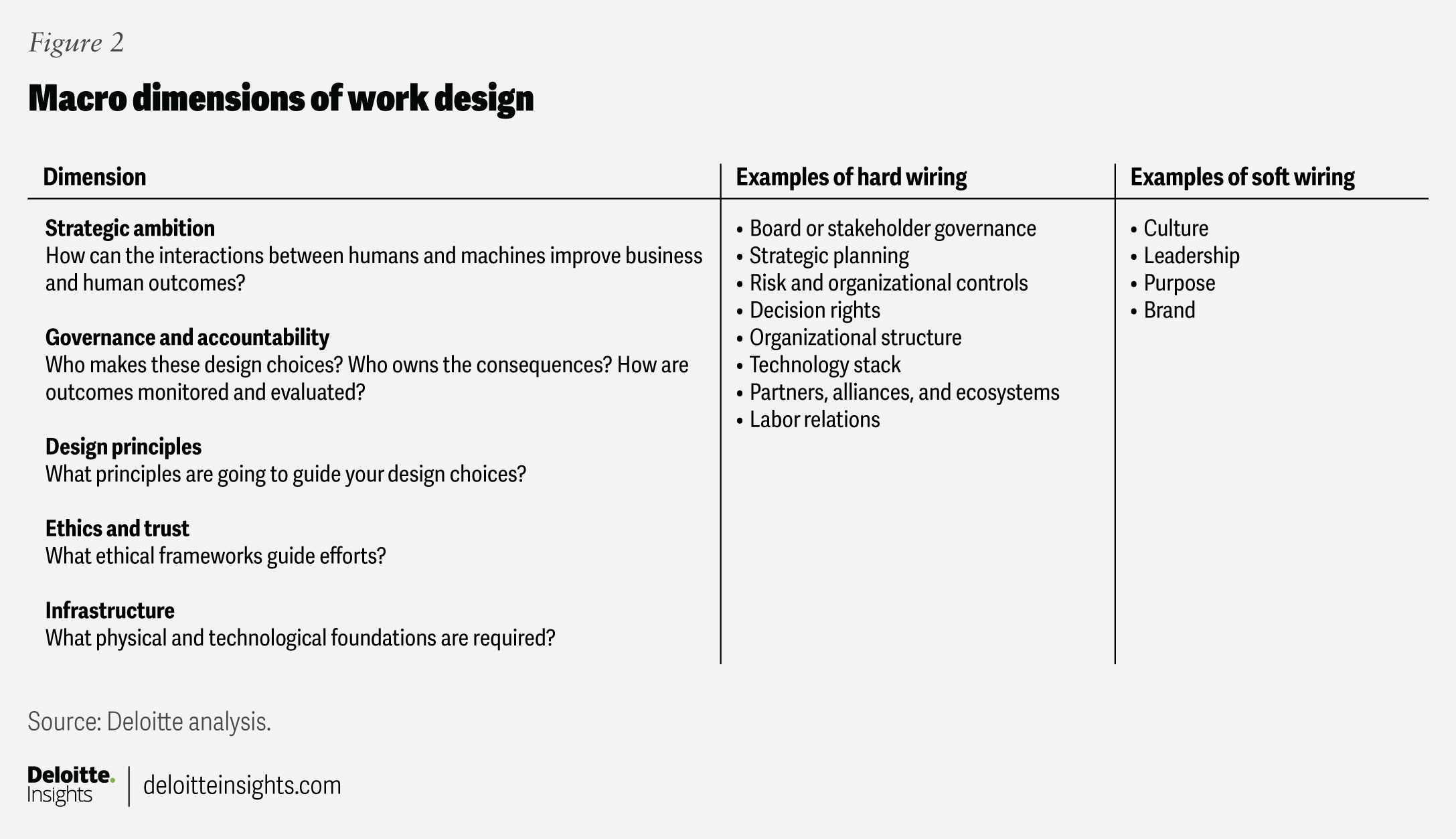
Another key macro dimension is governance and accountability. As the dimensions of human-AI collaboration expand—spanning technology, people, process, risk, and culture—the C-suite should increasingly operate as a symphony. Business, information technology, human resource, finance, operations, risk, and legal each play their part, all following the same score.
To move beyond traditional silos, some organizations are adopting cross-functional governance models. For example, Moderna has merged IT and HR to unify technology and people strategy;7 Skillsoft’s AI council enables cross-functional oversight;8 and Disney’s chief AI and collaboration officer focuses on enabling better collaboration across the business.9
Once the organization establishes governance, leaders can set overall design principles to guide teams in creating optimal human and machine interactions. These principles should be anchored in the enterprise’s values and mission, so they might vary by organization. Some design principles to begin with include:
- Outcome-driven: Define the human and business outcomes to amplify, focusing on results that transcend what humans or AI could achieve alone.
- Contextual: Tailor solutions to each workflow, team, risk profile, and human-AI relationship.
- Transparent: Make roles, decision rights, trust thresholds, and accountability explicit, so everyone understands how human and AI contributions combine to drive superior outcomes.
- Adaptive: Design human-AI systems for continuous learning, feedback, and evolution, ensuring they sustain outcomes and adapt as needs change.
- Human-centered: Elevate human agency, creativity, judgment, empathy, and leadership. AI should amplify and never diminish what makes us uniquely human.
- Empowering: Design AI systems and culture so workers are confident to challenge, escalate, experiment, and learn from both success and failure.
Save the Children demonstrates how choices around trust can accelerate adoption and impact. The organization’s early gen AI pilots delivered fragmented adoption. To address this, the organization worked on building a culture of curiosity, learning, and collaboration through a variety of mechanisms, including training, leadership engagement, and an ambassador network. The organization also established clear guardrails on when and how to use gen AI. This approach quickly doubled weekly usage (from 36% to 71%), and as fluency and adoption increased, the organization was able to apply AI to more value-creating use cases (quadrupling complex task application from 10% to 45%). Guardrail awareness increased from 42% to 70% and collaborative learning from 36% to 60%. Having strengthened its capabilities and culture, the organization is now positioned to redesign work and roles for greater impact.10
Design at the micro level
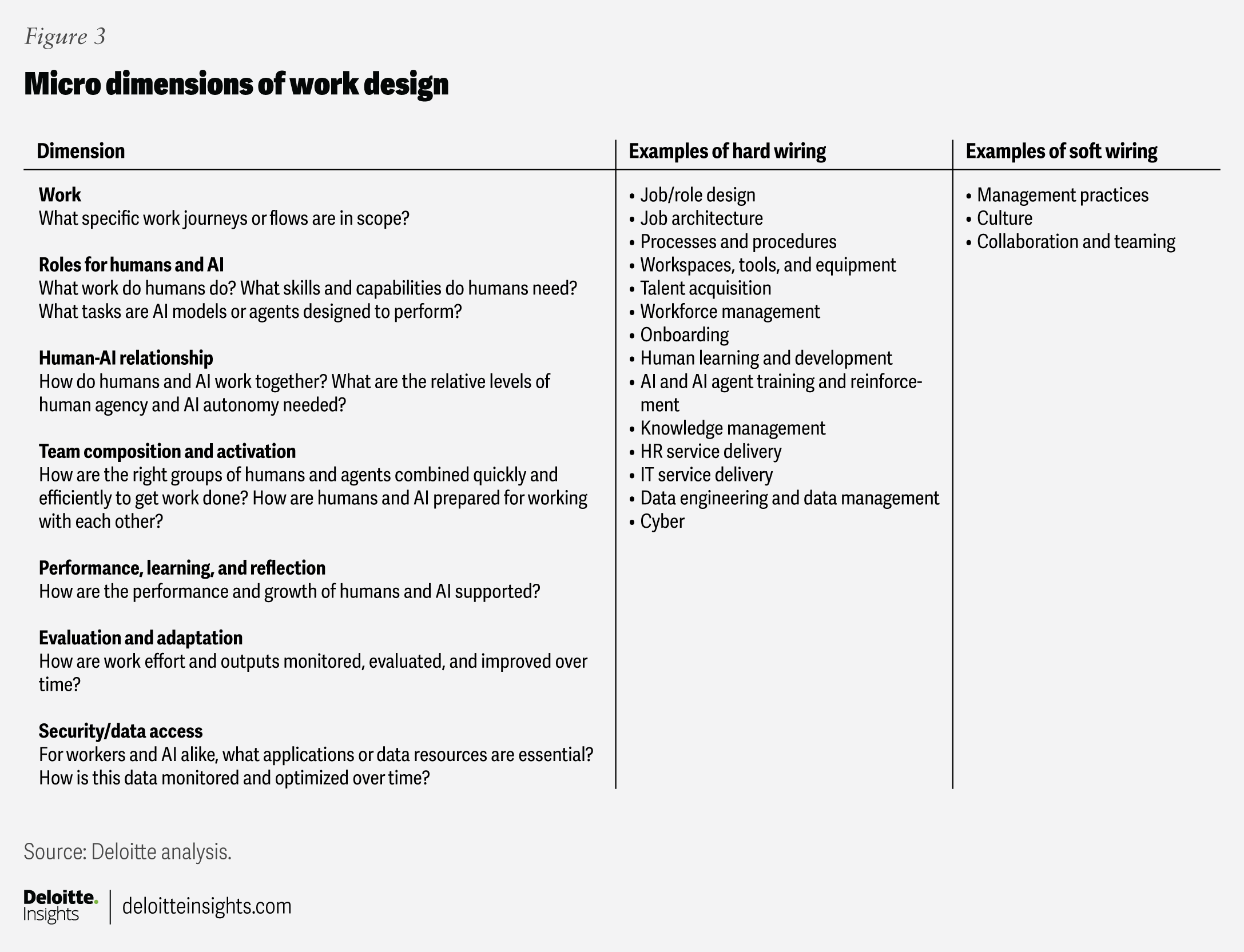
Beyond establishing the foundations at the organizational level, leaders need to consider how to design human and machine interactions that are optimal for each team and type of worker. The micro dimensions of work design will vary based on the work, the relative roles for humans and AI, the team composition, and more (figure 3).
Figure 3
Micro dimensions of work design
${optionalText}
Consider, for example, how 7-Eleven redesigned roles for humans and AI. When rapid AI automation threatened to make the company’s specialized recruiter role obsolete, it used the rollout of “Rita”—an AI assistant automating 95% of routine hiring tasks and freeing 40,000 hours weekly—to redesign the role rather than replace it. Recruiters shifted from transactional tasks to a strategic focus on enabling store leaders, partnering more closely with stores to improve hiring quality and strengthen onboarding. With redesigned roles, streamlined workflows, and strong leadership support, recruiters elevated talent fit and reduced turnover, showing how intentional redesign can transform the risk of displacement into greater organizational value.11
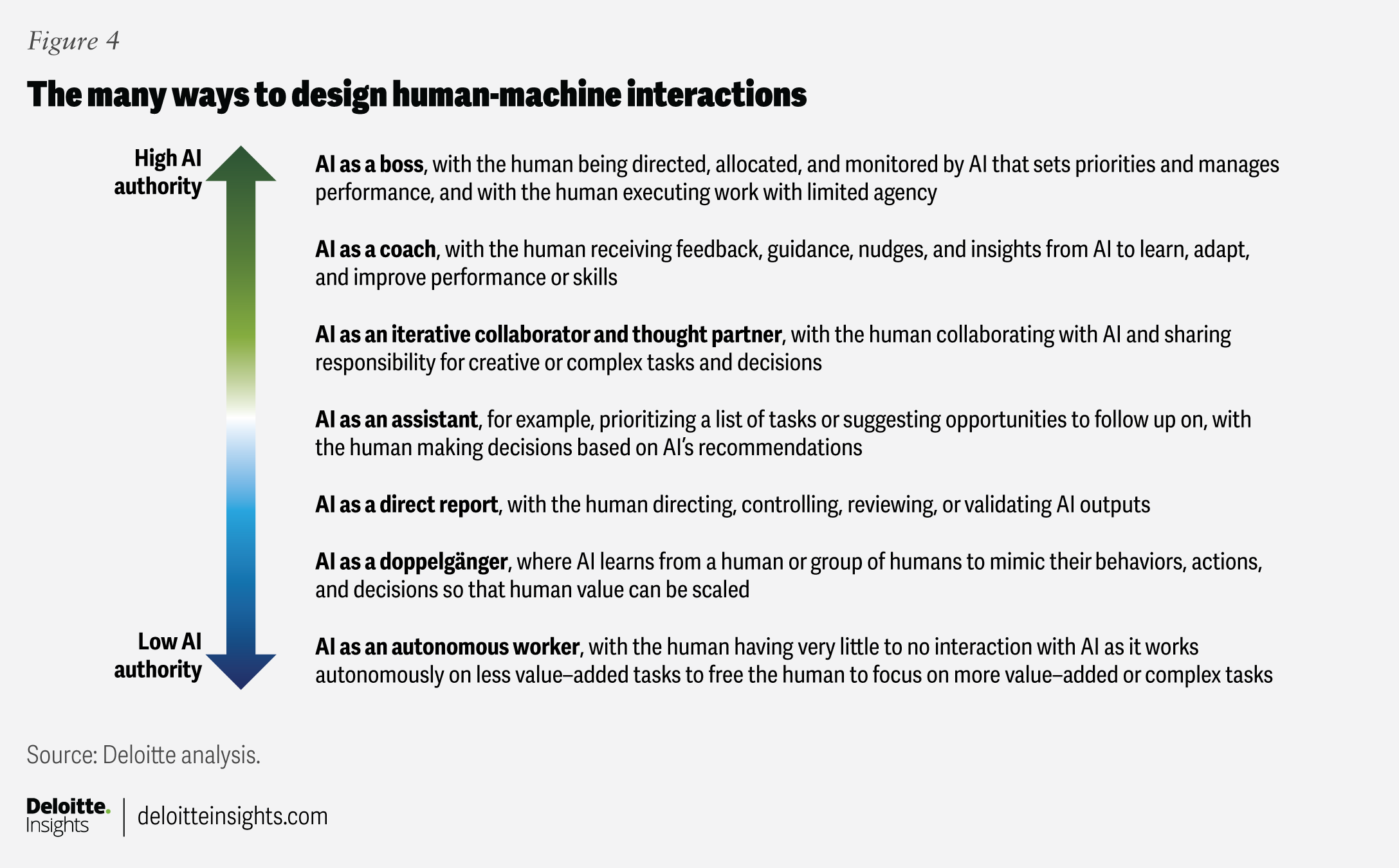
A critical yet often overlooked dimension is choosing the right human and machine interaction type. Workers can interact with AI in a variety of different ways. There are many types of daily interactions workers can have with AI—ranging from people working with AI to supervise AI’s work, to the reverse when AI acts as the boss and directs someone’s work, to people working with AI in open-ended, highly iterative, and interactive ways where AI plays the part of a muse, thought partner, mentor, or performance coach (figure 4).12 To optimize the relationship between people and AI, organizations should explicitly define the types of interactions they want workers to have with AI and support them in achieving healthy, productive relationships with it.
MetLife, for example, chose AI as a coach for its call center workers, using AI-powered real-time coaching tools to help staff navigate emotionally charged calls with greater empathy and effectiveness. This approach has improved both experience and outcomes—boosting customer satisfaction by 13%, reducing call times, and lowering associate stress. The company’s latest innovation, Thrive Resets, uses AI to monitor associate stress and proactively prompt personalized recovery breaks after difficult calls. By pairing human empathy with AI insight and relentlessly evolving these interactions, MetLife is setting up a new standard for care, resilience, and performance.13
How can organizations choose the right interaction type? In addition to selecting the relationship that suits the type of work and their desired business and human outcomes, organizations need to select and tailor interaction types to the workers themselves. Preferences vary: For example, creative professionals may resist what they perceive as AI micromanagement, while other groups may prefer more direct oversight or guidance from AI. Involving workers in the selection process and providing clarity on how to interact with AI are important for adoption and engagement. As Marcia Oglan, senior vice president of enterprise HR at Highmark Health, notes, “For change with new technologies like AI to succeed, employee engagement must be ongoing and multilayered—not just a single communication. Employees need repeated, clear guidance on how to work with AI.”14
Each interaction type calls for distinct approaches to hardwiring and softwiring. For example, an AI “direct report” requires strict protocols and training, while an “iterative collaborator” relies more on trust, open communication, and adaptability. An AI “coach” benefits from structured feedback and a culture of continuous learning, while AI in a “boss” role demands clear escalation paths and ethical guardrails.
One multinational consumer products company puts this tailored approach into practice. Business leaders collaborate with the teams from digital and technology services, HR, legal, and insights to match each interaction type to the work and the needs of specific workers. As the vice president of global talent strategy and succession, explains, “As we deconstruct work, we’re asking: What can we trust AI to fully handle, and where do we draw the line to hand over from agent to human? Sometimes it’s a combination—AI does the work and a human checks it, or vice versa. Ultimately, we ask: which interaction type is most useful for which workers?”15
Organizations should be aware of the hidden consequences that can emerge with each interaction type. For example, shifting routine tasks to AI when using AI as a direct report often leaves humans with more complex, demanding work, requiring greater problem-solving skills and new forms of recognition. Increased reliance on AI can also lead to worker isolation as intelligent technology replaces peer collaboration. Organizations should work to anticipate and address these silent impacts from the outset to ensure healthy, effective relationships between people and AI.
Multiplying potential by design
Intentionally designing human and machine relationships does more than create efficiency; it opens new frontiers for value creation, human flourishing, and organizational resilience. The future may reward not the fastest adopters, but the most intentional designers: those who see AI as an invitation to multiply the people who make their organizations truly exceptional.
by
Nicole Scoble-Williams
Sue Cantrell
David Mallon
Stefano Besana
The authors would like to recognize the expertise of Nitin Mittal, Stuart Scotis, Dr. Elea Wurth, John Eikland, Steve Elliott, Joan Pere Salom, Franck Cheron, Robert Sanderson, Doug Schairer, and Aniket Bandekar, whose insights, perspectives, thoughtful analysis, and creative vision significantly enriched our exploration and sharpened the narrative.
A special note of thanks is reserved for Abha Kishore Kulkarni and Karen Vazquez Hernandez for their meticulous research and steadfast support, which were invaluable to completing this work.
Editorial: Corrie Commisso, Hannah Bachman, Pubali Dey, Cintia Cheong, Anu Augustine, and Stacy Wagner-Kinnear
Design: Molly Piersol, Alexis Werbeck, Govindh Raj, Guido Agüero Gonzalez, and Sylvia Chang
Audience development: Atira Anderson and Maria Martin Cirujano
Knowledge Services: Rishitha Bichapogu