
Dealing with AI’s cultural debt
AI may be creating an unnoticed, steady accumulation of negative cultural behaviors. How do we manage it so culture can be an advantage in the age of AI?
In moments of uncertainty when cultural coherence may matter most, organizations often struggle to maintain it. Behaviors and norms may begin to diverge from an organization’s stated values; faced with more urgent matters, organizations may fail to address unresolved issues like poor communication or lack of psychological safety. This neglect can cause organizations to develop “cultural debt”—the negative consequences an organization accumulates by neglecting its culture, similar to how financial debt accrues interest.
Such is the case as we begin 2026. Amid rising tensions in the worker-organization relationship, artificial intelligence is adding even more complexity as it transforms work in profound ways. However, much of the organizational focus of this disruption seems to center on how workers interact with AI rather than how AI impacts the human-to-human work interactions that shape organizational culture. In fact, 42% of workers in Deloitte’s 2026 Global Human Capital Trends survey report that their organization rarely evaluates the impact of AI on people—an indicator of mounting cultural debt.
Culture is built on a foundation of trust, and AI is breaking that trust in many ways, as reflected by the statistic from our 2026 survey that 80% of leaders, managers, and workers are concerned their co-workers and teams are using AI to appear more productive than they are. As a result, workers are often quietly adopting or challenging norms, values, and behaviors in light of fundamental new questions that organizations are not addressing, like: Is it cheating if I use AI to do my work? What is hard work if AI is now doing the heavy lifting? Who is to blame if AI is wrong? If I don’t use AI, will I lose my job—or will AI take my job anyway?
When organizations don’t answer these kinds of questions, workers are left to navigate new ethical and value-based decisions in ways that can accumulate cultural debt.
While even the strongest cultures will likely need to be reinforced to weather the influence of AI, AI’s infusion into work can further degrade weak cultures, quietly eroding organizations from within. But organizations that intentionally nurture and evolve their cultures can unlock AI’s potential and create sustainable competitive advantage.
The cultural costs of AI in the workplace
As we discussed in our 2025 Global Human Capital Trends report, AI is reshaping work in ways that affect people daily—increased workloads and stress, reduced well-being, higher levels of loneliness, and decreased autonomy. More broadly, AI is posing big-picture questions about employment. While many experts say that AI is more likely to transform jobs than to fully replace them, a report in Forbes indicates that, on Wall Street alone, industry analysts forecast that AI and automation will eliminate up to 200,000 jobs by 2028 or 2030.1 The World Economic Forum reports that 41% of employers globally plan to reduce their workforce due to skills obsolescence by 2030.2 And as a growing number of organizations brand themselves as “AI first,” workers receive implicit messages about their perceived value. If AI is first, does that mean human workers are second?
These impacts are happening amid a broader power shift from workers back to organizations. The post-pandemic hiring surge has pivoted to an uncertain job market. Workers have moved from job hopping to job “hugging,” as data from the Federal Reserve Bank of St. Louis shows fewer US workers voluntarily quitting their jobs3—a potential indication of declining confidence—while hiring has slowed substantially.4
This confluence of changing power dynamics and AI’s impact on workers’ jobs has pushed us to a tipping point. Culture is now showing strain: A 2025 Gallup poll found that only 20% of US workers feel strongly connected to their company’s culture.5 And trust appears to be eroding in both directions. Edelman’s Trust Barometer found that trust in employers declined in 2025 for the first time since 2018.6 Leaders, likewise, are losing trust in their workers, according to survey respondents.
The good news is that organizations are taking note of the problem. Our survey this year indicates that 34% of organizations recognize culture as a direct inhibitor to their AI transformation goals, and 65% of respondents believe their culture needs to change significantly considering the impacts of AI.
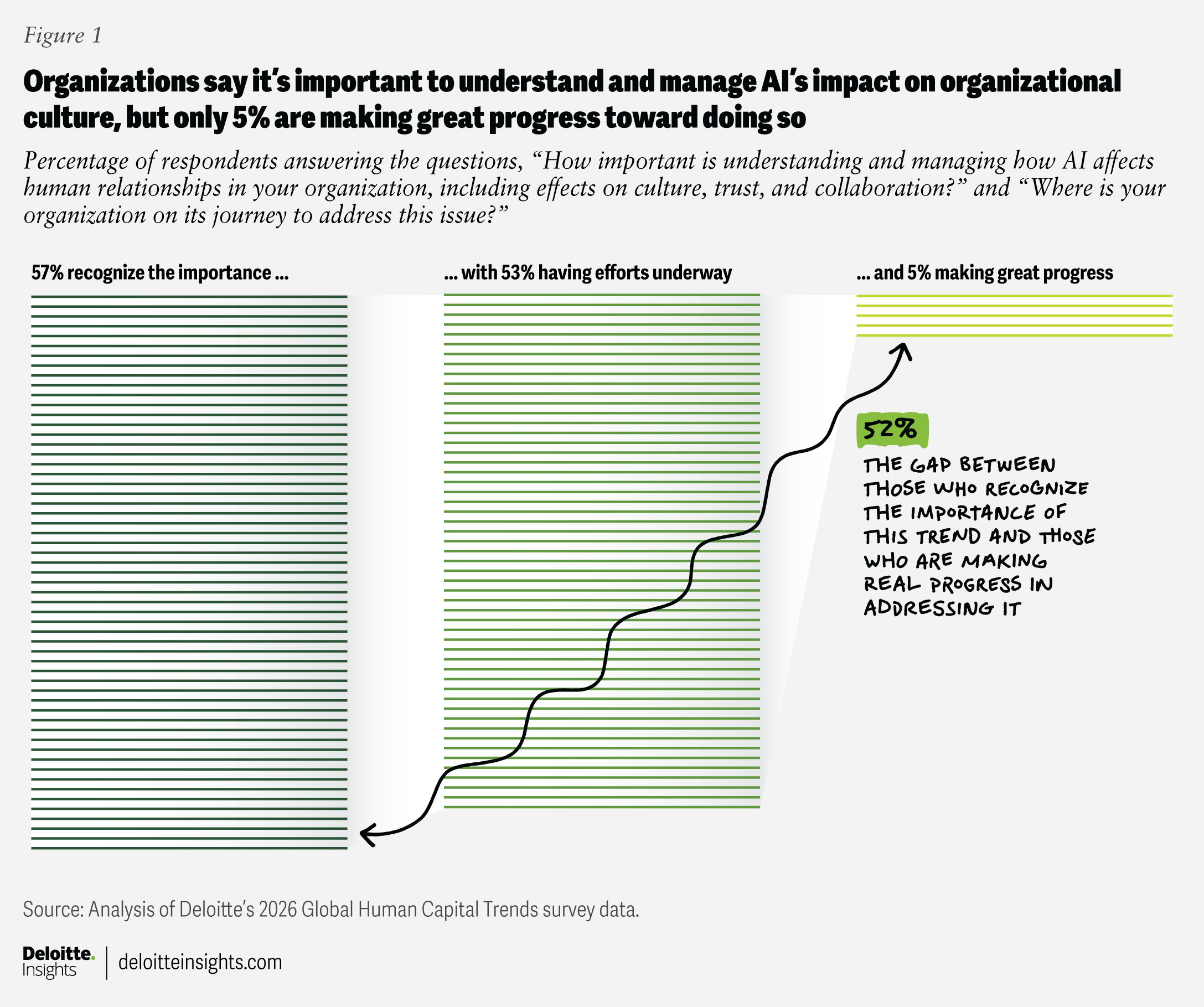
So why do some organizations seem to be struggling to address the potential impact of AI on culture, connections, and trust? Our 2026 survey found that while just over half of respondents felt the impact of AI on culture was important or very important, only 5% are making great progress.
From cultural debt to culture as an asset
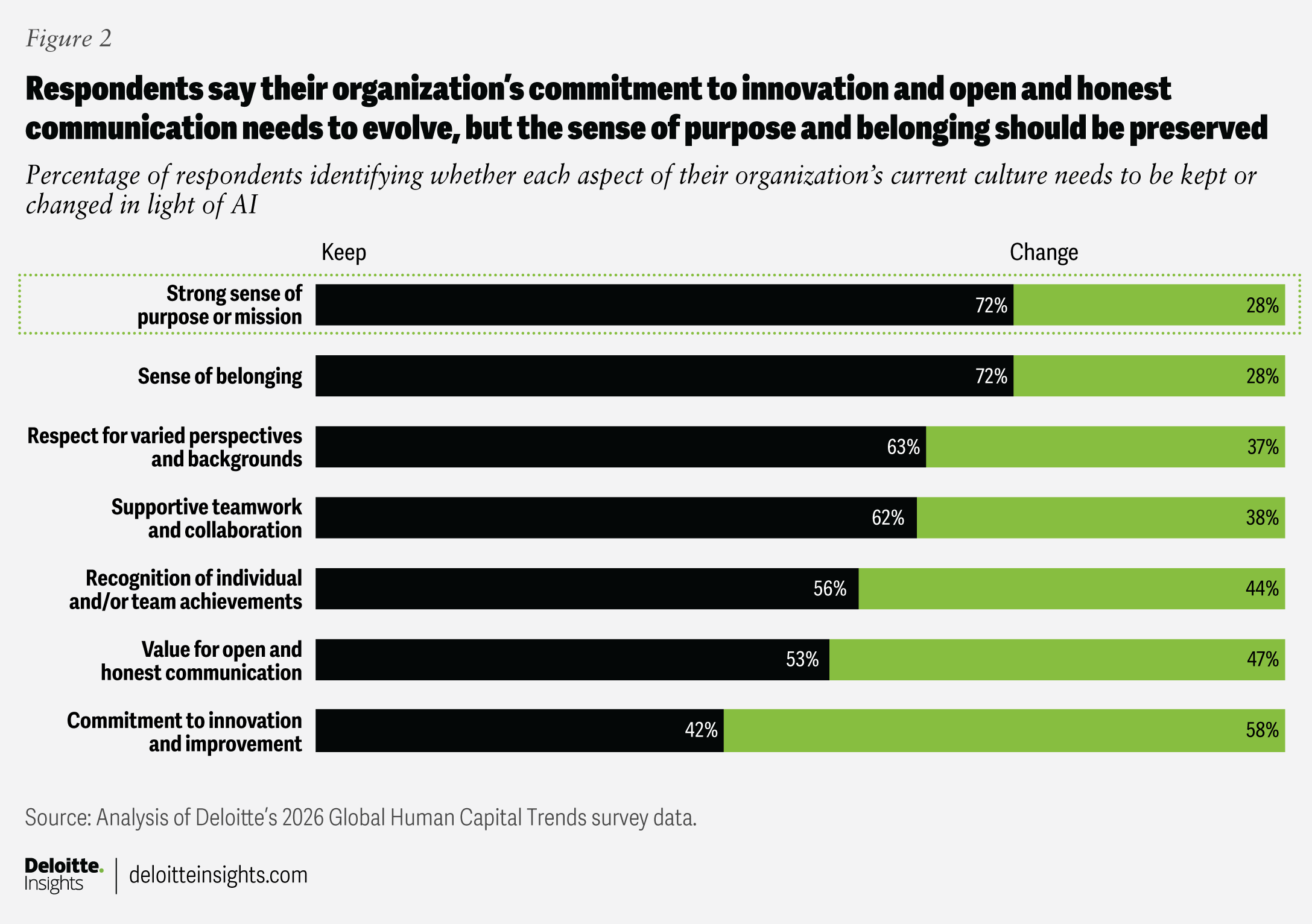
Leaders should take stock of their existing culture and map that against where they believe culture could become a true competitive asset. How culture needs to shift is a case of “best fit” over “best practice” and may vary. Our research this year showed many organizations recognize they need to sustain their sense of purpose, mission, and belonging within their existing culture while looking to improve recognition, open communication, and commitment to innovation (figure 2).
With an understanding of current cultural strengths and weaknesses and clarity on a desired future state, organizations can begin the important work of shaping their culture to help them thrive in the age of AI. To do so, organizations need to set a strong foundation for cultural evolution, build trust by activating the change in the flow of work, and recognize that AI itself can be a helpful tool for the journey ahead.
Set the foundation
With a clear idea of the current state and desired future culture, organizations can put several foundational items in place. The basics still hold true: leadership alignment, anchoring on purpose and values, and communication. But understanding how we do those things is changing in the context of AI.
While leaders alone cannot drive culture change, they play a pivotal role in creating the environment for desired changes to take hold and be sustained. “Leadership and culture are inextricably linked,” says Zach Parris, former director of organizational effectiveness at Atlassian. “The attitude and example set by those at the top have a significant impact on individual behavior throughout the organization. There’s a powerful connection between leadership’s comfort with technology and the tone it sets for company culture, adoption, and how deeply new tools are integrated.”7 Indeed, Cisco research found that employees are twice as likely to use AI if their leaders do.8
Mission, purpose, and values are also important. In fact, a strong sense of purpose and belonging is ranked by respondents to this year’s survey as the most important element of culture they are looking to sustain.
Walmart describes its AI transformation as people-led and tech-powered—positioning AI as a tool to amplify human potential, rather than supplanting it. “Change is constant, and there’s no time to craft a case for each new shift. The best thing an organization can do is stay clear and connected to its purpose and values, reinforcing why the work matters during challenging transitions,” says Michael Ehret, senior vice president and chief people officer at Walmart International. “Those that use technology and AI to advance their mission and values will be better positioned to adapt over time.”9
Embedding the ethical use of AI into culture is also important. Leading organizations are establishing groups to review AI projects for fairness, bias, and transparency, and encouraging workers to voice concerns about automation, data privacy, and algorithmic decision-making. For example, IBM created an AI ethics board, composed of people with diverse life experiences and professional backgrounds, to oversee AI exploration.10
Finally, open and transparent communication remains more important than ever. When asked to name the most important actions to drive organizational culture, the top two responses in our survey were creating an open dialogue between workers and leaders and providing clear and regular updates on how AI is affecting work and jobs.
One example of prioritizing this kind of communication comes from Highmark Health. As they redesign work to integrate AI, they are building a culture of agility, accountability, and innovative care via ongoing communication between leaders and the workforce. As senior vice president of enterprise human resource at Highmark Health, Marcia Oglan says, “Tech won’t solve trust issues. Only visible, consistent leadership and accountability can do that.” She added, “The angst around AI and job security is real, so the deeper conversation is about reskilling and supporting people as roles evolve. If HR is the glue between technology and people, our real work is helping everyone see their place in our changing organization.”11
Build trust and human connection in the flow of work
Leadership messages and formal programs play a role, but culture is primarily shaped by the countless daily interactions and experiences across the organization. AI is evoking many unexpected behaviors when it comes to human-to-human connections. For example, cultural debt may accumulate when people work less with one another due to working more with AI. Intentionally building in human connection and trust in the flow of work is an important step toward paying down cultural debt.
Organizations can foster these conditions by designing interventions and rituals that encourage connection and trust as AI is adopted. They can actively redesign work to embed AI with a focus on both human-to-human and human-to-machine interactions. Forward-thinking companies often frame AI as a collaborative partner, even redesigning job descriptions to emphasize uniquely human skills like creativity, empathy, and complex problem-solving alongside technical agility.
Leading organizations may also evaluate how machines affect values, behaviors, and relationships, and foster open dialogue about the role of machines, including their limitations and their impact on workers. At Trek Bicycle, a technology team interviewed workers at all levels in every department to understand how AI could improve the work environment. The team ultimately identified nearly 40 concrete AI use cases that prioritize current employees’ well-being.12
Talent practices and ways of working should also evolve to support better human connections when introducing AI. Technology company Cisco believes dynamic teaming and collaboration are critical to its future success. The company has built these attributes directly into its performance management approach, supporting them with an internal tool called Team Space. The tool enables real-time communication and continuous assessment, making it easier for teams to stay focused on collective goals.13
Aligning goals and behaviors with how people are rewarded and recognized is another important lever. Consider Singapore-based DBS Bank. It reimagined its culture to encourage employees to disrupt its own roles, experiment, and drive automation and digitization. Employees earn recognition and reward points for contributing to transformation initiatives or participating in digital experimentation teams and hackathons. The company also instituted transformation days, carved digital skill-building time out of regular schedules, and embedded digital transformation metrics into performance evaluations and compensation systems14—initiatives that have contributed to record profits and the distribution of companywide bonuses.15
Use AI to promote healthy cultures
While AI is creating some cultural challenges, it can also be a key tool to amplify traditional practices that create healthy cultures. Using AI tools in this capacity directly reinforces culture through targeted analytics and actions. It also aligns with organizational messaging on being human-centered as a key to AI transformation. There are several ways organizations are using AI in specific practices to improve culture.
Leading organizations recognize that shaping workforce culture should start from the very beginning of the hire-to-retire cycle and are using AI to help.
For example, Atlassian uses AI agents to improve onboarding, delivering targeted training and upskilling to new members of distributed teams with a focus on transparency and safeguards to build trust. As Zach Parris explains, “Onboarding is a moment where you get a real opportunity to rewire behaviors. We approach it as the front door for new hires, integrating AI-driven practices grounded in organizational psychology experiments. This isn’t just about process—it’s about shaping how people connect with tools, teams, and leadership from day one.”16 As a result, Atlassian has seen a jump from 57% to 93% in average weekly AI usage among new hires.
Organizations can also use AI to coach workers—if such coaching is complementary to, not a replacement for, personalized coaching. To enable effective AI coaching, a member of the renowned Van der Schaar AI and Machine Learning Lab at the University of Cambridge developed ScultureAI, a tool that guides workers toward their organization’s core values by coaching their everyday digital interactions. Organizations train the tool on their values, then throughout the day it suggests culture-reinforcing tweaks to chats on Teams or Slack as well as workers’ emails.17 Other organizations are implementing tools like CultureAmp’s AI Coach to help leaders and managers run real-time employee sensing, analyze sentiment, and build targeted action plans to enable change.18
AI cultural intelligence tools can also mine information from peer-to-peer recognition programs to identify key skills, star performers, and culture-enablers in real time. Employee recognition provider Workhuman now offers human intelligence functionality to help HR teams submit prompts and questions through the platform to understand organizational culture drivers and develop targeted actions. The tool also provides real-time data to help enable peer-to-peer recognition for employees who live the company’s values.19
Turning debt into differentiation
AI is transforming how organizations operate across industries, reshaping human experience at work, as broader dynamics are shifting the worker-organization relationship. In this environment, clinging to the cultural status quo is not a neutral choice—the cultural debt AI creates is real, and it’s a risk. Acceptance of an outdated or misaligned culture may erode trust and sacrifice competitiveness.
The alternative is to treat culture as a strategic asset that boosts productivity, drives innovation, and anchors workers navigating disruption. Looking ahead, the adaptivity most organizations strive for could come more through culture than process and structure. As culture becomes a competitive advantage, organizations that shape and deploy culture to harness AI’s potential are likely to drive better outcomes—for workers, for the organization, and for society at large. Those who do not may find themselves left behind, undone not by AI itself, but by a culture they failed to cultivate.
BY
Jason Flynn
Yves Van Durme
Stephen Harrington
Ashley Reichheld
The authors would like to recognize the expertise of Christina Brodzik, Stefano Besana, Julie Duda, Sue Cantrell, David Mallon, Corrie Commisso, and Victor Reyes, who contributed their insights and perspectives.
Dedicated recognition goes to Olivia Rueger, whose commitment and meticulous research supported the development of this work.
Editorial: Corrie Commisso, Hannah Bachman, Pubali Dey, Cintia Cheong, Anu Augustine, and Stacy Wagner-Kinnear
Design: Molly Piersol, Alexis Werbeck, Govindh Raj, Guido Agüero Gonzalez, and Sylvia Chang
Audience development: Atira Anderson and Maria Martin Cirujano