
Have organizational functions outlived their function?
The time has come to question the usefulness of traditional organizational pillars
A CEO is preparing for a major expansion of the company’s product line. Speed is critical: Staying ahead of the competition means getting the newly designed product into manufacturing as quickly as possible. But the CEO still needs to develop an integrated financial, workforce, and supply chain plan, which requires onboarding people from multiple corporate functions.
The challenge: Functional capacity is limited. Functional capability is mismatched, and end-to-end data and processes are lacking. Ultimately, the functions aren’t set up to orchestrate across the business at speed. Meanwhile, functional headcounts and leadership layers have expanded, adding cost without enabling business growth. The CEO has a nagging thought: Is there a better way?
This is just one scenario that points to the opportunity for organizations to rethink the very concept of corporate functions. Are they fit for purpose as they are currently configured? How can they work differently to help the business deliver on its strategic priorities with the speed, scale, and agility that today’s environment demands?
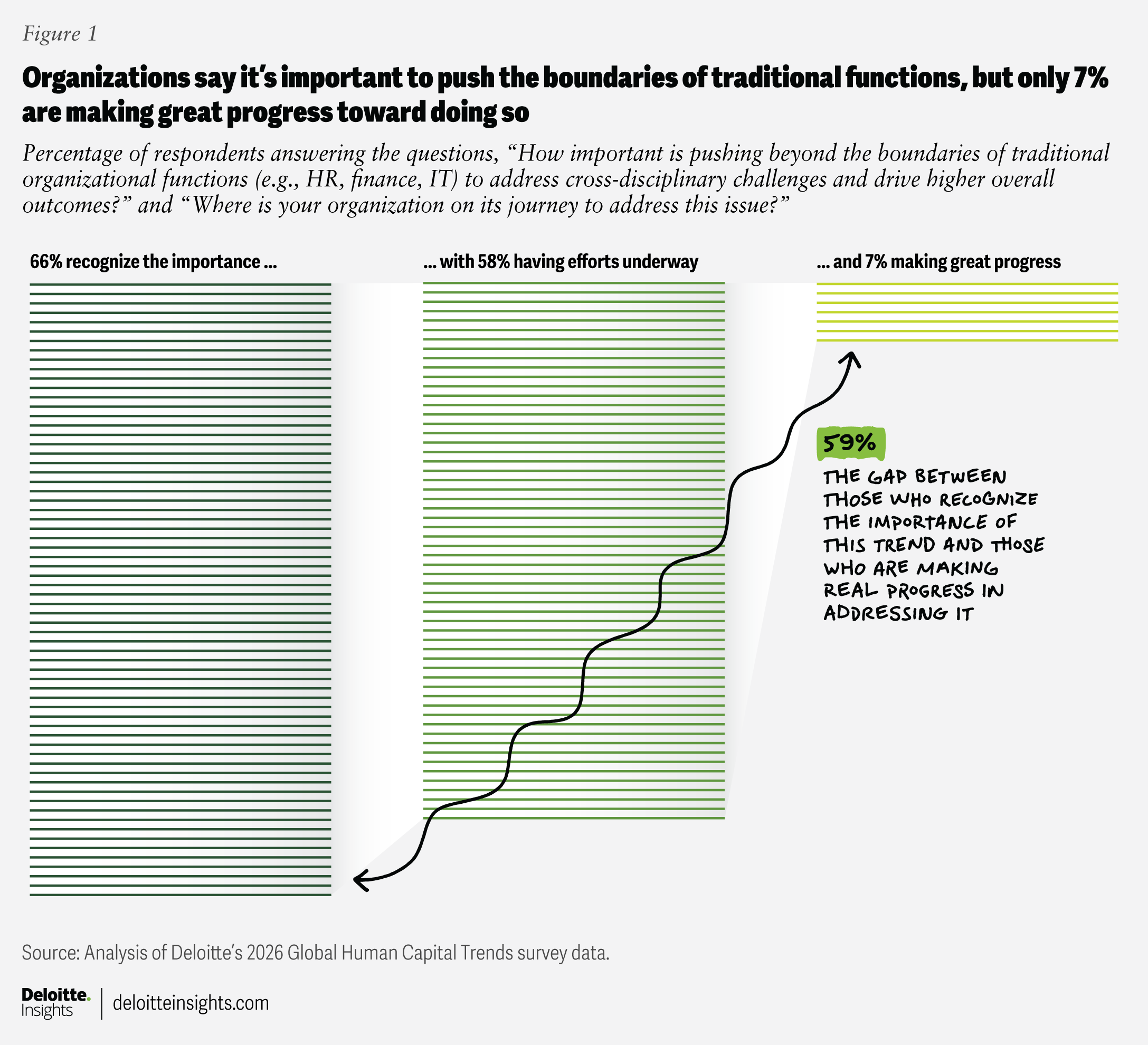
The functional pillars that have long been foundational at many organizations increasingly feel outdated. In Deloitte’s 2026 Global Human Capital Trends survey, 66% of C-suite leaders agree that it is very or extremely important for their organizations to push beyond the boundaries of traditional organizational functions, but only 7% are making great progress in doing so (figure 1).
Functions such as human resources, finance, information technology, legal, and procurement were originally designed for dependability, efficiency, and specialization. These days, traditional functions may be misaligned with the dynamic, multidisciplinary needs of modern organizations.
For example, organizations today need expertise from multiple functions to realize value from artificial intelligence by redesigning work and optimizing human and machine interactions. The ability to adapt and be resilient in the face of a turbulent business environment now requires collaboration across functions to fluidly orchestrate capability and capacity. Sustainability and environmental, social and governance programs; innovation and new product development; and transformation and change all now rely on functions that work together, not separately.
To meet this moment, organizations may need to rethink the very concept of functions. Rather than clinging to rigid silos, they have an opportunity to deconstruct traditional corporate functions and reassemble their capabilities around human and business outcomes.
Functions under pressure
A confluence of factors has contributed to the need for organizations to reimagine traditional functions. Organizations are under constant pressure to rein in the cost of corporate functions while also increasing speed to value. In the last three years, headcounts in areas such as HR, sales and support, and business management have shrunk considerably, and US public companies have cut white-collar workforces by 3.5%.1
Cost pressures and a push to increase operational efficiency have led many organizations to turn to global business services that provide shared and outsourced services in corporate functions. Over half of organizations using a global business services model include finance, HR, IT, and procurement in scope for shared services, and 58% expect to increase that footprint over the next three years. In Deloitte research, more than half of organizations with a global business service leader role reported savings of more than 20%.2
But with this focus on cost, functional leaders such as chief human resources officers, chief financial officers, and chief information officers are struggling to bridge the gap between the cost of services and the value they deliver.
As work increasingly gets automated, augmented with AI, or consolidated into global business services, what’s left are domain experts who have specialist expertise but sit outside the core value chain. Increasingly, they will be challenged to broaden their expertise around business problems (for example, mergers and acquisitions, transformation, etc.), collaborating and connecting with one another to bring a multidisciplinary perspective on core business problems to realize outcomes.
Our survey revealed that while over half of executives say that their corporate functions work together, more than half also say that those functions are in need of substantial reinvention in both capability and mission to meet rapidly changing demands in the future. Almost half of all respondents agreed that internal constraints, such as organizational structure, were the primary barrier to pushing beyond the boundaries of traditional organizational functions.
Meanwhile, AI is increasingly making it possible to reimagine the way functions deliver value and how they are defined. In addition, end-to-end processes and integrated data that transcend organizational boundaries are prompting leaders to rethink their functional structures.
Getting intentional about the future of functions
In many cases, organizations are responding to these factors by tweaking at the margins; for example, building more dotted-line reporting relationships between functions, or reactively standing up ad hoc teams.
But without a clear future strategy, these responses don’t necessarily create a long-term solution. What’s more, they can be counterproductive, creating an organizational model that introduces greater complexity and confusion—especially if they’re undertaken without a vision of why corporate functions exist and what value they need to deliver to the business.
The accelerating pace of change is creating urgency for a more agile and adaptive approach. How can organizations ensure that transformation efforts are more sustainable and scalable? To truly transform an organization, leaders should consider reimagining those functions by breaking them down and building them up in new ways.
Run the business versus grow the business
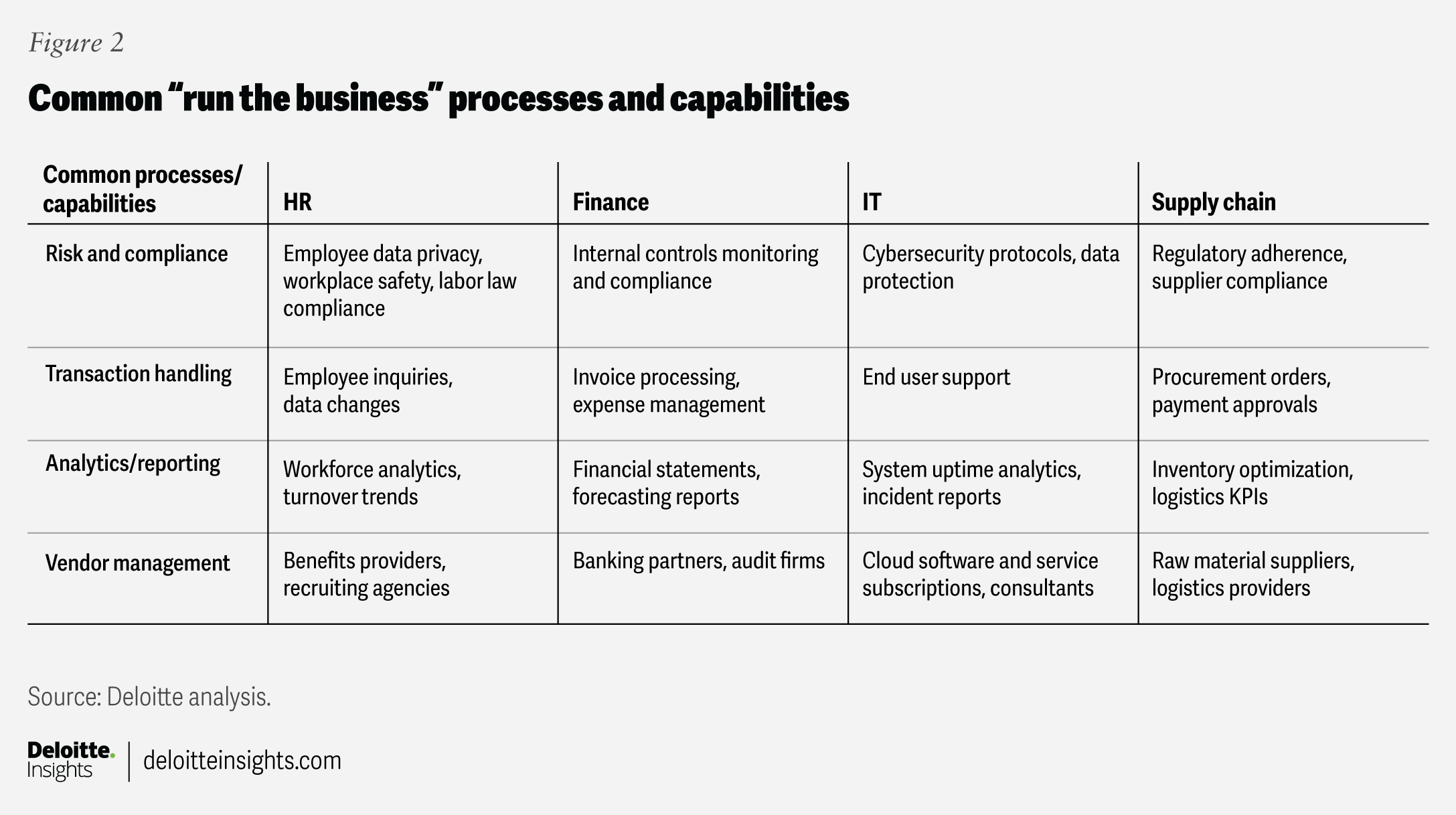
The first step in this process is to separate those elements that support running the business day to day from those that support growing the business. The tables below illustrate some of the adjacent processes and capabilities across functions in both of those categories.
While “run the business” activities may require unique domain knowledge, they also share many similarities. These include repeatable processes with the opportunity for substantial automation and enablement through technology and shared data (figure 2). For example, the handling of many routine workforce inquiries and transactions has been transformed by self-service technology and AI that can address the need for tier 1 support—whether that need arises from HR, IT, finance, or procurement. Increasingly, the data to satisfy those requests and the workflow technology supporting them are already integrated.
Figure 2
Common “run the business” processes and capabilities
${optionalText}

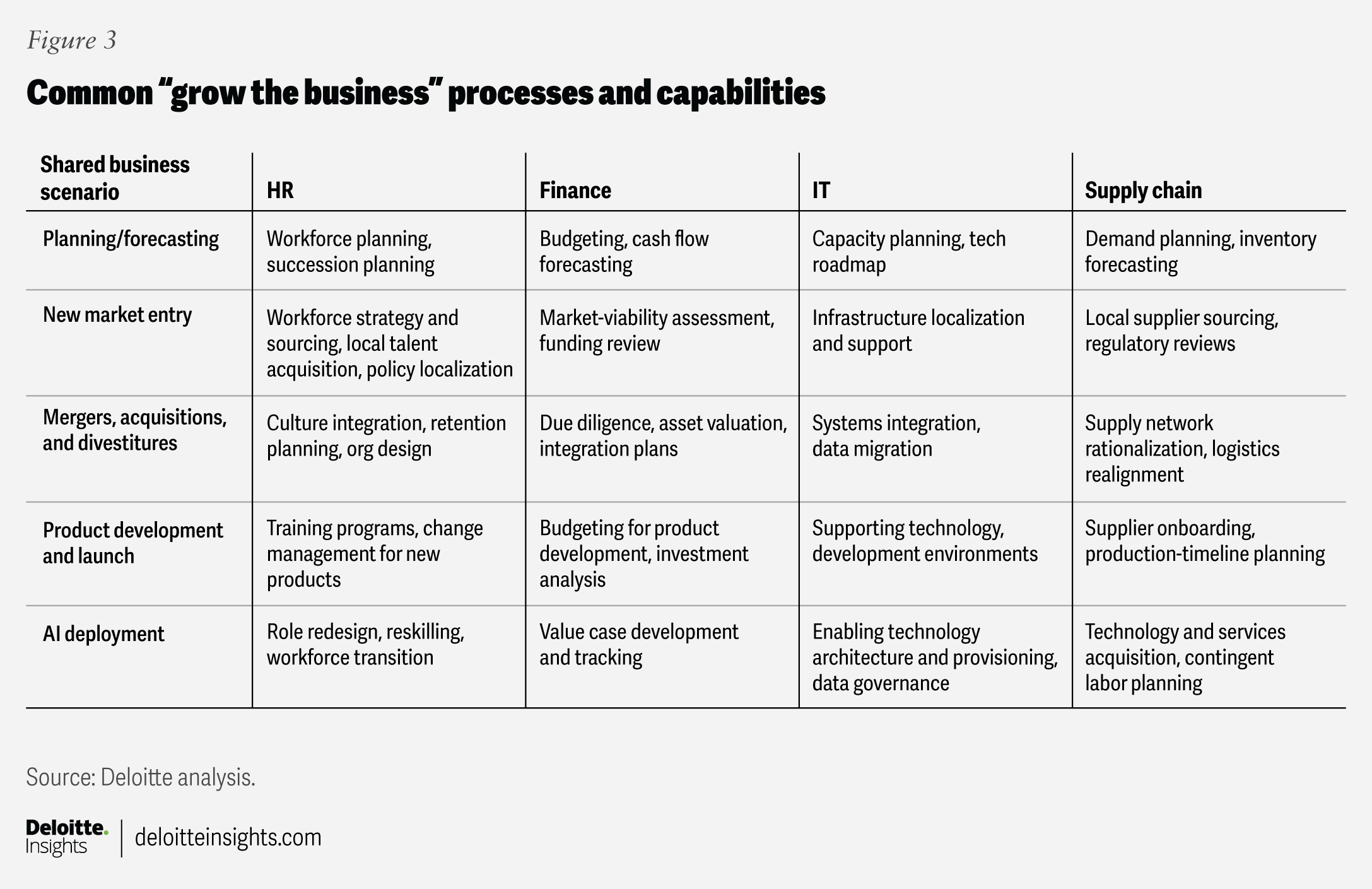
Meanwhile, “grow the business” activities tend to be linked together by the business situations they support. They often involve a common set of stakeholders, project life cycles, and business objectives (figure 3). Leaders want professionals who can bring together various types of data to produce fully integrated forecasts that put the right people, materials, and technology in place to deliver products and services. They also need agile teams that can execute all aspects of a merger or acquisition, from diligence to integration. These teams need to bring not just functional expertise but also pattern recognition around how to drive results in that specific business context.
Figure 3
Common “grow the business” processes and capabilities
${optionalText}
The move toward cross-functional global business services can help address “run the business” functions. However, many organizations that have deployed global business services have made only limited strides in recombining the remaining components of corporate functions to be more effective in “grow the business” capabilities.
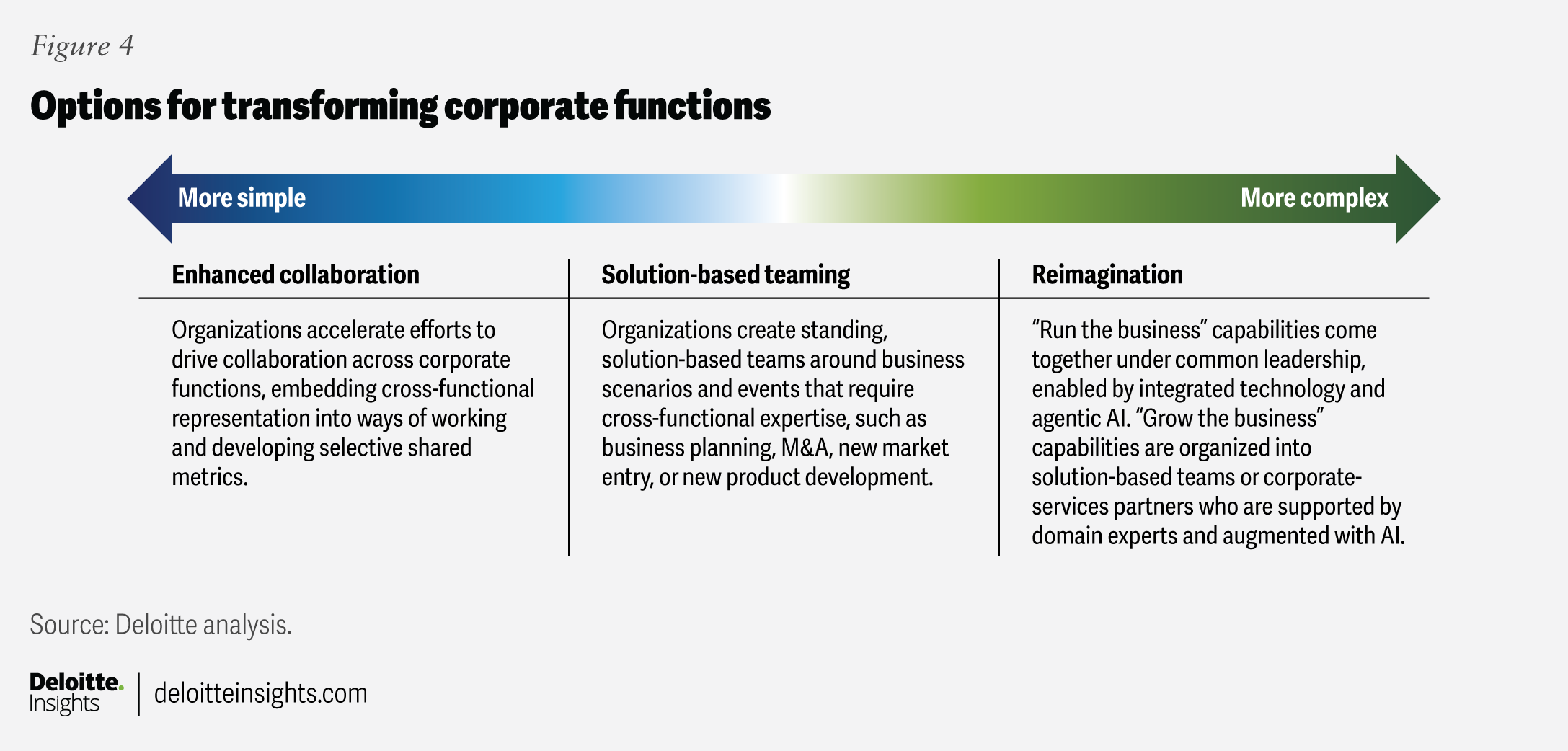
There’s no one-size-fits-all approach to rethinking corporate functions. Organizations have a range of options, with varying degrees of integration and disruption, to best fit the needs of the business and its appetite for change (figure 4). An organization choosing a reimagined approach with significant M&A activity, for example, may create a dedicated M&A team with expertise in people, finance, technology and data integration, legal, and risk.
Figure 4
Options for transforming corporate functions
${optionalText}
Regardless of how much complexity an organization decides to take on in rethinking corporate functions, there are several areas of opportunity to consider:
Follow data and tech across functional boundaries
It is likely that organizational technology and data are already more integrated than organizational boundaries. There is an opportunity for the structure of organizational functions to integrate along these paths.
Some organizations are already taking the leap. HR and IT are key functions that many organizations are considering integrating: Ninety-three percent of IT leaders in a Nexthink report believe HR-IT integrations can boost productivity, satisfaction, and engagement.3
For example, recognizing that many talent practices are now being reimagined with technology and AI, and with data being integrated from across multiple functions, Moderna merged HR and IT under a newly created role of chief people and digital technology officer. Teams were built to focus on work that required human input while delegating other tasks to AI tools—a process that included deploying more than 3,000 tailored ChatGPT versions for specific HR tasks, streamlining performance management and employee support. The effort also helped improve responsiveness and efficiency in addressing Moderna’s workforce needs.4
AI talent management platform Workleap encountered difficulties in delivering a consistent and supportive experience for its globally distributed employees. By bringing together HR and IT expertise, the company redesigned its onboarding and daily support processes, using technology to create smoother interactions for remote and hybrid staff.5
In early 2025, Unilever gave its CFO responsibility for a range of other corporate functions, including supply chain and procurement, digital and technology, and business services, in connection with a new five-year growth plan.6
Decouple domain expertise from organizational structure
Keeping expertise locked in functions can stifle collaboration and innovation. Instead, organizations can encourage leaders and their teams to apply their expertise across different functions, promoting broader understanding and more balanced exposure across various domains. This flexibility broadens individual perspectives, enabling workers to contribute more broadly throughout the organization rather than being confined to a single function.
Megan Bazan, vice president of people at Cisco, notes that their model for leadership includes multiple roles managing technology and talent transitions. That model places an emphasis on dynamic teaming that is cross-functional; hybrid, including humans and AI agents; and able to drive rapid activation.7
Organizations can establish communities that help specialists deepen their expertise, share best practices, and mentor colleagues. Cultivating these communities can foster an ongoing exchange of knowledge that helps maintain high standards and drives continuous learning across the organization. Meanwhile, robust communities supported by incentives and infrastructure can help professionals advance their domain knowledge in areas such as HR, finance, and IT, while also playing new roles in more fluid corporate support structures.
Enhance cross-functional accountability and collaboration
What gets measured gets done. Clear, shared cross-functional metrics can help hold teams and individuals on track to reach outcomes aligned with overall business objectives. Tracking progress can also build transparency and foster an ownership mindset across the organization.
In addition, the design of collaborative structures and processes should ensure that team members are jointly accountable for the success of a project. Doing so will help cultivate a culture where individuals take responsibility for their own contributions as well as the collective results of the larger group.
IT and HR could share accountability for workforce experience measures, and finance and supply chain could share working capital optimization metrics. A full range of functions could also share accountability with the business for speed to market.
One senior vice president notes, “Every function or team offers an AI bot for something, but our challenge is bringing together that world for employees and aligning collectively around the shared outcome metrics we want to drive.”8
Enable new capabilities and insights in the business
Finally, organizations can explore ways to build capabilities across the business. Our 2024 Global Human Capital Trends report, for example, spoke of boundaryless HR, in which the HR function can provide access to data to help leaders make better people decisions. Our 2025 Global Human Trends report discussed focusing on the role of managers in redesigning work, reallocating resources, and optimizing human and machine interactions. Imagine a world in which corporate functions are measured on how successfully they have built new capabilities into the business.
This shift moves organizations away from a model where functions are essentially gatekeepers of data, processes, and expertise and toward a model of cross-functional teaming that bolsters efforts to democratize insights and catalyze change.
As an example, Marcia Oglan, senior vice president of enterprise HR at Highmark Health, points to the role of HR as “the glue between technology and people—our real work is helping everyone see their place in a changing organization.” To that end, HR is forming a workforce innovation team to help deconstruct jobs, analyze tasks, identify where technology fits, and reconstruct roles accordingly across areas ranging from nursing to customer service. “The more cross-functional and integrated our teams are, the more trust and collaboration become strategic assets rather than accidental byproducts,” Oglan says. “We want a networked culture ... that’s about creating connections and visibility, not just new org charts.”9
There will always be a need for human expertise, capability, and courageous, independent perspectives. For example, the role of a CFO, CHRO, or chief legal officer often includes the ability to deliver an unpopular opinion to the leadership team in the interest of protecting the enterprise and its many stakeholders. Any changes to functions should strive to preserve the expertise and stewardship that are the professional cornerstones for these leaders. These changes should also leave room for constructive friction among leaders.
Leaders hoping to reimagine functions must be clear-eyed about the human tendencies to protect turf and political power within an organization—regardless of what the most agile or cost-effective future structures may be. Bold leaders should create a safe space to work through these issues and present a vision for how those aligned to the organization’s goals and direction can be individually successful.
Organizing the enterprise for a more dynamic world
Functions may have outlived their function. Organizations today have the opportunity to arrange themselves not around these traditional pillars, but in ways that provide greater fluidity, agility, and cohesiveness throughout the enterprise. Doing so will position organizations to act as dynamically as the world around them and create new roles and career paths for those who do their essential work.
By
Victor Reyes
Yves Van Durme
David Mallon
The authors would like to recognize the expertise of Robert Sanderson, Kyle Forrest, Tom Alstein, John Brownridge, Justin Silber, and Greg Vert, whose insights, perspectives, thoughtful analysis, and collaborative spirit enriched our exploration and helped sharpen the story.
A special note of thanks is reserved for Sarah Hechtman and Kailyn Hornbeck for their meticulous research and steadfast support.
Editorial: Corrie Commisso, Hannah Bachman, Pubali Dey, Cintia Cheong, Anu Augustine, and Stacy Wagner-Kinnear
Design: Molly Piersol, Alexis Werbeck, Govindh Raj, Guido Agüero Gonzalez, and Sylvia Chang
Audience development: Atira Anderson and Maria Martin Cirujano
Knowledge Services: Agni Wagh