
From function to discipline: The rise of boundaryless HR
The future of work requires human resources to evolve, shifting from a siloed function to a boundaryless discipline integrated with the people, businesses, and community it serves.
To meet the new demands of a boundaryless world, human resources itself should become boundaryless, shifting from a specialized function that owns most workforce responsibility to a boundaryless discipline, cocreated and integrated with the people, business, and community it serves. One where people expertise isn’t solely owned by HR, but where the people discipline in an organization becomes a responsibility and capability of all, woven throughout the fabric of the business to create multidisciplinary solutions to increasingly complex problems.
Harnessing the potential of people has become as important as, or more important than, leveraging physical assets to achieve outcomes.1 And as dramatic changes in business, technology, and the world often demand unprecedented agility, responsibility, and the creation of human outcomes, no single function can tackle these on its own: People expertise (within or beyond HR), alongside expertise in other disciplines, will be critical.
Consider how the explosion of human and machine interaction demands close collaboration between HR and information technology. Chris Nardecchia, chief information officer for Rockwell Automation, for example, works closely with the chief human resources officer “because there is an inherent link between leadership, culture, skills, and behaviors in achieving digital transformation outcomes.” This collaboration has helped the organization achieve business process improvements, resulting in a 75% reduction in total order cycle time.2 Digital transformation—in particular, the impact of generative artificial intelligence—also creates a premium on people capabilities and skills for all; indeed, talent management is one of the top 10 skills that is increasing in importance for all workers, according to the World Economic Forum.3
Or consider how as work becomes more dynamic, people expertise is needed at the edges of the organization, close to the point of need—rather than many steps removed in a function. Likewise, the responsible use of workforce data and AI requires HR to partner with information technology, risk, and ethics. The pursuit of responsible business practices, including environmental, social, and governance concerns—in particular, the increasing importance of human sustainability—means HR is collaborating closely with other functions and groups like corporate social responsibility; diversity, equity, and inclusion; finance; operations; marketing; and public affairs.
A new mindset for HR
These are just a few examples of boundaryless HR in action. But what exactly is boundaryless HR? Boundaryless HR is first and foremost a mindset shift—supported by the adoption of a different set of practices, skill sets, metrics, technologies, and even in some cases, structural changes. Boundaryless HR embeds the people discipline into the fabric of a business by breaking down the following boundaries:
- Boundaries between HR and other disciplines. As people expertise is integrated across functional areas to jointly solve business problems, all functional areas (including HR) should work toward—and measure themselves against—common business and human outcomes. With the breakdown of these boundaries, not only do functional disciplines start to merge, but the traditional people discipline itself starts to merge with other related disciplines like decision science, behavioral economics, and academic disciplines such as psychology, sociology, and anthropology.
- Boundaries between HR, workers, leaders, and managers. All people in an organization—from the board to the C-suite to every individual contributor—need people expertise and to be mutually accountable for human performance. HR democratizes people management, serving as a platform aided by automation and AI that provides leaders, managers, and workers with the tools, information, and real-time data they need to perform more of the HR-related work themselves. Rather than owning the discipline of people, HR cocreates that discipline and cultivates it across all roles in the organization, transforming workers from consumers of HR practices into coproducers.
- Boundaries that equate the notion of “jobs” to work and “employees” to workers. HR, together with other disciplines, fluidly orchestrates the skills of all resources who perform work—employees, partners, extended workers, and smart machines. People are increasingly becoming less tethered to work bound in “jobs;” rather, their skills can be flexibly deployed based on evolving work needs.
- Boundaries between HR and external organizations, customers, and other outside parties. HR thinks beyond the traditional internal “customer” of leaders, managers, and employees, and now also focuses on end customers, investors, and society. HR orchestrates a wide range of relationships beyond the organization, including those with educational institutions, governments, partners, and communities.
HR has already worked to dissolve boundaries within the HR function, adopting more agile, employee-centric operating models.4 Now, HR is poised for the next evolution: shifting its mindset to reconsider the very boundaries of the HR function itself (figure 2). When HR becomes boundaryless, HR professionals can act more like orchestrators, coaches, and cocreators, rather than traditional employment managers.
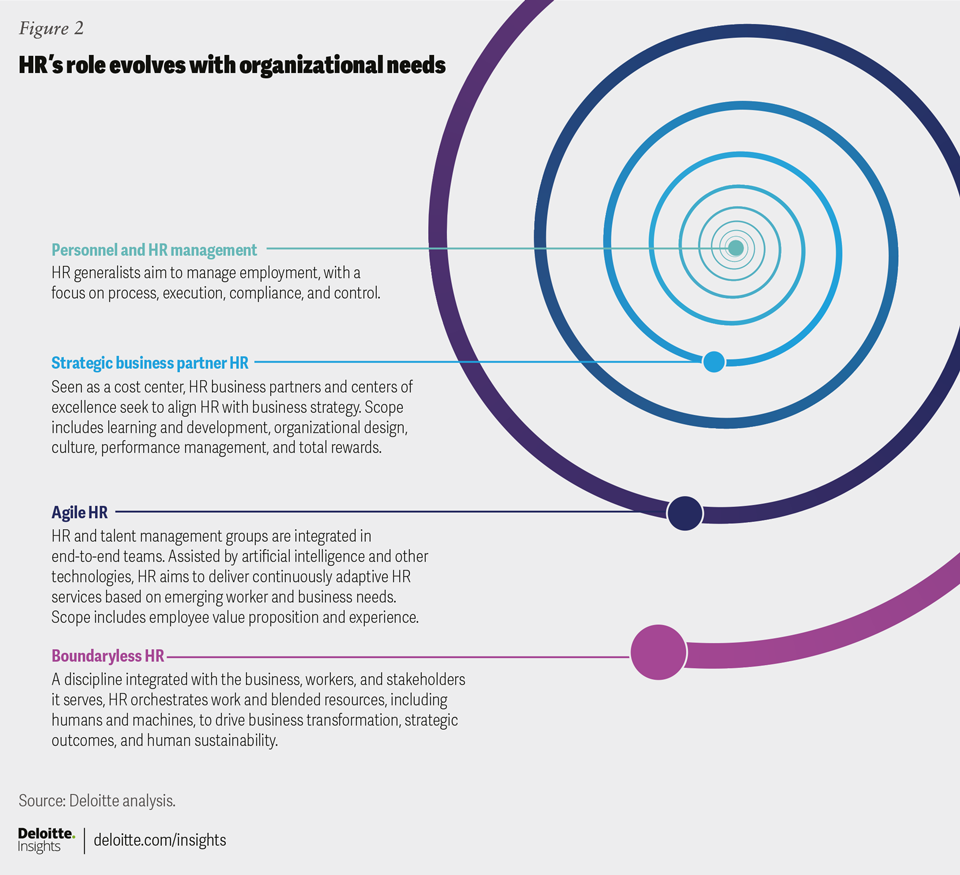
It’s worth noting that boundaryless HR is not an HR operating model problem or a neat remapping of who owns what. It’s less a matter of where people are in the boxes and lines of an organization’s structure, and more how the organization taps into the most skillful people, no matter where they reside, inside or outside the organization, to address people-related challenges and issues.
“HR is an ability and a discipline that everybody has to have. As HR, we have to stop thinking that our managers being better is a detriment to our function. Every person who works with other people has to be good at HR.”
—Gabriel Sander, Cuervo
As leaders recognize the critical importance of people expertise, it becomes less of a question as to where this expertise is housed, or where, when, and how it is delivered through an HR operating model, and more of a question of how to operationalize people expertise throughout the organization at the point of need. “HR is an ability and a discipline that everybody has to have,” explains Gabriel Sander, head of human resources at Cuervo. “As HR, we have to stop thinking that our managers being better is a detriment to our function. Every person who works with other people has to be good at HR.”5
This shift builds on our 2020 Global Human Capital trend, Memo to HR,6 which called for HR to expand accountability, extending its scope of influence beyond the function to the enterprise and business ecosystem as a whole, and broadening its focus from employees to the organization—and ultimately, to the work and workforce itself. Boundaryless HR is how we get there.
The end result is an ecosystem of HR professionals, business leaders, and workers who are equipped with the people expertise to unlock human performance.
What boundaryless HR helps unlock for organizations
The COVID-19 pandemic put a spotlight on the value realized when HR has broad involvement across the organization. During the pandemic, HR often:
- Worked closely with IT to manage the technological implications of remote work, with finance to work through tax and payroll implications of remote work, and with real estate and operations to keep workers safe;
- Adopted capabilities outside its typical scope, such as the health expertise needed for effective contact tracing; and
- Established new partnerships entirely outside the organization, collaborating with medical providers, departments of health, and even other organizations to borrow or loan workers. Cross-company talent exchanges that emerged during the pandemic enabled organizations to temporarily move workers in industries without work due to the crisis (for example, airlines and hospitality) to those organizations that had an excess of work (for example, health and logistics).7
By working outside of its traditional functional boundary, HR successfully kept people safe while sustaining business operations, created new ways of working with digital technologies, and helped advance human sustainability by keeping workers employed. And leaders recognized the impact: The percentage of executives who are very confident in HR’s ability to navigate future changes doubled from 2019 to 2020.8
Now, there is risk of a snapback, perhaps because HR earned a temporary spotlight and entry into work-related decisions, but business leaders didn’t fully recognize the ongoing value of people expertise; or because the prepandemic status quo offers a simpler path.9 Although the pandemic may have been an accelerator, the need for greater HR impact was growing well before the pandemic. Simply going back to previous ways of working overlooks the need to operationalize collaborative work across the organization and the ecosystem in which it operates.
At the same time, the pace of change and expectations continue to rise, suggesting that HR should reinvent its purpose. The world of work is changing, as illustrated by so many of our current and previous trends, requiring five major shifts (figure 3). But moving to a boundaryless HR approach can help organizations protect themselves against a snapback and evolve fast enough to keep pace with change. Moving toward boundaryless HR can be a path toward increased value creation—for HR, for workers, and for the organization as a whole. And value creation is what it needs; although HR has certainly made progress in recent years, only about 1 in 3 executives strongly agree that their organization values the work performed by HR, according to our 2024 Global Human Capital Trends research.
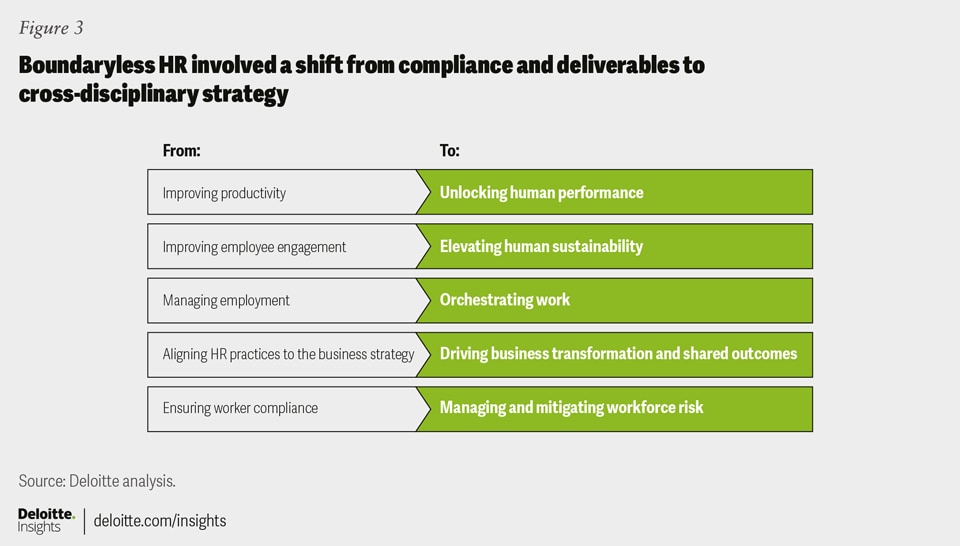
The five major shifts, and why boundaryless HR is needed to execute them, are as follows:
- From improving productivity to unlocking human performance. As work and productivity metrics shift away from industrial-era concepts to become more human-centric, HR will need to shift to measuring and unlocking human performance and potential; 70% of leaders agree that this should be HR’s new role, representing a bold move away from a function long devoted to standardization.10 Currently, however, only 20% of C-suite leaders strongly agree that their HR function improves their workers’ performance. To truly unlock human performance, HR should help build people expertise across the organization. It should integrate new sources of work and workforce data with business data and become more integrated with, and tailored to, the individual needs of the workers and people managers it serves. Today, however, only 10% of workers strongly agree that their HR organization’s practices meet their unique needs and preferences.
- From improving employee engagement to elevating human sustainability. For decades, employee engagement has been a goal of HR. But engagement can be an imperfect proxy for the bigger goal that boundaryless HR can help orchestrate: pursuing human sustainability, which we define as the degree to which an organization creates value for people as human beings, leaving them with greater health and well-being, stronger skills and employability, good jobs, sustainable wages, opportunities for advancement, and greater belonging, equity, and purpose. Management appears to be already on board with this shared outcome: Seventy-nine percent of executives agree that the organization has a responsibility to create value for workers as human beings and society in general.11
- From managing employment to orchestrating work. As speed and near real-time responsiveness increasingly create competitive advantage, work is becoming unbound from jobs. Instead, work is often fluidly organized based on skills12 in blended, cross-disciplinary teams of humans and smart machines,13 as well as a workforce ecosystem composed of internal and external talent.14 In addition to increased agility, this new workforce ecosystem can help solve some of business leaders’ most pressing challenges: chronic skill shortages, cost optimization, and demand for innovation. A majority of business and HR leaders (72%) believe that HR will shift beyond managing traditional employment activities to orchestrating work.15 Indeed, 81% of leaders say a shift from jobs to skills demands greater cross-functional collaboration,16 and 84% say orchestrating an entire workforce ecosystem already requires close collaboration between two or more functions.17
- From aligning HR practices to the business strategy to driving business transformation and shared outcomes. Today’s business problems are increasingly complex, demanding multiple disciplines to come together to solve them. In this environment, HR is no longer merely a supporter of business strategy as a “business partner.”
Instead, the people discipline is cocreating business strategy and key business outcomes, and 81% of business executives say the business agenda and the people agenda have never been more intertwined.18 Whether it’s innovation, customer satisfaction, digital transformation, or organizational agility, the discipline of people is a key, and often the most critical, driver of the major outcomes.
“It’s hard to implement change effectively if you’re not leading change,” said Donna Morris, chief people officer at Walmart. “If we want to be a strategic function, we need to think about the role we play in architecting that change—envisioning organizational design, ways of working, new opportunities for impact.”
- From ensuring worker compliance to managing and mitigating workforce risk. HR’s historical focus on employment-related compliance is shifting to a broader view of managing and mitigating workforce risk. However, only 35% of organizations have made this shift.19 This lens expands organizations’ focus beyond operational and financial risk to include the human implications of a growing list of disruptive external risks, including environmental, social, technological, political, and economic issues. Although the chief human resources officer (CHRO) is the C-suite executive most often responsible for managing workforce risk,20 addressing and mitigating workforce risk demands cross-functional collaboration. Building on its expertise across the organization, boundaryless HR orchestrates a cross-functional view of workforce risk that involves finance; risk and legal; the chief purpose, sustainability, DEI, or ESG officer; and operations, with mutual accountability and responsibility for shared outcomes from managers to the board.
“It’s hard to implement change effectively if you’re not leading change. If we want to be a strategic function, we need to think about the role we play in architecting that change—envisioning organizational design, ways of working, new opportunities for impact.”
—Donna Morris, chief people officer, Walmart
The move toward boundaryless HR is underway
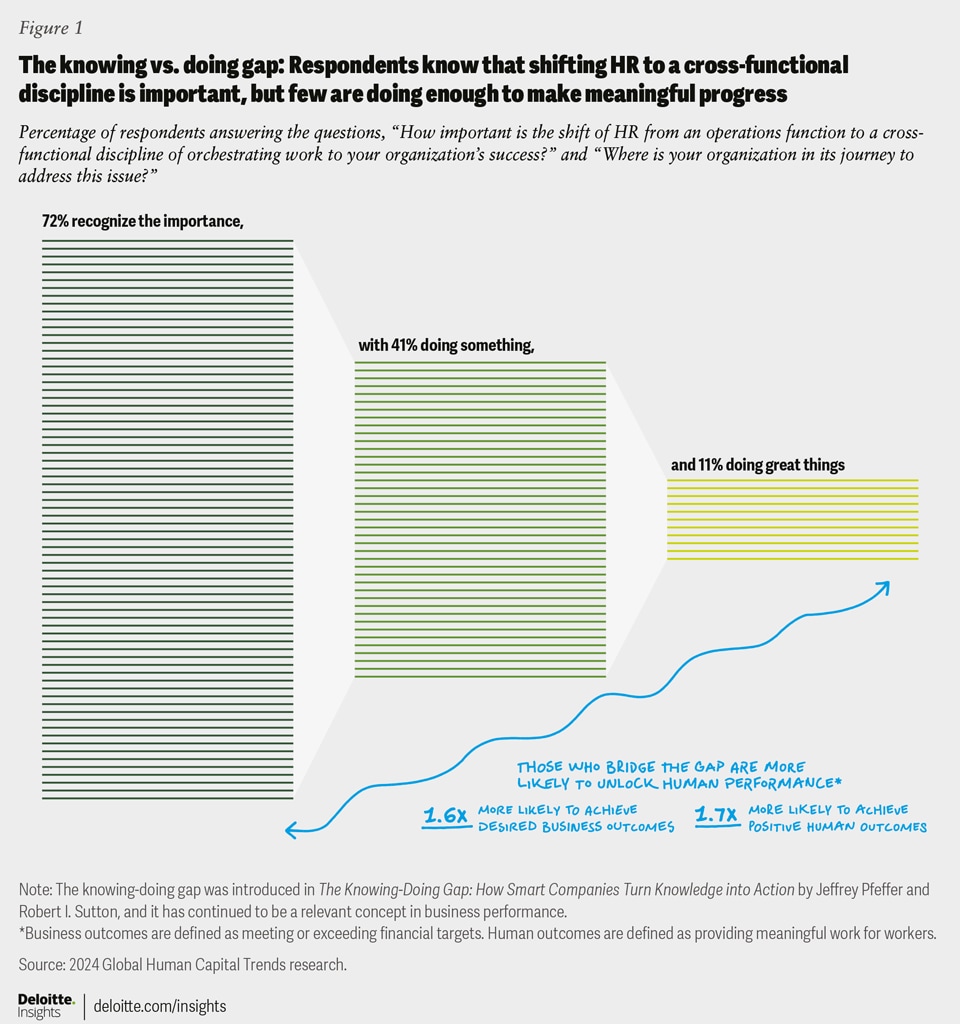
Seventy-two percent of respondents in our research agreed that HR’s shift from an operations function to a discipline operating across functions to orchestrate work is very important or of critical importance. Some progress is being made: Thirty-five percent of respondents said that the HR function at their organization has expanded its scope over the past three years. And 27% of C-suite leaders strongly agreed that their HR function has become increasingly integrated with the practices of other business functions.
That trend is reflected across the organization, where functional boundaries are becoming less meaningful overall. In fact, 81% of executives said work is increasingly performed across functional boundaries21 and 54% of executives in our survey said cross-functional collaboration at the worker level is now happening often or all the time. These results represent a substantial shift from the data of our 2018 survey, in which 73% of respondents said their C-suite leaders rarely, if ever, work together on projects or strategic initiatives.22 Johnson & Johnson’s HR leadership saw an opportunity to break down functional boundaries in creating the HR Decision Science team, which is tasked with tapping the organization’s vast data resources to make better end-to-end workforce-related decisions and improve organizational and worker outcomes. The team includes experts and specialists from across the organization working together to help strengthen J&J’s ability to drive science-based and data-driven people decisions across talent practices (see the case study titled “Johnson & Johnson: A case study in cross-functional teaming”).23
The shift to boundaryless HR doesn’t necessarily indicate that HR needs to take over the responsibilities of other functions. At the same time, it is also true that, as the people discipline is increasingly integrated into the business, HR leaders may take on responsibilities such as real estate and customer experience that are outside their traditional functional purview. Consider how Alexion Pharmaceuticals introduced a chief patient and employee experience officer, integrating the worker and patient experience,24 or how KION Group AG’s chief people officer expanded her role to become chief people and sustainability officer.25
But these dynamics will work the other way, too. To become better integrated, HR may give up some of its ownership over certain tasks as HR-related activities are folded into other groups. For example, marketing may take on the responsibility of employer branding; chief strategy officers may be responsible for creating a human capital strategy; operations management groups may take on some HR responsibilities related to process excellence. Octopus Energy, for example, does not have an HR department, but rather empowers managers to be responsible for tactical tasks like resolving a case of bullying or mediating contract disputes.26 Managers will also need to take on more people management responsibilities themselves—performing their own analytics, conducting workforce planning, or identifying areas to improve human performance. For instance, Google Cloud managers use people dashboards provided by HR to share insights on organizational health and performance, and they plan to embed AI in the future to model changes to things like team structures or roles.27
However, it’s still early when it comes to fully shifting HR from an operations function to a boundaryless discipline that orchestrates work—and organizations are finding the process challenging. In our survey, 31% of C-suite leaders said this shift is one of the top three most difficult changes for their organization’s leadership to address.
Further, our research also indicates that organizations may be particularly challenged by their internal constraints. Potential constraints could include not prioritizing people expertise or not having a culture that supports it, as well as competing priorities. For example, while organizations might offer training courses on people-related issues to first-time supervisors or provide mid-level managers feedback or coaching to help them become better people leaders, these can sometimes be treated as secondary priorities, lack investment, and not be well-integrated into day-to-day ways of working. Resolving those issues, in part by moving boundaryless HR higher on the organizational priority list, is necessary for organizations to benefit from boundaryless HR’s promise.
Boundaryless HR in action
HR is not alone in becoming boundaryless: IT, finance, and other functions are increasingly becoming integrated into the business to drive agility, innovation, and human sustainability. Like other functions, HR will need to actively seek better integration across roles, processes, objectives, teams, metrics, technologies, and systems throughout the organization.
Organizations can take the following actions to transform HR from a function to a boundaryless discipline:
- Redefine the role of the manager to be a people leader. Recognizing the need to embed the people discipline into the role of managers, Standard Chartered Bank redefined the role of the manager as a people leader and created training and an accreditation process for people skills.28 Telstra split the role of the manager into two: leaders of people (responsible for similarly skilled workers, ensuring they have the skills and capabilities to meet current and future needs) and leaders of work (responsible for creating and executing work plans), with neither being subordinate to the other..29 Cisco reinvented its HR function to make its primary purpose to support managers in becoming better people leaders, building an entire set of tools and apparatus around data and manager capability.30 To be effective, organizations should also measure and recognize the people leader aspect of managers’ roles, making the people outcomes just as important as the financial or business outcomes. Some organizations, for example, have performance management ratings and compensation outcomes based on whether a leader is a producer or developer of an organization’s people, or even an “exporter of talent.”
- Create new metrics and analytics shared across functional areas. As the people discipline becomes a responsibility for all, accountability should follow. Data suggests that it’s been lacking thus far: Sixty-five percent of organizations said their people analytics created no commercial benefit for the organization over the previous year.31 And only 24% of executives strongly agreed that the HR function is measured against the same business metrics as other operational functions. Now, boundaryless HR should focus on shared outcomes, such as agility, customer satisfaction, and human performance, and analytics that combine multiple data sources (HR, finance, operations, etc.) to uncover issues and illuminate solutions. Organizations should ensure that managers—especially people leaders—have access to the data and information they need to assess performance. VW Australia, for example, created a democratized platform integrating its customer and employee experience data for access by local managers. This shift prompted investments in dealer facilities that led to sustained sales growth and the highest retention rates and workforce experience scores in the company’s history.32
- Democratize people practices and data with AI and other digital tools, creating science-based processes that unlock performance. AI—in particular generative AI—is poised to shatter the boundaries of the HR function. What is the role of HR-provided training when workers can now, for example, get information on any topic, along with actionable suggestions, with a simple question on a generative AI platform? Generative AI can create first drafts of job postings or integrate performance feedback, suggest career options for workers or managers’ direct reports, offer real-time performance insights into worker sentiment or the extent of collaboration across silos, or automatically assemble learning content and assessments to help people learn in the flow of work. Data democratization is also important. At IBM, for example, new AI tools are helping managers make better people decisions and spot issues like attrition risks; an AI-driven adviser even suggests salary increases. The AI considers not only performance and market pay gaps, but also internal data on worker turnover by skills, and current and future external demand for each worker’s skills. AI has also freed up managers to take on more people development responsibilities—for which training programs accredit them and for which they are held accountable through a metrics-driven performance development system.33 Organizations should consult with legal advisors prior to implementing employment-related AI tools like this and ensure responsible data practices are in place.
- Create cross-functional teams or cross-functional “integrator” roles to tackle business problems and people issues. To start, organizations can cross-pollinate expertise by bringing people from other functions or disciplines into HR roles or projects, and vice versa. Upskilling HR professionals so they understand other functional areas (for example, finance and technology) and upskilling leaders in other domains in people expertise can also help. In addition, organizations can create cross-functional teams; many organizations have already created teams of IT, facilities, and HR to improve workforce effectiveness, others are starting to create teams composed of the chief digital or information officer, chief human resources officer, chief marketing officer, and chief executive to achieve digital transformation. Johnson & Johnson’s HR Decision Science team exemplifies how cross-functional collaboration can improve organizational and worker outcomes (see the case study titled “Johnson & Johnson: A case study in cross-functional teaming”).34
Alternatively, organizations can create integrator roles that include the people discipline such as joint worker or customer experience leader, chief collaboration officer, or chief transformation officer. For example, after spinning off from Western Union, fintech organization Convera has created integrated transformation roles to drive its business strategy, naming a leader to each transformation goal. Senior leaders recognized the importance of embedding change capabilities and resilience throughout the organization, not siloed to one workstream or team within HR. To operationalize this change capability, each of the transformation leaders has been trained in change management, and each initiative is measured against organizational change management metrics as part of its business case.35 The change management training has also been rolled out for managers and employees to build individual and organizational resilience amid change.
- Transform workers into producers of people practices, not just consumers. Boundaryless HR organizations work side by side with workers, involving them in the design, deployment, and iteration of things like microcultures and other people practices that affect them. However, only 30% of C-suite leaders say their organization’s leaders are involving their workers in cocreating the organization’s solutions often or all of the time.
To be effective, cocreation needs to go far beyond end-to-end journey mapping, persona development, design-thinking, agile methodologies, and insight gathering from workers through sentiment analysis or analytics—all of which have been borrowed from the customer experience field. Workers are not customers; in fact, treating workers in a transactional way, like customers, is counterproductive. Real cocreation can break down the boundary between workers and HR by, for example, involving workers directly in virtual focus groups, interactive whiteboards, extended hackathons, or idea jams to come up with ideas or test drive concepts. Allstate Insurance, for instance, involved 170 workers in designing and testing employee experience products like a new performance rating scale,36 while Convera invited all its workers to participate in a hackathon to redesign its rewards platform.37
- Pursue collaborations and partnerships with external entities. Organizations can start by appointing teams of ambassadors to engage with the broader community, including educational institutions, governments, regulators, investors, suppliers, partners, and global collective movements. Or consider joining consortiums with other organizations to do things like influence regulations, share skills-demand data with educational institutions, or provide input into post-secondary curriculum to better develop the talent pipeline.
The future of boundaryless HR
The mindset shift to boundaryless HR often requires that HR leave its comfort zone—shifting from owning the discipline of people to coowning and cocreating it with the people and business it serves in order to drive shared outcomes with mutual accountability. It’s a two-way street: Like counterparts in IT and finance, HR can become more integrated with the business, and the business can become integrated with HR.
The CHRO has a critical role to play in this evolution, which demands a new way of leading. It may even be time to make the CHRO the chief work officer, responsible for a workforce that is now composed of internal and external workers collaborating with AI, and where the line between technology and people is increasingly blurred. “The future of HR is one where we think about boundaryless differently, and how that changes our team constructs,” said Michael Ehret, PhD, head of global talent management at Johnson & Johnson, in an interview with Deloitte. “For example, our talent acquisition team has transformed into a talent access team, because it's not just about hiring people full-time or part-time. We need to access the best talent in the world, with the right skills, whether that’s full time, part time, contingent, or smart machines that will allow our people to focus on the most impactful work. Our Global Talent Management team has adopted the mantra of ‘ready for any future.’ We want to make sure the organization, our leaders, and our people are ready for whatever comes.”38
CHROs may need to shift their own roles, too, as they integrate the people discipline across the organization and cocreate new approaches to unlocking human potential and measuring human performance along with other functional leaders. Fortunately, many CHROs are already well-positioned to be an orchestrator across disciplines, as it is one of the only roles that serves every part of the business. For example, the CHRO is often well-placed to identify and orchestrate the connections among technology, data, and people, or the connections between the customer and worker experience. This shift will require that many CHROs grow their skills, as they forge connections across and beyond the enterprise, and create a stable home for HR professionals through belonging and purpose as they increasingly work outside of the HR function itself.
The shift to boundaryless HR will require a new vision of HR, a new mindset, new skills, a new way of leading, and potentially new roles and organizational structures. But the payoff from the move from knowing to doing can be tremendous. HR can help create more compelling worker value propositions, improve workforce effectiveness, and move talent management closer to serving as a strategic function of the business, rather than one that is primarily operational or reactive. In addition, the work of HR professionals can be more creative and meaningful. As human performance is unlocked and measured, organizations can thrive, along with the workers, partners, and communities they reach.
By
Kraig Eaton
Sue Cantrell
Kim Eberbach
Julie Duda
The authors would like to thank Jodi Krause (Convera), Vitalija Jakovoniene (Convera), Gabriel Sander (Cuervo), Tracey Arnish (Google), Monica Morrella (Google), Heather Riemer (Google), Michael Ehret (Johnson & Johnson), Sarah Brock (Johnson & Johnson), and Donna Morris (Walmart) for their contributions to this chapter.
Thank you to Victor Reyes, Amy Sanford, Steve Hatfield, Robin Jones, and Karen Weisz for sharing their expertise and insights to support this chapter.
Special thanks to Sarah Hechtman and Brittany Bjornberg for their leadership in the development of this content, and to Meghan Bayne for her contributions.
Cover image by: Sofia Sergi