
The orchestration advantage
AI can enable quick intent-to-action. But turning speed into competitive advantage will likely come from learning to orchestrate capabilities and capacity in real time.
Competitive advantage today depends on more than what organizations own—large customer franchises, product portfolios, and supply chain capabilities. Increasingly, it depends on how they can steer intent into action, fluidly reconfiguring capabilities and capacity as business conditions, customer demand, or technologies shift. Scale still matters, but the edge is tilting toward speed and agility: Some 67% of leaders responding to our 2026 Deloitte Human Capital Trends survey say their primary competitive advantage over the next three years will come from being fast and nimble, while only 28% believe scale will be their main differentiator.
Artificial intelligence is accelerating this shift by making previously scarce capabilities widely available and reshaping how work gets done. It is upending traditional assumptions around capability (the ability to effectively perform work), capacity (how much can be done and how fast), and the classic speed-quality-cost triangle of strategy. Where organizations once had to choose two of the three, AI is creating a new performance frontier where speed, quality, and cost can improve simultaneously.
Scaling, for example, no longer automatically requires more people or more spending, as shown by many new ventures that aim to operate as primarily AI companies, simulating the operations of a large firm using AI with very small human teams doing high-leverage work. Rapid learning cycles can also convert speed into quality. Consider how close collaboration between doctors and AI can help detect diseases earlier and with higher accuracy than either humans or AI could achieve alone. It’s the difference between humans plus machines and humans times machines.
But the key to speed and agility is not just planning for a new math of capabilities and capacity and organizing or allocating resources into fixed structures. It is the ability to fluidly orchestrate people, skills, data and technologies around business-critical outcomes—continuously sensing, assembling, and recombining the right elements as needs evolve. Allocation is assigning a musician to play a specific part. Orchestration is the conductor’s role, adjusting elements in real time to deliver the outcome.
Consider Levi Strauss as an example of orchestration in action. The company increased sales in its loose fit jeans category by 15% in three months by rapidly bringing together the skills and expertise of people across functional domains (including designers, merchants, and marketing) and pairing them with AI to sense weak signals, identify the surge in demand for baggier silhouettes, and iterate quickly from insight to design to market response.1
An organization that effectively orchestrates its capabilities and capacity can become both big and fast, escaping the traditional zero-sum relationship between scale and speed. It can simultaneously improve speed, quality, and cost—not just two of the three—and can consistently rewrite its own source code as the world changes. In the process, it can transform unpredictability from a source of risk to a source of opportunity.
Our survey suggests orchestration is more than just a future aspiration; it offers present-day competitive advantage. Analysis of our 2026 research shows that organizations leading the way in this area are about twice as likely as their peers to report better financial results and to say they are providing meaningful work for workers.
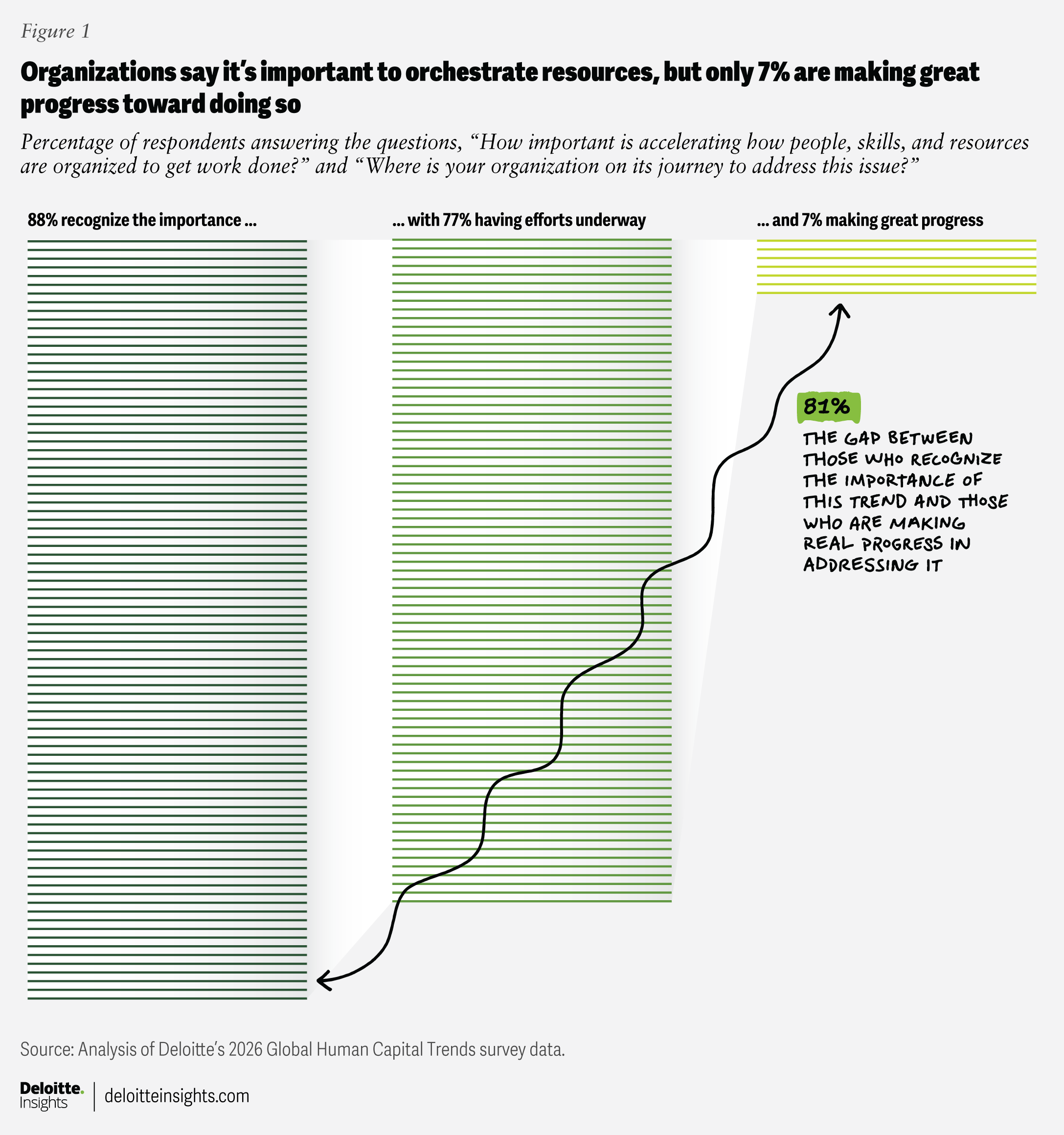
The ability to dynamically orchestrate work ranks No.1 among trends of importance this year, with 88% of leaders saying it is extremely or very important to accelerate how people, skills, and resources are orchestrated to get work done. Yet only 7% of leaders say they are making great progress toward this goal (figure 1). The 81-point difference between importance and action is the largest such gap in this year’s survey.
Four actions to orchestrate capability and capacity
Orchestrating capability and capacity involves four critical actions. Together, these actions can help organizations not just adapt, but adapt at least as fast as the world around them is changing.
Identify and create capability and capacity
Organizations can start by defining the mission and outcomes they want to achieve, and then aligning the capabilities and capacity required to deliver against them. At Walmart, this has meant setting a clear focus on efficiency and encouraging leaders across its international business to explore how AI could unlock new capacity and reinvest that time into innovation and growth.2
This is the “bot” (or AI) strategy—a newly added “b” to the traditional build (train and develop internal talent), borrow (temporarily access capabilities through external sources like contractors or outsourcing), and buy (hire talent) menu of options to access capacity and capability. Fifty-six percent of leaders in our survey say they now organize and evaluate AI agents as digital workers and 60% say their teams have the right human and AI capabilities to effectively perform the work that needs to be done.
Although these four “bs” are foundational to accessing capability and capacity, there are some specific approaches organizations can take to multiply and extend them (figure 2).
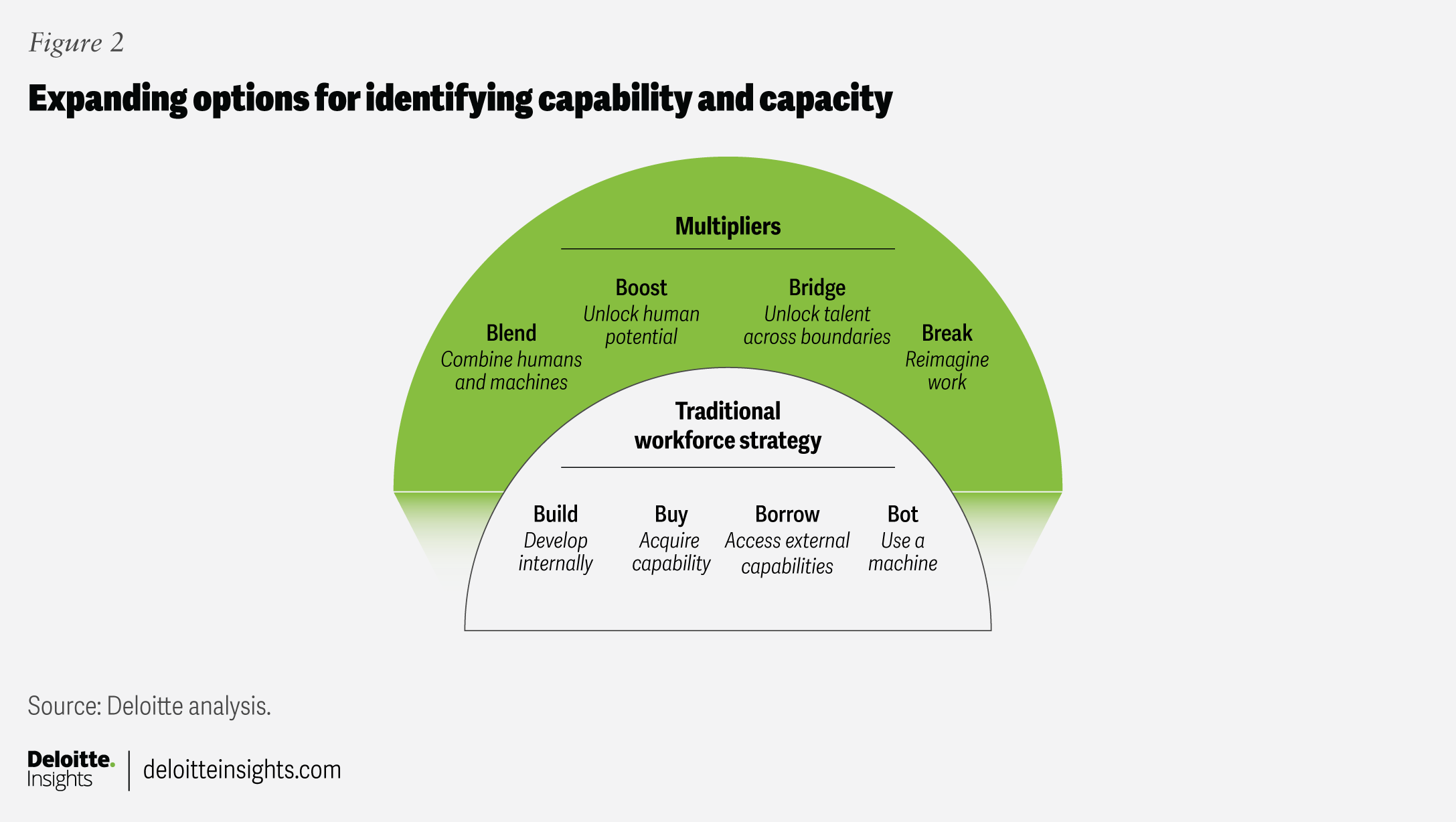
For example, organizations can blend human and AI capabilities. Instead of treating digital labor as a separate cohort, the blend strategy recognizes a new category, in which AI dramatically enhances workers’ productivity, performance, and creativity as an exponential multiplier of outcomes. This is an example of humans times machines.
Already, just over half (51%) of leaders in our survey say they account for human and machine collaboration’s potential to unlock value when they plan the size and composition of their human workforce. We expect understanding and capitalizing on the human/AI multiplier effect to grow in strategic importance. That seems to be happening already: Of the one-third of surveyed leaders who exited workers due to AI, more than half (57%) say they have come to question their decision. For example, a year after claiming that its AI chatbot could do the work of 700 representatives, a financial tech company is now rehiring those people to work with AI, combining AI’s speed with human empathy to deliver better customer outcomes.3
As we discussed in last year’s trends, another way organizations can unlock capacity is to boost the productivity of their workforce by reducing nonessential work so workers can focus on what matters most.4 Once nonessential work is reduced, workers can better realize their potential and take on more value-added work. Only 50% of workers and managers say their organizations are tapping into their full potential.
One multinational consumer products company practices another “b” of bridging, unlocking talent across organizational boundaries. After fully automating its plants, the company bridged production and warehouse workers into new roles monitoring the AI and performing quality checks.5 Bridging also can mean unlocking capacity by moving people into temporary assignments through internal talent marketplaces or into agile, mission-driven teams, all while workers remain in their current jobs. Megan Bazan, vice president of people at Cisco, explains: “The rise of rapid mobilization of cross-business squads—including humans working alongside machines or agents—means the static team is becoming a thing of the past.”6
Only 28% of organizations say they currently use dynamic teams organized at the point of need or by the problem to be solved. But more than twice as many (59%) say doing so will be important for their organization’s success in the next three years.
Finally, break—redesigning work, roles, and organizations—is another approach. In responses to talent shortages in health care, for example, Cleveland Clinic’s workforce planning group turned to role design, breaking down tasks and asking whether each needed to be done, and whether they could be automated, performed remotely, reassigned, or rescheduled.
For medical assistants, this analysis led to shifting most tasks (37 of 40) to lower credentialed or non-clinical staff and automating or augmenting others with technology. As a result, this approach created the capacity equivalent of 430 full-time employees and generated more than $2 million in cost savings, while boosting employee engagement by enabling staff to spend more time on patient care instead of paperwork.7
Right people, right decision, right time
Orchestration requires quicker, more effective decision-making, placing the right decisions with the right people at the right time.
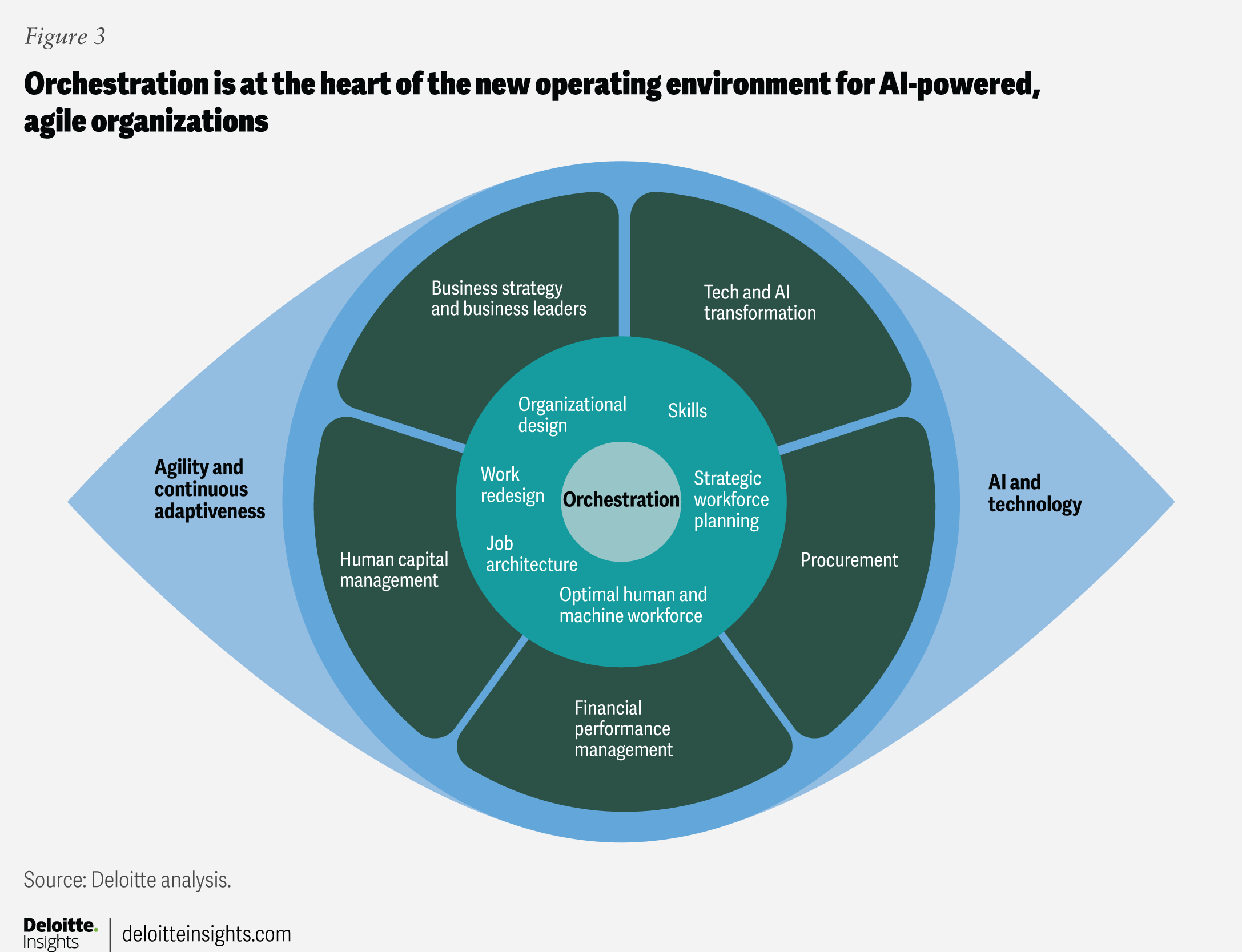
Walmart exemplifies a new approach to decision-making designed to support the orchestration of capabilities and capacity (figure 3). To support this approach, Walmart uses a cross-functional leadership model that brings together people across functions including human resources, technology, finance, and procurement. Rather than working in silos, these leaders take a holistic view of work across different roles, capabilities, and delivery models to determine how work is best designed and supported in this new era.
This approach also integrates a wide range of capabilities, including work redesign, fluid job architecture, workforce planning, human and machine collaboration, effective organizational structures, and improved skill utilization. For example, Hewlett Packard Enterprise recently integrated its strategic workforce planning and organization design teams—and the combined team works closely with finance, business operations, and IT to explore how certain roles could be automated or augmented.8
Orchestration should also happen at the point of need. Top leaders typically don’t experience the changes that workers see on the ground every day. To be truly adaptive, workers at all levels will also need to be able to dynamically orchestrate capabilities and capacity.
Mastercard, Seagate, and Standard Chartered, for example, are using an orchestration platform to integrate skills, tasks, and AI as a performer of work, according to Gloat. Workers can specify the types of work they want to do or outcomes they want to achieve. The system then identifies relevant workstreams, people in the organization who have the skills to execute those workstreams and can be pulled into temporary projects, and technologies (including software, gen AI, and AI agents) that can either work with these people or perform the work autonomously. The result: All workers can design and orchestrate work in real time.9
So far, it appears that relatively few organizations are joining the leaders mentioned above. Only 11% of managers in our survey strongly agree that their organization provides them with relevant data and tools to make effective decisions around the distribution of work. That said, certain signs suggest an orchestration mindset is beginning to inform organizations’ thinking: More than six in 10 (61%) organizations say they now align and deploy workers based on tasks, skills, and outcomes, compared with only 33% that use job or position-based models.
Create plug-and-play modularity
Leaders have traditionally relied on formal organization structures to deploy capabilities. Now, they’re asking a different question: “How fast can we move around what matters?”
Six in 10 (60%) leaders in our survey say they are working to redeploy internal capabilities such as people, technology, and expertise across the organization to meet the areas of greatest need. Creating diverse human-AI teams can be challenging: People may not speak the same language, data might be trapped in silos, and teams may not have established trust and working norms. Organizations can overcome these hurdles by creating modularity so they can plug and play capabilities and capacity as needed. More than six in 10 (62%) leaders say they are adept at plugging in external people and technology capabilities, but that it can be difficult to do so internally.
The job starts with establishing a shared mission based on outcomes, not outputs. Jon Pitts, founder and chief executive officer of ihp Analytics, uses the analogy of a Formula 1 team. “All functions, data streams, sensors, and analytics are unified around a single mission: making the car go fast and stay fast,” he says. “Egos are set aside as everyone collaborates in real time, guided by data and a shared outcome.”10
Creating modularity can help clarify situational leadership (what type of leadership is needed based on the needs of the situation, the task, and the makeup of the team) and create team roles such as AI-human interaction designer or toolchain specialist (someone who brings or integrates the right set of AI tools).
Cultivating trust is also essential. Marcia Oglan, senior vice president for enterprise HR at Highmark Health says, “The more cross-functional and integrated our teams are, the more trust and collaboration become strategic assets. We want a networked culture, not isolated silos.”11
AI can play a valuable role in creating modularity. As one senior vice president explains, “When collaboration between functions is automated, the workflow becomes more efficient. Automated handoffs help bring people together.”12
AI can also create a shared body of knowledge and help people get up to speed in new roles and teams. One leader we interviewed trained AI agents on different stakeholder personas (for example, chief human resources officer, chief financial officer, chief information officer), so he could dialogue with them, have them review his work, and learn their language and context.13 If AI democratizes expertise, generalists could work across multiple areas, helping organizations benefit from so-called M-shaped workers—professionals with deep expertise in at least two different areas, supported by a broad base of general knowledge across disciplines. Over time, agentic AI may also increasingly orchestrate workflows, potentially giving rise to multidisciplinary teams that oversee and evaluate end-to-end outputs.
Eventually, AI could help create a new operating model in which structures are no longer the primary axis of control. Instead, the focus shifts to fluid, mission-driven teams of humans working closely with AI (figure 4).14
Figure 4
Evolving from cost efficiency to adaptive orchestration
${optionalText}


Use AI to help orchestrate capabilities and capacity
With AI, strategies can emerge and develop in real time, as capabilities and capacity inform strategic decisions and vice versa. Already, 58% of leaders say they prefer to shape strategy through frequent experimentation at the ground level; only 37% prefer to shape it through careful, centralized planning.
One of these experiments is employing a digital twin—a live, AI-powered model of an organization and its workforce. Only 15% of organizations we studied are currently using digital twins, but nearly half of leaders (49%) say they will be important to their organization’s success in the next three years. Leaders can use digital twins to test decision-making and simulate scenarios, giving them insights they can use to prioritize initiatives, predict needs, and take action. One organization, for example, uses a digital twin to simulate the impact of decisions like increasing AI investment, changes in outsourcing, and shifts in location strategy on talent needs and organizational structure. This approach helps organizations make better decisions about moving and optimizing capabilities and capacity.15
Agentic AI in particular can enable more dynamic and iterative orchestration. Teams of humans and AI agents working together can anticipate needs and deploy resources in real time. For example, AI agents can continuously monitor signals indicating workforce changes, such as shifts in the supply of particular skills, or changes in worker capacity. AI can alert leaders at key moments, prompting them to reassess workforce plans and potentially to redesign roles and work. And AI agents can then even execute a decision (after a human approves)—initiating a job posting, for example, or scheduling a learning event based on skills gaps.
One US hospital network deployed agentic AI to create dynamic shift scheduling, resulting in enhanced patient care and reduced clinician workload and burnout, according to a technology firm specialized in health care.16 A global pharmaceutical company is piloting using AI agents to track changes in shipment routes, notify supply chain planners of the disruptions, summarize the implications, and suggest options to solve the problem. Planners oversee the AI agent in executing the preferred choice, creating a self-healing supply chain. Other AI agents could track how this worker and others choose to reallocate resources in light of disruptions, signaling when workforce plans may need to be adjusted or when a role might be ripe for redesigning.17
Only 20% of leaders say they are currently using AI to monitor signals of workforce changes, inform decisions, and take action, even though 52% say doing so will be important for their success over the next three years.
Orchestrating a way forward
The rise of AI is rewriting organizations’ nervous systems. The cycle of planning, locking in resources, and execution can no longer keep pace with reality.
Adaptive orchestration is the alternative. It enables leaders to continuously align people, processes, and technology, coordinating workflows that flex and adapt in real time. The future may belong not to the best planners, but the best orchestrators—those who can turn uncertainty into momentum and complexity into advantage.
By
Sue Cantrell
Stephen Harrington
Nicole Scoble-Williams
Kevin Moss
Russell Klosk
The authors would like to acknowledge Maya Bodan, Harini Angara, Renzo Tognocchi, Casey Caram, Chloe Domergue, Amir Rahnema, Robert Sanderson, Sarah Rogers, Michael Griffiths, and Simona Spelman for their expertise and guidance.
Separate recognition goes to Chris Tomke and Zac Shaw for their research support and attention to detail.
Editorial: Corrie Commisso, Hannah Bachman, Pubali Dey, Cintia Cheong, Anu Augustine, and Stacy Wagner-Kinnear
Design: Molly Piersol, Alexis Werbeck, Govindh Raj, Guido Agüero Gonzalez, and Sylvia Chang
Audience development: Atira Anderson and Maria Martin Cirujano
Knowledge Services: Agni Wagh