
Expanding the skilled manufacturing workforce with AI
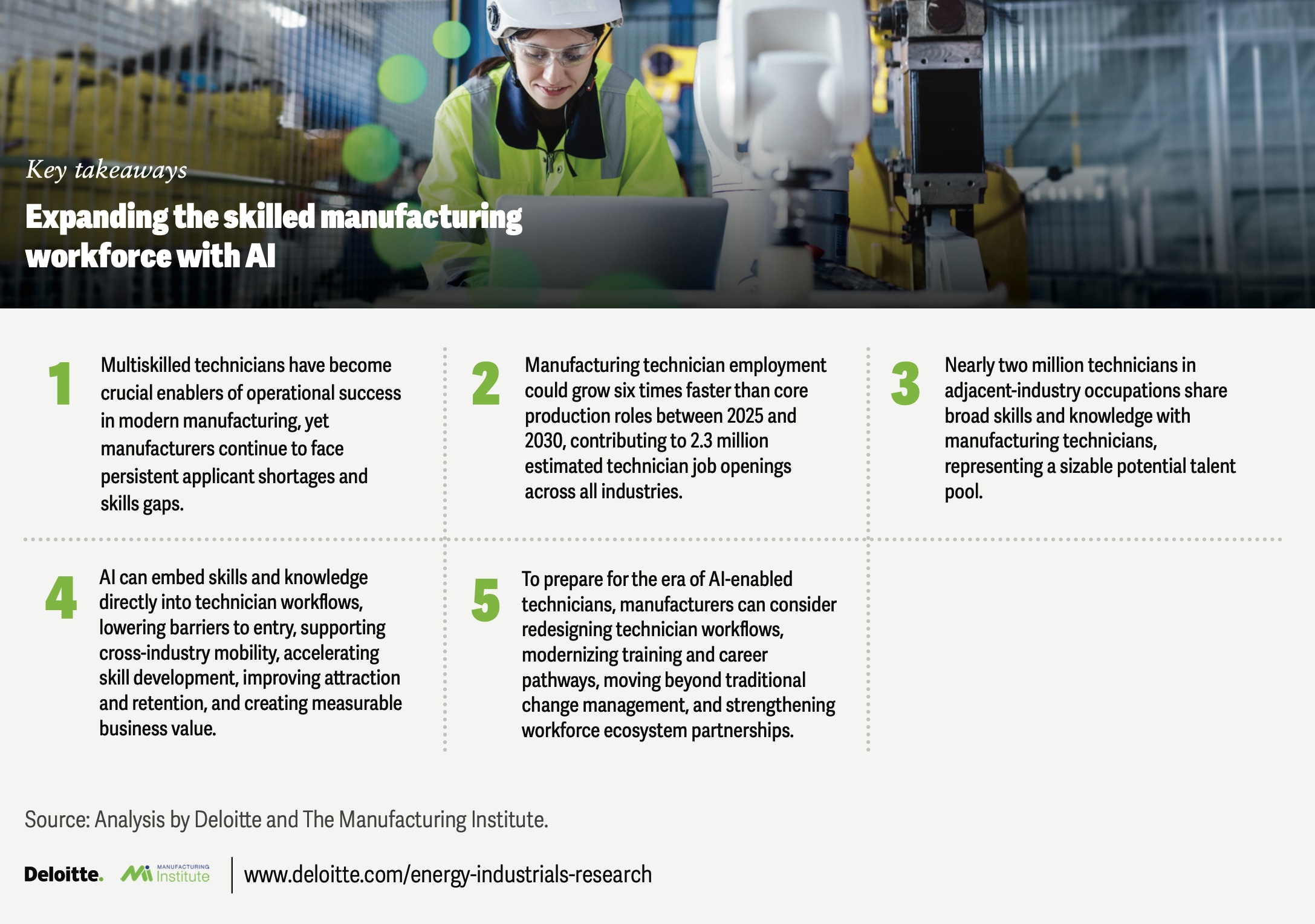
AI could help US manufacturers address one of their most pressing workforce challenges: finding and developing more technicians
US manufacturing is increasingly defined by sophisticated, high-precision products that rely on advanced and interconnected production technologies, automation, and capital-intensive processes.1 In this new paradigm, multiskilled technicians with expertise across multiple technical domains, such as mechanical, electrical, and control systems, have become crucial enablers of operational success.
Although they represent a relatively small share of a manufacturer’s workforce,2 technicians often play an outsized role in keeping advanced production systems running, supporting the adoption of new processes and technologies, driving efficiency and product quality, and enabling productivity across the factory floor. Demand for these technicians has grown substantially faster than demand for production occupations.3
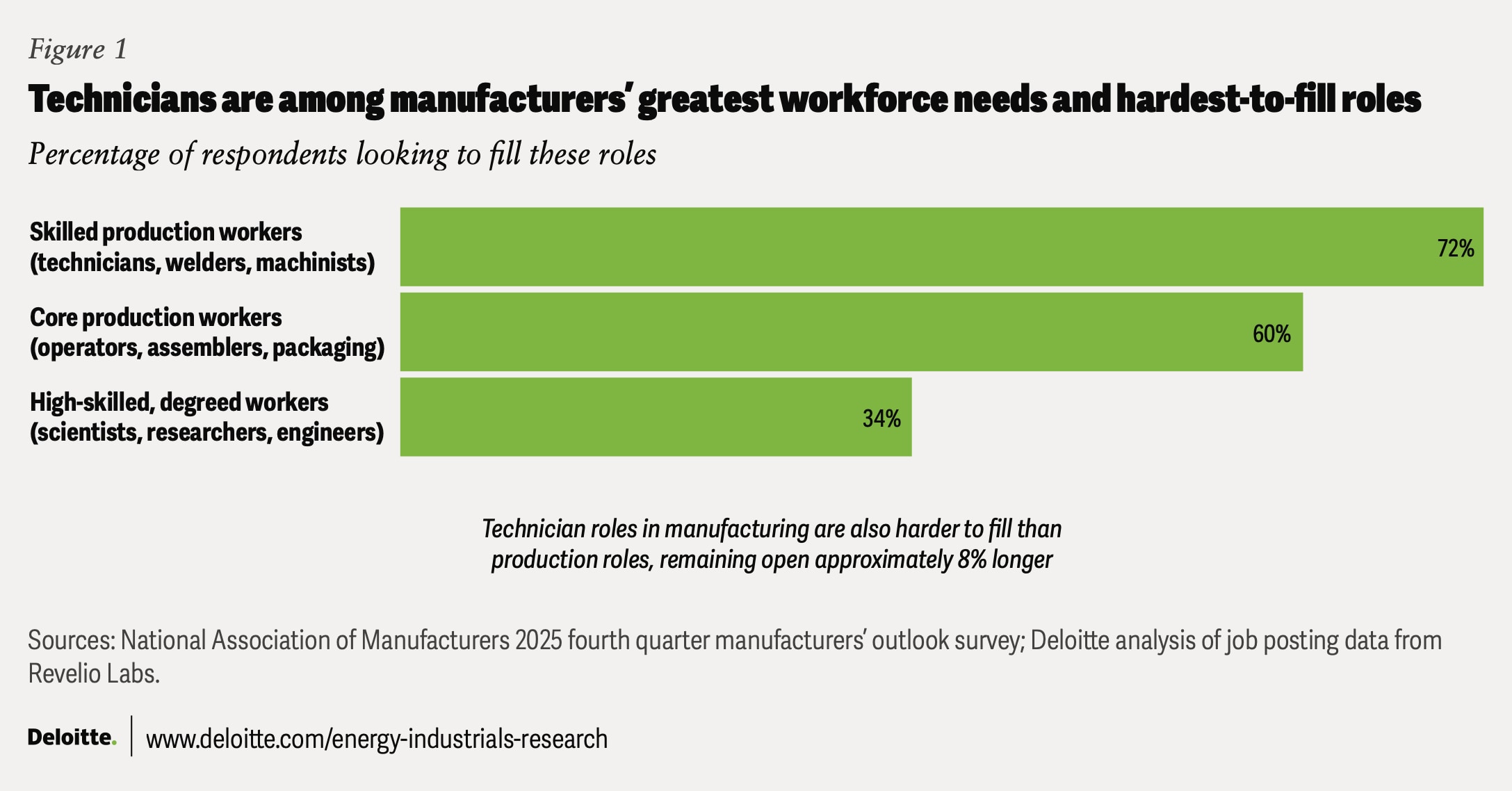
At the same time, applicant shortages and skills gaps have made it difficult for manufacturers to secure the technician workforce they need (figure 1).4 These workforce challenges can ripple through operations, increasing downtime and constraining production capacity, operational performance, and growth. Artificial intelligence could create a new opportunity to address these challenges. By embedding expertise directly into daily work, AI can help workers, including those with less experience and others transitioning from adjacent industries, develop and apply knowledge and skills in manufacturing roles, thereby broadening the technician talent pool.
To explore this opportunity, Deloitte and The Manufacturing Institute embarked on a study in May 2026 to map the technician ecosystem across manufacturing and adjacent industries and examine how generative and agentic AI (which we collectively refer to as “AI”) could help reshape technician roles to improve business outcomes and enhance their appeal to current and future workers.
Mapping the technician ecosystem in manufacturing and adjacent industries
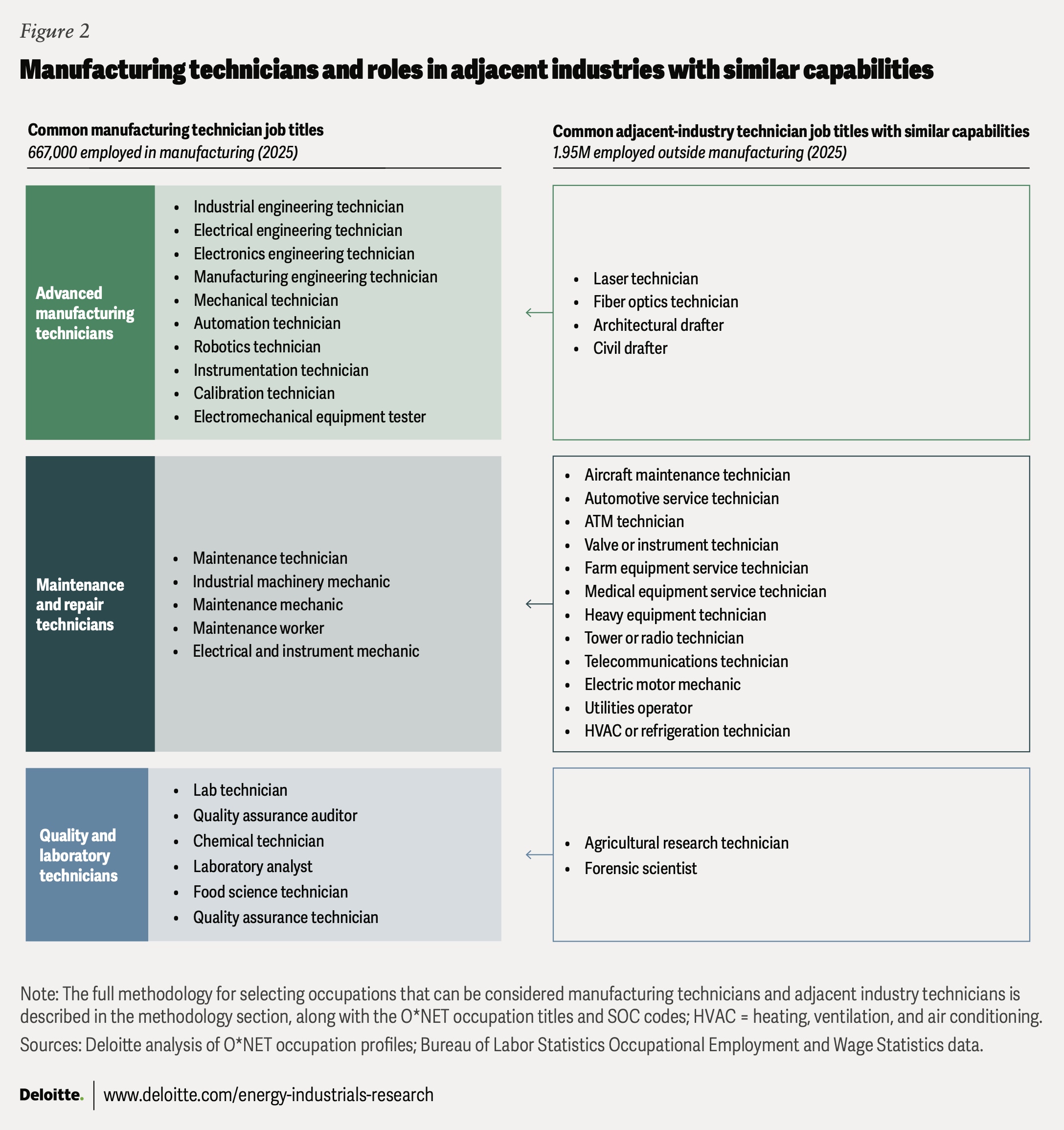
The manufacturing technician workforce (which we refer to as “manufacturing technicians”) encompasses a range of occupations that we grouped into three primary categories based on typical preparation pathways,5 work activities, knowledge, and transferable skills (see methodology).6
- Advanced manufacturing technicians support the design, implementation, testing, calibration, and optimization of manufacturing equipment, systems, and processes.
- Maintenance and repair technicians keep advanced equipment operating through preventative maintenance, troubleshooting, and repair.
- Quality and laboratory technicians ensure product and process quality through testing, analysis, and validation.
These categories enable a better understanding of the distinct technician roles in a manufacturing environment while also revealing the common capabilities they share with technicians in similar occupations primarily employed outside manufacturing (whom we refer to as “adjacent-industry technicians”) and could represent a future source of manufacturing talent (figure 2).7
More than two-thirds of adjacent-industry technicians are employed in construction, retail trade, other services (except public administration), wholesale trade, and government (see, "Adjacent-industry technicians represent a potential talent pool across many industries").8
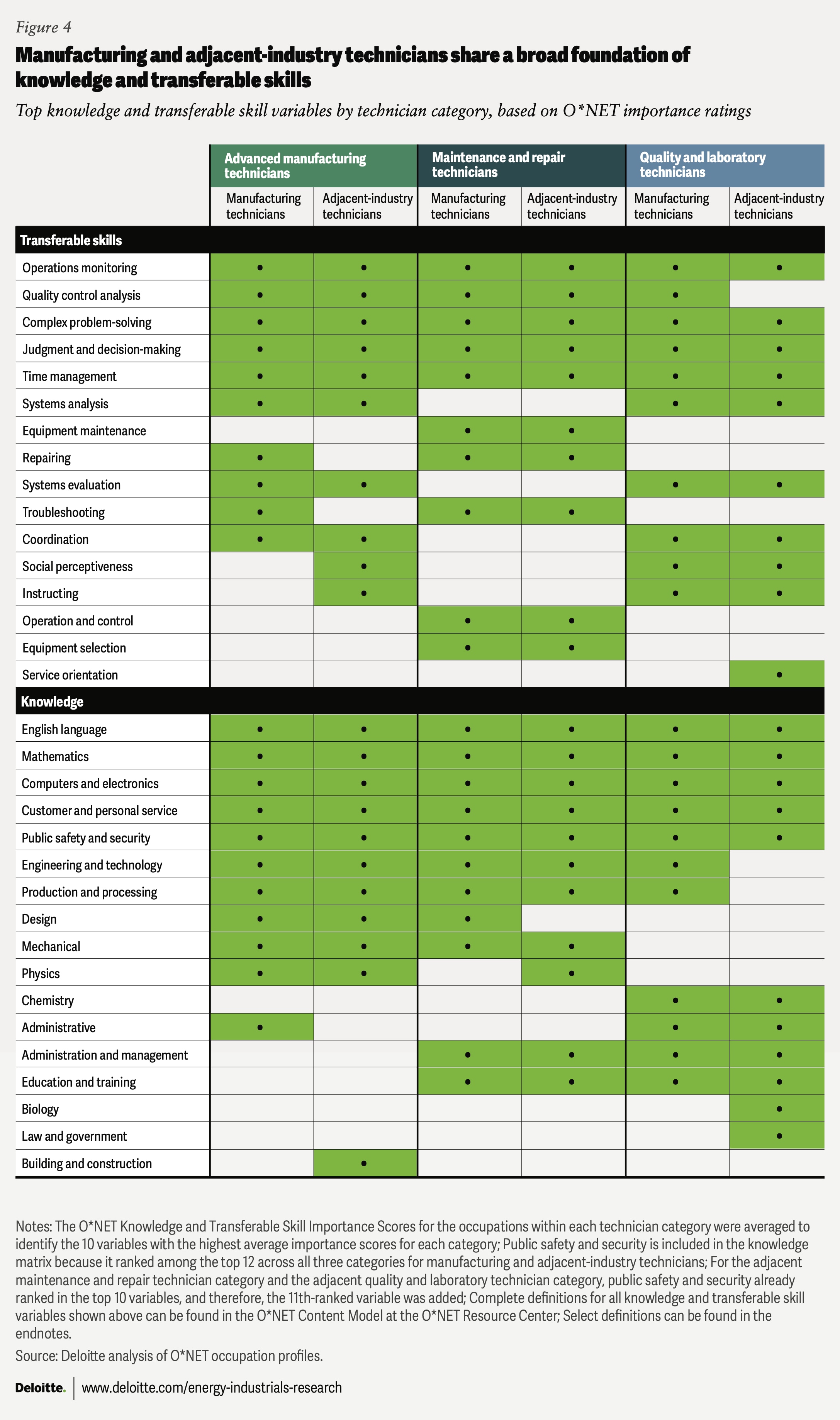
Adjacent-industry technicians share a broad foundation of knowledge and transferable skills with manufacturing technicians, but emphasize different domain knowledge, such as construction, biology, and law and government, and skills such as social perceptiveness and service orientation (figure 4).9 These shared capabilities can create an opportunity for AI to help bridge domain knowledge and skill gaps and support greater cross-category and cross-industry mobility, which could help manufacturers expand the technician talent pool.
Strong employment growth is another commonality between manufacturing technicians and their adjacent-industry counterparts (figure 5). Between 2010 and 2025, employment among manufacturing and adjacent-industry technicians grew substantially faster than production occupations.10 Further, during the most recent period, 2020 to 2025, this gap widened, and based on current industry trends, the growing need for technicians is anticipated to continue.
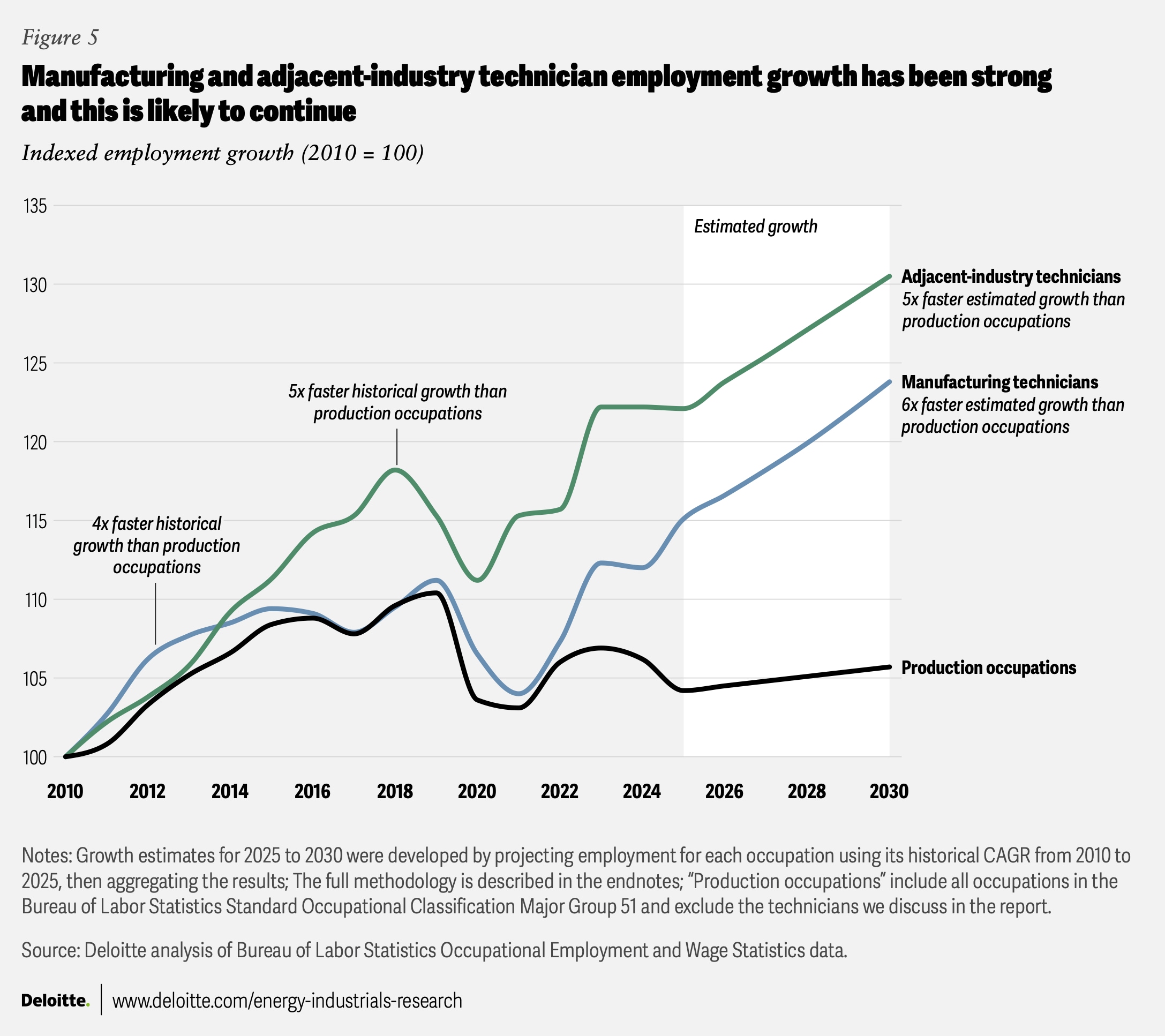
Deloitte and The Manufacturing Institute estimate that, between 2025 and 2030, manufacturing technician employment could grow six times faster than employment in production occupations, whereas adjacent-industry technician employment could grow five times faster.11
“Between 2025 and 2030, manufacturing technician employment could grow six times faster than employment in production occupations.”
As the demand for technicians continues to grow across industries, competition for a limited talent pool may intensify, especially if ongoing skills and applicant shortages aren’t addressed. More than 4.5 million workers were employed in manufacturing technician and adjacent-industry technician occupations across all industries in 2025.12 According to an analysis of Bureau of Labor Statistics data, employers may need to fill 2.3 million job openings across these occupations between 2025 and 2030, due to both employment growth and replacement needs from retirements, other labor force exits, and occupational transfers.13 Meeting this workforce demand will likely require a new approach that broadens and strengthens the talent pool by lowering barriers to entry, accelerating technician development and mobility, elevating the ability to perform increasingly complex work, and enhancing technician attraction and retention.
How generative and agentic AI could help meet the increasing need for technicians
AI has the potential to help manufacturers meet the growing demand for technicians while creating business value.
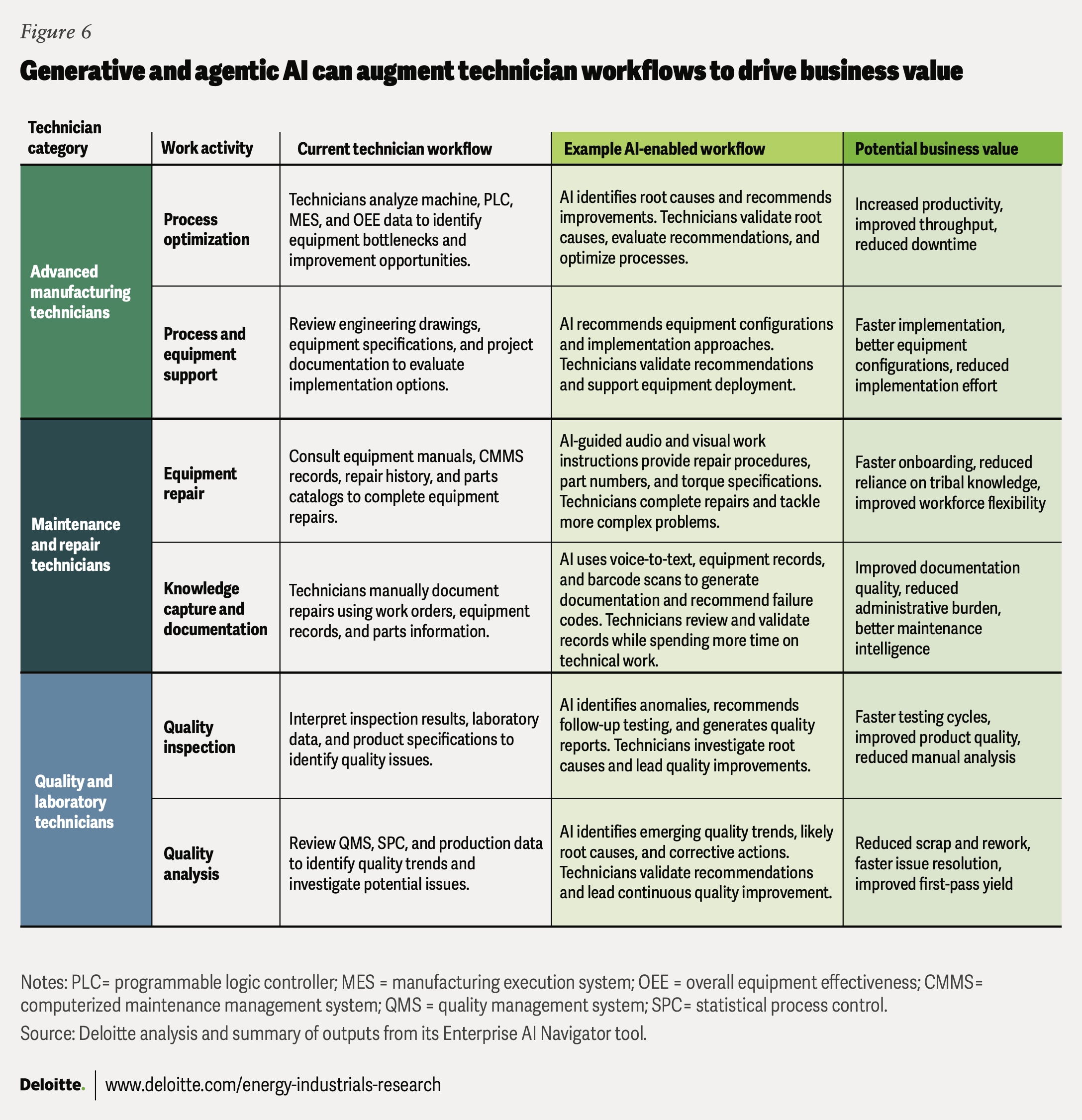
Lower barriers to entry and accelerate technician development: By embedding learning, guidance, expertise, and intelligent action directly into workflows, AI can help workers develop, augment, and apply new knowledge and skills in the flow of work while automating routine decisions and tasks (figure 6).14 This includes the shared and unique transferable skills that define manufacturing and adjacent-industry technicians, such as troubleshooting, equipment maintenance, and quality control analysis, as well as knowledge of production processes and electronics. As a result, barriers to entry can be reduced for less-experienced workers, technicians transitioning from adjacent industries, or manufacturing technicians moving between categories, enabling them to contribute more quickly. For example, a new manufacturing maintenance technician could capture a video of an unfamiliar equipment problem for AI to analyze and recommend troubleshooting steps within minutes, rather than waiting for remote expert support.15
Enable increasingly complex work: AI can also enable experienced technicians to take on increasingly complex and higher-value responsibilities. For instance, an advanced manufacturing technician may spend less time manually interpreting inspection data and test results and more time leading process improvement efforts.
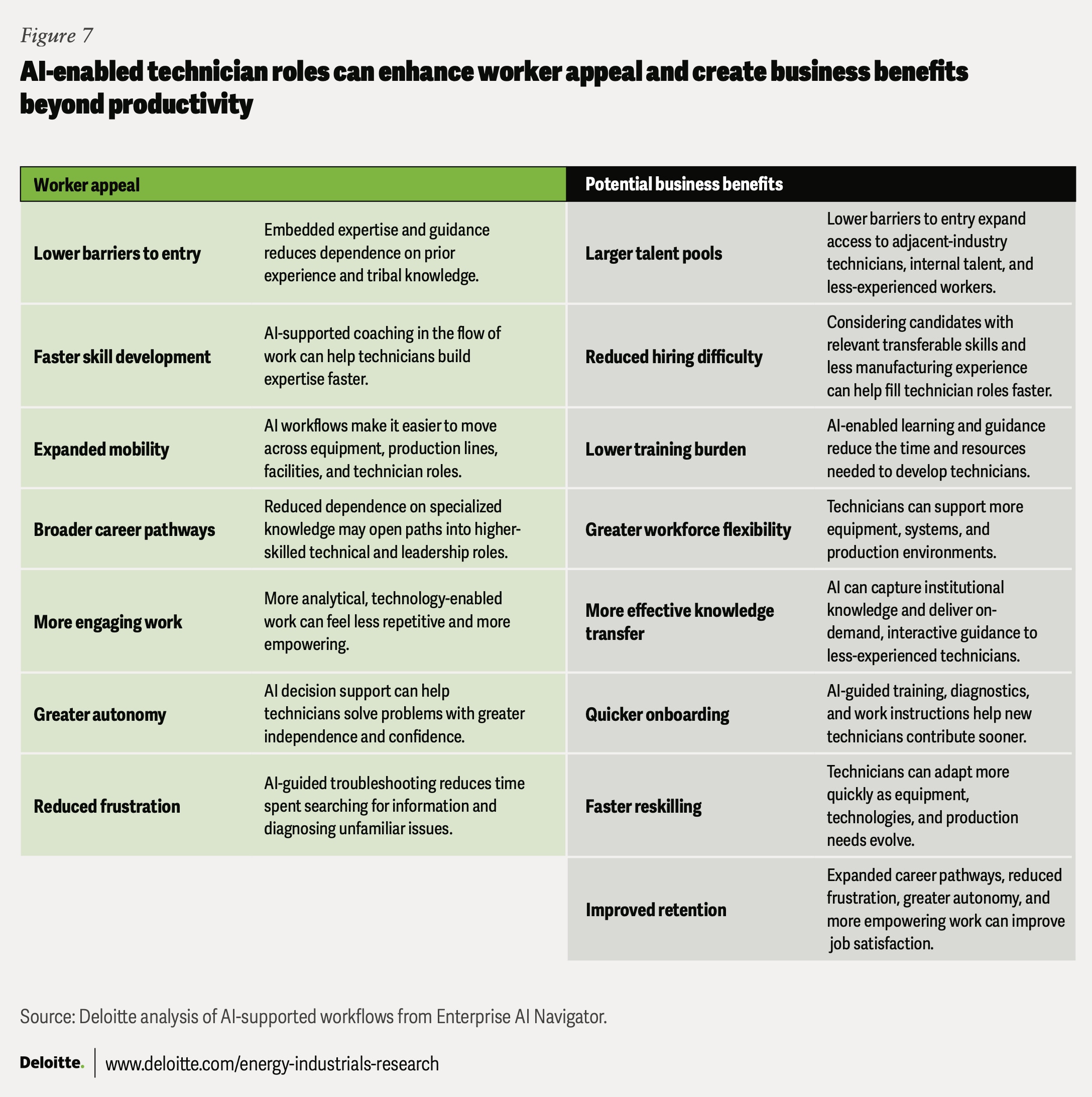
Enhance talent attraction and retention: As AI becomes embedded in technician workflows, the opportunity extends beyond improving operational performance to fundamentally reshaping the technician experience—from onboarding and career development to mobility, autonomy, and job satisfaction (figure 7). These benefits could have far-reaching impacts on a company’s ability to attract and retain the technician workforce it needs. For example, Generation Z and millennial workers surveyed value learning and development, on-the-job experience and guidance, and opportunities to acquire new skills16—areas where AI can serve as a powerful enabler and potentially boost the appeal of technician roles (see, “Empowering manufacturing workers to do more, higher-value work with AI”). This is particularly important given that Gen Z and millennials now comprise the majority of the US workforce.17
Preparing now for the AI-enabled technician workforce
Manufacturers and their ecosystem partners should focus on answering the question: “What do we need to build now to help ensure we have the AI-enabled technician workforce we need in the next three to five years?” The answer should include a workforce plan that builds on the complementary strengths of humans and AI to improve the productivity of existing technicians, accelerate technician development, and expand access to internal and adjacent talent across the three technician categories. Manufacturers should consider five actions when building this plan.
1. Develop a prioritized AI implementation road map
Manufacturers should first develop a prioritized road map identifying where AI can generate the greatest value within the company, while considering the key factors required to achieve scale: cost, data architecture, tech stack modernization, governance, trust, and workflow transformation.18
2. Reimagine and redesign technician workflows around human–AI collaboration
Rather than layering AI onto existing systems and processes, companies should reimagine and redesign technician workflows to leverage the unique strengths of humans and AI.19 This can also help understaffed technician teams accomplish more today while longer-term hiring, training, and career pathways continue to evolve.20 In fact, according to a recent Deloitte study, companies that take this approach are twice as likely to outperform on AI-related return-on-investment expectations as those that don’t.21 Effective redesign should engage current technicians as key stakeholders and balance human outcomes with business benefits at both the task and organizational levels.22
3. Define AI-enabled technician skills and redesign training programs and career pathways
A recent Deloitte survey of company leaders found that companies are increasingly aligning and deploying workers based on tasks, skills, and outcomes rather than traditional jobs and positions.23Accordingly, manufacturers should consider defining the new skill sets AI-enabled technicians will need, building on the broad foundation of shared capabilities across the three technician categories. These skill sets include foundational AI literacy, such as prompt design, output interpretation, and validation, alongside higher-order skills such as oversight, orchestration, exception handling, and strategic and ethical decision-making.24 As AI becomes increasingly embedded in manufacturing systems, the need to validate AI-generated recommendations and safely oversee and work alongside more autonomous systems—including intelligent collaborative robots and other forms of physical AI—could further increase demand for technicians with new and more advanced skills.25
Because AI can embed knowledge and expertise directly into workflows, training programs should be designed around experiential learning based on the redesigned workflows technicians will use. AI-enabled coaching, diagnostics, and work instructions can be leveraged to support learning in the flow of work. Career pathways can be redesigned to leverage shared transferable skills and knowledge, while AI can help workers move from production roles or adjacent industries into manufacturing technician jobs, move between technician categories, and advance from technician jobs into higher-skilled technical or supervisory roles within the industry.
4. Move beyond traditional change management by embedding learning and adaptation into technician work
Creating an adaptive workforce is increasingly important: Eighty-five percent of respondents to Deloitte’s 2026 Global Human Capital Trends survey say it is important for organizations and workers to develop the ability to adapt at the speed required by today’s world, but only 7% say they are making great progress toward doing so.26 Manufacturers can move beyond traditional change management by embedding adaptation, experimentation, learning, and growth into the daily technician work experience.
Successfully integrating AI into technician roles should include building trust, encouraging experimentation, and helping workers understand how AI can augment their expertise. This includes establishing clear decision rights for when AI should recommend, act, or require human validation, while training supervisors to coach workers through adoption. It also involves being mindful of “cultural debt”—the gap that can emerge when technology adoption outpaces changes in culture, behavior, and ways of working.27 Implemented well, AI can reduce frustration, expand access to expertise, support career mobility, and give technicians greater autonomy in solving complex problems on the production floor. Together, these efforts can enable workers to continuously evolve, help avoid stalled transformations, and potentially turn technician workforce flexibility and adaptability into a competitive advantage.28
5. Strengthen partnerships to modernize technician education and workforce development
Education and workforce systems should evolve alongside technician roles. Manufacturers, educators, workforce organizations, and equipment and technology providers should establish and maintain close partnerships to help ensure that training programs reflect changing technician workflows and skill requirements (see “A workforce ecosystem partnership to accelerate AI skills through FAME”).29
Technician curriculum should be updated to include AI literacy, AI-enabled diagnostics, digital and audiovisual work instructions, data interpretation and validation, and human–AI collaboration. It should also shift toward an even stronger emphasis on transferable skills that will be important across technician categories in AI-enabled roles, such as complex problem-solving, judgment, and decision-making. These capabilities should be embedded in hands-on exercises that use actual manufacturing equipment, systems, and scenarios. Programs should also create stackable credentials and skills-based pathways that support movement between adjacent industries and among manufacturing occupations.
Together, these elements can help usher in a new era of AI-enabled technicians that could turn one of manufacturers’ greatest workforce challenges into a strategic advantage. Companies that act now to redesign work and prepare their technician workforce may be best positioned to create new value, accelerate innovation, and sustain a competitive edge.
Continue the conversation
Meet the industry leaders
Steve Shepley
Kate Hardin
BY
Luke Monck
Victor Reyes
Tim Gaus
Victoria Bloom
Kate Hardin
John Morehouse
The authors would like to thank Anuradha Joshi for her key contributions to technician occupation analysis, analytical leadership, and framing, and Vrinda Garg for important contributions to research, data analysis, and writing support.
Deloitte advisory board:
Ajay Chavali, Matt Fox, and Leticia Camara Roinesdal
NAM advisory board:
Gardner Carrick, Sytease Geib, and Monique Lopez
The authors would like to acknowledge the support of Clayton Wilkerson for orchestrating resources related to the report; Kimberly Prauda and Neelu Rajput for driving the marketing strategy and related assets to bring the story to life; Mariel Balaban for her leadership in public relations; and Rithu Thomas, Aparna Prusty, Harry Wedel, and Anu Augustine from the Deloitte Insights team for supporting the report’s publication.
Editorial (including production and copyediting): Rithu Thomas, Aparna Prusty, and Anu Augustine
Design: Rahul Bodiga and Harry Wedel
Cover image by: Rahul Bodiga
Knowledge services: Rohan Singh
Visit the Deloitte Center for Energy & Industrials
Access more insights for the aerospace and defense, chemicals and specialty materials, engineering and construction, industrial manufacturing, mining and metals, oil and gas, power and utilities, and renewable energy sectors.