
The healthcare CFO readiness gap in enterprise decision-making
Surveyed healthcare finance leaders say they’re expected to shape enterprise decisions. Stronger systems, data, and capabilities may strengthen their influence.
Across seven enterprise decision areas, 73% of surveyed healthcare chief financial officers and finance leaders, on average, say they’re expected to be regularly or heavily involved in enterprise decisions, while only 49% feel well equipped to contribute across those same areas (figure 1). The result is a 24-percentage-point average gap between expectations and enablement, according to the Deloitte Center for Health Solutions’ 2026 annual survey of 32 health plan and 32 health system CFOs (see methodology).
That gap is showing up in the decisions that tend to matter most. Surveyed finance leaders indicate that boards and executive teams expect them to be regularly or heavily involved in affordability, access, patient and member experience, care model transformation, technology transformation, and long-term strategy.1 As financial pressure intensifies across the healthcare sector,2 decisions once viewed primarily through clinical, operational, or strategic lenses can now carry more direct economic implications, expanding the role finance is expected to play.
The readiness gap may, at its core, reflect an organizational design gap: Expectations for CFOs may have expanded faster than the systems built to support their enterprise role. Closing that gap likely involves three moves: embedding, enabling, and empowering finance more intentionally across the enterprise.
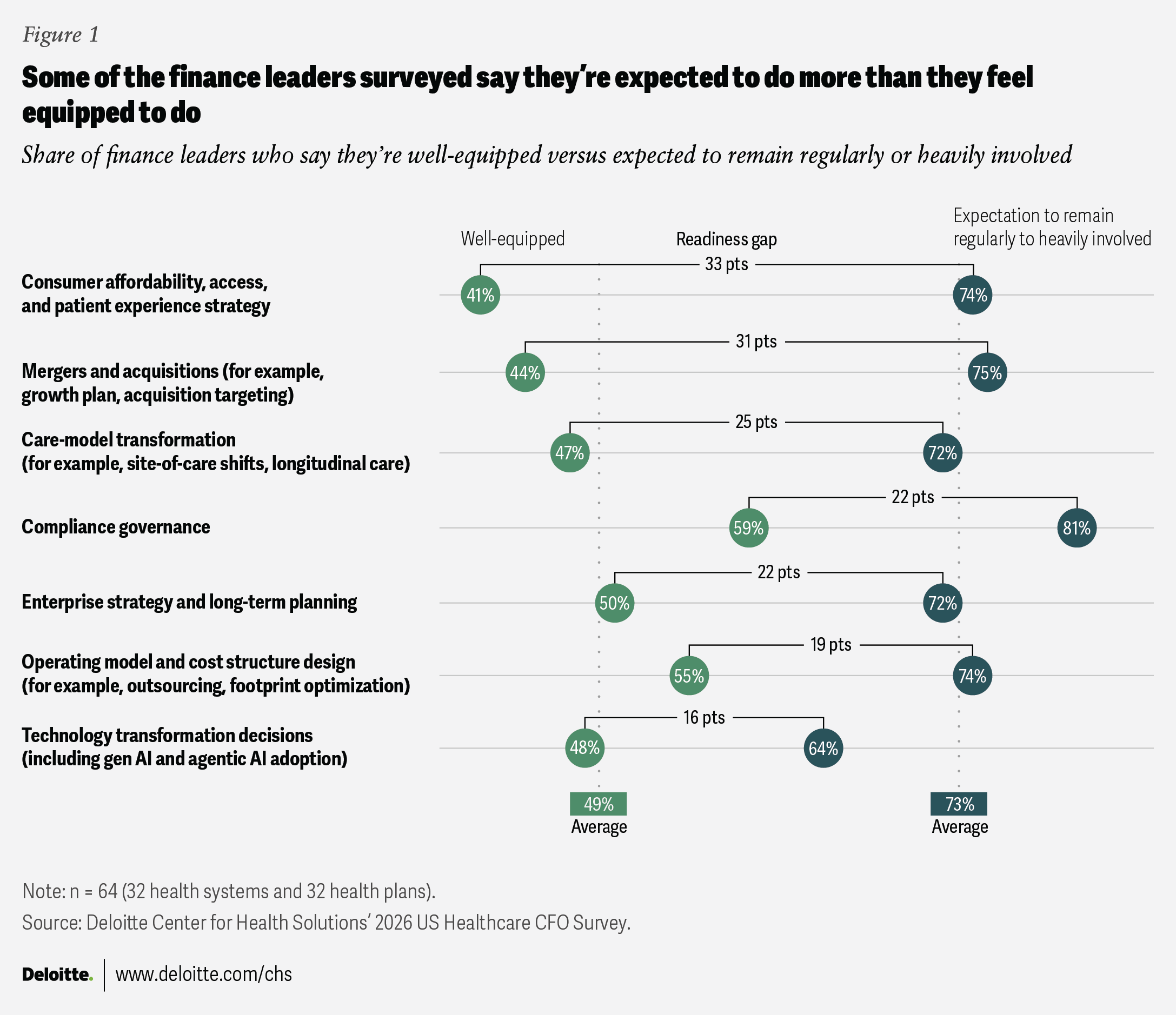
The largest readiness gaps are concentrated in some of the most consequential decisions facing healthcare organizations. The widest gap is in consumer affordability, access, and patient experience strategy: Seventy-four percent of CFOs say they’re expected to be regularly or heavily involved, but only 41% feel well equipped to contribute—a 33-percentage-point gap. This gap is wider in health systems than in health plans, at 38 percentage points versus 28 percentage points. Large gaps also appear in mergers and acquisitions and growth decisions (75% expected versus 44% equipped, a 31-percentage-point gap) and care model transformation (72% versus 47%, a 25-percentage-point gap).
Technology transformation shows a smaller gap (64% expected versus 48% equipped; a 16-percentage-point gap), but that appears to reflect lower expectations for finance involvement rather than higher readiness. Even so, technology remains central to enterprise transformation, particularly as organizations invest in artificial intelligence, automation, and data modernization.3 If CFOs are expected to play a larger role in those decisions over time, this gap could become more significant.
These findings are notable because many of the largest gaps appear in areas that extend beyond traditional finance responsibilities and involve enterprisewide trade-offs. Decisions about affordability, patient and member experience, care delivery redesign, technology transformation, and AI adoption often involve significant enterprise investments4 and require organizations to balance clinical, operational, consumer, and financial outcomes simultaneously. Finance leaders are well positioned to connect those dimensions and evaluate enterprise trade-offs,5 yet many survey respondents reported that they don’t yet feel equipped to do so consistently across domains.
The pattern may reflect a mismatch between expanding expectations for CFOs and the organizational systems designed to support the finance function. Many finance functions may have been built for a narrower remit,6 with data environments, reporting structures, and operating models that predate the CFO’s expanded enterprise role. Without corresponding changes to those systems, finance leaders may need to shape enterprise decisions without the information and support needed to influence them.
Three enterprise considerations to turn CFO involvement into influence
Closing the readiness gap is fundamentally an organizational design challenge: how finance is embedded, what information it can access, and how decisions are governed. Creating CFO influence involves more than inviting finance to more meetings or expecting leaders to develop new skills in isolation. It may mean redesigning the systems around the CFO role, including the operating model, data environment, and decision-making processes to let finance help shape priorities early rather than weigh in after choices are already underway. Capability development still matters, but it can be most effective when those structural conditions are in place.
1. Embed: Redesign the finance operating model around enterprise value creation
A readiness gap can persist even when the CFO is “in the room” if finance isn’t involved as enterprise priorities are being translated into initiatives, investments, and transformation programs. In some technology transformations, for example, finance may need to quantify the business case only after initiatives have already been prioritized based on clinical, operational, or technology objectives. By that point, finance can still evaluate the economics, but its ability to shape the underlying growth, efficiency, and value considerations may be more limited.
To close that gap, organizations may need to redesign the finance operating model around enterprise value creation rather than functional oversight alone. That means embedding finance business partners early in cross-functional efforts such as affordability programs, patient and member experience initiatives, technology transformation, and care model redesign—early enough to help set priorities, frame trade-offs, and shape choices, not simply approve them. It may also require finance leaders to consistently demonstrate how financial insight improves enterprise decision-making, especially in areas where trade-offs are complex and outcomes extend beyond the near-term budget impact.
As finance becomes more deeply embedded in cross-functional initiatives, enterprise fluency tends to become more important. Finance leaders should understand how operational, clinical, technology, workforce, and consumer choices translate into margin, risk, capital needs, and growth.7 Building that fluency may require closer exposure to the operating context behind strategic decisions, as well as stronger consultative, influencing, and strategic decision-support capabilities.8
The result is a shift from finance as a control function that reviews decisions to finance as a cross-functional partner that helps shape priorities and trade-offs alongside other leaders, similar to how information technology has evolved from a support function into a strategic enabler.9
2. Enable: Build the decision infrastructure for cross-functional leadership
When information is fragmented across financial, clinical, operational, workforce, and consumer domains, finance leaders struggle to effectively influence interconnected enterprise decisions.10 Traditional finance systems and data environments are built to track financial performance metrics, including revenue, cost, capital, and margin,11 which makes them well -suited to decisions with direct financial impact. However, this can leave finance with less visibility into broader decisions such as care management, service line strategy, or transformation investments, where financial outcomes depend on operational, clinical, and consumer variables that aren’t consistently connected. When that visibility is missing, finance participation tends to be reactive rather than influential.
Organizations may therefore need decision-making infrastructure that gives finance a more integrated enterprise view. This infrastructure can include connected data platforms that provide visibility across financial, clinical, operational, workforce, claims, and consumer data; scenario models that show how affordability, utilization, reimbursement, staffing, capacity, and margin move together; and shared key performance indicators for cross-functional priorities such as AI, care model transformation, and access redesign. In many cases, the core challenge is a lack of connection across functions and an inability to evaluate implications at the enterprise or population level rather than within individual departments, programs, or budgets.12
For example, a health plan evaluating affordability initiatives may need to determine whether changes in benefit design, care management, or access models could improve member experience and retention enough to justify their impact on utilization, medical costs, and margin. Finance can help shape those decisions only when consumer, operational, clinical, and financial signals are connected well enough to make those trade-offs visible.
3. Empower: Strengthen governance around finance’s enterprise role
As expectations for finance expand, organizations may need greater clarity about where finance leads, co-owns, advises, or challenges enterprise decisions, including its decision rights and measures of success. Without that clarity, finance leaders could be held accountable for outcomes without having sufficient authority or influence over them.
Finance may not need authority over the final decision, but it may need a clearer role in shaping the assumptions, trade-offs, and outcomes used to evaluate that decision. That can be especially important in transformation efforts, where value may emerge over longer time horizons, cut across functions, or depend on the combined impact of multiple initiatives. Governance mechanisms may need to account for those broader enterprise outcomes when prioritizing investments and measuring success.
Consider a health system launching a hospital-at-home capability. Clinical, operational, workforce, technology, and finance leaders may all help shape the initiative, yet accountability for measuring its full impact can become fragmented. Finance may be expected to assess the implications for access, capacity, quality, reimbursement, and margin without a clearly defined role in the governance processes that shape those outcomes.
Practical steps may include clarifying decision rights and formalizing finance’s role in the enterprise forums where priorities are set, investments are approved, performance is reviewed, and transformation outcomes are tracked. These forums may include strategic planning, capital allocation, transformation governance, and enterprise performance reviews. Organizations may also need clearer accountability for value realization, including who owns the outcomes, how they’re measured, and how performance is managed over time.
This may also require expanding how CFO and finance functions are measured beyond traditional finance metrics to include enterprise outcomes such as affordability, access, transformation value realization, AI investment performance, capital productivity, and growth impact. Stronger governance can help turn finance participation into sustained influence rather than keeping it largely advisory.
Meeting the healthcare CFO’s expanded role
CFOs report that their roles have expanded, but the finance leaders we surveyed say they don’t feel fully equipped to fulfil those expanded responsibilities. That means their organizations may also need to evolve. Healthcare organizations that align the operating model, decision infrastructure, and governance with the CFO’s expanded role may be better positioned to convert finance participation into enterprise influence.
Continue the conversation
Meet the industry leaders
Alicia Janisch
Dr. Jay Bhatt
by
Alicia Janisch
Omosede Ogiamien
Abhinav Astavans
Hashim Simjee
Dr. Jay Bhatt
Richa Malhotra
The authors would like to express their sincere gratitude to Nivedha Subburaman and Madhushree Wagh for contributing significantly to the research design, analysis of key findings, and writing of sections of the report. The authors would also like to thank Maulesh Shukla for helping shape the insights, reviewing the paper, contributing subject matter expertise, and providing overall research guidance.
The authors would also like to thank Jeff Burke, Hash Simjee, Abhash Dhar, Cole Wheeler, Bill Laughlin, Ed Hardy, Priya Ehrbar, and Roxanne Lucy for their subject matter expertise and review; and Rebecca Knutsen and Jared Johnson for their review and support in developing the narrative. Additional thanks go to Shyamili M, Nicole Jupe, Daniela Bain, Jennifer Wotczak, Debra Asay, and the many others who contributed to the project.
Editorial (including production and copyediting): Rebecca Knutsen, Shyamili M, Arpan Kumar Saha, and Anu Augustine
Design: Natalie Pfaff and Alexis Werbeck
Cover image by: Alexis Werbeck; Adobe Stock
Knowledge services: Vanapalli Viswa Teja
Visit the Deloitte Center for Health Solutions
Access more insights for the hospital, health system and provider, pharmaceutical manufacturer, health plan and payer, medtech, and health tech organization sectors.