
CFO-ready, or not? 5 gaps that can quietly hold finance leaders back from advancement
CFOs interviewed pointed to these as the most common roadblocks high performers face. Understanding them can help next-gen leaders break through and strengthen the pipeline.
Many finance leaders may be meeting—or exceeding—expectations on paper. They’ve achieved strong results, have deep technical credibility, and have made steady progress in their careers. Yet the move to chief financial officer is increasingly determined by a different set of capabilities: not more finance skills, but more experience leading across the enterprise.
To identify potential readiness gaps that high-performing finance leaders may face in rising to the CFO role, Deloitte’s US CFO Program conducted 236 interviews between 2024 and 2025 with senior finance leaders across industries, including many from large, complex organizations. Overall, CFOs told us that, when evaluating potential successors, in most cases, the technical qualifications were there. What was often missing was the signal that these candidates were ready to lead across the organization.
These readiness gaps showed up as perception or confidence gaps. The CEO, board, and the executive team had trouble seeing the candidate as an enterprise partner, not just a top functional performer.
Understanding them—and taking steps to overcome them—can help aspiring CFOs gain the experiences and exposure they will need to become CFO-ready. It can also help sitting CFOs and the executive team more effectively coach, sponsor, and assess successors. Taking these actions can help executive teams build a deeper pipeline of next-generation leaders who have the requisite skills and capabilities to step into C-suite roles.
Here are five readiness gaps that can quietly hold high-performing finance leaders back from becoming the next CFO—and what leaders and executive teams can do to help prevent them.
1. Their communication skills and everyday presence aren’t developed enough to inspire confidence among stakeholders
A senior leader’s message may be spot on, but its impact will depend on how others feel when they hear it. In a 2024 Deloitte survey of 200 CFOs from large North American organizations, when asked about the quality they valued most when selecting the next CFO, 39% of respondents cited good communication skills—the ability to explain results in clear, simple terms, which was the highest-ranked response.1
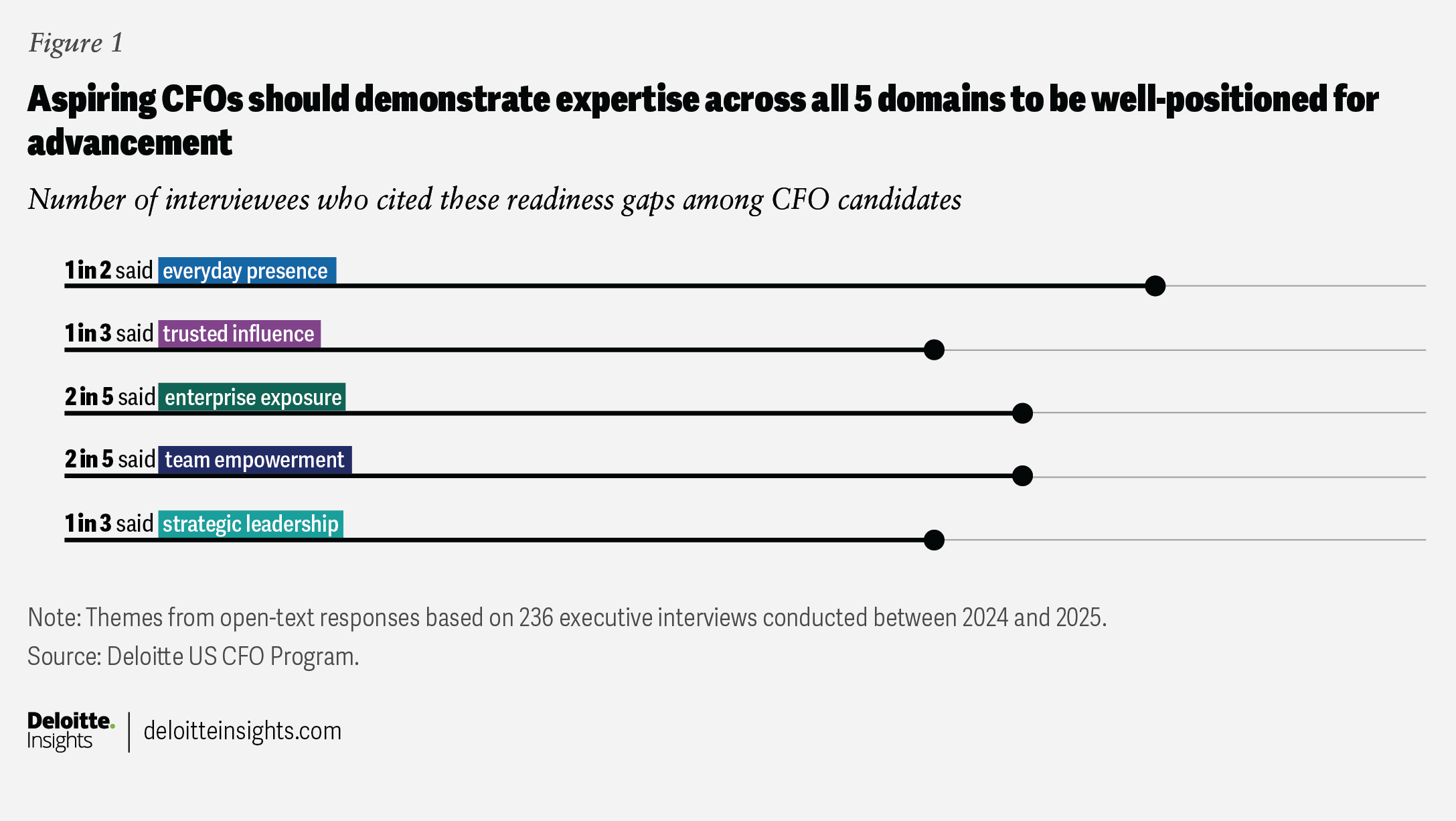
Additionally, leaders need to show everyday presence: consistently and authentically projecting confidence, competence, and credibility in ways that can reduce uncertainty and accelerate decision-making. Everyday presence is often most visible when the stakes spike; when leaders must simplify quickly, stay steady and composed, and land a decision in real time. Not having demonstrated enough everyday presence was the readiness gap most often mentioned in interviews (figure 1).
In particular, everyday presence can be demonstrated when CFOs tailor the narrative so that each audience—the board, investors, the CEO, peers, or employees—can quickly understand the “so, what” and the recommended next steps.2 “You’re an executive first and a CFO second,” says Steve Priest, the former CFO of eBay and JetBlue. “Tailor your message to the distinct audiences you are addressing; help them feel informed, make them feel important, make them feel valued. The ability to walk into a room and drive a conversation that is appropriate to the audience is a learned skill. If you can do that, it can drive so much opportunity.”
2. They’re respected—but not influential enough to be sought out to shape decisions
If everyday presence is demonstrated in how you deliver in the moment, influence is how you shape the path to the moment. Our interviews suggest that these factors often surface together. Among leaders who flagged presence as a gap, roughly one-third also pointed to challenges with influence across the organization.
Among leaders who flagged presence as a gap, roughly one-third also pointed to challenges with influence across the organization.
Many finance leaders may equate influence with being persuasive in meetings. But from our conversations with CFOs, we’ve found that CFO-level influence is built through three levers: establishing trust, bringing a clear point of view that ties finance to business outcomes, and participating in the forums where decisions are shaped.
Trust: Leaders need to believe that aspiring CFOs understand their goals, will protect what matters, and that they’ll bring a perspective that will help them get to the best answer. “It’s about asking, ‘How can we get to yes?’” Priest explains. “Finance gets a bad rep[utation] for being the ‘no’ police. If you can flip that on its head, you become someone that people knock on your door for counsel.”
Point of view: Aspiring CFOs shouldn’t assume their strong work speaks for itself. They should make a point to share crisp points of view and the “why” behind their recommendations. Doing so can encourage C-suite leaders to seek their counsel, not just rely on them for execution. Kimberly Fontan, CFO of Entergy Corporation, says, “No matter what role you currently hold, you need to be able to connect what you’re doing in finance to how it helps the business, so you can drive positive business outcomes and value for your stakeholders.”
Visibility: You can’t influence what you’re not invited to. Aspiring CFOs can offer to present in executive team meetings, in front of the board, and in committee meetings where recommendations are formed. If board exposure isn’t happening organically, they can ask to own a slice of the board preparation process (pre-reads, committee deep dives, or rehearsals) before requesting airtime in the meeting.
3. They don’t have enough operational experience and exposure to show they can run the business, not just finance
Another common readiness gap mentioned in the interviews was being perceived as “finance only”: someone who excels within their role but hasn’t demonstrated an understanding of the entire enterprise. Jason Winkler, CFO of Motorola Solutions, Inc., says: “Finance is not a spectator sport. I’ve always attacked finance with an operations mindset: Fix problems, not report on problems. I expect my finance teams and operational teams to work closely together. At the end of the day, we’re all solving for greater sales, greater profitability, greater cash flow, no matter what team you’re on.”
Finance leaders can gain wider exposure and experience across their organization by:
- Rotating across core finance domains (such as financial planning and analysis, treasury, mergers and acquisitions, or investor relations)
- Owning operating outcomes (commercial, supply chain, customer, or productivity levers)
- Gaining exposure to external stakeholders (investors, lenders, or rating agencies)
When pursuing these experiences, finance leaders shouldn’t be aiming to check boxes. They should see them as opportunities to build credibility and understand how the business works, how trade-offs are made across the organization to align with business priorities, and how capital markets behave.
4. They haven’t delegated enough work to develop their teams and scale their leadership impact
Leaders whose calendars are packed with work that only they can do may be signaling the opposite of readiness. The CFO role typically requires the ability to delegate, build a strong leadership bench, and scale decision-making by having others handle most of the day-to-day functional responsibilities.
Winkler says: “When you have an A team, ask tough questions, but encourage them to take calculated risks and support them if they fail. I learned that from my predecessor … At that time, I considered myself a JV athlete, and he often let me take the ball and play varsity in various assignments.”
Deloitte’s 2026 Global Human Capital Trends report reinforces why “letting go” is a CFO-readiness issue, not a style preference. The report stresses the importance of deploying talent to the highest-value work. But delegating and scaling up doesn’t mean doing less. It’s about redesigning the system, so outcomes don’t depend on one person. Aspiring CFOs can coach and develop team members to represent finance with credibility across the enterprise—and become next-in-line finance leaders.
Priest says: “Delegate, delegate, delegate. You’ll get pulled into seismic issues, and you need to make sure you have the capacity to handle those while the engines keep running.”
5. They’re delivering results, but they’re not serving as strategic leaders across the organization
CFOs are expected to operate at altitude by shaping strategic priorities, making visible trade-offs, and driving transformation. These key strategic areas can be described as disciplined risk-taking: making decisions on liquidity, capital allocation, and transformation timing that include explicit guardrails, scenarios, and downside plans.
For many organizations, artificial intelligence is quickly becoming the most visible proof point of catalytic and strategic leadership. But aspiring CFOs may need to go beyond piloting a tool to be considered CFO-ready. They will likely need to find ways to translate AI into enterprise value, funding and prioritizing the right bets, scaling adoption through process redesign and talent, and putting governance in place so leaders trust decisions supported by AI.
In Deloitte’s Finance Trends 2026 survey, 57% of finance leaders surveyed said they are among the top influencers of strategy. This reflects how explicitly the role is shifting toward enterprise leadership. Melissa Thomas, CFO of Cinemark Holdings, Inc., says: “As CFO, my role is to serve as a strategic thought partner to the business. My focus is on advancing our company forward and driving incremental, long-term value.”
Actions that can help cultivate CFO-ready leaders
In many ways, signaling CFO readiness involves demonstrating ability, and even expertise, in areas that CFOs are expected to master. And while more than two-thirds of CFOs interviewed mentioned multiple readiness gaps, these gaps are not insurmountable (figure 2). The following actions can help set talented finance professionals up for success and help prepare them to step into the CFO role down the line.
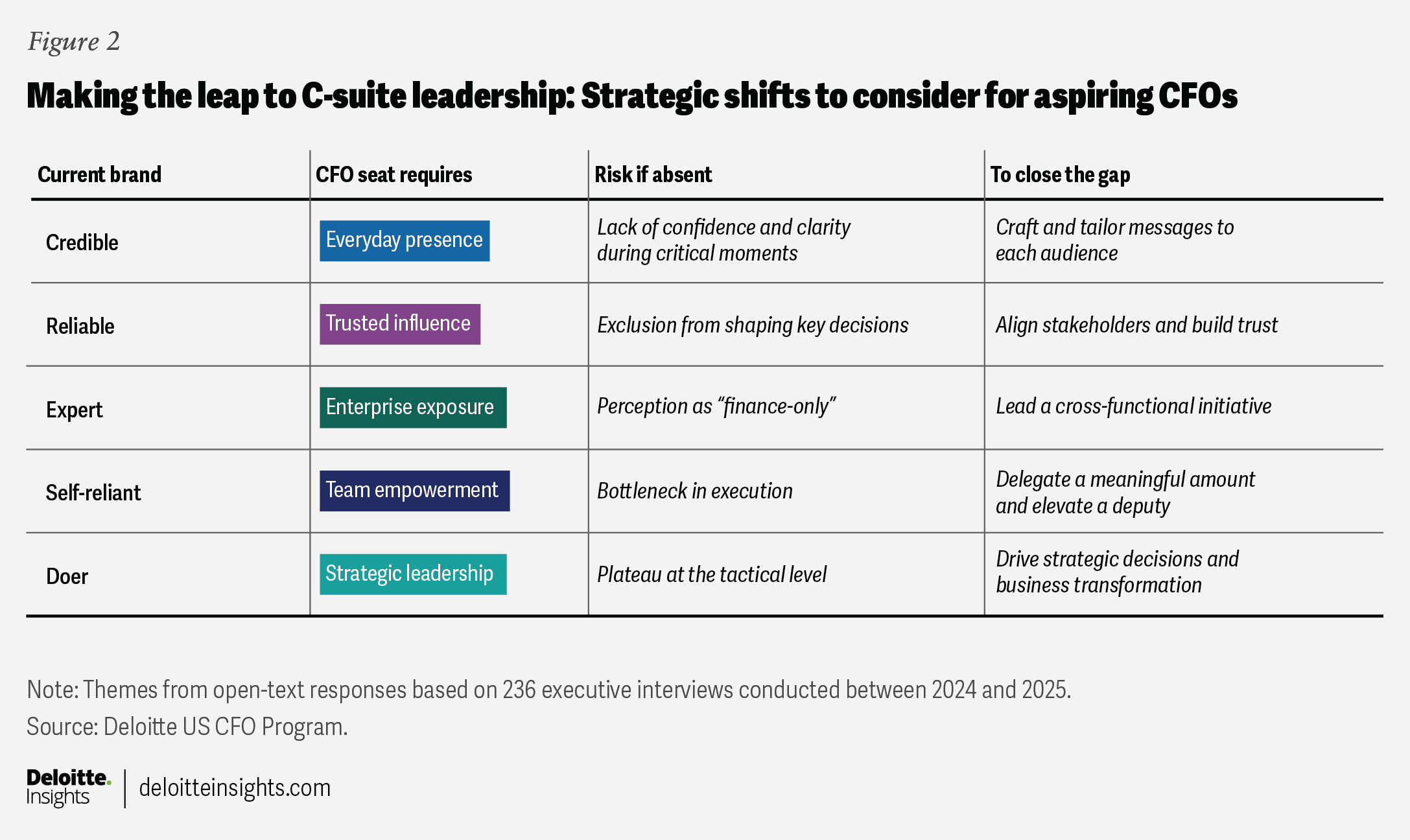
Aspiring CFOs: Finance leaders shouldn’t wait for the title to start building the profile. They can seek enterprise exposure and opportunities to demonstrate strategic leadership, practice executive-level communication in high-stakes settings, and cultivate relationships with leaders who make (and influence) the biggest decisions. They can also evaluate—either individually or with the help of mentors—their progress in demonstrating everyday presence, influence, enterprise exposure, delegating and team building, and strategic leadership (see “Practical self-checks for aspiring CFOs”).
CFOs and the executive team: Current CFOs and other C-suite leaders, such as the chief human resources officer, also have a pivotal role to play in helping pave the way for talented finance professionals to become viable successors. Leaders should be mindful that the finance pipeline won’t strengthen through technical development alone. These executives should identify high-potential talent early, sponsor them into enterprise experiences, and give them visible “ownership moments” that prove they can lead beyond the finance team.
Continue the conversation
Meet the industry leaders
Jessica L. Bier
Casey Caram
by
Jess Day
Laura Bauke
Ashley Foster
Many thanks to Jessica Bier, Casey Caram, Kristen Klimenko, Robin Feinman, and Priya Ehrbar for their guidance in shaping this article.
Editorial: Karen Edelman, Hannah Bachman, Preetha Devan, Pubali Dey, and Anu Augustine
Design: Alexis Werbeck, Steffanie Lorig, and Molly Piersol
Audience development: Kelly Cherry
Cover image by: Steffanie Lorig
Knowledge services: Rohan Singh