
Many healthcare CFOs are pursuing margin gains amid preparedness gaps
A Deloitte survey suggests that healthcare finance leaders are setting bold margin goals, even as self-reported preparedness to manage key pressures remains uneven
According to Deloitte’s 2026 survey of 64 healthcare finance leaders, nearly 60% are targeting operating-margin improvement of 2 percentage points or more over the next two years, including 27% aiming for an improvement of more than 5 percentage points (see methodology). Those goals seem ambitious for an industry that often operates on low single-digit margins, on average, and where many organizations have reported ongoing financial pressure in recent years.1
At the same time, healthcare organizations are navigating converging pressures that constrain revenue growth, limit pricing flexibility, increase costs, and delay needed investments.2 Those pressures may make it harder for chief financial officers to deliver on margin goals. In fact, only 47% of surveyed finance leaders, on average, say their organizations are well prepared to manage the external forces and enterprise capability gaps that could affect operating margins (figure 1).
Our survey suggests a meaningful disconnect between ambitious margin goals and confidence in the organization’s ability to manage key performance drivers. In today’s environment, organizational preparedness tends to be increasingly important to financial performance.
Organizations’ preparedness may be a weak link
To assess where preparedness may be most strained, we looked at the gap between the share of finance leaders who expect a given issue to affect margins and the share who say their organizations are well prepared to manage it. We refer to these differences as “preparedness gaps.”
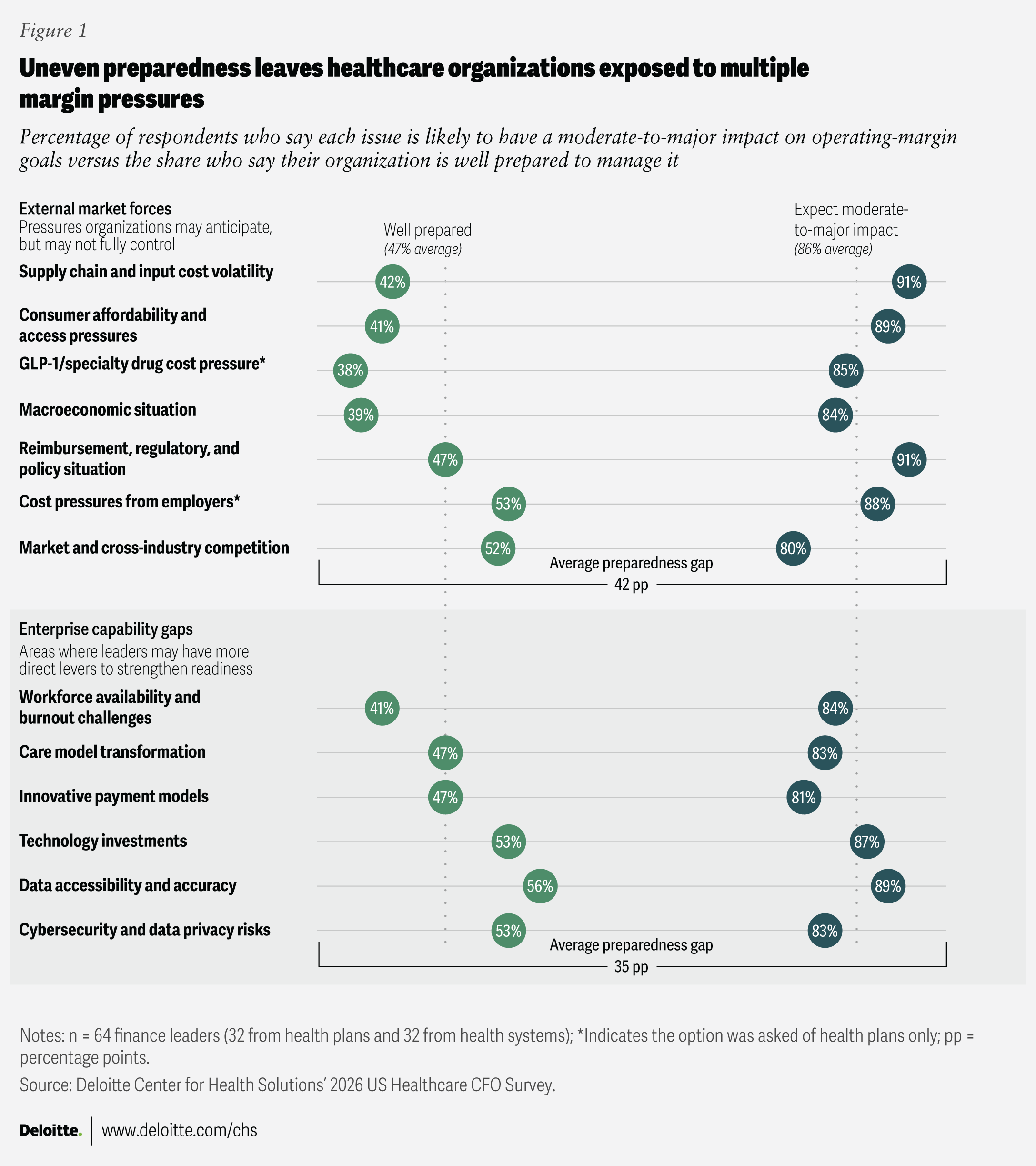
As shown in figure 1, preparedness gaps are wider for external market forces, which include areas organizations may be able to anticipate but not fully control. Across these forces, the average preparedness gap is 42 percentage points, compared with 35 percentage points for enterprise capability gaps.
Two issues stand out among the largest preparedness gaps in our survey: consumer affordability and access pressures, and GLP-1 and specialty drug costs. These findings suggest that gaps in “how prepared organizations are” may create execution risk.
The affordability paradox: Traditional price-led strategies may face limits
Many healthcare organizations are still leaning on traditional pricing levers to meet ambitious margin goals. More than half of surveyed health plans (59%) cite premium pricing and benefit design as the top margin lever, while 44% of health systems cite increasing service prices.
But these strategies are being pursued at a time when affordability and access pressures remain prominent,3 and when finance leaders recognize that those pressures could materially affect performance. In our survey, 89% of finance leaders say consumer affordability and access pressures are likely to have a moderate-to-major impact on margins, yet only 41% say their organizations are well prepared to manage them. Amid persistent affordability pressures, traditional price-led growth strategies may prove harder to rely on as a durable margin approach.
In a separate Deloitte analysis of 17,622 publicly available newsroom and press-release articles published between January 2023 and May 2026 across 62 health systems and health plans, affordability and access emerged as one of the most visible external narratives. Among articles aligned with our 15-theme taxonomy, affordability- and access-related actions and challenges consistently ranked as the second-largest theme, representing roughly 18% to 24% of share of voice over the 2023–2026 period (see methodology).
Amid persistent affordability pressures, traditional price-led growth strategies may prove harder to rely on as a durable margin approach.
GLP-1 and specialty drug costs: When demand acceleration outpaces readiness
For health plans, GLP-1 and specialty drug cost pressures reflect another substantial gap, with 85% of surveyed finance leaders expecting a moderate-to-major margin impact, yet only 38% reporting that their organizations are well prepared to manage it.
The GLP-1 example reflects a broader market dynamic. Demand for GLP-1 therapies appears to be rising, driven in part by expanded indications, growing consumer awareness, their expanding role in obesity and diabetes management, and an ongoing debate about their value in preventing high-cost conditions.4
Across health plans of varying sizes, that demand is contributing to higher drug-cost trends and rising utilization, in some cases adding pressure beyond what organizations had planned for.5 While these therapies may offer long-term clinical and cost benefits,6 their near-term cost impact likely introduces more volatility into medical loss ratios and actuarial forecasts.7
Health systems may face a different set of considerations. As GLP-1 utilization expands, these organizations are evaluating the potential implications for demand across select service lines, particularly those tied to obesity-related interventions and chronic disease management.8
More broadly, these examples highlight a common tension. Healthcare organizations may increasingly recognize these forces as likely to affect margins. However, many may still be building strategies, operating models, funding mechanisms, accountability structures, and performance measures needed to respond at scale.
Revenue growth may require more than traditional operating levers
The preparedness gap may widen because the margin playbook itself needs to evolve. Many of the surveyed finance leaders are signaling a potential shift away from conventional cost reduction and toward revenue-led strategies over the next two fiscal years. Among health systems, the share of finance leaders inclined toward revenue-led strategies rises from 31% in the prior two fiscal years to 50% in the next two fiscal years. Among health plans, that share more than doubles, from 25% to 53% (figure 2).
This shift can add complexity because revenue-led margin improvement involves growth in an environment where affordability, reimbursement, labor, and capital pressures can limit the very investments and operational flexibility needed to deliver it.
Even so, many organizations appear to continue prioritizing levers close to the existing operating models, including productivity improvement, pricing actions, utilization management, administrative efficiency, and cost optimization, according to our survey results.
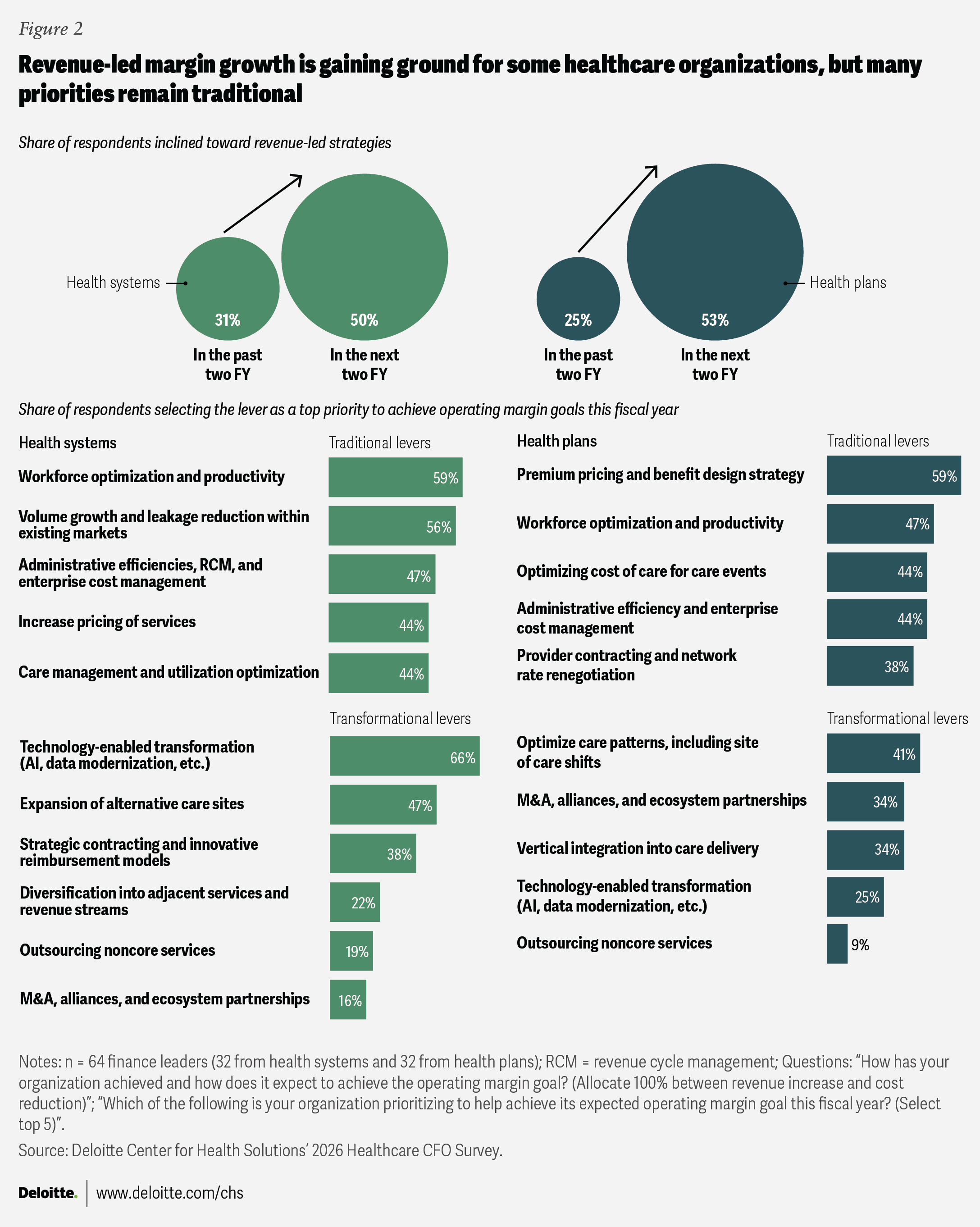
For health systems, the levers fall into four broad categories:
- Operating productivity: Workforce productivity, administrative efficiency, and technology-enabled transformation, such as denials prevention and predictive staffing.
- Access and throughput: Volume growth, leakage reduction, and alternative care sites that can expand capacity without relying solely on inpatient growth.
- Revenue capture: Revenue cycle improvement and selective pricing strategies.
- Strategic growth: Care model redesign, partnerships, service-line mix, and capital reallocation.
Outside a few areas, such as technology-enabled transformation, the survey suggests that many health systems are still placing more emphasis on levers that strengthen the current model rather than on initiatives that could materially reshape future growth.
Surveyed health plans show a similar pattern and appear to be pursuing a broad portfolio of margin levers. Premium pricing and benefit design, workforce productivity, cost-of-care optimization, site-of-care shifts, administrative efficiency, provider contracting, and network rate renegotiation all reflect reasonable responses to reimbursement pressure, utilization volatility, and medical cost inflation. But many of these levers continue to optimize the existing model.
However, if the objective is truly revenue-led margin growth, health plans may also need to evaluate product and geographic portfolio optimization, member retention strategies, risk-bearing partnerships, digital engagement models, and care-management capabilities that can create new sources of value.
For both health systems and health plans, the opportunity may lie in making clear choices about which levers will create differentiated value and concentrating resources on them rather than spreading effort across a broad portfolio of incremental improvements. Doing so will likely require organizations to shift their current margin playbook.
Turning margin ambition into execution capability
As margin improvement in 2026 and beyond is likely to take place in a more complex execution environment, the following four considerations can help health system and health plan CFOs close the gap between margin ambition and execution preparedness:
1. Build speed, scale, and agility into the margin plan
Organizations should stop treating headwind preparedness as a separate risk management exercise and instead build it directly into the margin plan. This involves advanced scenario planning and agile governance capabilities that can enable more effective navigation of uncertainty.9
In practice, this can mean moving beyond static annual or semiannual planning toward more frequent and dynamic scenario planning, supported by artificial intelligence-driven insights, continuous monitoring, and the integration of external market signals into enterprise risk management processes.10 For example, AI-enabled monitoring could identify emerging patterns in claim denials and reimbursement leakage, estimate the potential revenue impact, and alert leaders when reimbursement assumptions begin to diverge from the plan.11
Finance leaders may need continuously updated models that show how changes in reimbursement, workforce, utilization, supply chain, affordability, and capital conditions could affect revenue, costs, growth, and investment assumptions. In other parts of the healthcare ecosystem, some organizations are investing in resilience capabilities such as scenario planning, real-time monitoring, and early-warning indicators to identify disruption sooner and respond more quickly.12
Health systems and health plans may not need to predict every disruption, but they should consider:
- Building headwinds into planning as the expectation rather than the exception. Factors like regulation, revenue pressure, cost inflation, labor challenges, consolidations, and competition may be the norm, and financial forecasts and strategies should be built to thrive under these conditions.
- Establishing a clearer way to identify when dynamics supporting margin assumptions changed enough to require action, and to define clear trigger points for when leaders should adjust priorities or shift resources before adverse experience turns into missed margin targets.
2. Pressure-test the margin growth model
Revenue-led margin improvement shouldn’t become a label for higher prices or more volume alone. Each growth lever should start with a margin thesis: source of demand and funding, expected margin math, required capacity, investment needed, time to value, owner, and risks to access, affordability, or quality.
For a health system, this could include testing whether leakage reduction in a high-margin specialty can be delivered with available physician capacity, scheduling access, and payer mix. Additionally, all strategies should consider the flow of funds. For example, while many revenue strategies interact directly with a payer, they ultimately rely on employers, governments, or households, which may increasingly be unable to bear those additional costs.
For a health plan, this may mean evaluating whether benefit design changes, network strategy, and care management investments can improve margins without increasing member abrasion or regulatory risk. Health plans should also consider whether these changes create only temporary gains or deliver sustainable, trajectory-changing differentiation.
3. Treat workforce engagement as a financial asset
Margin ambition also depends on whether organizations have the capacity to deliver change. Several transformational levers, such as technology-enabled transformation and care model redesign, involve teams that can adjust to new ways of working while continuing to run the business. Yet only 41% of surveyed finance leaders say their organizations are well prepared to manage workforce availability and burnout challenges.
Prior Deloitte research suggests that health system cost and technology initiatives that prioritize clinician engagement are five times more likely to be rated as effective by frontline clinicians.13 For finance leaders, this emphasizes the importance of assessing workforce readiness as part of the business case for major transformation initiatives, alongside traditional measures such as cost, revenue, and return on investment.
Organizations may consider treating workforce capacity, skill mix, access to tools, and change readiness as margin variables, not just operating considerations. For finance leaders, this readiness extends beyond labor cost management. It can be a financial asset that influences whether transformation investments convert into measurable margin improvement. This tends to be especially important as organizations invest in transformational levers such as AI and care model redesign.
4. Establish a finance-led margin command center
Margin improvement increasingly spans finance, operations (clinical and nonclinical), technology, workforce, strategy, and risk. A margin command center (or integrated value management office) led by the finance function can give leaders a common view of which levers are delivering, which are falling behind, and what trade-offs are emerging across margin, access, affordability, quality, capacity, and risk.
The command center shouldn’t be another reporting layer. Instead, it should connect enterprise financials, operational key performance indicators, and decision-making, such as when to reallocate capital, stop an underperforming initiative, scale a proof point, pursue new revenue and growth opportunities, or revisit assumptions. Enterprise financial analysis should also take a holistic view of impacts across population cohorts, including service lines, fee-for-service contracts, risk-based contracts, and entities such as management services organizations and provider-sponsored plans.
AI and analytics can help surface early warning signals faster and automate parts of forecasting,14 but speed alone is unlikely to improve performance. The larger opportunity can lie in strong governance structures that define who reviews the signals, how often leaders act on them, what thresholds trigger escalation, and who has authority to reallocate resources or change course. Leaders may need to meet frequently enough, with the right data and decision rights, to make difficult trade-offs before performance slips below margin targets. This margin management approach is also likely to depend on finance having the visibility and cross-functional decision structure to connect operational choices to enterprise economics, as we discussed in “The healthcare CFO readiness gap."
Building the execution advantage
Bold margin targets can be useful because they create focus and urgency. But in 2026 and beyond, the advantage may belong to organizations that translate ambition into an execution system: driver-based planning, funded growth theses, affordability discipline, workforce-enabled change, and enterprise governance that can adapt as conditions shift. The question for healthcare finance leaders is how effectively their organizations can respond as these forces continue to shape margin performance.
Continue the conversation
Meet the industry leaders
Alicia Janisch
Dr. Jay Bhatt
by
Alicia Janisch
Bill Laughlin
Cole Wheeler
Jeff Burke
Dr. Jay Bhatt
Madhushree Wagh
The authors would like to express their sincere gratitude to Nivedha Subburaman and Richa Malhotra for contributing significantly to the research design, analysis of key findings, and writing of sections of the report. The authors would also like to thank Maulesh Shukla for helping shape the insights, reviewing the paper, contributing subject matter expertise, and providing overall research guidance. The authors would like to thank Sandeep Vellanki, Sanjay Mallik, and Alluri Rohith Reddy for their support with the gen AI-enabled public commentary analysis.
The authors would like to thank Hash Simjee, Abhash Dhar, Abhinav Astavans, Ed Hardy, and Priya Ehrbar for their subject matter expertise and review, and Rebecca Knutsen and Jared Johnson for their review and support in developing the narrative. Additional thanks go to Shyamili M, Daniela Bain, Nicole Jupe, Jennifer Wotczak, Debra Asay, and the many others who contributed to the project.
Editorial (including production and copyediting): Rebecca Knutsen, Shyamili M, and Anu Augustine
Design: Natalie Pfaff and Alexis Werbeck
Cover image by: Alexis Werbeck
Knowledge services: Vanapalli Viswa Teja
Visit the Deloitte Center for Health Solutions
Access more insights for the hospital, health system and provider, pharmaceutical manufacturer, health plan and payer, medtech, and health tech organization sectors.