
Trust drives consumer value and adoption in life sciences and health care
Consumer trust shapes loyalty, engagement, and growth. Deloitte research shows how organizations can build it through four measurable factors.
In today’s life sciences and health care landscape, trust is a measurable driver of consumer behavior, loyalty, and long-term value. Deloitte research shows that trust is a key reason why consumers adopt new services and stay engaged.
In Deloitte modeling of more than 42,500 consumer responses across more than 100 life sciences and health care organizations, including health systems, health plans, biopharma companies, and medtech firms, trust emerged as the factor most strongly correlated with perceived value (see methodology). On average, trust explains 52% of perceived value across the life sciences and health care sectors studied. Its influence varies by sector, accounting for 83% of perceived value for health plans, 61% for biopharma, 50% for health systems, and 51% for medtech firms. In other words, within these sectors, trusted organizations are also more likely to be seen as delivering value.
That relationship is stronger in some sectors than in others, suggesting that consumers may trust certain parts of an experience without assigning the same level of value to the organization overall. When we examined trust alongside other measures, we found that organizations offering similar levels of accessibility and pricing may be experienced very differently depending on whether consumers trust them. The implications are operational: Trust is something leaders should actively measure, design for, and manage across the consumer experience. This is important as stakeholders increasingly invest in virtual-first care, digital tools, home-based services, specialty therapies, and preventive services.1
Four core drivers of consumer trust
To help organizations operationalize and measure trust in products and services, Deloitte’s analysis identified four core drivers that consistently influence how consumers evaluate their experience: humanity, transparency, capability, and reliability.2 These factors reflect practical signals that consumers look for in health interactions and provide actionable starting points for leaders across the health ecosystem looking to build trust at scale.
- Humanity reflects whether the service experience is caring and recognizes different patient needs. Trust falters when systems prioritize internal processes over lived realities, such as when scheduling or care delivery fails to account for needs like income, access to transportation, or prior care experiences.3
- Transparency reflects whether consumers/patients understand what is happening, what comes next, and why decisions are made, communicated in clear, plain language. It can break down when information is late, incomplete, or hard to interpret, such as billing surprises, confusing prior authorization processes, unclear denials, or complex communications about drugs or devices.4
- Capability reflects whether an organization delivers high-quality clinical outcomes, products, services, and experiences. Trust suffers when offerings or digital tools are not well designed or fail in execution.5
- Reliability reflects whether patients can depend on care, products, and support to perform consistently. Lack of access to care and prescriptions, or inconsistent information, often due to complex ecosystems (including, vendors, suppliers, and partners), translate into perceived unreliability that creates frustration and diminishes trust, thereby impacting market share.6
These factors shape consumer experiences across the journey, from choosing coverage, to accessing and using care, to resolving issues. They also reinforce one another: A breakdown or improvement in one area can quickly affect the entire experience.
Trust translates into consumer adoption, retention, and willingness to pay
Trust doesn’t just shape perceptions; it drives behavior. Additional Deloitte analysis of more than 37,000 consumer responses shows that when trust is high, consumers are more than twice as likely to try new products and services (see methodology). Organizations with higher trust scores also see 2.5 times greater consumer loyalty than their lower-trust peers.7
Sustained consumer engagement, which is key to the success of these models, is influenced by trust. And in moments of friction and fragmentation, such as sharing data, complying with care, or navigating coverage rules, trust becomes a deciding factor in whether consumers follow through.8
Trust may also determine whether growth strategies achieve their full potential. In Deloitte’s nationally representative 2025 US Health Care Consumer Survey, nearly 1 in 3 respondents said they would pay more for services that offer easier access to specialists or advanced medicines and technologies that improve outcomes or convenience. But that willingness hinges on adoption and adherence, both of which can be closely tied to trust.
As health care stakeholders move toward long-term value strategies,9 like reducing avoidable health events through preventive care, trust can become foundational enabler. Deloitte actuarial analysis estimates that disease-prevention investments could reduce US medical and drug spending by US$2.2 trillion annually.10 Organizations that treat trust as an operational capability, not just a reputational asset, may be well positioned to realize that potential by deepening consumer loyalty and fueling long-term growth.
Trust deficits could undermine growth as consumers seek simpler, more accessible care
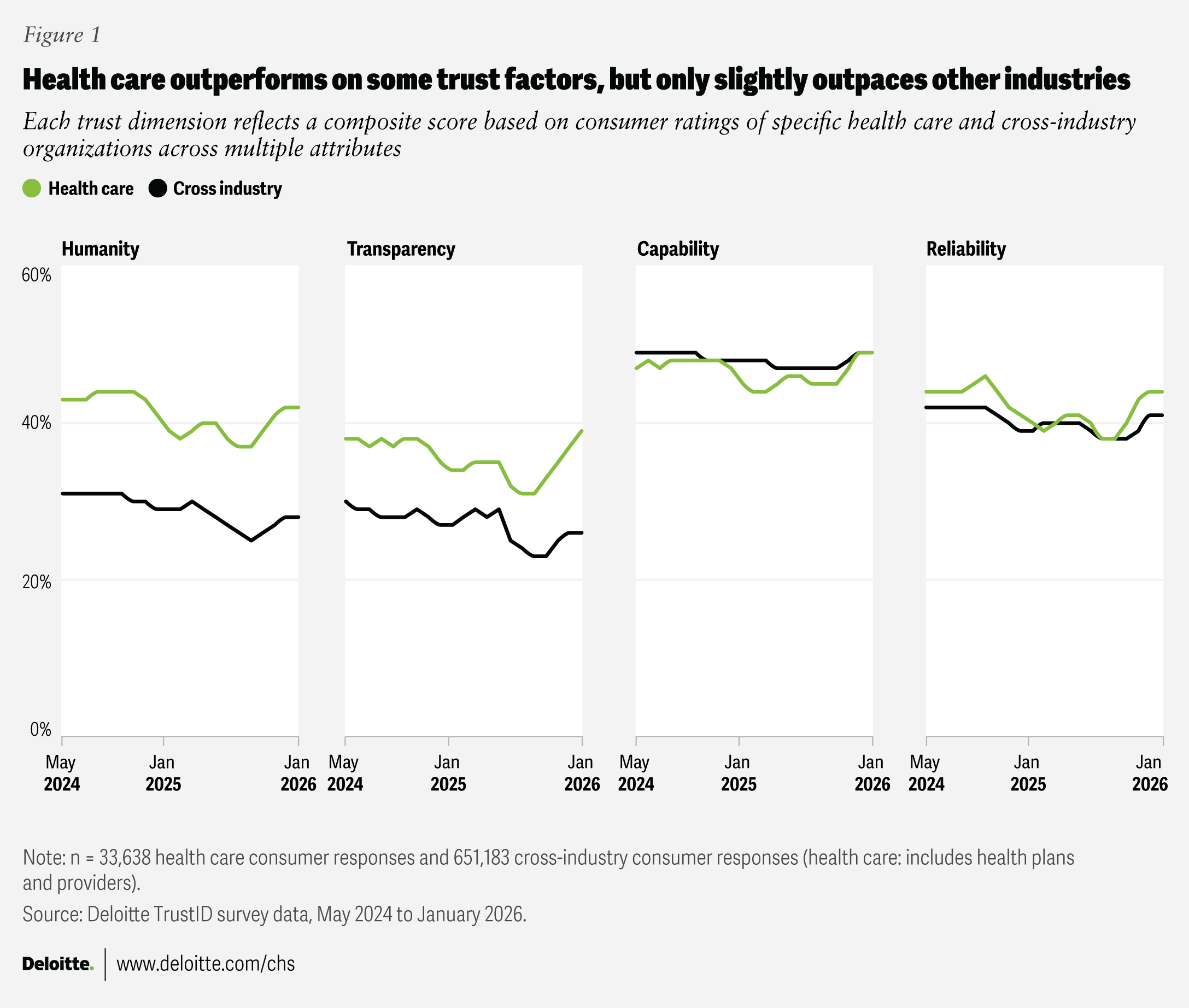
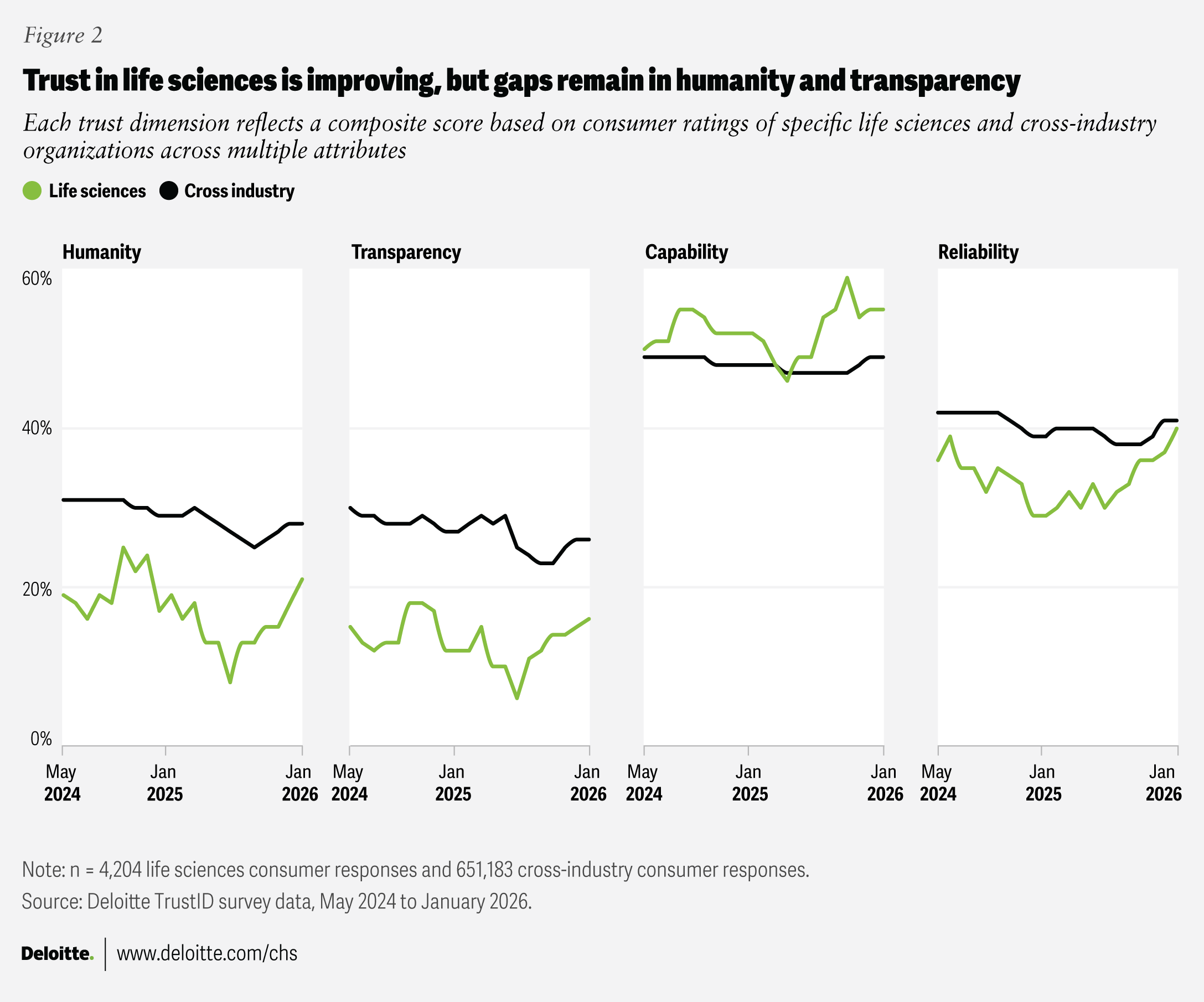
Deloitte’s analysis of 25 life sciences and health care organizations from May 2024 to January 2026 highlights an uneven performance across the four trust factors. Relative to other industries, health care organizations lead on humanity and transparency, score lower on capability, and perform slightly above average on reliability (figure 1). Life sciences organizations, meanwhile, tend to perform well on capability and are narrowing the gap on reliability, but score lower on transparency and humanity (figure 2).
These trust gaps are emerging at a moment of heightened competition and increasing consumer choice. As new market entrants disrupt traditional care models and access options expand, consumers now have more choices and less tolerance for friction, delays, or disjointed experiences.11 For organizations that underperform on trust, this could signal a structural barrier to growth and resilience.
Channel disruption appears to be raising the bar for trust. Consumers now have more ways to access care and products, and they’re increasingly willing to bypass traditional pathways when alternatives are simpler and more dependable.12 The rise of direct-to-consumer (DTC) models, where patients access health services, products, or support directly from a company often without going through a physician, signals this shift.13 According to Deloitte’s nationally representative 2025 US Health Care Consumer Survey, 23% of respondents have used a DTC health offering (see methodology). Among those users, 52% sought prescription drug access, 30% used mental health services, 29% engaged in weight management programs (including GLP‑1s), and 30% used other wellness services like nutrition counseling or doula care.
Younger consumers are redefining what trust can look like
Trust tends to evolve alongside consumer expectations and lived experiences. For younger generations, trust appears to be increasingly shaped by speed, clarity, and control of services. Deloitte’s 2025 US Health Care Consumer Survey reveals that Gen Z and millennials are more likely to engage with DTC health offerings: In fact, 39% of Gen Z and 34% of millennials have used DTC services, compared with just 19% of Gen X and 7% of baby boomers.14
This generational gap may reflect more than preference; it could signal a response to unmet needs. Nearly 1 in 5 Gen Z respondents report missing or avoiding care in the 12 months before the survey because of long wait times (23%) or limited availability outside traditional hours (19%). In contrast, only 7% and 2% of baby boomers cite those reasons, respectively. Given lifestyle differences, DTC options may appeal to younger consumers by offering faster access, extended hours, and simpler digital interactions that deliver on trust dimensions like transparency, reliability, and capability.
Some surveyed consumers also show greater willingness to pay for convenience. Nearly 4 in 10 Gen Z and millennial respondents say they would pay more for easier access to specialists or advanced technologies, compared with just 2 in 10 baby boomer respondents. As organizations plan for the next generation’s loyalty, they should consider designing trust intentionally with a focus on the lived realities and preferences of different population groups.
Designing end-to-end health experiences that build trust
With industry investments in virtual-first care, digital tools, home-based services, specialty therapies, preventive services, and other strategic priorities,18 trust can be a lever for adoption, growth, and value for stakeholders across the health ecosystem. Approaches to coverage, therapies, devices, and services span multiple players, including clinicians, health systems, health plans, regulators, pharmacies, digital platforms, and more. Trust is often shaped by how well these players work together to deliver seamless, reliable, and easy-to-understand care that consumers can adopt and sustain over time.
Consumers can feel the effects of trust through both the quality of individual experiences (how humane, transparent, capable, and reliable they are) and the degree to which organizations coordinate seamlessly with each other within the health ecosystem. When those connections break down such as when roles are unclear, data is inconsistent, processes are broken, workflows are fragmented, or service quality varies, trust can erode, even if one part of the experience is strong. This can lead to confusion, repeated paperwork, delays in care, and a sense that the system isn’t working. Building trust in this landscape involves addressing both sector-specific improvements and cross-organizational coordination.
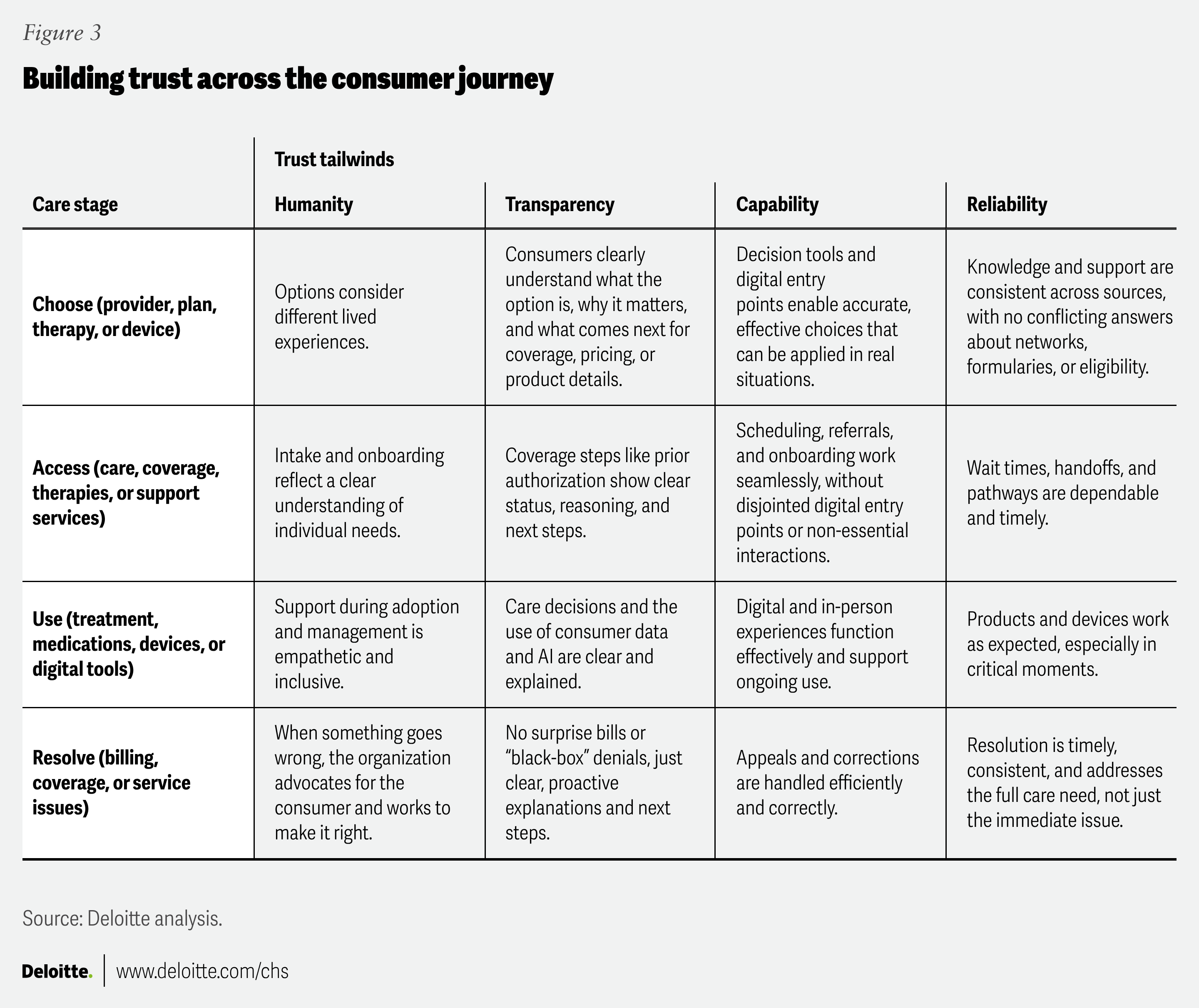
In other industries, consumers may build trust through direct interactions with a single brand. In life sciences and health care, trust can vary across a series of moments as consumers choose, access, use, and resolve care (figure 3). These stages help identify the moments that matter to consumers and highlight handoffs (like eligibility checks, prior authorization, or service recovery) that can create friction if poorly managed. This creates several opportunities to embed trust in the strategic actions that stakeholders may already be prioritizing:
- Health plans can make coverage, costs, administrative steps, and care navigation easier to understand, while pairing that clarity with behavioral support, preventive care, and home-based services that enable consistent follow-through across and beyond the clinic.
- Providers and health systems can strengthen clinical guidance, care navigation, and continuity, while reducing ambiguity and improving access through more seamless experiences that meet consumers where they are.
- Pharmaceutical and medtech companies can reinforce trust by improving onboarding, coordinating affordability and coverage, offering plain-language product information, and ensuring supply reliability.
- Health technology firms can reduce fragmentation in the consumer experience by integrating workflows and clearly communicating how data and AI are used at the key moments in the consumer journey (for example, when consumers provide consent while using digital tools).
- Public agencies can shape the trust environment with clear guidance that is easy for consumers to understand and use to make decisions about their health.
- Community organizations can serve as trusted bridges between consumers and businesses by fostering transparent communication and developing resources tailored to consumers’ lived experiences to support sustained participation.
- Organizations including health plans can make benefits easier to navigate, improve transparency around privacy practices, and simplify fragmented vendor experiences.
In a consumer-directed market, trust is emerging as an important lever for growth because it tends to accelerate adoption, enable selective pricing, and reduce operational friction which can potentially lead to better outcomes at lower costs. At the same time, rising consumer expectations and easier switching between providers can raise the stakes.19 As organizations consider where to invest next, they should take a broad view, looking across both brand and ecosystem performance. The organizations that lead will likely focus less on trust as sentiment and start treating it as an operating system for value creation: measurable, intentionally designed, and actively managed to turn intentions into repeatable outcomes.
Continue the conversation
Meet the industry leaders
Dr. Jay Bhatt
Dr. Kulleni Gebreyes
by
Ashley Reichheld
Drew Wilkins
Dr. Jay Bhatt
Stan Orkin
Mani Keita
Richa Malhotra
Project team: Madhushree Wagh and Leslie Korenda contributed significantly to the scoping, research design, analysis of key findings, and reviewing key sections of the paper. They also supported the overall coordination with an external survey vendor. Pavan Kumar Bhoslay provided critical support on data analysis and interpretation.
The authors would like to thank Rebecca Knutsen for key data review and narrative development; Maulesh Shukla, Anna Doherty, George Forakis, Lisa Iliff, and Christie Murphy for their subject matter expertise and review; and Divya Saha, Urvashi Yadav, Doppalapudi Sriharshavardhan, Shyamili M, Komal Sapra, and Roxanne Lucy for their contributions to this research.
Editorial (including production and copyediting): Rebecca Knutsen, Shyamili M, Prodyut Borah, Anu Augustine, and Cintia Cheong
Design: Meena Sonar and Harry Wedel
Cover image by: Sofia Laviano; Adobe Stock
Knowledge services: Vanapalli Viswa Teja
Visit the Deloitte Center for Health Solutions
Access more insights for the hospital, health system and provider, pharmaceutical manufacturer, health plan and payer, medtech, and health tech organization sectors.