
Momentum isn’t a metric: Many healthcare CFOs report they need clearer proof of AI value
A Deloitte survey shows some healthcare finance leaders are committing capital to AI at scale, but many still report limited financial attribution capability
Article
•
10-min read
•
12 August 2026
•
Deloitte Center for Health Solutions
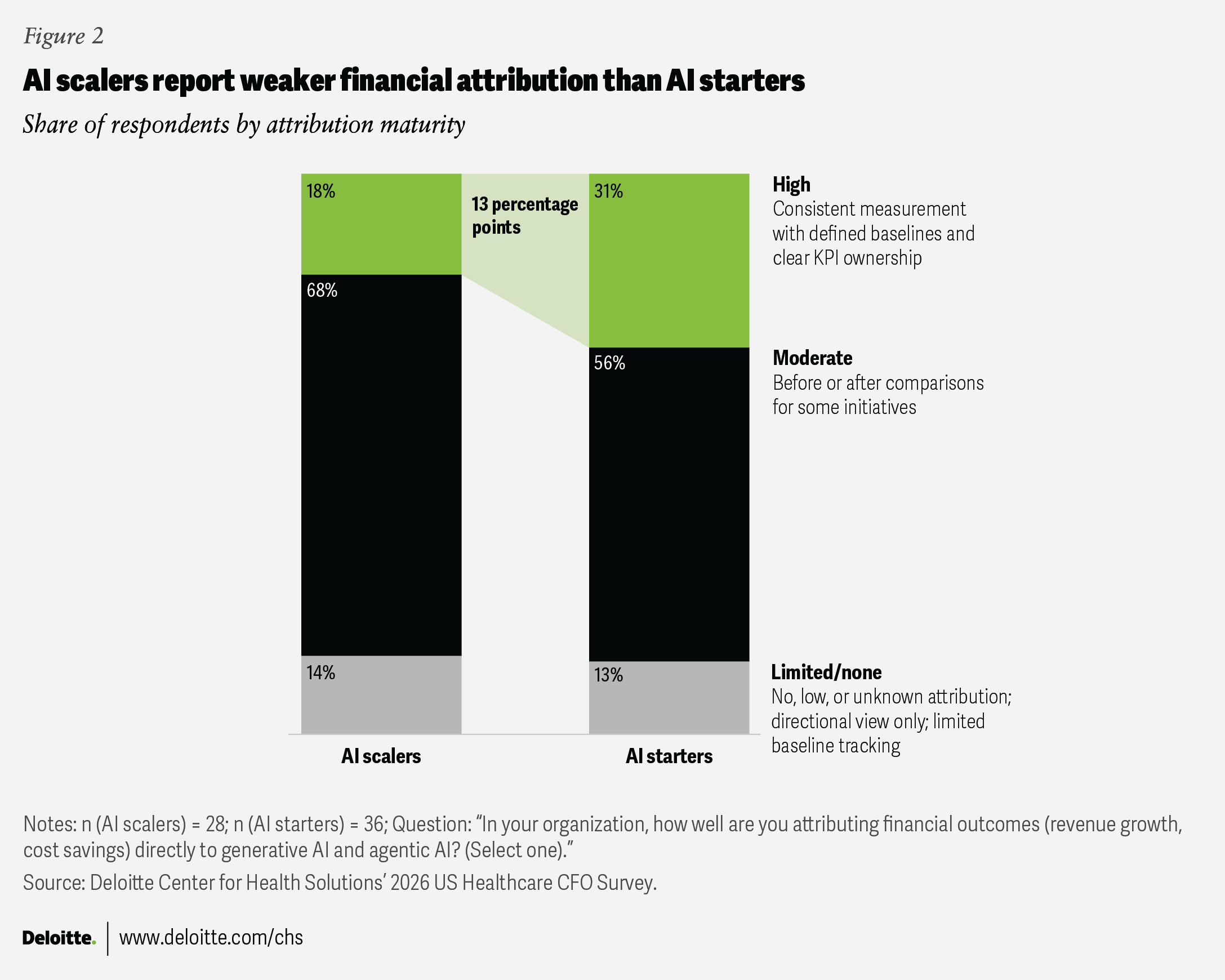
Among surveyed healthcare finance leaders, the organizations that report they’re furthest along in scaling artificial intelligence aren’t necessarily the strongest at proving its value. In the Deloitte Center for Health Solutions’ 2026 survey of 64 US healthcare CFOs—split evenly between health plan and health system leaders—44% can be considered as “AI scalers,” organizations with broader gen AI deployment (see methodology for detailed classification of AI scalers and AI starters). Yet only 18% of AI scalers report mature financial attribution capabilities, compared with 31% of surveyed “AI starters,” organizations earlier in their AI scaling journey.
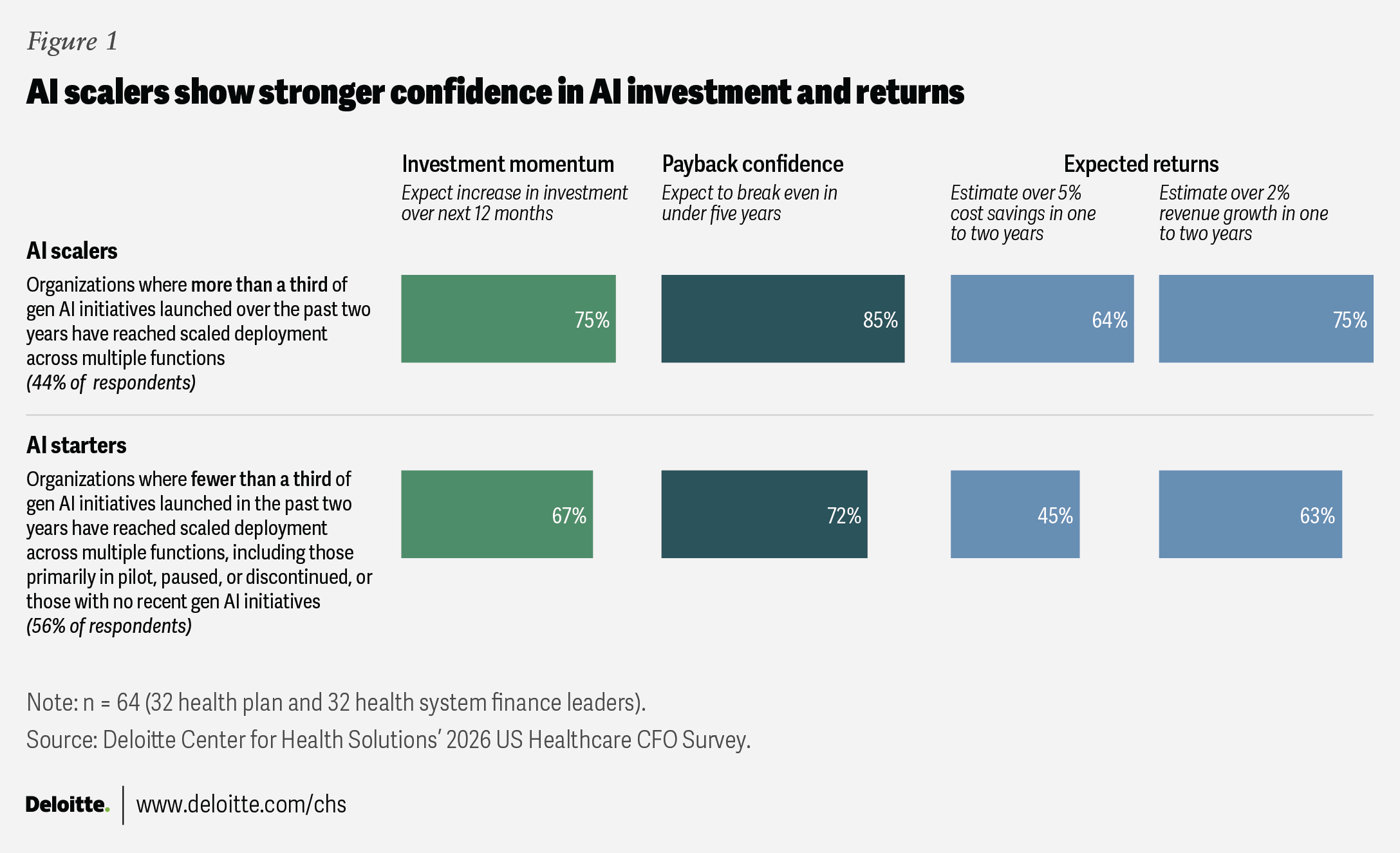
That gap matters because the organizations moving fastest also report they’re among the most confident in what AI can deliver. Of the executives we surveyed, AI scalers are more likely than AI starters to say they plan to increase investments over the following 12 months, expect to break even in less than five years from the time of investment, and anticipate stronger cost savings and revenue growth (figure 1). The result is a sharper version of a familiar CFO challenge: Capital is moving faster than the ability to tie spending to measurable outcomes.
Attribution challenges aren’t new in enterprise technology, and our prior research suggests technology value often goes undermeasured in healthcare organizations. But AI tends to raise the stakes. As adoption expands across functions and workflows, it may become harder to prove its value even as investment grows.1 The next phase of AI maturity may depend on how consistently CFOs can connect AI spending to performance, use that evidence to govern deployment, and scale what works.
AI scalers report they’re more confident in AI’s financial potential
While confidence in AI’s financial potential is generally high across all surveyed finance leaders, AI scalers differ in three ways: stronger investment momentum, greater confidence in payback, and higher expected returns (figure 1).
- Investment momentum: 75% of surveyed AI scalers say they plan to increase investments in gen AI and agentic AI over the following 12 months, compared with 67% of AI starters.
- Payback confidence: 85% of AI scalers expect AI investments to break even in less than five years from the time of investment, compared with 72% of AI starters. This confidence also shows up in relative payback expectations: 64% of AI scalers say AI payback is comparable to or faster than that of other enterprise technologies, such as electronic health records or revenue cycle improvement technologies.
- Expected returns: 64% of AI scalers estimate 5% or more annualized cost savings from AI initiatives in one to two years, compared with 45% of AI starters. Revenue expectations are also higher: 75% of AI scalers estimate 2% or more annualized revenue growth, compared with 63% of AI starters.
The proof gap: Expectations are outpacing measurement discipline
The organizations with the strongest confidence in AI’s economic potential don’t appear to be the most advanced at measuring results. Only 18% of AI scalers report mature financial attribution capabilities, meaning they consistently measure AI’s impact on revenue growth or cost savings with defined baselines and clear KPI ownership. Among AI starters, 31% report that level of maturity (figure 2).
This pattern may reflect the complexity that comes with wider deployment. As AI spreads across functions and workflows, attribution may become more difficult. Multiple teams may shape the same outcome. Baselines may shift. Benefits may show up indirectly, unevenly, or over longer time horizons.2 Notably, most AI scalers surveyed fall into a middle tier of attribution maturity, with 68% saying they rely primarily on before-and-after comparisons for some initiatives, compared with 56% of AI starters.
Another part of the challenge is AI’s cost structure. AI consumption is increasingly metered in tokens rather than traditional licenses or seats, and costs can be usage-driven, nonlinear, and highly variable.3 For healthcare CFOs, that means expected savings or revenue lift may need to be tested against variable consumption in high-volume workflows such as revenue cycle, contact centers, prior authorization, clinical documentation, and member services. A use case may improve cycle time or productivity while still falling short financially if prompts, retrieval, outputs, orchestration steps, or agent-to-agent activity cause costs to rise faster than benefits.
CFOs should consider that as investment levels rise, confidence in expected returns may outpace the evidence needed to validate, govern, and optimize those investments. To help them bridge this value gap, CFOs could require each AI use case to carry a value ledger: value driver, baseline, owner of the key performance indicators, consumption metric, and review cadence.
Turning AI investment into measurable value
For many organizations, the decision to invest in AI has already been made. A challenge now may be turning that investment into results that can be defined, measured, governed, and scaled. As AI becomes part of the healthcare capital agenda, building accountability around AI value may become a defining CFO priority.
Here are three considerations for CFOs as they focus on closing the gap between AI investment and measurable outcomes:
Establish value attribution
A key consideration in scaling AI is whether the pace of adoption aligns with the organization’s ability to define and measure outcomes. Before expanding AI initiatives across the enterprise, leaders should establish how success will be defined, measured, and governed. Prior Deloitte research suggests that mature AI adopters are more likely to track a broad suite of performance measures, including customer, process, workforce, and purpose indicators, rather than focusing only on cost and efficiency.4 Attributing value to AI may require looking beyond traditional technology return on investment and aligning finance, technology, strategy, and human resources leaders around shared priorities and common measures of success.5
Measuring AI outcomes can vary by use case. A prior-authorization agent could be measured by nurse review minutes avoided, approval turnaround time, avoidable-denial reduction, escalations, and cost per authorization. A revenue cycle copilot could track denial overturn rate, days in accounts receivable, coder productivity, rework, cash acceleration, and cost per claim touched. A clinical documentation assistant could measure documentation time, after-hours physician work, note completion timeliness, coding specificity, and downstream revenue integrity.
The CFO may not be able to convert every leading indicator into a P&L line immediately. But finance can connect operational signals to defined financial hypotheses such as cost-to-serve reduction, working-capital improvement, leakage reduction, capacity creation, or revenue capture, and agree upfront how much of the observed change can reasonably be attributed to AI. Where AI influences multiple workflows, finance can separate impact that’s directly attributable, reasonably contributory, and not yet monetized. That can help finance avoid overclaiming benefits while still recognizing capacity or experience gains.
Manage AI tokenomics
Early insight into token demand can help CFOs forecast the AI value equation with greater confidence. A meaningful share of AI spending behaves like a variable input cost rather than fixed overhead, making cost visibility and consumption discipline important aspects of proving AI’s financial value.6 Yet, many organizations still lack the cost visibility, allocation mechanisms, and governance discipline needed to track token consumption by use case, workflow, team, or business outcome.7 Without that visibility, it can be difficult for finance leaders to tie token spending to broader cost optimization, savings, or capacity creation AI is expected to deliver.
When usage patterns and scaling paths remain unsettled, token budgeting guidelines may be needed. That makes token dynamics a CFO issue, requiring close partnership with business and technology leaders to validate expense assumptions, assess total cost of ownership, and connect investment decisions to ROI.8
Bring governance into the value equation
As AI moves into more consequential workflows, responsible scaling can become part of the financial case. Leaders should assess whether AI value is sustainable, compliant, secure, and trusted by the people expected to use it. Unmanaged AI risk can create real financial exposure through regulatory penalties, operational failures, erosion of clinician and patient trust, and reputational costs that outweigh the efficiency gains AI was meant to deliver.
This likely requires organizations to bring in risk, compliance, legal, cybersecurity, and business stakeholders early, while balancing the push to move quickly with the need to operate responsibly.9 In practice, that can include input controls to help validate that data is accurate, complete, and within expected ranges before processing, as well as output controls such as risk-based human oversight to help confirm results are reliable before they inform decisions.
These controls may become especially important in healthcare as regulatory expectations expand10 and organizations use AI in workflows involving sensitive patient and member data. Strong controls shouldn’t be treated as a brake on progress. Done well, they can help create the confidence needed to scale AI in workflows that affect patients, members, clinicians, and financial performance.
From AI momentum to measurable value
For surveyed healthcare finance leaders, AI appears to be entering a new phase. Investment is scaling and confidence in payback seems high. The focus now appears to be moving from adoption to accountability. CFOs that can consistently connect AI spending to measurable operational and financial outcomes may be better positioned to scale investment, secure board confidence, and allocate capital effectively. Those that can’t may find that enthusiasm alone is no longer enough. Momentum may justify initial investment. Sustained investment will involve evidence.
Continue the conversation
Meet the industry leaders
Alicia Janisch
Vice chair | US health care sector leader | United States | Deloitte Tax LLP
Deloitte United States
Dr. Jay Bhatt
Managing director, Deloitte Center for Health Solutions | Deloitte Services LP
Deloitte United States
by
Alicia Janisch
Deloitte United States
Bill Fera
Deloitte United States
Adarsh Gosu
Deloitte United States
Dr. Jay Bhatt
Deloitte United States
Maulesh Shukla
Deloitte India
The authors would like to thank Nivedha Subburaman, Richa Malhotra, and Madhushree Wagh for their significant contributions to research design, analysis of the key findings, and writing of key sections of the paper. The authors would like to thank Sandeep Vellanki, Sanjay Mallik, and Alluri Rohith Reddy for their support with the gen AI-enabled public commentary analysis.
The authors would also like to thank Jeff Burke, Omosede Ogiamien, Michael McCallen, Ryan Yee, Bill Bonner, Swati Patel, Dave Wagner, Hash Simjee, Abhash Dhar, Abhinav Astavans, Bill Laughlin, Cole Wheeler, Ed Hardy, and Priya Ehrbar for their subject matter expertise and review; and Rebecca Knutsen and Jared Johnson for their review and support in developing the narrative. Additional thanks go to Shyamili M, Daniela Bain, Nicole Jupe, Jennifer Wotczak, and Debra Asay and the many others who contributed to the project.
Editorial (including production and copyediting): Rebecca Knutsen, Shyamili M, Arpan Saha, and Cintia Cheong
Design: Natalie Pfaff
Cover image by: Alexis Werbeck; Adobe Stock
Knowledge services: Vanapalli Viswa Teja
Visit the Deloitte Center for Health Solutions
Access more insights for the hospital, health system and provider, pharmaceutical manufacturer, health plan and payer, medtech, and health tech organization sectors.