


Recapping our FBT webinar FAQs
Tax Alert - May 2026
By Robyn Walker
A hallmark of a mediocre tax rule is that people can’t remember it. Usually that’s because it’s unintuitive, arbitrary, or overly complex—or simply not applied often enough to stick. Fringe benefit tax (FBT) can tick all those boxes, and it’s often top of the list of tasks to hand to a brave new starter.
These factors help explain why our annual FBT webinar is one of our most well-subscribed and well-attended events. The questions come thick and fast during these sessions, so this article provides a recap of some of the most frequently asked questions with practical takeaways for employers.
Motor vehicles
Is an employee declaration/letter which prohibits private use of a vehicle sufficient to ensure there is no FBT liability?
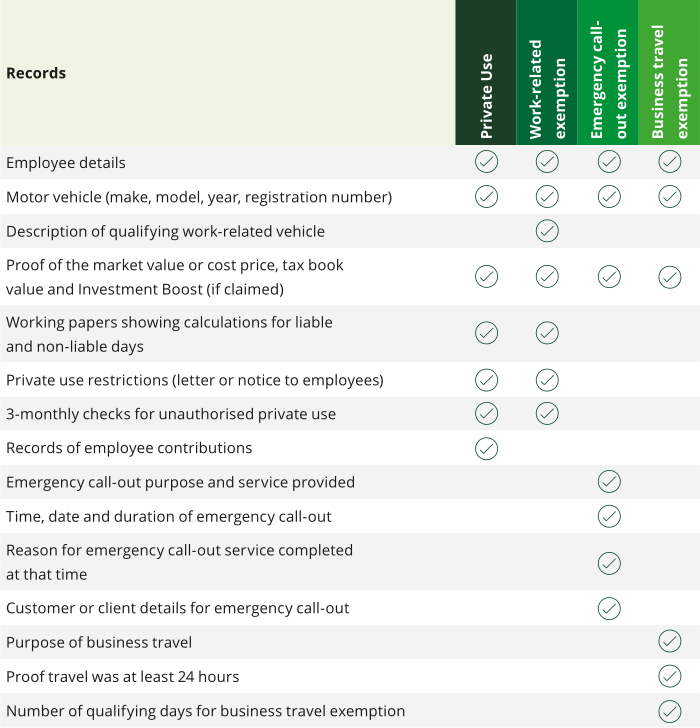
This approach is a good starting point, as it is necessary to have a private use prohibition in place for the private use or work-related vehicle exemption to apply. However, Inland Revenue expects there to be 3-monthly checks on vehicles to ensure there is no unauthorised use. This could be facilitated by having GPS tracking/reporting that validates the vehicle isn’t being used at night or on weekends (if that is the period when use is restricted). Inland Revenue has a table that specifies what is required for each motor vehicle exemption:
If an employee parks a car at the airport while they are away, is this exempt from FBT?
There is a “business travel” exemption from FBT, however this only applies when an employee is travelling with the vehicle. As such, if an employee parks a vehicle at an airport while they fly to another work location, this exemption doesn’t apply. That said, if an employer has required an employee to go away for work, the ability to use the vehicle is effectively removed and therefore an exemption may apply for any full days that the employee is away (that is, FBT will still apply on the day of departure and return).
There is no exemption available if the employee is away for personal travel or if the vehicle is left at home and other family members are permitted to use the vehicle.
Is there an exemption for vehicles which are “on call”?
FBT will not apply on any day when a vehicle is used for an emergency call-out. Unfortunately, the exemption does not extend to days when the vehicle is simply on call. There are a number of criteria (including in the table above) that apply before the emergency call-out exemption applies.
How should the provision of a fuel card be treated?
Fuel cards used to fuel an employee provided motor vehicle that is already subject to FBT do not need to be included as a separate item in the FBT return. To the extent a fuel card is being provided to compensate an employee for work-related travel in their own vehicle (for example, an alternative to paying a tax-exempt mileage allowance), then this is likely to be exempt from FBT. However, if the fuel card also covers the cost of the employee’s fuel for private travel, FBT is likely to apply. There are practical issues to consider if apportionment is required.
How does the “tax book value” method work for paying FBT on vehicles?
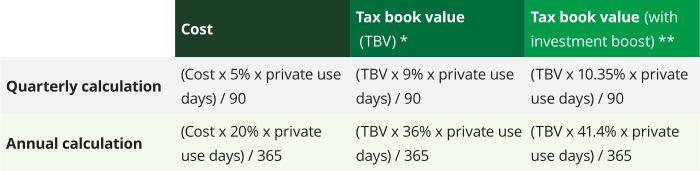
Employers have a limited ability to choose whether to calculate FBT based on the cost or the tax book value of a motor vehicle. Once an election is made, it applies for a minimum of 5 years. Typically, employers would choose to use the cost method when a vehicle is purchased and then consider switching to tax book value if the vehicle is still owned 5 years later. A new set of rules applies for vehicles if investment boost has been claimed on the original vehicle cost.
The taxable value of a motor vehicle is calculated as follows (all amounts are GST inclusive value):
Is there a fringe benefit?
What are the implications of providing a benefit to an independent contractor?
If the contractor is someone undertaking a schedular activity (i.e. one that is subject to withholding tax), then they are considered an employee for FBT purposes and so any benefits they are provided are also subject to FBT. In practice, check whether withholding tax applies to the contractor’s payments.
If an employer pays for a professional membership, is that subject to FBT?
Generally speaking, covering the cost of professional memberships that have a sufficient connection to the employee’s role (e.g. a membership fee for an accounting body for someone in the finance team) is not subject to FBT or PAYE.
Is an airline lounge membership subject to FBT?
Whether a membership for an airport lounge is subject to FBT is fact dependent. If the lounge membership is provided due to frequent work-related travel, it is essentially replacing the need for the employer to reimburse the employee for meals while travelling (or paying a per diem allowance), which would be exempt from tax. If the employee is not undertaking work-related travel, then the membership cost is likely to be subject to FBT.
If an employer reimburses an employee $300 for fitness/health related expenses, is this subject to FBT?
The payment of general wellness costs is likely to be subject to tax. As a starting point, prior to 1 April 2026, a reimbursement is not subject to FBT, it is a benefit which is subject to PAYE. From 1 April 2026, employers do have the option to choose which tax to apply to the reimbursement. Refer to our separate article about this new rule.
We’re a charity and provide car parks. Is there any FBT obligation?
If benefits are provided to employees who are working in a charity, then an FBT exemption usually applies. If the charity is running a business outside of its charitable purposes, FBT rules apply as normal. The provision of a car park will be exempt from FBT if it is provided on premises which the employer owns or leases and over which it has substantially exclusive use.
Our staff attend an annual conference in Australia, which includes a gala dinner. Is there an FBT cost to this?
Gala dinners would normally be considered under the “entertainment rules” rather than the FBT rules, however the entertainment rules do not apply to entertainment provided outside of New Zealand. If attendance at the conference is necessary for work-related purposes, the cost of attendance and the dinner would be outside of the FBT regime. If spouses or family members are travelling with employees, we would generally treat all costs associated with this (including flights) as a fringe benefit, which is attributed to the employee.
How are “open loop cards” treated now?
There is no longer any distinction between “open loop” and “closed loop” cards with effect from 16 April 2025. There is also a new rule that allows employers to choose whether they tax the provision of a “gift card” through the FBT regime or the PAYE regime. Under the amended rules, gift cards are a new category of benefit, rather than being an unclassified benefit. However, they are aggregated with unclassified benefits when determining whether the de minimis rule applies and when performing FBT attribution calculations.
Calculation and valuation questions
If prizes are given out at a work function and records are not kept about who the recipients were, how should these be treated?
Assuming an FBT attribution is being performed (rather than paying at the flat rate of 63.93%), it is necessary to attribute benefits to the employee who mainly uses or receives the benefit. In some cases, it’s not possible to attribute because a benefit is provided to multiple employees (e.g. a group prize for winning a competition). If a benefit has been provided to a group of employees, this can be treated as a non-attributed benefit which is pooled and subject to FBT at 49.25% (unless the group includes major shareholder-employees, then the 63.93% rate applies).
If prizes are given out to individual employees, ideally the information should be collected as to who the recipient was in order for these benefits to be properly attributed (and to ensure that there is accurate data when doing the per employee attribution calculations). If this information is simply not available, it is recommended that FBT be paid at 63.93% to ensure there is no FBT shortfall (Inland Revenue is unlikely to consider there is an FBT concession for poor record keeping).
How are staff discounts offered by third parties treated?
Provided a third party offers a similar discount to other employers of a similar size, and the discount is negotiated on normal commercial terms, there is no FBT obligation. This reflects that such benefits may be very difficult to quantify because (a) the employer is not paying anything and (b) the employer isn’t an active party to the transaction and won’t have the information necessary to quantify discounts received by employees.
For a manufacturing business, how is a “friends and family” discount treated?
The FBT rules for goods vary depending on whether the employer pays for the goods or they manufacture them. The valuation depends on whether the goods are purchased from a third party or manufactured by the employer:
- Goods acquired from a third party: GST-inclusive cost price
- Goods manufactured, produced or processed by the employer: market value. Market value means the lowest price at which identical goods were sold by the employer, to an arm’s length buyer (whether wholesale, retail or the public) in the open market in New Zealand, in a sale freely offered and made on ordinary trade terms.
If the benefits are offered to family members, these benefits will be treated as being provided to the relevant employee if the discount results in the goods being sold for less than the values above.
If an employer is providing goods which retail at $200 or less and the employer allows a staff discount of no more than 5% and that discount results in the goods being supplied for less than the cost to the employer, there is a separate FBT exemption which will apply to that staff discount. Given the amounts, this exemption applies in very limited circumstances.
If the de minimis is exceeded, is it just the excess that is taxed?
No - exceeding the de minimis (of either $300 per quarter per employee or $22,500 per rolling 12 months) results in FBT being triggered on all unclassified benefits and gift cards, not just the excess. In the case of an employee receiving more than $300, but total unclassified benefits and gift cards still being below $22,500, it is only the benefits to the employee receiving more than $300 which are no longer exempt from FBT. Annual filers are able to apply a $1,200 per employee limit. When assessing the $22,500 threshold, it’s necessary to aggregate the unclassified benefits and gift cards of all associated employers.
The following example is from Inland Revenue’s guidance:
A company provides goods and services to 2 employees, Nicole and Bailey, in the quarter 4 March return.
- Benefits provided to Nicole total $195. This is not more than the $300 limit. No FBT is payable for Nicole’s benefits.
- Benefits provided to Bailey total $500. This is more than the $300 limit and FBT applies to the full amount.
If Bailey contributed $200 towards the benefits in the quarter, the taxable value is $300, the limit does apply, and no FBT would be payable.
If you’d like to discuss how these issues apply to your organisation or need assistance with quarter four FBT attributions, please get in touch with your usual Deloitte advisor.
May 2026 - Tax Alerts

