


Investment Boost one year on
Tax Alert - May 2026
By Angus Isherwood, Amy Sexton and Robyn Walker
Investment Boost is approaching its first anniversary.
The scheme was the centrepiece of Budget 2025 and a key cog in the Government’s plan to stimulate economic growth by encouraging businesses to invest more through larger upfront deductions. But questions persist about how effective it has been so far.
Accordingly, this article provides a refresher on Investment Boost, including recent changes to the scheme, as well as looking at how New Zealand businesses have been utilising it to date.
The nuts and bolts of Investment Boost
Investment Boost allows businesses to claim an upfront tax deduction for 20% of the cost of eligible purchased assets that first became available for use in New Zealand on or after 22 May 2025. Under the scheme, businesses can choose to deduct 20% of a new asset’s cost in the year of purchase. The upfront deduction operates alongside the standard depreciation rules, meaning depreciation can still be claimed on the remaining 80% of the asset’s value.
Investment Boost applies to both brand-new assets and new to New Zealand, second-hand assets imported after 22 May 2025. Most new depreciable property (including the purchase of new commercial buildings) and improvements made to depreciable property are eligible under the scheme. Notable exceptions include land, residential buildings, trading stock, and fixed-life intangible property. For more information on how Investment Boost works including frequently asked questions, please refer to our June 2025 Tax Alert article.
How much does Investment Boost save?
Given Investment Boost is effectively accelerated depreciation, the total amount of depreciation that a business can claim over a new asset’s lifespan remains the same regardless of whether the business elects for the new Investment Boost deduction (with the exception of commercial buildings, which are otherwise depreciable at 0%).
To demonstrate the impact of Investment Boost, consider the following example:
A company purchases a $100,000 asset that is used solely for business purposes and is subject to a 20% straight-line depreciation rate. Assuming the asset is first available for use in New Zealand after 22 May 2025 and the company is entitled to a full year of depreciation; the company will be able to deduct $36,000 from its taxable income in the year the asset is purchased ($20,000 from Investment Boost plus $16,000 of regular depreciation).
The asset can be further depreciated up to $16,000 a year in the subsequent years until its tax book value is nil. Conversely, if the business opts not to use the Investment Boost deduction, it can claim depreciation of up to $20,000 in the first year and each subsequent year (subject to the remaining tax book value). In both situations $100,000 has been claimed in deductions at the end of year 5.
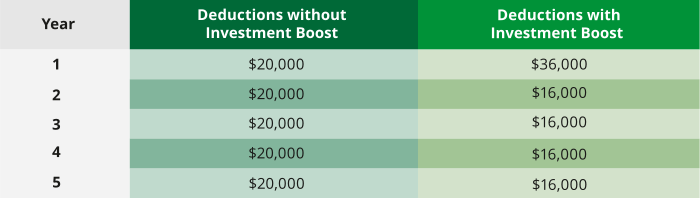
Investment Boost gives a timing advantage, the earlier deductions up front lower the present value of the tax paid and can help with cashflow.
Recent tweaks
Parliament recently introduced some minor remedials in The Taxation (Annual Rates for 2025−26, Compliance Simplification, and Remedial Measures) Act to ensure that Investment Boost rules operate as originally intended.
Investment Boost is still bedding in
In December 2025, Inland Revenue sent out a voluntary survey to businesses to investigate how they are utilising Investment Boost and whether the scheme is encouraging them to invest in new assets. In March 2026, Inland Revenue released the full findings of the survey in this report.
Just under a third of respondents reported a strong understanding of the scheme, one third reported some knowledge of Investment Boost, and an additional third had limited or no awareness of the scheme. The report noted businesses with less than 20 employees were more likely to be unaware of the scheme than their larger counterparts. Of those businesses that knew of the scheme and had invested in assets, 40% reported that Investment Boost had increased their spending.
Among the businesses that (1) knew about the scheme and (2) invested in assets in the last 12 months, only 58% had or intended to claim the deduction. The report suggests the most common reasons Investment Boost had not been claimed related to ineligible spending, particularly as the scheme was introduced part way through the year. Other reasons given for not claiming included the incentive not being large enough to make a meaningful difference and administrative complexity. The survey shows that a significant proportion of New Zealand businesses are still leaving money on the table simply due to their lack of awareness of Investment Boost.
If you’re considering purchasing an eligible asset and want assistance estimating how Investment Boost help your cashflow or if you just have general questions regarding Investment Boost, please reach out to your usual Deloitte advisor.
May 2026 - Tax Alerts

