
How will AI agents fit into the human workplace?
Agentic AI could empower workers, exhaust them, or fundamentally change what organizations ask them to do. How does your AI strategy consider the potential scenarios?
A recent Gartner forecast suggests that the average Fortune 500 company is likely to have 150,000 artificial intelligence agents by 2028.1 Many leaders are already anticipating significant change: In a Deloitte study of senior managers and above, two-thirds of respondents said disruptions from multi-agent AI could significantly transform how work is performed within the next two to three years.2 But only about a quarter said their business processes or workforce are prepared for that transformation.3
What does it mean to prepare? What might a future in which thousands of digital agents collaborate with humans—and with each other—look like? And what risks or opportunities might be hiding in plain sight?
The race to adopt agentic AI is accelerating. But the organizations that create the most value won’t necessarily be the ones that deploy the most agents the fastest. They’ll likely be the ones that build the trust, governance, and human capabilities needed to use those agents well.
How leaders can prepare for a multi-agent future
Rather than trying to predict the long-term future of multi-agent systems, organizations can prepare by pressure-testing their strategies across a range of plausible futures.
To explore those futures, Deloitte’s Center for Integrated Research and Deloitte’s human capital consulting practice conducted a scenario analysis informed by quantitative surveys, executive interviews, and a horizon-scanning initiative focused on near- to medium-term trends (see methodology). The analysis indicates that agentic transformation is not simply a question of how many agents an organization deploys, but also requires organizations to reimagine their full potential and, most importantly, that of their people.
The scenarios that follow are plausible depictions of future states, not forecasts. The future will most likely contain elements of several of these paths at once, each carrying its own mix of opportunity and risk. Their value lies not so much in guessing which future will occur, but in the perspective each scenario offers on an organization’s potential readiness under different conditions.
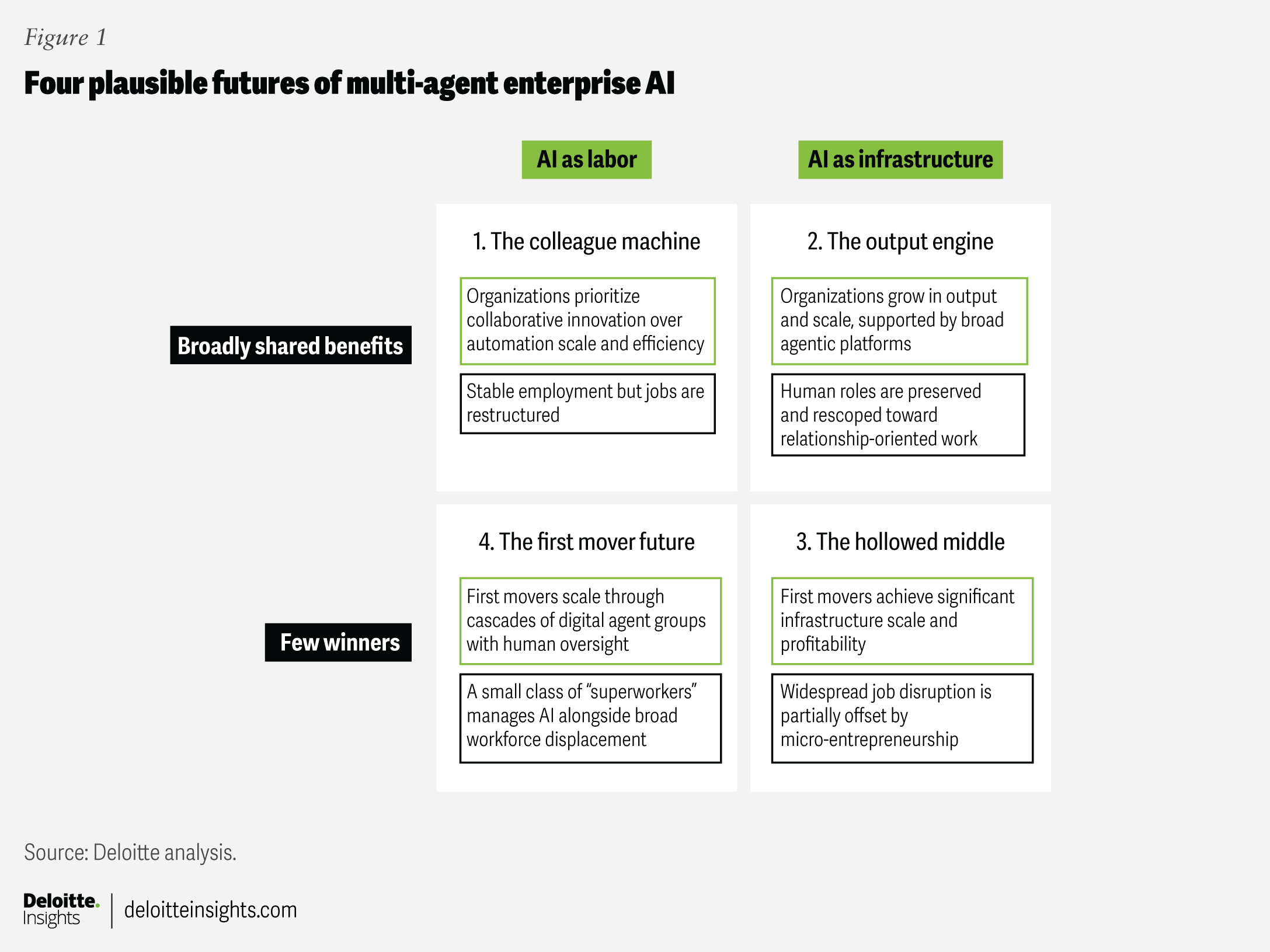
We developed four plausible futures by intersecting two high-impact uncertainties:
- Will organizations treat AI agents primarily as labor or as infrastructure?
Agentic AI combines characteristics of both labor and technology. An AI agent is a tool that learns, an asset that requires supervision, and a system that can sometimes behave more like a colleague than a platform. How organizations resolve this ambiguity will shape strategy, governance, work experience, organizational culture, and trust, as well as how and why workers adopt agentic tools. Some might assign agents employee IDs, positions, and defined roles. Others might manage agents as a tech layer that operates largely behind the scenes. - Will the gains from agentic AI be distributed broadly across markets, industries, and society, or concentrated among a few?
The second uncertainty concerns who benefits. Agentic AI could benefit a broad range of companies, industries, and communities, or its benefits could accrue primarily for a small number of hyperscalers and early adopters. The distribution of these gains will carry consequences beyond economics, influencing social mobility, political stability, and collective capacity to adapt to further technological disruption.4
The resulting four futures (figure 1) are designed to help leaders imagine the conditions their organizations could face and identify actions that could position them for success regardless of the future that unfolds.
Scenario 1: The colleague machine (agents as labor, with broadly shared benefits)
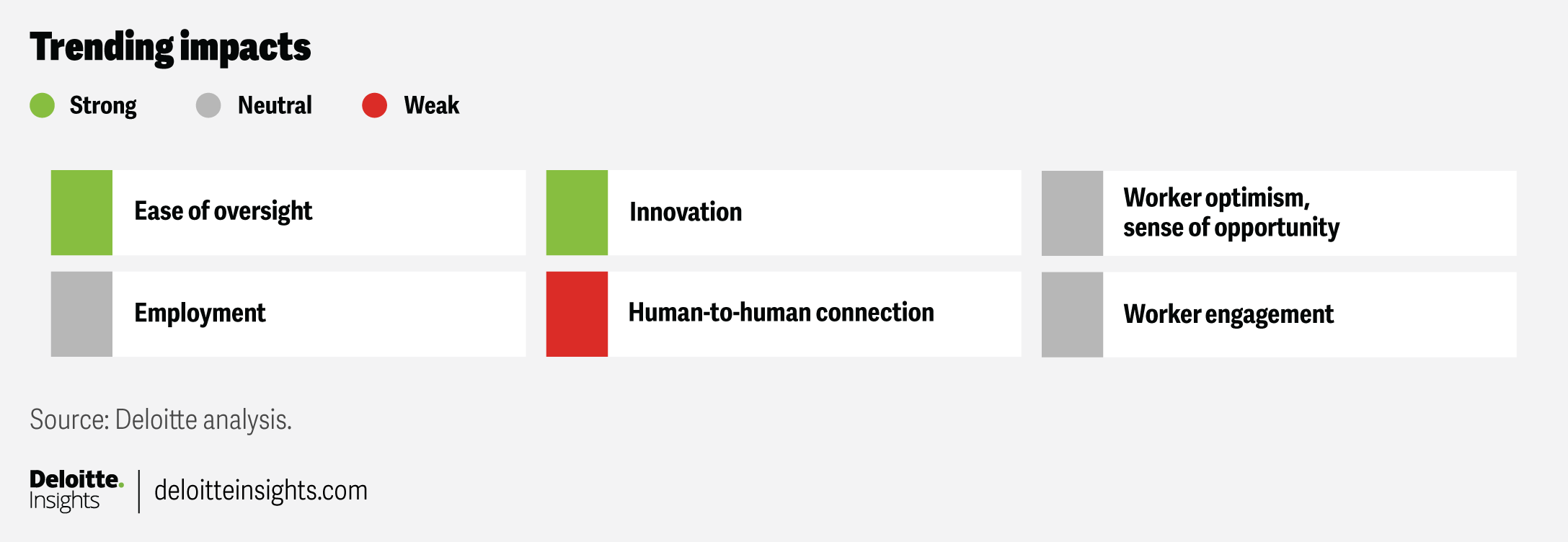
In this world, companies might find that humans create more value when they collaborate with and supervise networks of AI agents with the same level of attention given to human workers. For example, agents might be developed with increasingly detailed memories to make them more relatable as colleagues in meetings. Some companies might experiment with elaborate onboarding and offboarding systems for their agents. Human workers might increasingly view the “agent manager” role as a lucrative growth opportunity.
Although these factors might increase adoption of agentic technology, they can also create controversy. Some critics worry that anthropomorphizing AI agents could blur important distinctions between people and machines, including personal responsibility for quality assurance, while some workers resist treating AI as though it were human. Perhaps more critically for business leaders, the need to maintain communication that’s understandable to humans could change the economics of agentic technology. In the colleague machine scenario, humans might most often engage with agents on a one-to-one or small-group basis, limiting agents to activities that can be monitored. As a result, human workers might favor narrow, legible agents over complex autonomous ones.
Scenario 2: The output engine (agents as infrastructure, with broadly shared benefits)
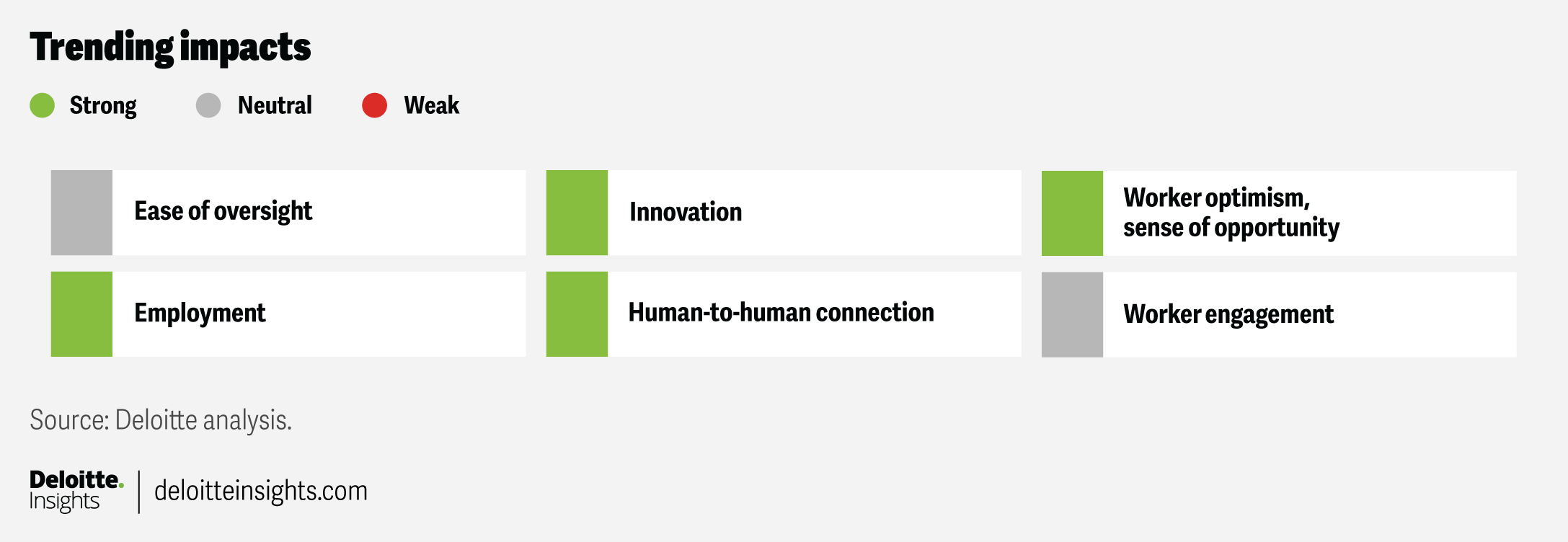
In this scenario, by 2030, the number and variety of AI agents have grown dramatically. Organizations will likely add layers of agentic infrastructure that automate simple tasks and enable human workers to accelerate their output with relative ease. Because AI agents will be managed as infrastructure rather than colleagues, they will be optimized to handle high volumes of process-driven work efficiently and at scale. This will free up capacity for the human workforce to take on higher-value tasks.
In customer service, for example, AI agents might address a wide variety of routine needs while people concentrate on trust and relationship building. When infrastructure handles processes, distinctly human contributions such as judgment, empathy, and relationship building become the scarce and valued inputs.
But higher output also creates a new burden. Someone must still ensure that the increased volume meets quality standards and that accountability is maintained. Those responsibilities would often fall to the same human workers now tasked with higher-value work. The result would likely be a workforce that becomes both more valuable and more cognitively stretched. With so much opportunity, many workers might accept the long hours, but exhaustion could become a persistent organizational risk.
Scenario 3: The hollowed middle (agents as infrastructure, with few winners)
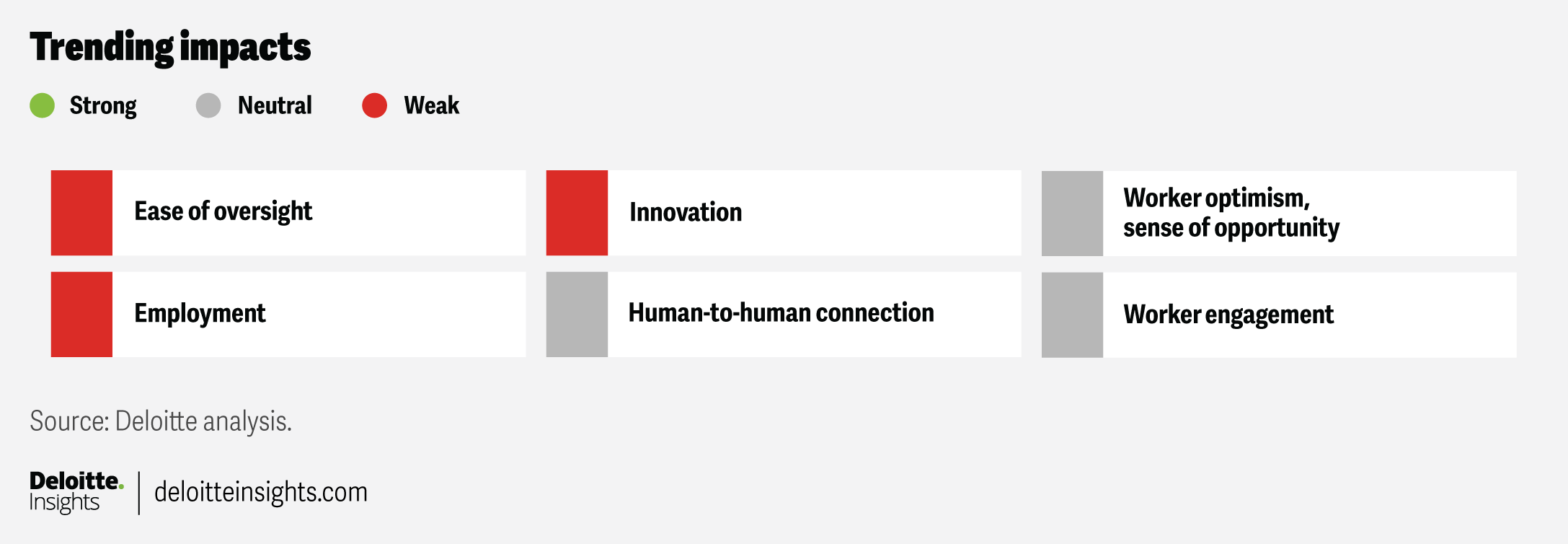
In this scenario, over the latter half of the 2020s, agentic tools might become increasingly reliable, productive, and autonomous.
Leaders might reimagine jobs as chains of agentic tasks, while workers might filter new requests through a layer of smart infrastructure that escalates only the messiest problems to humans. This “agent-first” approach could successfully reduce short-term costs and grow profits for early movers who take market share from less efficient competitors. The rise of agentic tech could also enable some small businesses and micro-entrepreneurs to flourish on a small scale with minimal human labor.
By 2030, two risks could become increasingly urgent. First, with fewer humans overseeing agentic output, mistakes can spread quickly in unexpected ways. Second, widespread unemployment and wage pressure can weaken demand and leave businesses searching for new sources of innovation and profitable growth.
Scenario 4: The first-mover future (agents as labor, with few winners)
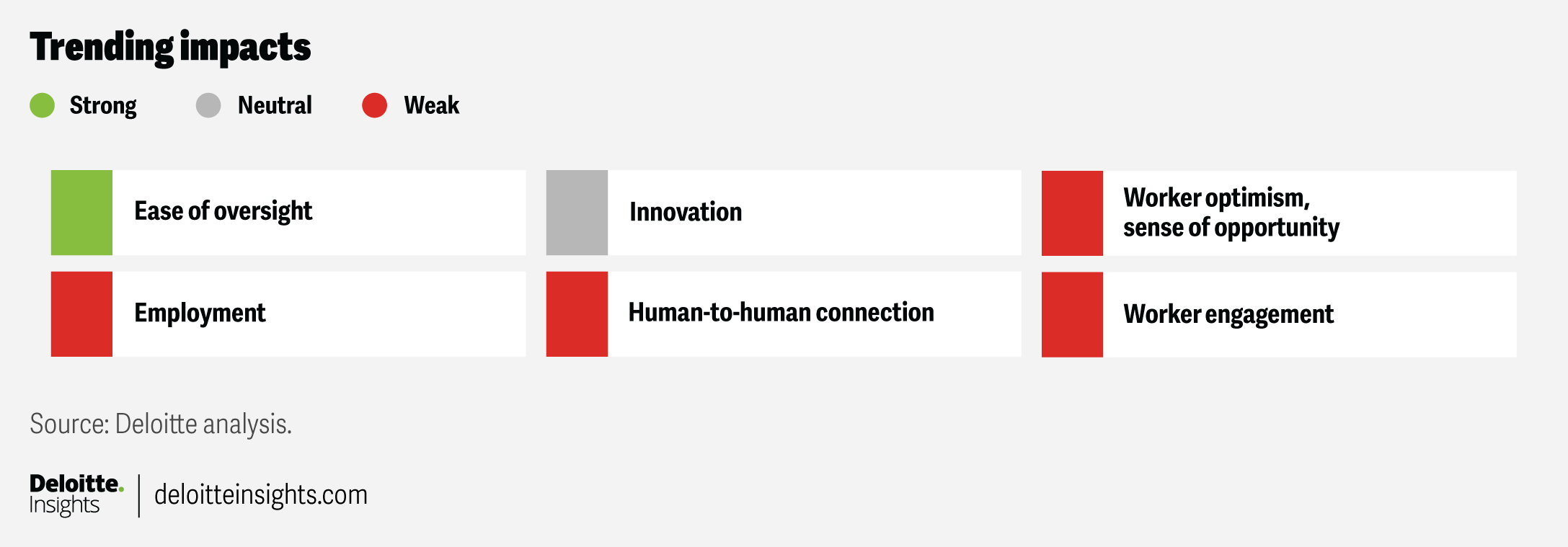
In this scenario, it turns out that there really was a race to adopt agentic technology. And by 2030, the early adopters have won.
In this scenario, aggressive investments by hyperscalers can create increasingly wide moats around the models underlying digital agents. Companies that act first within their industries might reduce overhead costs, redesign human jobs as tightly specified agentic roles, and push less efficient competitors out of the market. The gains might be similarly concentrated among workers. Those who embrace digital agents early on position themselves as “superworkers,” capable of producing the output of a human team by managing groups of digital workers.
As agents become more sophisticated, they might also become increasingly human-like in their interactions. But their always-on nature and speed could allow them to outpace most people, making it harder for human workers to keep up.
Even workers who are thriving professionally might become more distrustful of their work environment. In remote work environments, it could become difficult to know which colleagues are human and which are agents designed to seem human.
Four priorities that build readiness no matter which future scenario unfolds
Deloitte’s 2026 State of AI in the Enterprise Survey suggests that agentic AI will become ubiquitous, with nearly three-quarters of surveyed organizations across industries and global regions planning to utilize agentic AI at least moderately in their operations in the next two years.5 Across the scenarios outlined in our research, four themes emerge as no-regret priorities: governance, strategy, workforce planning, and trust. In other words, our findings suggest that it’s just as critical for organizations to invest in agentic AI’s adjacencies as it is to invest in the tech itself, and doing so could offer companies a competitive advantage at this stage. A recent Deloitte study found that 93% of organizational AI investments go toward technology infrastructure, while just 7% go toward work and people-related issues,6 even though evidence suggests that human factors such as team dynamics strongly shape AI-related outcomes.7
Governance: Invest in human accountability rules from the start
Nearly 70% of respondents to a recent Deloitte survey identified “an inability to trust and govern agents” as a major barrier to realizing value from agentic technology.8
The executives interviewed for this research repeatedly identified accountability as the dimension most at risk of being overlooked. As one financial services executive notes, “The machine will never be accountable.”9
As humans are removed from more stages of end-to-end workflows, responsibility becomes harder to assign. Organizations should map their agentic workflows to identify where human accountability should be required, and then build structural checkpoints that make it difficult to bypass that accountability.
Accountability also depends on measuring the right things. When organizations reward those who build agents fastest, quality and safety checks can fall away. Measurement frameworks should track error rates and output quality alongside speed and adoption.
One human resources and talent executive we spoke with cautions that incentivizing individual AI innovation can encourage behaviors like siloed agent-building that create risk for the organization.10 In contrast, early investments in accountability structures could help lay the foundation for sustainable growth and innovation across all four scenarios.
Strategy: Clarify and strengthen decision-making processes with the human in mind
Sixty-four percent of respondents to Deloitte’s 2026 Global Human Capital Trends Survey agree that decision-making is very important to the success of AI, but just 5% say they are making “great progress” in this area.
Multi-agent systems intensify an existing generative AI challenge: keeping humans genuinely, rather than nominally, in the loop.
Organizations can address this challenge by designing purposeful friction into agentic workflows. Rather than a final approval step, human intervention should occur at moments that require consequential judgment, exception handling, or evaluation of agent performance.
And before deploying these friction points, leaders should know where to place them. Rather than starting from the org chart, organizations can map actual workflows, which include the steps where information is gathered, interpreted, decided upon, and acted on, to identify where agentic AI is compressing or removing those steps.11 As coordination and routine synthesis become more automated, the moments that most need a human aren’t necessarily the ones that used to require sign-off by default; they’re the ones where genuine ambiguity, exceptions, or consequential trade-offs remain.
As one human capital leader who works for a large technology company explains, “The human is brought into the loop at the right moment to pause, reflect, and evaluate agent performance.”12
Workforce planning: Build processes and capabilities to enable humans to manage the unexpected
Fifty-three percent of respondents to a recent Harvard Business Review study admitted to sending colleagues AI-generated work that is “unhelpful, low effort, or low quality” because they felt overwhelmed by current work demands.13
In all four scenarios, organizations risk over-optimizing for efficiency and leaving workers stretched too thin to manage agentic output, especially when unanticipated challenges arise. Leaders should preserve enough slack in work processes and operating plans so workers can manage unexpected events.
Organizations should also develop the human capabilities that become more important as routine work is automated. Executives interviewed for this research highlight critical thinking, judgment, and resilience14 as critical to ensuring their human workers have the capabilities to navigate ongoing change.15 In an informal Deloitte webinar poll of 1,700 global respondents, 47% identified judgment as the most important behavior in the age of AI.16
Several executives we interviewed also cautioned that capacity building alone likely isn’t enough. Leaders should deliberately redesign human roles by reimagining what contribution people should make when workflows and processes change. Organizations that fail to find the thread connecting existing human skills to new ways of working risk eliminating workforce capacity they could need later. Those that do make the connection could extend the value of their people.
Trust: Proactively design for trust so it becomes an opportunity and not a risk
The four scenarios suggest that worker trust in AI could be a key factor in shaping the long-term success of agentic strategies. Deloitte’s TrustID research finds that workers with high levels of trust in their organizations are 3.8 times as likely to use agentic technology.17 Building trust requires designing roles in which human contribution is visible, meaningful, and clearly differentiated from what agents do. As one consumer goods executive told us, organizations that build on their people’s existing skills while developing new capabilities and ways of working can do more than just preserve trust. They could give employees a reason to embrace the transformation rather than fear it.18
Two additional trust levers could be easy to overlook: middle management AI fluency and credible channels to flag AI-related challenges. Middle managers who don’t actively use agentic tools might become a trust gap rather than a trust bridge. The people employees turn to for guidance could end up being the least positioned to give it. At the same time, organizational cultures in which employees don’t feel safe flagging problems with agentic systems create risks that go well beyond morale. Credible feedback channels are as important to governance as formal policies.
Pressure-testing your strategy for a future you can’t predict
To pressure-test agentic technology strategies, leaders can begin by examining how their current strategies would fare in each of the four scenarios. They should look especially for hidden risks the organization has not yet addressed and unexpected opportunities to accelerate growth.
Next, leaders can identify which investments appear likely to succeed across multiple scenarios. These may include early-stage pilots or more mature efforts, but their resilience across different futures makes them strong candidates for accelerated commitment.
Organizations can also work backward from long-term goals to determine which model of human-agent interaction is most likely to support those goals.
The stakes over the next several years are high, and so is the uncertainty. In a future crowded with agents, speed to market will matter, but not as much as trust, governance, and human capabilities.
Continue the conversation
Meet the industry leaders
By
David Mallon
Brad Kreit
Natasha Buckley
The authors would like to thank the following for their meaningful contributions:
Core research and activation team: Brenna Sniderman, Aditi Vashishtha, Abha Kulkarni, Saurabh Rijhwani, Akshay Poojari, Siri Anderson, and Negina Rood
Subject matter experts: David Jarvis, Sue Cantrell, Tiffany Kim, Cole Oman, Gabriella Boros, Ashley Reichheld, Bill Eggers, Amrita Datar, Diana Kearns Manolatos, Greg Vert, Kyle Forrest, Andrew Blau, Aniket Bandekar, Chloe Domergue, Laura Shact, Maya Bodan, Kate Schmidt, and James Kilgour
Editorial (including production and copyediting): Corrie Commisso, Annalyn Kurtz, Aditi Rao, Shyamili M, Cintia Cheong, and Anu Augustine
Design: Molly Piersol and Sofia Laviano
Cover image by: Sofia Laviano
Knowledge services: Agni Wagh
Visit the Deloitte Center for Integrated Research
Access more insights on some of the most complex issues facing businesses today.