
AI agents are only the beginning: The path to agentic transformation
Deloitte research reveals why organizations need to reinvent their processes and workforces to unlock the full promise of an agentic enterprise
Enterprise artificial intelligence agents have the potential to improve productivity, increase revenue, and deliver more meaningful work for humans—and organizations want to reap those benefits as fast as they can. But the full promise of the agentic future won’t come simply from deploying AI agents. Because an agentic enterprise is likely to operate fundamentally differently from today’s organizations, the way work gets done must also change.
Collections of intelligent agents are expected to work autonomously—and with human partners—to execute tasks and make decisions, all while continuously improving.1 Preparing for that future requires far more than simply deploying new technology; it requires organizations to redesign work, and the systems where that work happens, with AI agents at their core.
However, our latest research into agent adoption at US-based organizations—which includes a survey of 501 leaders involved in their organization’s agentic AI strategy or implementation and interviews with 20 executives and AI and data science leaders (see methodology)—found that many organizations are struggling to develop an executable, integrated road map in these early days of the agentic era. An executive vice president of information technology in the retail industry sums up the challenge they’re facing: “If generative AI is the pill, agentic AI is the whole pharmacy. It can do so much. You have to take a step back [to understand how to proceed].”
Most organizations are under pressure and striving to make the shift from experimentation to production.2 Although many are still testing small numbers of AI agents or have a few deployments underway (42%), about the same number are expanding the deployment of AI agents across functions (43%). Few organizations have reached scaled, orchestrated, multi-agent adoption (15%). Where scaling is happening, it is more in lower-risk, repeatable use cases with near-term return on investment—in areas like customer service, IT, and engineering. What can organizations do to successfully manage this shift and reinvent how work gets done in the agentic era?
Challenges to creating an agentic operating model
Agentic AI is forcing leaders to ask themselves a fundamental question: Will their business models remain valid when intelligent agents can reshape a business’s cost structure and the role of humans in value creation? That question is no longer theoretical. Nearly two-thirds of surveyed leaders say their organizations are reevaluating their business model because of advances in agentic AI.
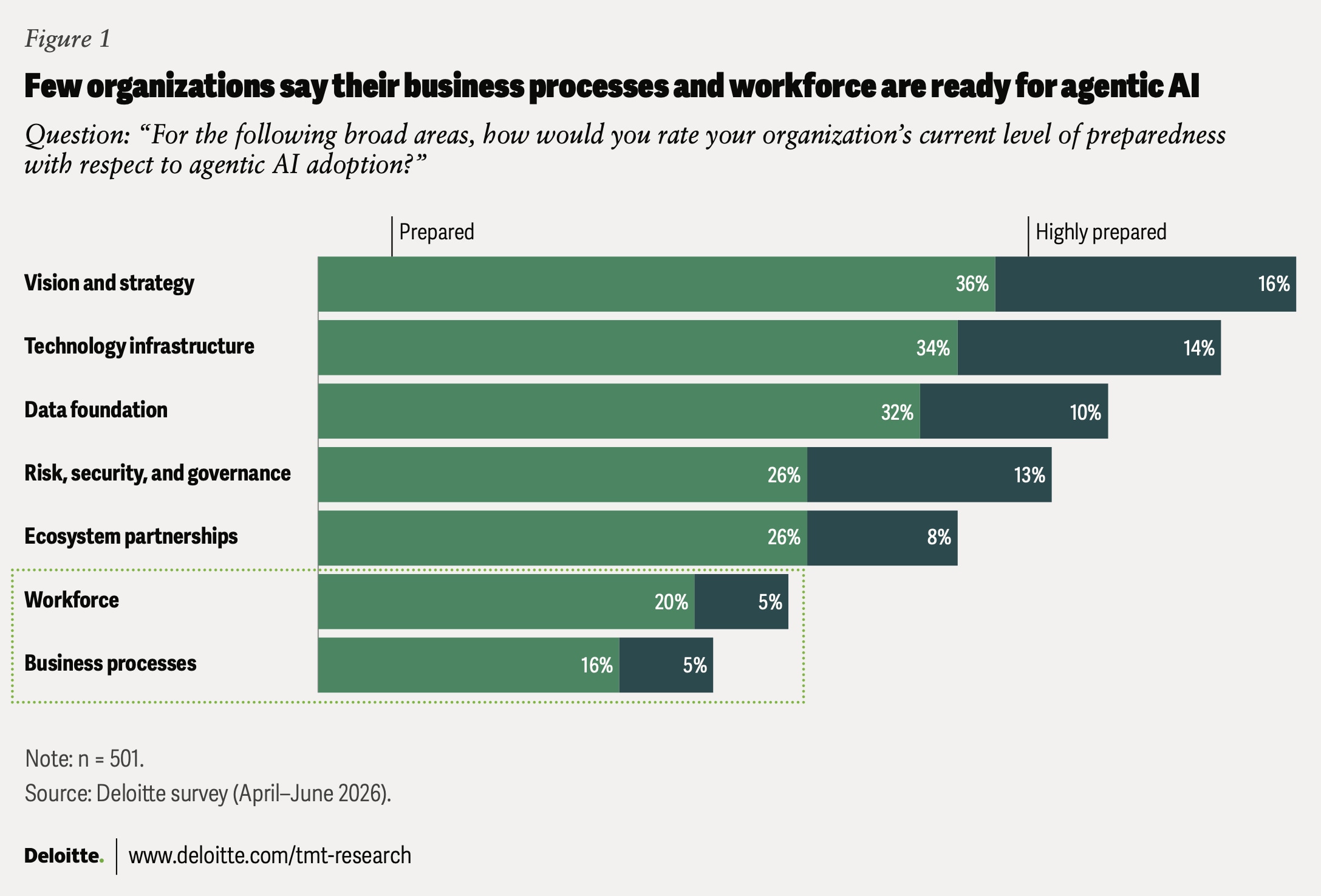
Fewer than half of the organizations surveyed say they are prepared for agentic AI across six aspects of their business.
The pressure to act is clear, but the immensity of the agentic shift can make it difficult to identify the path forward.
The head of digital and data science product management at a life sciences company says: “If we do not move in this direction [toward an autonomous agentic enterprise], maybe in five or ten years, we will find ourselves irrelevant in the market. So, the urgency is real, but we also have to deal with significant challenges along the way.”
About half of surveyed leaders say they have a clear view of their future operating model empowered by AI agents. Obscuring that vision are three foundational and interrelated factors preventing organizations from scaling AI agents: the lack of a unified and accessible data foundation (72%), an inability to trust and govern agents (70%), and the cost and complexity of integration (67%).
What’s more, common challenges to AI adoption and integration—such as those related to data, decisions, governance, organization design, workforce, and costs—are evolving as the speed of technological change outpaces the speed of organizational change.3 Looking specifically at preparedness for AI agents, fewer than half of leaders say they’re ready for agentic AI across almost all aspects of their business (figure 1). The two weakest areas by far are workforce and business processes, signaling that developing new ways of working with agentic AI still needs significant focus.
The same life sciences company leader emphasizes the point: “The bottleneck is not only AI technology. It is equally about corporate culture, the operating model, change management, and having the right talent and workforce. Technology, process, and people all need to transform simultaneously to qualify as a fully agentic organization.”
Process and workforce transformation are critical to the agentic future, and most of the leaders we surveyed expect significant changes in these areas within the next four years:
- Nearly half of their business processes will be redesigned or rebuilt around AI agents (74% expect this).
- Most of their processes will be powered by AI agents, running continuously to support real-time decisions and actions (61% expect this).
- Most of the AI agents they use will be largely autonomous, with humans serving primarily in an oversight role (61% expect this).
- Most AI agents will autonomously coordinate and collaborate with each other across functions, completing multistep tasks (58% expect this).
Most processes aren’t ready for AI agents
Only 16% of respondents said their business processes were prepared, and 5% said they were highly prepared for agentic adoption—and that gap doesn’t close with maturity. Even organizations that have adopted AI agents at scale (those that have orchestrated multi-agent systems deployed across many workflows and functions) are facing challenges, with only 46% saying their business processes are prepared. Additionally, just one in five leaders said their organizations are prepared to redesign processes to run autonomously with AI agents. These areas cited show the lowest levels of preparedness across all the areas we examined.
This lack of preparation is likely not due to an absence of ambition. Rather, organizations could be slowed by several obstacles that are not necessarily unique to AI. The leaders we interviewed pointed to poorly documented and understood processes, inconsistent and fragmented data and systems, and entrenched ways of working. In addition, limited AI fluency among leaders and employees can prevent the strong sponsorship and approach to change management needed to fundamentally reimagine workflows.
For now, many organizations are focused on applying AI agents on top of existing processes (“layering”), rather than redesigning those processes from the ground up. One of the reasons for this approach is that layering may be a quick path to the short payback periods many organizations need to justify their agentic investment.4 An enterprise AI architect at a healthcare company highlights the economic challenges: “Today, we cannot do redesign. It is too expensive, because the only way you can show an ROI right now is to layer. It is incremental: short term, three months, six months; [instead] do a layering to show that we are returning value.”
This isn’t necessarily a bad thing. Layering can build operational capacity and organizational credibility. However, organizations can’t stop there. Process redesign can take years, and organizations need to make a long-term commitment to agentic implementation.5 Otherwise, it’s unlikely that layering efforts will progress past simple optimization and efficiency improvements. All this will take time. Only 31% of organizations expect at least half of their processes to be redesigned and rebuilt around AI agents within two years, but that number increases to 74% within four years (figure 2).
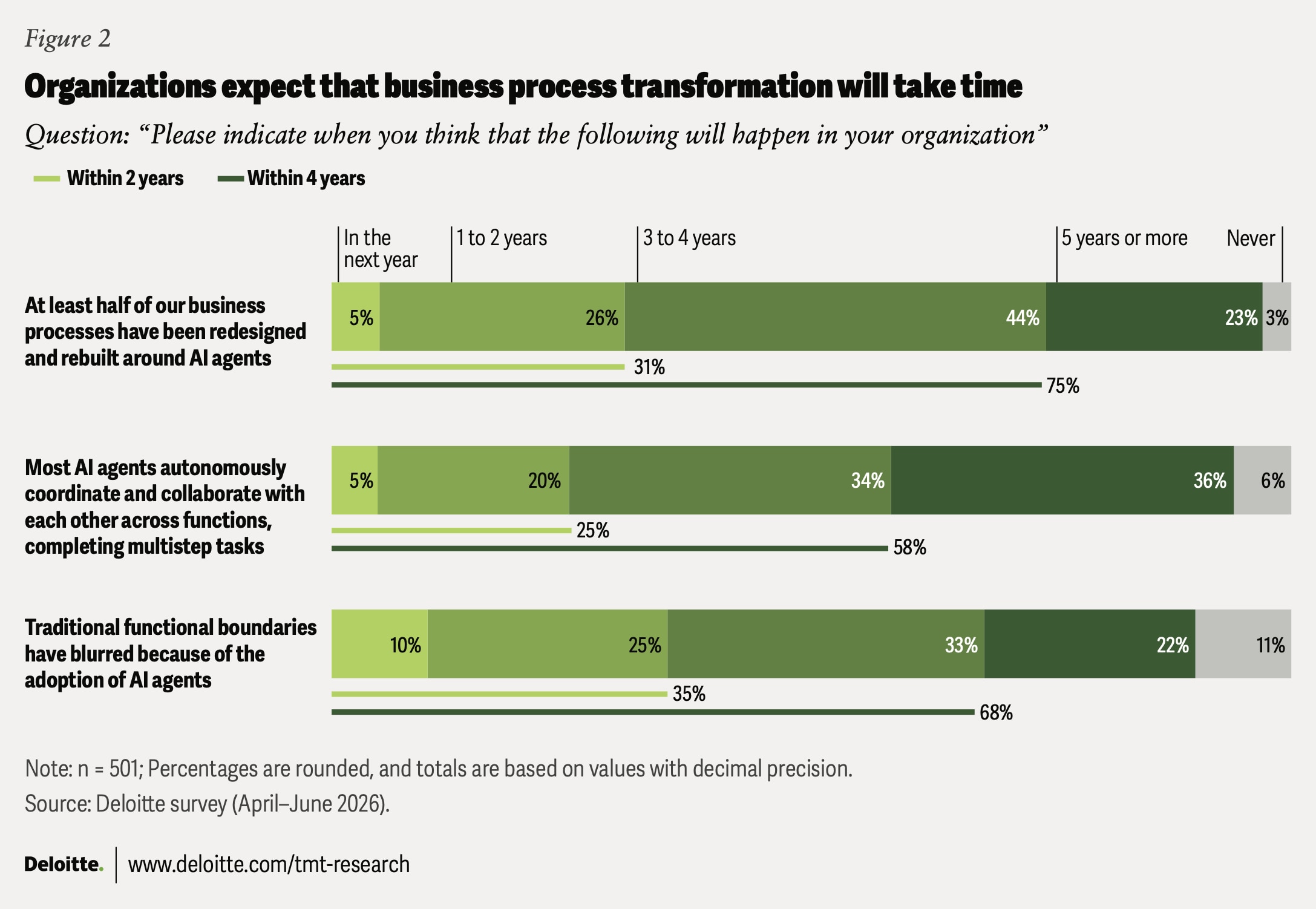
Successfully progressing from layering to process redesign can allow organizations to eventually move toward more cross-functional work design—the redesigning of workflows to enable orchestrated AI agents to coordinate end-to-end across functions and achieve broad outcomes. Only 25% of survey respondents expect cross-functional agent coordination within two years, but that number grows to 58% within the next four years. The blurring of functional boundaries, which some believe will be a result of large-scale agentic adoption, follows a similar pattern (35% expect this within two years, increasing to 67% within four years).
Reshaping the workforce requires investment
Organizations also expect agentic deployment to cause significant workforce disruption across industries over the next few years. This disruption includes changing job requirements, the need for additional learning and development, the design of new ways of working to leverage human and agentic capabilities, and the creation of new roles. Nearly half (43%) of surveyed leaders anticipate “a lot” to “extreme” job disruption because of their organizations’ adoption of AI agents within the next 12 to 18 months. Almost three-quarters (72%) expect the same over the next two to three years. Many of those interviewed believe that routine, structured tasks should increasingly become autonomous, while creative, strategic, and high-judgment roles should continue to rely heavily on human oversight.
Half of the leaders surveyed say their organizations aren’t investing enough in the workforce transformation efforts necessary for the successful adoption of AI agents.
The growing cost of AI infrastructure and the variable expense of AI aren’t making workforce investment any easier for some industries.6 Many are struggling to find a balance between spending on workers and tokens, which can put pressure on budgets, introduce unexpected expenses, and make it difficult to calculate the total cost of ownership for agentic systems. These challenges highlight the need for cost-aware architectures that consider the design of agentic systems and human processes together.7
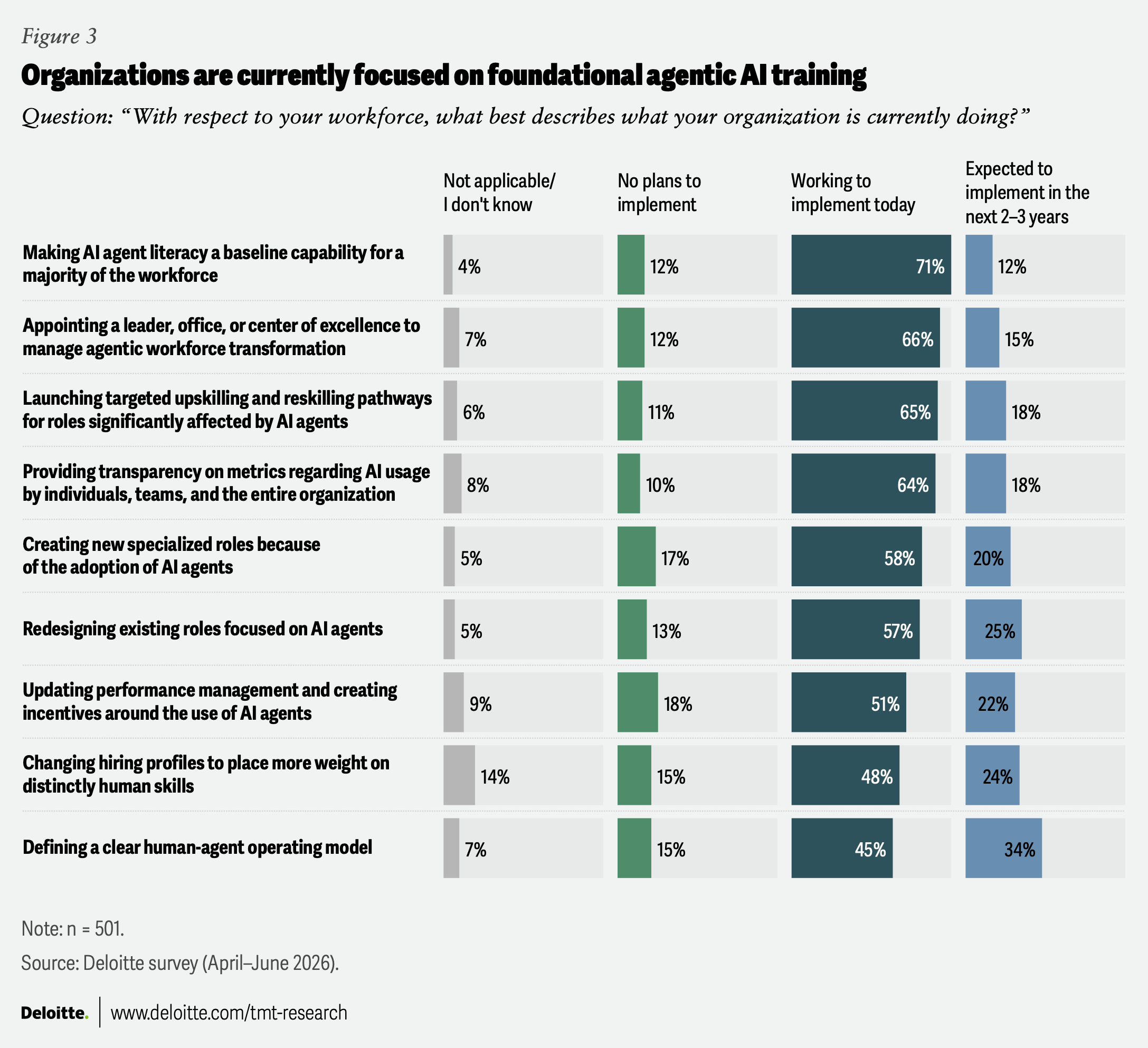
Organizations appear to feel the urgency around workforce readiness, and many are building foundational capabilities: Leaders report that their organizations are currently working on baseline AI agent literacy efforts (71%) and targeted upskilling and reskilling efforts for roles that could be affected by AI agents (65%) (figure 3).
However, the investment model is often not keeping pace with ambition—half of leaders say their organizations aren’t investing enough in workforce transformation efforts necessary for the successful adoption of AI agents. A bank vice president explains their situation: “We have general training, but I don’t know of any bank that does training well. Outside of roles where AI agents are core to the work, banks aren’t providing enough hands-on time with the models and tools to establish expertise.”
Without adequate investment and training, workers are unlikely to manage the shift from simple task execution to AI agent orchestration, supervision, and collaboration.8 Agents are increasingly described not just as tools, but as coworkers. Employees will be expected to direct agents, review outputs, validate quality, and decide when human judgment is needed.9
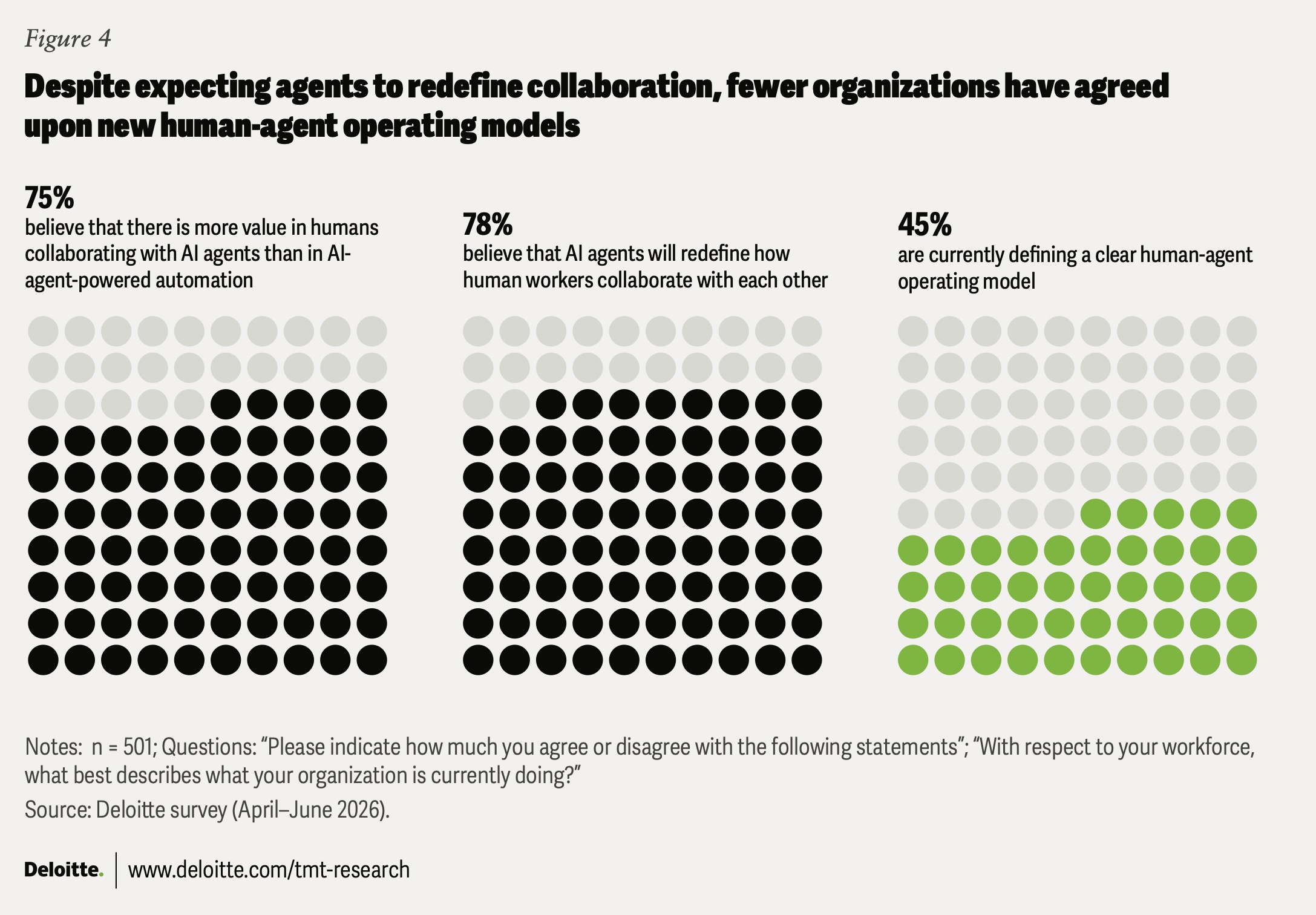
The workforce operating model is still maturing as well.10 Among those we surveyed, leaders expect agents to redefine how collaboration happens, both between humans and agents and among humans (figure 4). Three-quarters of leaders believe there is more value in human-agent collaboration than in pure automation, but fewer than half of organizations have defined the human-agent operating models to achieve that value.11 Those new models are likely to rely heavily on strong governance that clarifies which decisions agents can make, when humans should intervene, who is accountable for outcomes, and how work is handed off between people and agents.12
Realizing the full potential of the agentic enterprise
Most organizations surveyed have moved past the proof-of-concept phase. They can imagine orchestrated, multi-agent systems, but scaled orchestration is still an exception. The result is a small, advanced cohort moving toward broader agentic value creation and a much larger group that is still layering agents onto existing processes and prioritizing quick wins.
To get to scale—and enable more autonomous, cross-functional workflows—organizations should treat agentic AI as an enterprisewide transformation. A life sciences leader we interviewed describes the comprehensive change needed: “An agentic enterprise is not defined by the number of AI agents you have. It is an organization that fully embeds fit-for-purpose AI agents into core operations… It is not just automation. It is autonomous operation with autonomous decision-making.”
Some considerations to help get there:
1. Develop an integrated agentic road map
“Executive sponsorship and sustainable investment are top factors for success. Organizations need a medium- to long-term investment road map, and the ability to plan against it, to accelerate progress toward desired outcomes.” –Chief data and AI officer, energy solutions
Leaders should start with outcomes, then connect use cases, data, governance, architecture, work design, and workforce changes to those outcomes. While IT and customer service applications are often prevalent and can provide quick ROI, organizations should look beyond these areas. They should plan to redesign end-to-end business value chains in finance, supply chain, operations, and sales as well. The economics of the road map also matter. It is not just about funding individual use cases. It should include building a flexible economic model and cost-aware architectures that can support multiyear transformation efforts.14
2. Use layering as a bridge, not the destination
“We’re starting a project to reimagine how we onboard new businesses. Today, we have a lot of manual steps in our operations and sales teams. We’re going to leverage a combination of intelligent document processing, workflow software, and AI agents to automate as much as we can.” –Chief technology officer, financial services
Layering can help organizations learn where processes need improvement, where data issues persist, and how the role of humans should evolve. Ultimately, these efforts should serve as a broader shift toward reimagined workflows powered by intentional human and agent collaboration and end-to-end agent orchestration. When mapping a future-state process with AI agents, organizations should ask: Who should do the work? Which steps can be eliminated? And how should the sequence of work change?
3. Provide sufficient resources for workforce transformation
“I see lots of disruption ahead. Lines will be blurred more than ever because people will have the ability to try different things and experiment quickly… More people are going to be able to code out a solution.” –Vice president and data scientist, banking
Some organizations are deploying AI agents faster than employees can adapt. Organizations should go beyond baseline AI literacy training and provide hands-on time with AI tools, role-specific training, and clear expectations for how employees will collaborate with agents. This training should include protected time and sandbox environments where employees can test AI agents on their own workflows, compare outcomes, and build confidence. Trust-building should also be an integral part of workforce training. It’s important to prepare employees to become partners with AI agents—supervising, validating, and managing the performance of multi-agent systems.
4. Define your human and agent operating model
“At least 30% to 40% of [our] time will shift to the [observation] of agents. It is important to know what to look for when it comes to anomalies, having an understanding that these agents aren’t always going to be correct.” –Vice president of engineering, artificial Intelligence, consumer products
Most leaders envision shared responsibilities between agents and humans across business functions over the next two to three years. However, the majority have not yet defined the approaches needed to make that collaboration a truly productive partnership. Any new workforce operating model should address a collaborative spectrum for humans and agents—from humans sharing a task with agents to agents acting completely independently. Organizations should clearly articulate what work agents will perform, how humans will validate and intervene if needed, who is accountable for outcomes, what domain expertise must remain human-owned, and how agent performance is governed.
Continue the conversation
Meet the industry leaders
by
China Widener
Laura Shact
David Jarvis
Sayantani Mazumder
We would like to sincerely thank Jeff Loucks, Diana Kearns-Manolatos, Natasha Buckley, and Brad Kreit for their valuable inputs.
Editorial (including production and copyediting): Aditi Rao, Anu Augustine, and Aparna Prusty
Design: Molly Piersol and Jaime Austin
Cover image by: Jaime Austin
Knowledge services: Rishitha Bichapogu
Visit the Deloitte Center for Technology, Media & Telecommunications
Access more insights for the technology, media, and entertainment; semiconductor; telecommunication; and sports sectors.