
Human capabilities are at the heart of high-performing teams
In a human-led, AI-powered future, cultivating the capabilities that technology can’t replace may be a key differentiator
What differentiates high-performing teams—which we define as teams that meet or exceed expectations for a sustained period—from others? To explore this question, Deloitte’s Center for Integrated Research conducted an external survey of nearly 1,400 professionals, including team leaders and team members, across a range of industries to better understand their attitudes and behaviors related to high-performance teaming (see methodology). This survey was complemented by five in-depth interviews with senior executives on high-performance teaming.
Our research found that team structure, skills, and technology all contribute to performance. But to achieve and sustain high performance, teams may also need enduring human capabilities. These capabilities relate to the broader ability to integrate skills, knowledge, and experience to adapt to a rapidly changing business landscape.1
Deloitte identifies six enduring human capabilities:2
- Curiosity: The drive to seek new information, knowledge, and experiences, and to challenge assumptions and conventional wisdom.
- Emotional and social intelligence: The ability to recognize, understand, and manage our emotions, and to perceive, interpret, and respond to others’ emotions to better navigate relationships and interactions.
- Divergent thinking: The ability to generate a wide variety of ideas or solutions by thinking in a nonlinear, free-flowing manner, in which multiple solutions and ideas are considered simultaneously
- Informed agility: The ability to continuously gather, evaluate, and synthesize information to adapt strategies and actions. Rather than prioritizing speed alone, it emphasizes thoughtful, context-driven pivots.
- Resilience: The ability to persevere and positively adapt in the face of adversity, including change, everyday challenges, and significant stress, emerging stronger and more capable.
- Connected teaming: The practice of collaborating effectively across organizational and geographic boundaries while enabling everyone to experience psychological safety and a sense of belonging.
As the half-life of skills—particularly technical skills—continues to decline,3 and as human collaboration with artificial intelligence continues to grow, these capabilities may become even more important in ensuring that individual workers and organizations are resilient to changes in the external landscape.4 Indeed, to unlock the potential of AI, teams may need human skills to use the technology most effectively.
What do high-performing teams do differently?
When we asked survey respondents to specify the defining characteristics of a high-performing team, those who self-identified as belonging to high-performing teams (68% of respondents) and those who did not pointed to the same characteristics, including a team environment that fosters learning from one another and the ability to adapt processes.
High-performing teams score higher on enduring human capabilities
Despite similar views on what high performance should look like, respondents who reported being part of a high-performing team indicated a greater presence of, and impact from, human capabilities (figure 1).
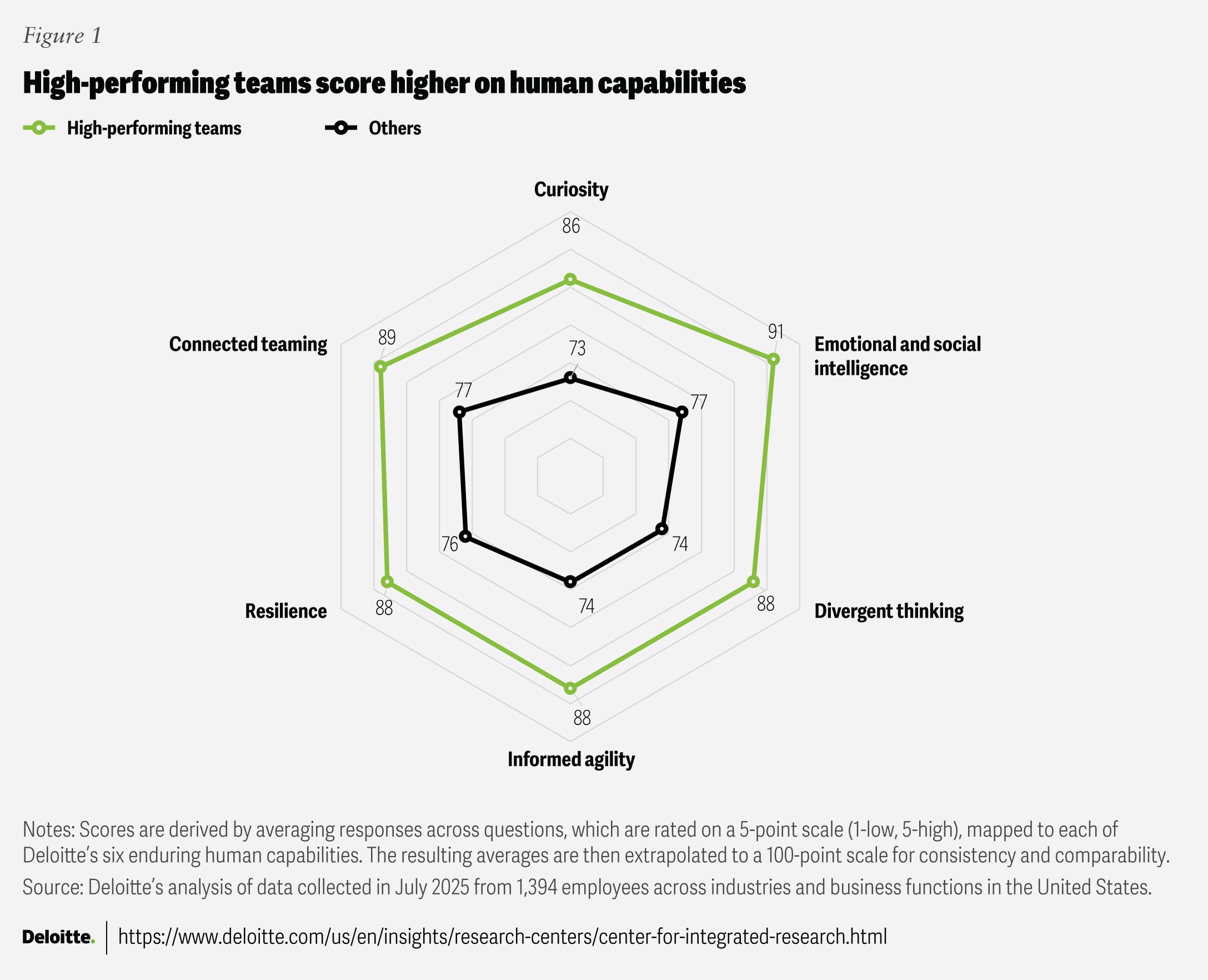
Respondents on high-performing teams indicated a stronger presence of connected teaming and were significantly more likely to say their team members respect each other (72% versus 31%) and ensure that everyone feels included and part of the team (68% versus 50%).
Likewise, emotional and social intelligence appears to be higher in high-performing teams, with 65% of those respondents saying they trust each other and 63% saying their team has a strong sense of support and encouragement—compared with 28% and 25%, respectively, for teams that don’t report high performance. Moreover, respondents from high-performing teams indicate strong connected teaming practices and are three times as likely to say that they feel empowered to reshape their roles or make changes in their day-to-day jobs.
High-performing teams report more divergent thinking
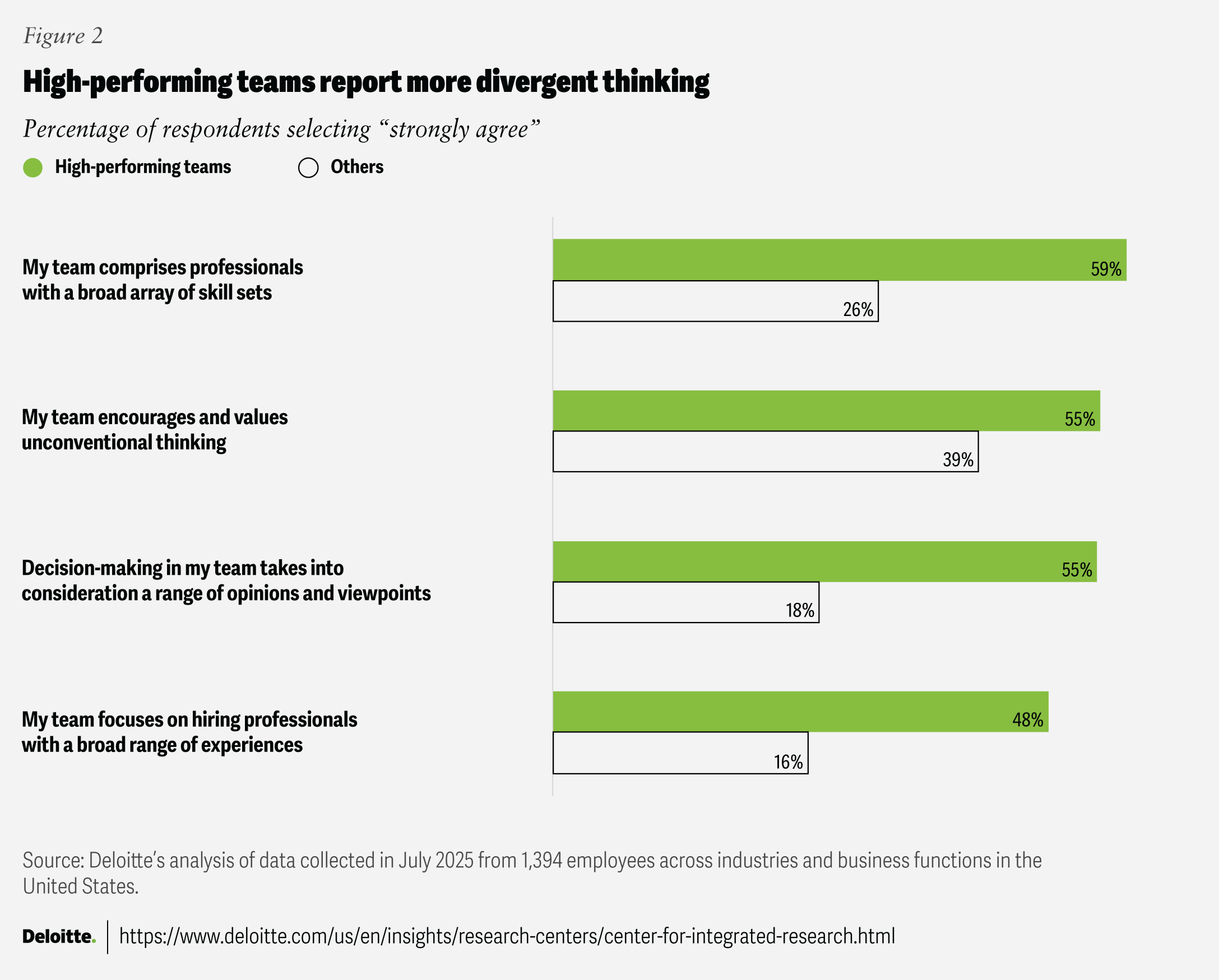
Our study found that members of high-performing teams were significantly more likely to belong to teams with a broad array of skills (59% versus 26%) and that these teams intentionally hire for more varied experiences across the team (48% versus 16%).5
The presence of a wider variety of skills and experiences seems to be connected to practices that harness divergent thinking for better decision-making and outcomes (figure 2). Respondents on high-performing teams were more likely to say that their team encourages and values divergent thinking (55% versus 39%) and to agree that “decision-making in my team takes into consideration a range of viewpoints” (55% versus 18%).
High-performing teams often use informed agility and resilience to navigate changing circumstances
Survey respondents who are members of high-performing teams are 2.5 times as likely to say that their teams can quickly change direction, support each other in times of change, and are open to exploring unfamiliar ideas by continuously learning new skills, demonstrating a higher degree of informed agility (figure 3). An executive director of a multinational financial services firm believes the rapid pace of change resulting from technological advancements is leading workers to redirect themselves more often, thereby creating greater resilience.6
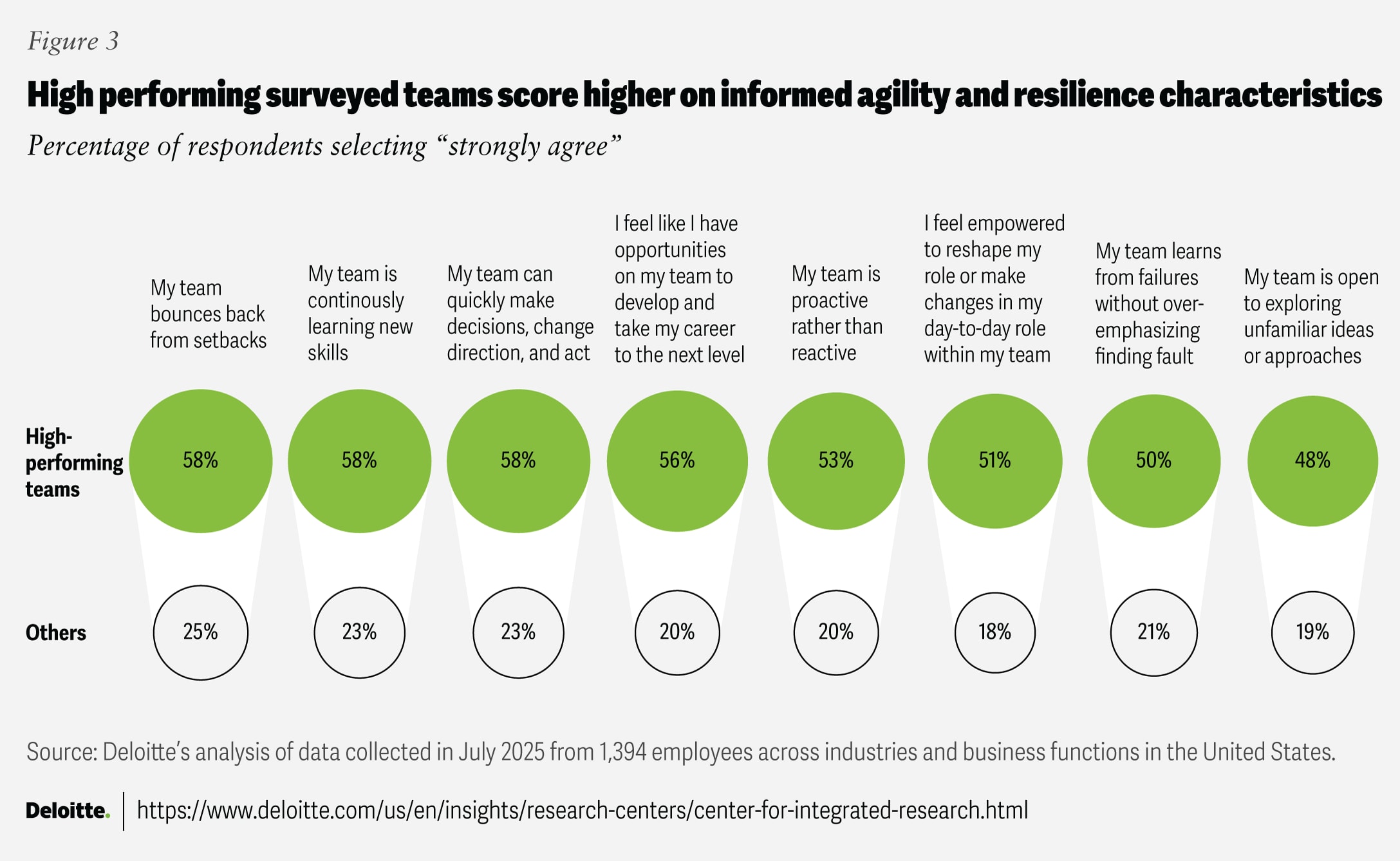
Among respondents, members of high-performing teams are significantly more likely to say that their teams learn from failures without overemphasizing fault-finding (50% versus 21%) and bounce back from setbacks (58% versus 25%).
High-performing teams may have a broader array of learning opportunities—and the curiosity to take advantage of them
Respondents who indicated they had been part of high-performing teams were significantly more likely to say that their team members approach work as an opportunity to learn from each other (figure 4).
In addition to fostering curiosity and learning, surveyed high-performing team members were significantly more likely to say that their team promotes a culture of apprenticeship (40% versus 15%).
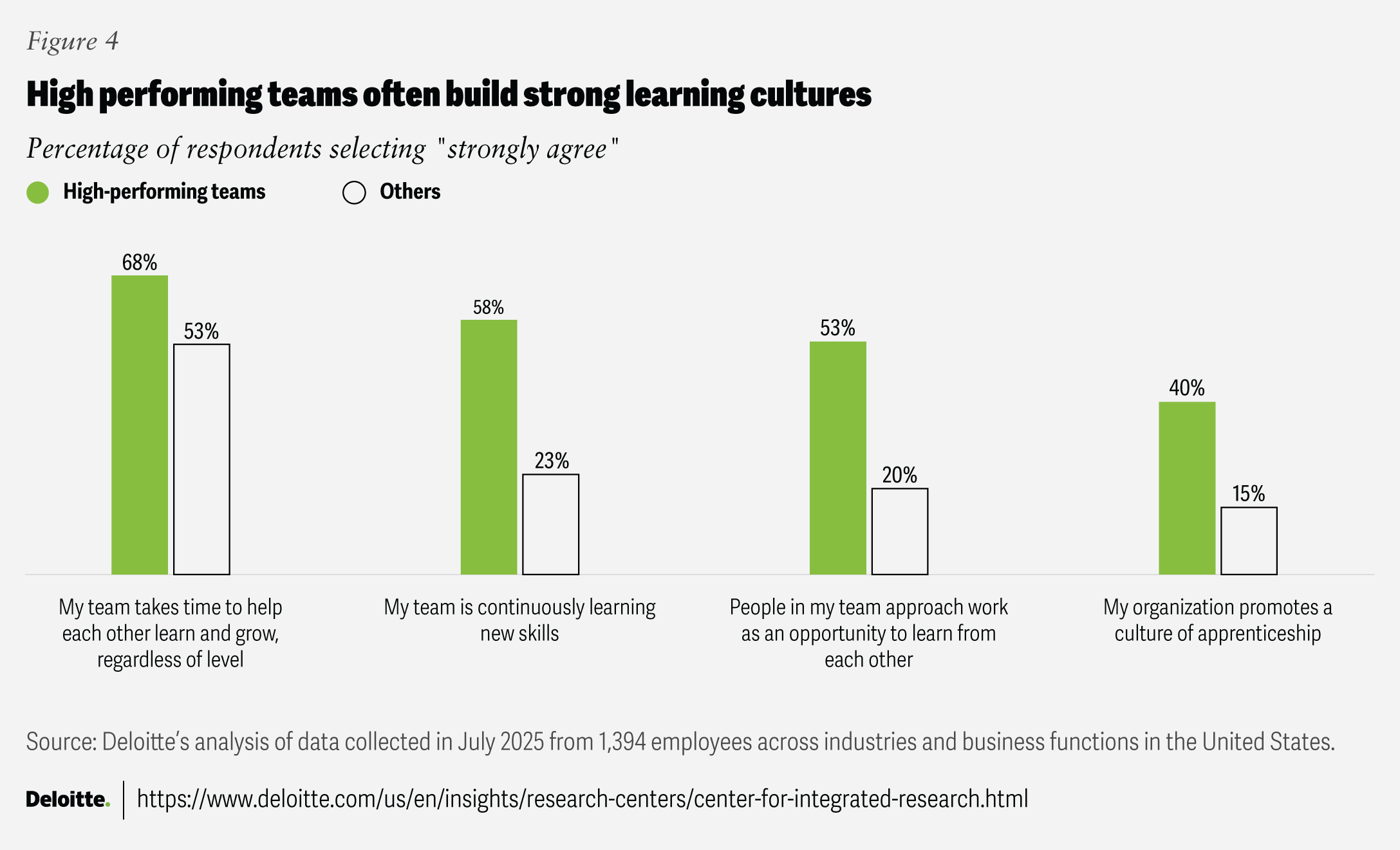
Respondents from high-performing teams were also less likely to say that their organization relies on only a few individuals for information-sharing. A culture of apprenticeship was also a top driver of respondents recommending both their team and their organization to others,7 suggesting that apprenticeships can benefit team performance now and help attract new talent.
High-performing teams largely know how to work with AI—and each other
Recent Deloitte research suggests that divergent thinking may enable teams to derive greater value from their AI investments.8 Our findings reinforce the importance of divergent thinking and other human capabilities on high performing teams’ more positive experience using AI at work (figure 5). For example, survey respondents from high-performing teams are significantly more likely to use AI tools in their work (78% versus 54%). They are also more likely to say that their experience working with AI was “very high quality” in supporting core work (36% versus 18%), which could suggest higher levels of curiosity and informed agility.
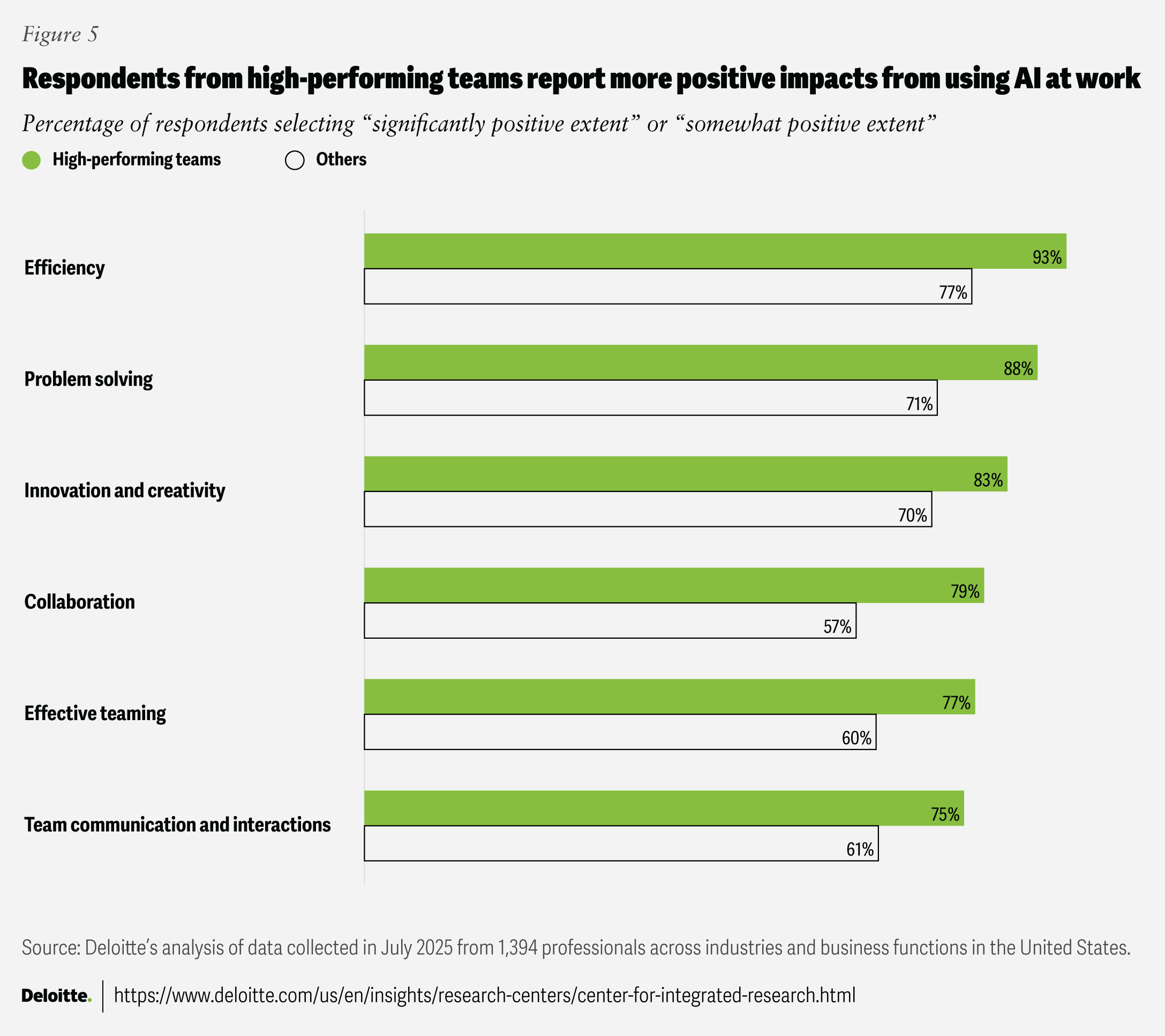
Additionally, high-performing team members were significantly more likely to say they had very high-quality experiences working with human colleagues on these same tasks, suggesting that high-performing teams have a clearer understanding of how to work together to integrate new technology into existing workflows.
Where do high-performing teams have opportunities for growth?
Even high-performing teams have room for improvement. Our research suggests the following areas for improvement, along with key action steps that organizations can consider.
Invest in human capabilities and core skills
Survey respondents generally see the value of human skills, with 63% saying human skills will increase in importance over the next two years, even as technology continues to advance. In addition, a recent Deloitte study found that organizational investments in AI initiatives are heavily tilted toward technology, with 93% of expenditures going toward technology infrastructure and just 7% going toward work and people-related issues.9
While high-performing team members were significantly more likely to say that they received equal amounts of training on technology and human skills (42% versus 15%), few respondents report receiving equal amounts of training in both areas. This suggests that there may be a growing gap between how organizations invest in training and development and what evidence from our study suggests is valuable to long-term performance.10
To invest in human capabilities, organizations can:
- Facilitate human skills while continuing to upskill technical proficiencies. Toyota trains its teams in both technical and human skills.11 In recent years, it has emphasized training its manufacturing workforce to focus on production issues that are not easily addressed by technology. At the same time, it has continued to invest in advanced manufacturing capabilities. By combining the two, its teams have been able to develop new manufacturing processes and designs.
- Focus on curiosity to strengthen learning and apprenticeship. Our findings suggest that high-performing teams create a culture of formal and informal learning and apprenticeship. This may be true even in settings with high levels of formal learning, as noted by the chief human resources officer of a hospital chain, who explains that informal connections can often lead to growth and development.12
Create opportunities for exploration and experimentation
Despite the strong presence of curiosity and resilience among our respondents, fewer than a third of respondents on high-performing teams said their team engages in exploratory behavior. As AI continues to reshape work, organizations may benefit from creative thinking about how humans can work with AI to create value.
Only half of surveyed respondents on high-performing teams said that their team learns from failures without overemphasizing fault-finding, suggesting that workers may need to feel comfortable engaging in exploratory behavior—despite the risks—to capitalize on its benefits. To help create space for more experimentation, organizations can:
- Destigmatize failure. As advances in technology increase future uncertainty, organizations can help their workforce prepare for multiple possible futures by enabling teams to safely experiment and learn from mistakes.13 These teams may have an advantage over teams in which pursuing something that might fail is considered too risky. “Learning is driven almost exclusively through moments where what we thought was going to happen doesn’t happen,” says Astro Teller, who leads Alphabet’s pioneering moonshot division, X, in an interview with Freethink in 2023.14 The lab, which turns experimental tech into businesses, fosters a culture of learning from failures. Failed projects are called “compost,” inspiring the next crop of ideas that the lab pursues.15
Help team members see the bigger picture and communicate the strategic vision of the organization
Surveyed team leaders were significantly more likely than team members to say they belong to a high-performing team (77% versus 59%) and were significantly more likely to say that they understand how they can best contribute to team performance (67% versus 52%). This understanding was especially low among team members who don’t belong to high-performing teams, with just 29% of this group saying they understand how their work contributes to team performance.
To address this, organizations can consider steps such as:
- Close perception gaps among teams. One way to close perception gaps is by bringing together team members with different backgrounds to gain a deeper understanding of each other’s roles. In doing so, leaders can learn about the hidden factors impeding processes and begin working to address them. The CHRO of a hospital chain says, “We are matching clinical and non-clinical leaders together. Physicians and administrators go through a very intensive learning experience together to really understand each other’s perceptions of one another and how they can build greater levels of trust and collaboration.”16
Thriving teams should start and lead with human capabilities
Organizations that prioritize human capabilities alongside technical skills will likely be best prepared for the future of work. By investing in enduring human capabilities, leaders can create conditions where innovation and value creation flourish. In doing so, they may help ensure that their teams are not just responsive to change, but capable of shaping it in ways that deliver long-term impact for both the workforce and the organization.
Continue the Conversation
Meet the industry leaders
Brad Kreit
Monika Mahto
by
David Rizzo
Brad Kreit
Monika Mahto
Simona Spelman
Neda Schlictman
The authors extend their gratitude to Abha Kulkarni for her support with data analysis and to Brenna Sniderman, Corrie Commisso, Katharine Suettinger, and Amanda Raknes for their valuable feedback throughout the development and writing process.
We would also like to thank Negina Rood for her contributions and research support, as well as Jessica Heine, Germaine Henry, Rachael Mesnik, and Anisha Sharma for their leadership in program management and collaboration on this research.
Finally, we are grateful to Corrie Commisso, Prodyut Ranjan Borah, Saurabh Rijhwani, Ireen Jose, and Akshay Poojari for their contributions to the production and marketing support of the research.
Together, their contributions were invaluable in bringing this research to life.
Editorial (including production and copyediting): Corrie Commisso, Prodyut Borah, and Anu Augustine
Design: Sonya Vasilieff, Sylvia Chang, Molly Piersol, and Pooja Lnu
Cover artist: Sonya Vasilieff; Adobe Stock
Visit the Deloitte Center for Integrated Research
Access more insights on some of the most complex issues facing businesses today.