
Bridging the AI value gap: Are team dynamics the missing link?
Deloitte survey findings suggest the strongest AI outcomes may come from larger, cognitively diverse, highly connected teams that invest in people, not just the tech
As organizations race to scale AI, many assume that the fastest path to impact lies in small, agile teams positioned closest to the technology. Our research suggests a different story. The teams reporting the strongest outcomes from AI are not the smallest; they are some of the most connected and cognitively diverse.
Deloitte’s 2025 Tech Value Survey found that 74% of surveyed organizations invested in AI in the prior 12 months, making it the single most-funded digital capability among these companies.1 The results, however, were mixed.2 Why is that so?
One reason may be a persistent investment imbalance. Deloitte’s Tech Trends research, for example, suggests that 93% of respondents’ tech-related funding is spent on the technology itself, while just 7% goes to training and upskilling the people who use it. This may leave teams underprepared for the behavioral changes, new skills, and cross-functional ways of working required to make the most of their AI investments.
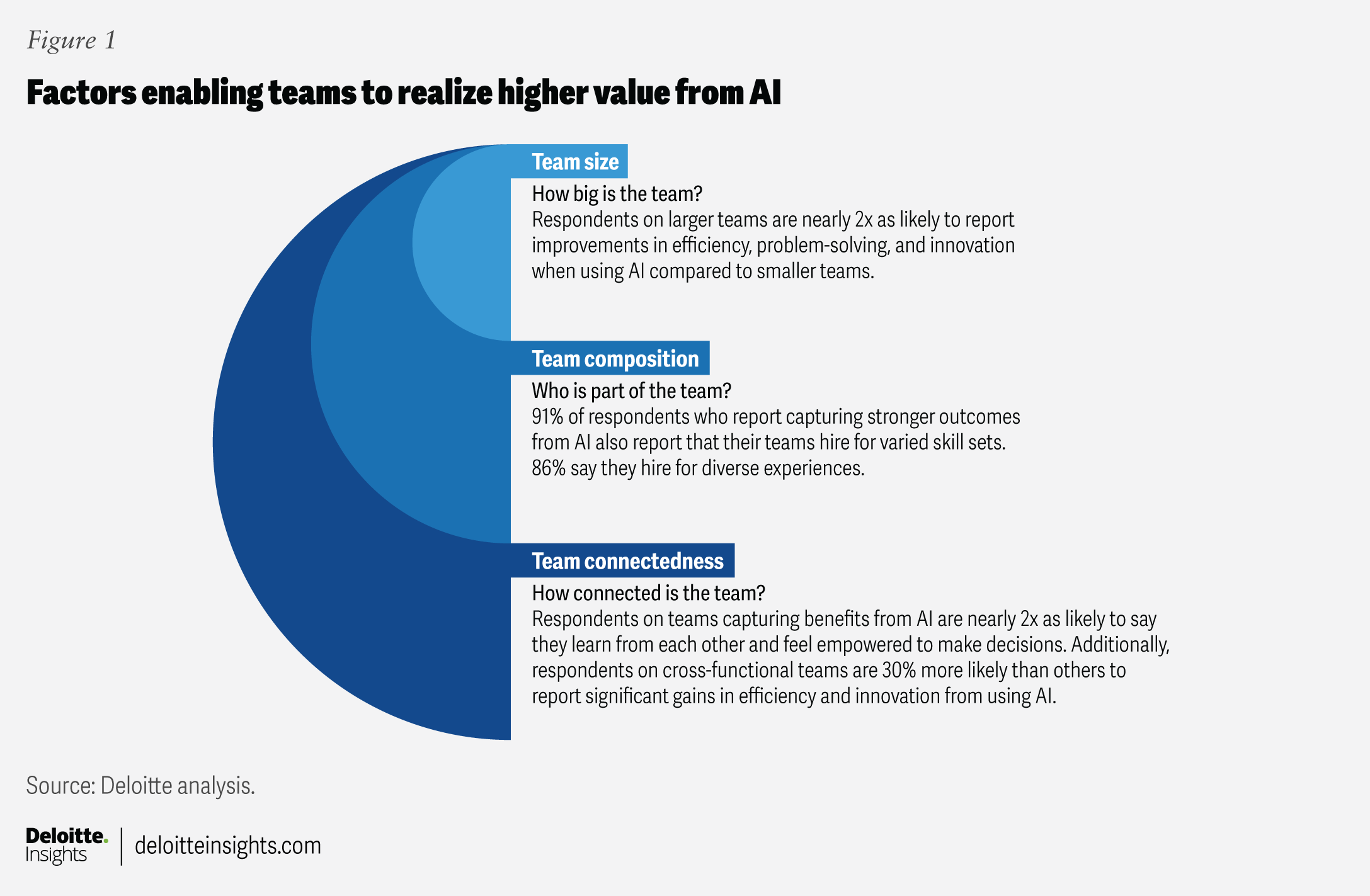
That gap matters because while AI decisions are often made at the enterprise level, success is often driven by what happens closer to the ground—within teams. Examining how teams are structured and how they work together can reveal why AI outcomes align with expectations, or not. In July 2025, Deloitte’s Center for Integrated Research surveyed 1,400 US professionals across various industries and found stark differences between teams that reported capturing higher value from AI versus those that didn’t. Our research uncovered three key themes related to team size, composition, and connectedness (figure 1).
- How big is the team? Respondents on larger teams are nearly two times as likely to report improvements in efficiency, problem-solving, and innovation using AI compared to smaller teams.
- Who is part of the team? Ninety-one percent of respondents who cite capturing stronger outcomes from AI also report their teams hire for varied skill sets, and 86% say they hire for diverse experiences.
- How connected is the team? Respondents on teams capturing benefits from AI are nearly two times as likely to say they learn from each other and feel empowered to make decisions. Additionally, respondents on cross-functional teams were 30% more likely than others to report significant gains in efficiency and innovation from using AI.
Larger teams likely generate greater value from AI tools
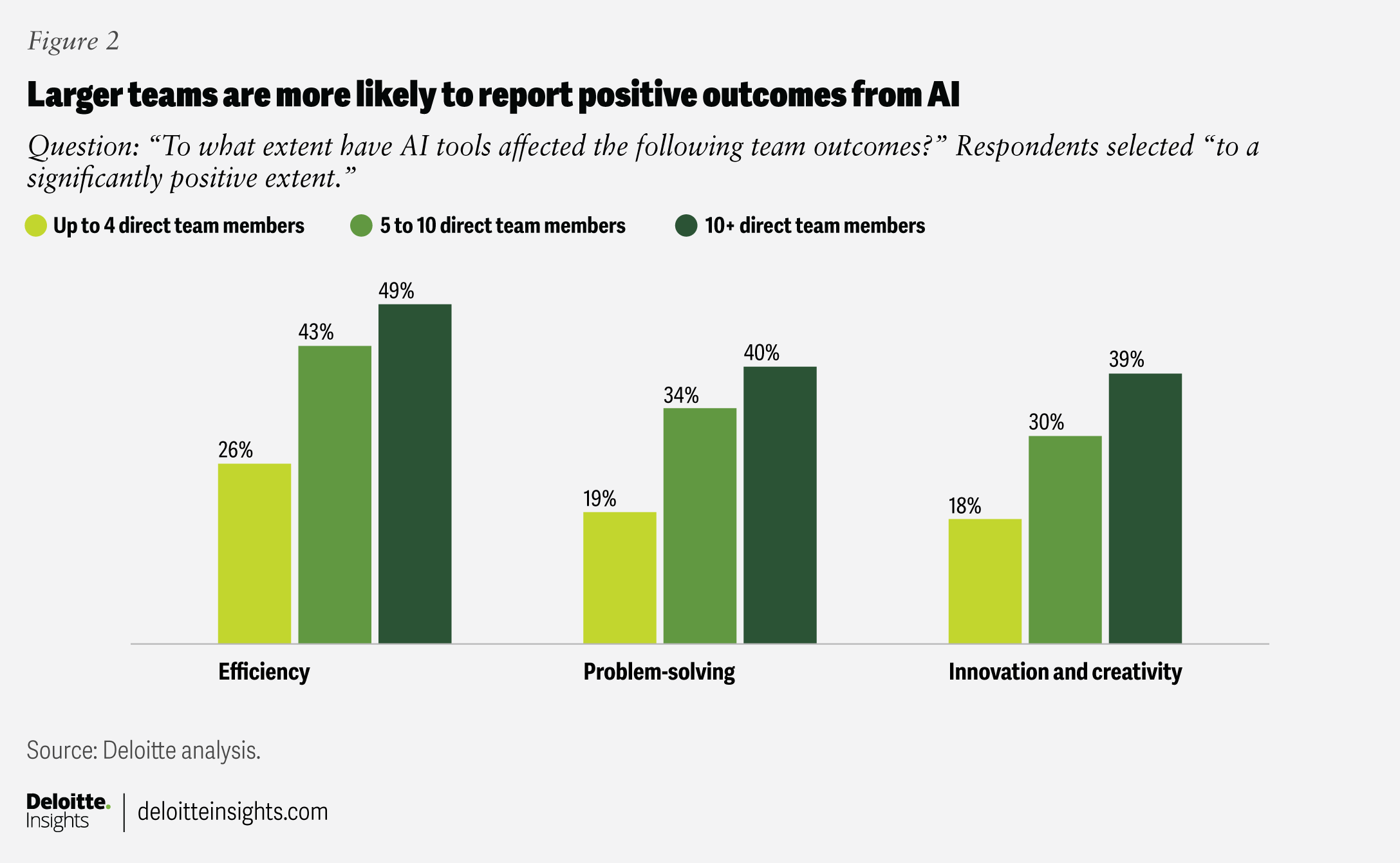
For our analysis, we categorized teams into three sizes (up to four team members, five to 10 members, and more than 10 members) and found that AI usage by teams, as well as the effectiveness of AI at achieving work outcomes, increased proportionately with team size.
- Larger teams report higher AI usage. Seventy-four percent of teams with more than 10 members reported using AI at work compared with 54% of teams with fewer than five members.
- Larger teams also report higher effectiveness of AI at achieving work outcomes. When asked about the “extent of AI tools impacting team outcomes,” teams with more than 10 members reported twice the improvement in innovation, problem-solving, and efficiency using AI, compared to teams with up to four team members (figure 2).
Larger teams appear better positioned to integrate AI into workflows, distribute responsibilities, and scale usage across varied tasks.
Cognitive diversity may amplify value realized from AI
Teams that report capturing the greatest improvements from AI aren’t just bigger; they are also cognitively diverse with higher variability in skill sets, work experiences, and ways of thinking. An earlier 2025 Deloitte study reinforces this point: Employees who felt their organization overlooked diversity of thought in AI design were 60 percentage points less likely than others to use AI tools daily, highlighting the critical role that diverse perspectives play in the adoption and effective utilization of AI technologies.3
Meanwhile, in our survey of 1,400 professionals, we found that among teams reporting significant improvements in efficiency, problem-solving, or innovation from AI:
- 91% report actively hiring for varied skill sets (versus 68% among other, non-high performing teams)
- 86% prioritize diverse past experiences (versus 51% among the others)
- 54% regularly incorporate diverse viewpoints into decisions—double the rate of lower-performing teams
Cognitive diversity expands the range of perspectives, enabling teams to leverage AI in more creative, adaptive, and multidimensional ways.4
Team connectedness can unlock benefits from AI efforts
A third, equally critical factor is how well teams collaborate, both within the team and across the organization. Teams reporting significant benefits from AI tools are:
- 2.5x likely to say they see work as an opportunity to learn from each other
- 1.9x likely to say they feel empowered to make decisions
- 2.1x likely to report they plan to reshape their roles as AI tools evolve
Trust within teams is an important factor influencing AI adoption, usage, and outcomes. Our research showed that 83% of high-trusting teams are AI users, compared to 63% of others. Additionally, cross-functional teams (those working across multiple business units) were 30% more likely to report significant gains in efficiency and innovation from using AI. These findings suggest that, as organizations look to scale their AI efforts, they are more likely to succeed by focusing on teams that cut across functions and bring multiple kinds of expertise.
Building teams for a human-led, AI-powered future
Many organizations continue to struggle with translating the true potential of AI into strong business outcomes. Our research shows that while AI decisions are often made at the macro-organizational level, the success of these investments may lie at the micro-level within teams.
Our findings show that teams tend to realize far greater value from AI when they are larger, blend varied experience and skill sets, and are highly collaborative, working fluidly across teams and business functions. These teams report significantly higher gains in efficiency, creativity, and problem-solving through their AI tools. By combining diverse skills and experiences with strong collaborative practices, they bring together broad expertise and deep domain knowledge, creating the conditions to realize value from AI.
Leaders should consider:
- Scaling AI within teams large enough to pressure-test and operationalize the tools
- Intentionally hiring for and cultivating cognitive diversity
- Strengthening connectedness within and across teams and fostering cross-functional collaboration
- Empowering teams to experiment, adapt, and evolve their roles with AI
- Allocating a larger portion of tech spending to training people and enabling teams to consistently realize AI’s value
This article contains general information only and Deloitte is not, by means of this article, rendering accounting, business, financial, investment, legal, tax, or other professional advice or services. This article is not a substitute for such professional advice or services, nor should it be used as a basis for any decision or action that may affect your business. Before making any decision or taking any action that may affect your business, you should consult a qualified professional advisor.
Deloitte shall not be responsible for any loss sustained by any person who relies on this article.
About Deloitte
Deloitte refers to one or more of Deloitte Touche Tohmatsu Limited, a UK private company limited by guarantee (“DTTL”), its network of member firms, and their related entities. DTTL and each of its member firms are legally separate and independent entities. DTTL (also referred to as “Deloitte Global”) does not provide services to clients. In the United States, Deloitte refers to one or more of the US member firms of DTTL, their related entities that operate using the “Deloitte” name in the United States and their respective affiliates. Certain services may not be available to attest clients under the rules and regulations of public accounting. Please see www.deloitte.com/about to learn more about our global network of member firms.
Copyright © 2026 Deloitte Development LLC. All rights reserved.
Continue the conversation
Meet the industry leaders
Brad Kreit
Monika Mahto
by
Christina Brodzik
Abha Kulkarni
Monika Mahto
Brad Kreit
The authors extend their gratitude to Brenna Sniderman, Annalyn Kurtz, and Molly Piersol for their valuable feedback throughout the development and writing process.
We are also grateful to Sayanika Bordoloi, Saurabh Rijhwani, and Ireen Jose for their contributions to the production and marketing support of the research. Their contributions were invaluable in bringing this research to life.
Editorial (including production and copyediting): Annalyn Kurtz, Sayanika Bordoloi, Anu Augustine, and Pubali Dey
Design: Molly Piersol and Sanaa Saifi
Audience development: Atira Anderson
Cover artist: Sanaa Saifi
Knowledge services: Rishitha Bichapogu
Visit the Deloitte Center for Integrated Research
Access more insights on some of the most complex issues facing businesses today.