
North American CFOs express concerns about AI governance and risk management
Facing pressure to deploy AI quickly, respondents to the second-quarter 2026 CFO Signals survey worry about cost uncertainty and transparency, as well as potential risks
AI can help boost productivity and efficiency, but it can also introduce risks. AI outputs can sometimes be incorrect, veer from their original instructions, or even surreptitiously copy essential files onto other computers.1
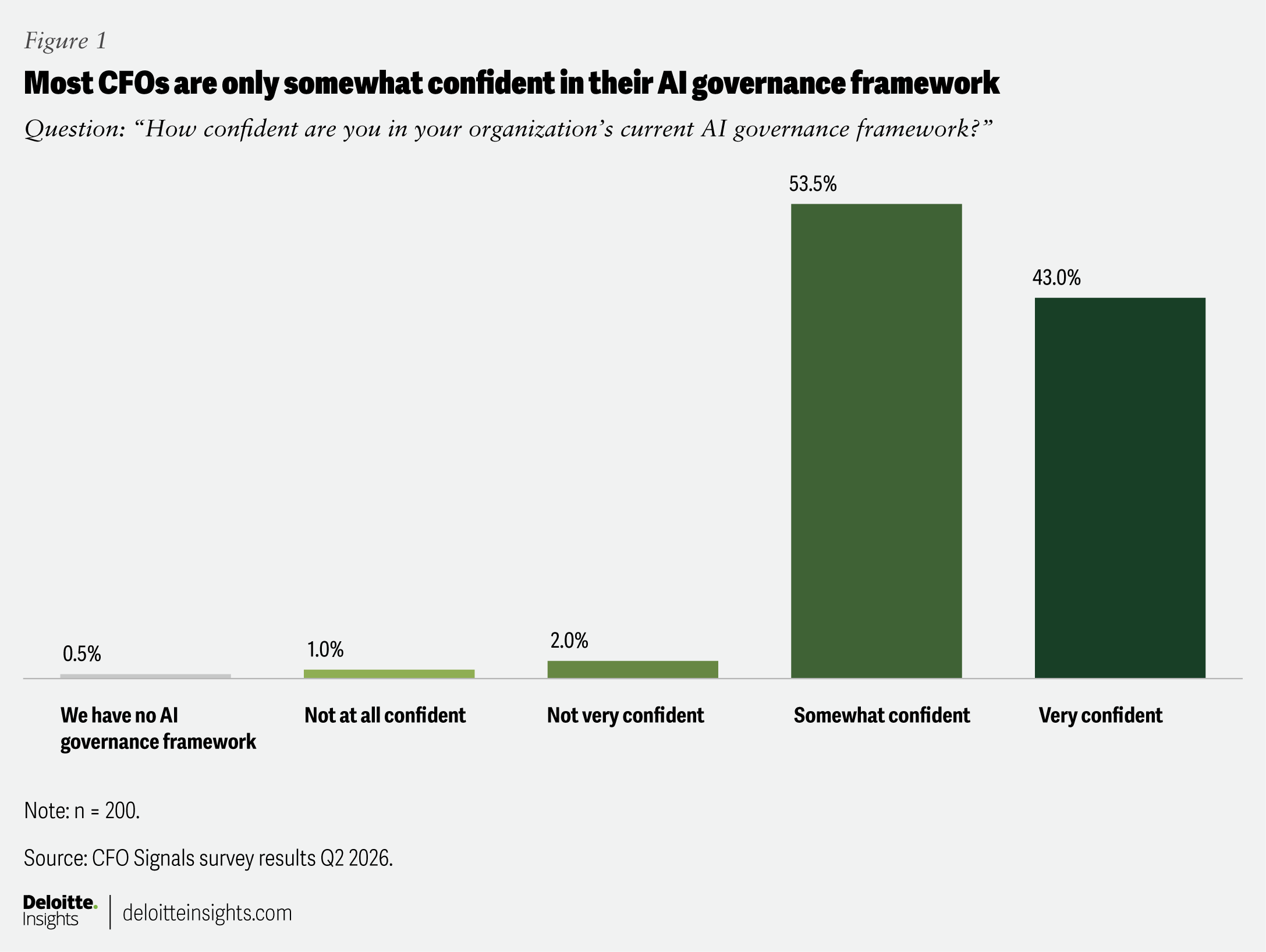
Having effective governance protocols can provide important guardrails for responsible AI use. In Deloitte’s second quarter 2026 North American CFO Signals survey of 200 chief financial officers at North American organizations with at least US$1 billion in revenue, CFOs were asked to rate their confidence in their organization’s current AI governance. While 43% say they feel confident, more than half (53.5%) feel only somewhat confident (figure 1).
Certainly, the speed and volume of adoption can complicate governance. In a CFO Signals survey conducted less than three years ago, most respondents (66%) said their companies were still experimenting with generative AI—or simply reading and talking about it. In this latest survey, 93% of respondents say their organizations use AI extensively or modestly across multiple key functions and operations.
The corporate investment in AI is unlikely to slow down anytime soon. Agentic AI, for one, seems to be gaining traction. A 2025 Deloitte survey of global business leaders found that 74% of the respondents’ companies plan to deploy agentic AI within two years.2
Heavy lifting: CFOs balance AI adoption and governance risks
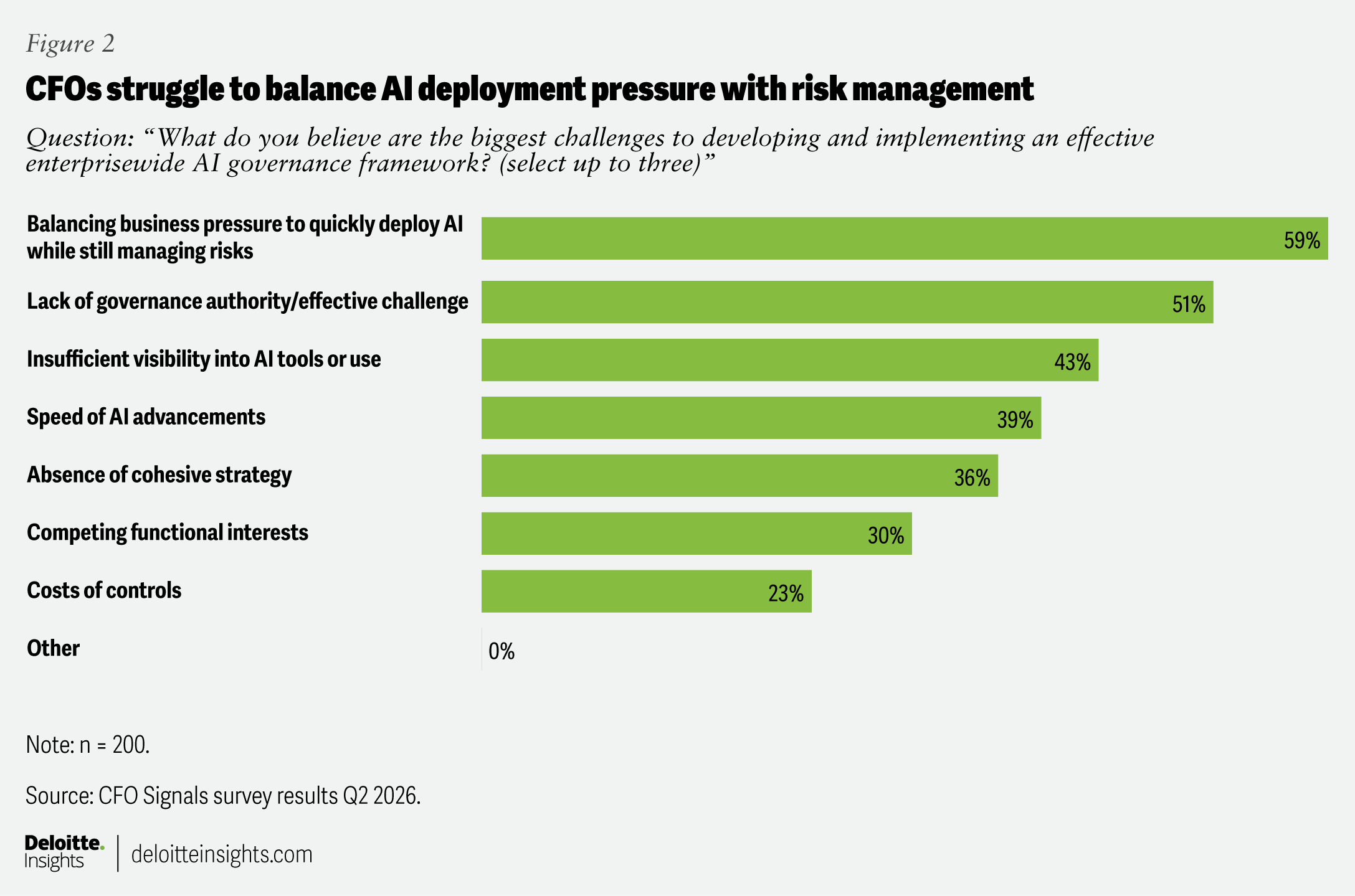
In the second quarter survey, 59% of respondents cite balancing pressure to deploy AI quickly while still managing risks as the biggest challenge to developing an effective enterprisewide AI governance framework (figure 2).
There’s no shortage of risks to manage, either. Stories about AI systems behaving unexpectedly are becoming increasingly common. While surveyed CFOs are worried about flaws in the technology itself, they also have concerns related to the adoption and utilization of AI within their organizations. Notably, 46% of respondents say their biggest internal concern about their organization’s use of AI is cost uncertainty or lack of transparency—the No.1 response (figure 3). Many AI providers now charge corporate clients by consumption, rather than a flat rate. Given that usage often fluctuates, the bill can be hard to predict.
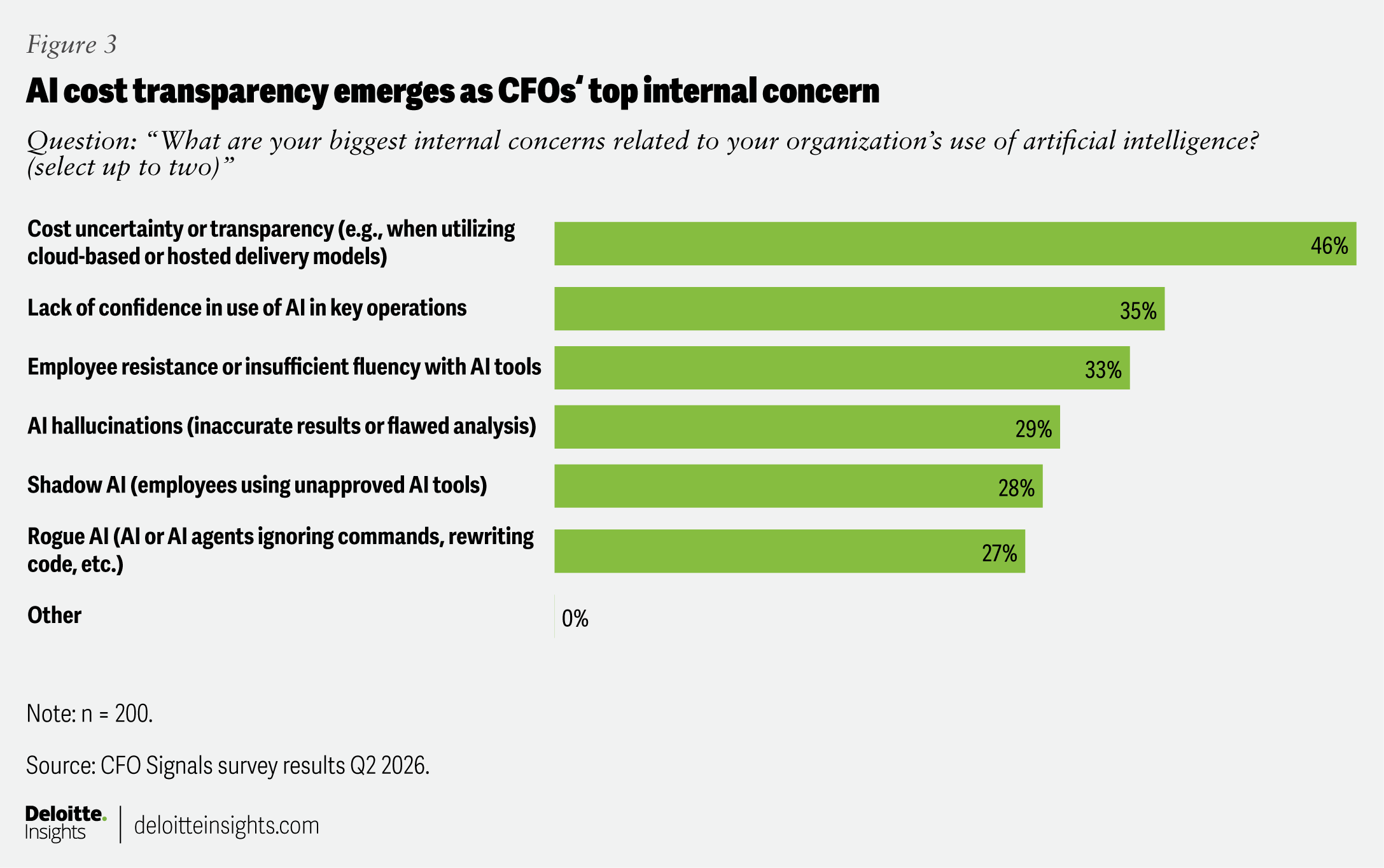
CFOs cite other nontechnology-related risks, too. More than one-third (35%) of respondents say their biggest internal concern related to their organization’s use of AI is a lack of confidence in using AI in key operations. That ranks second, followed by employee resistance or insufficient fluency with AI tools. Meanwhile, 25% are concerned about the potential for AI-driven mistakes. These mistakes, if not adequately mitigated, could possibly damage a company's brand and bottom line.
Among external concerns related to their organization’s use of AI, respondents’ top concern (43%) is litigation related to the use of protected or private content (figure 4). Issues such as copyright infringement or intellectual property violations could trigger legal action. So, too, could a successful attempt at hacking corporate computer systems.
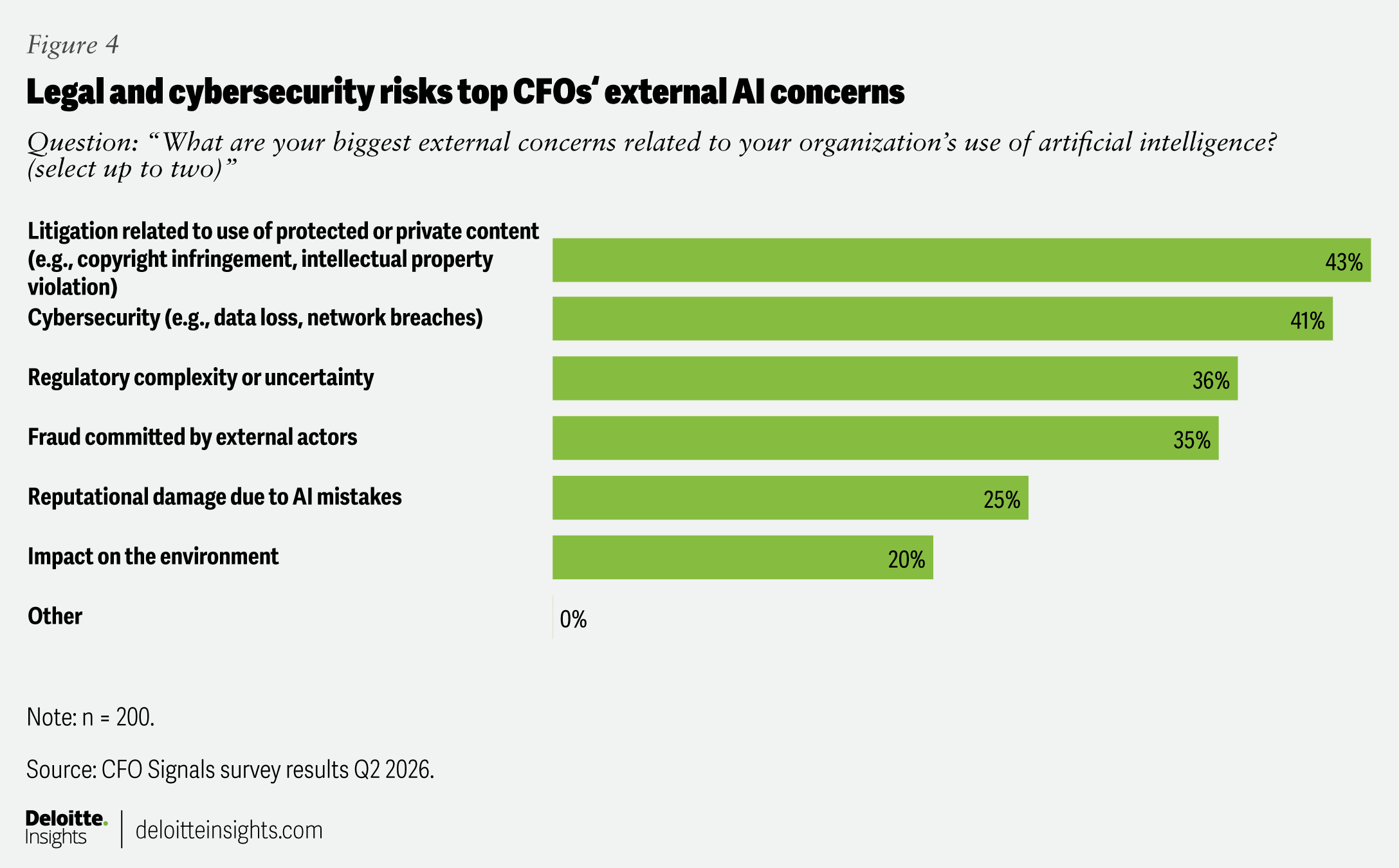
In fact, AI is becoming a tool for both cyber attackers and defenders. Many organizations are turning to AI to strengthen their own security measures. But as organizations adopt AI more broadly, malicious actors may also use the technology to launch increasingly sophisticated attacks. Respondents rank cybersecurity as the second-most-cited external concern (41%) related to organizations’ use of AI (figure 4). That finding dovetails with Deloitte’s Finance Trends 2026 survey, which polled 1,326 global finance leaders. When asked to identify barriers to AI adoption in their finance functions, 47% cite data security concerns—their No. 1 response.
AI is becoming part of the finance function's day-to-day work
Given the potential for network vulnerabilities, it may not be surprising that 33% of surveyed CFOs say their chief information security officer owns AI governance at their organizations. What may be somewhat surprising is that 19% say they have the greatest responsibility for AI governance at their company. That puts CFOs ahead of CEOs (12%), AI governance committees (8%), boards and board audit committees (4.5%), and chief risk officers (0.5%).
At the same time, CFO respondents are overseeing the use of AI in their own finance function. More than half (51%) say they use AI for operational productivity tasks: things like organizing meeting transcripts, drafting emails, and the like. But 44% of respondents are using AI for financial planning and budgeting. And 41% use AI to analyze financial data to gain insights.
That’s a long way from only reading and talking about it.
Continue the conversation
Meet the industry leader
By
Ed Hardy
John Goff
Rachel Tagle
Many thanks to James Glover, Jamie Weidner, Amy Steele, Kate Fusillo-Schmidt, and Ryan Hittner for guidance in shaping this survey and article. Also, much appreciation to Abhinav Annapureddy, and Justine Barry for their indispensable contributions in producing the report. Additional thanks to Josh Hyatt for his always-excellent editing.
Editorial (including production and copyediting): Karen Edelman, Kavita Majumdar, Aparna Prusty, Anu Augustine, and Pubali Dey
Design: Molly Piersol and Natalie Pfaff
Audience development: Kelly Cherry
Cover image by: Natalie Pfaff
Knowledge services: Agni Wagh