
Facing uncertainty on several fronts, North American finance leaders zero in on cost management
Respondents to Deloitte’s Q1 2026 CFO Signals survey identify two top forces shaping cost management efforts: pressure to invest in new technologies and declining profit margins
In periods of economic uncertainty and geopolitical volatility, or both, cost management can prove to be especially challenging, yet important for corporate performance. Companies can’t always boost top-line growth. But they can cut back on spending.
A heightened focus on cost management is reflected in the results of the Q1 2026 North American CFO Signals survey, which polls 200 chief financial officers from North American organizations with at least US$1 billion in annual revenues each quarter. The survey was fielded in the first two weeks of March, just after the start of the Middle East conflict. In it, 52% of respondents cite cost management as their most worrisome internal concern—the top response. Six months ago, cost management ranked third (47%). Meanwhile, their No. 1 external worry is now supply chain disruption, which rose from 35% in the Q4 2025 CFO Signals survey to 52% this quarter.
It’s too soon to know how geopolitical conflicts may play out. But changes in input costs or interruptions in supply chains can put pressure on finance chiefs to tamp down spending.
Respondents prioritize cost savings and innovation
Focusing solely on the “cost” part of cost management, though, may not be sufficient. Saving in one area might free up money to invest in projects or technologies that could deliver long-term competitive advantages or generate greater efficiencies. For many CFOs, then, the question could be: How do you rein in costs without stifling innovation?
The balancing act can be seen in the latest survey. When asked to select up to three factors driving their organization’s efforts to manage costs, 49% of respondents cite pressure to invest in new technologies, such as cloud or artificial intelligence (figure 1). But at the same time, 48% also cite shrinking profit margins as a key reason they’re prioritizing cost management now.
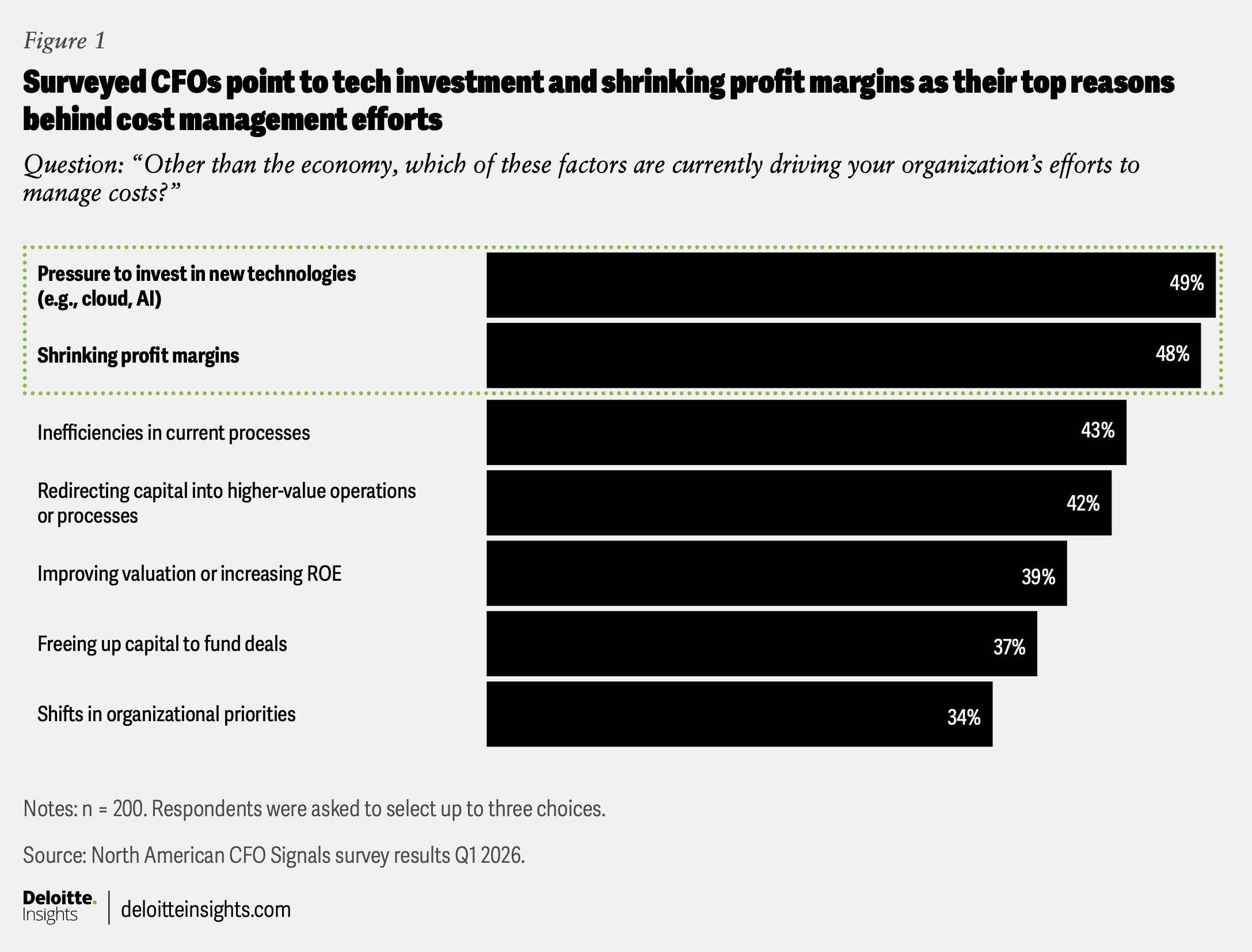
This concern about profit margins is understandable. The Federal Reserve has indicated it expects the 2026 inflation rate to come in higher than originally forecast.1 At this point, however, surveyed CFOs appear more interested in diverting capital than in reflexively reducing it.
Asked to indicate how current cost management considerations are changing their organization’s allocation of capital, more than half (52%) cite redirecting operating expense investments. It was the No. 1 answer. In addition, 46% say their organizations are redirecting capital expenditure investments due to cost management considerations, the second most-cited response.
At the bottom of the list? Reductions in current CapEx (41%) and OpEx (39%) allocations.
CFOs lean on tech and automation to help manage costs
If finance chiefs are feeling pressure to manage costs and preserve funds to invest in new technologies, that pressure will probably find its way to their departments. To be sure, cost management typically involves many functions across an organization. But nearly 7 in 10 respondents (68%) say that, excluding the CEO and board of directors, finance has the greatest responsibility for overseeing cost management at their organizations. When asked which levers have proven to be most effective in controlling costs within their organizations, excluding workforce reductions, more than half of respondents (53%) say automation or technology upgrades—the most-cited choice. Increased productivity efforts or investments are next, at 43%.
So, which technologies do CFOs deem most important for enabling cost management in their businesses? The No. 1 response is cloud-based planning, budgeting, and forecasting, chosen by 43% of respondents. That’s followed closely by data analytics tools at 42.5% (figure 2, rounded up to 43%).
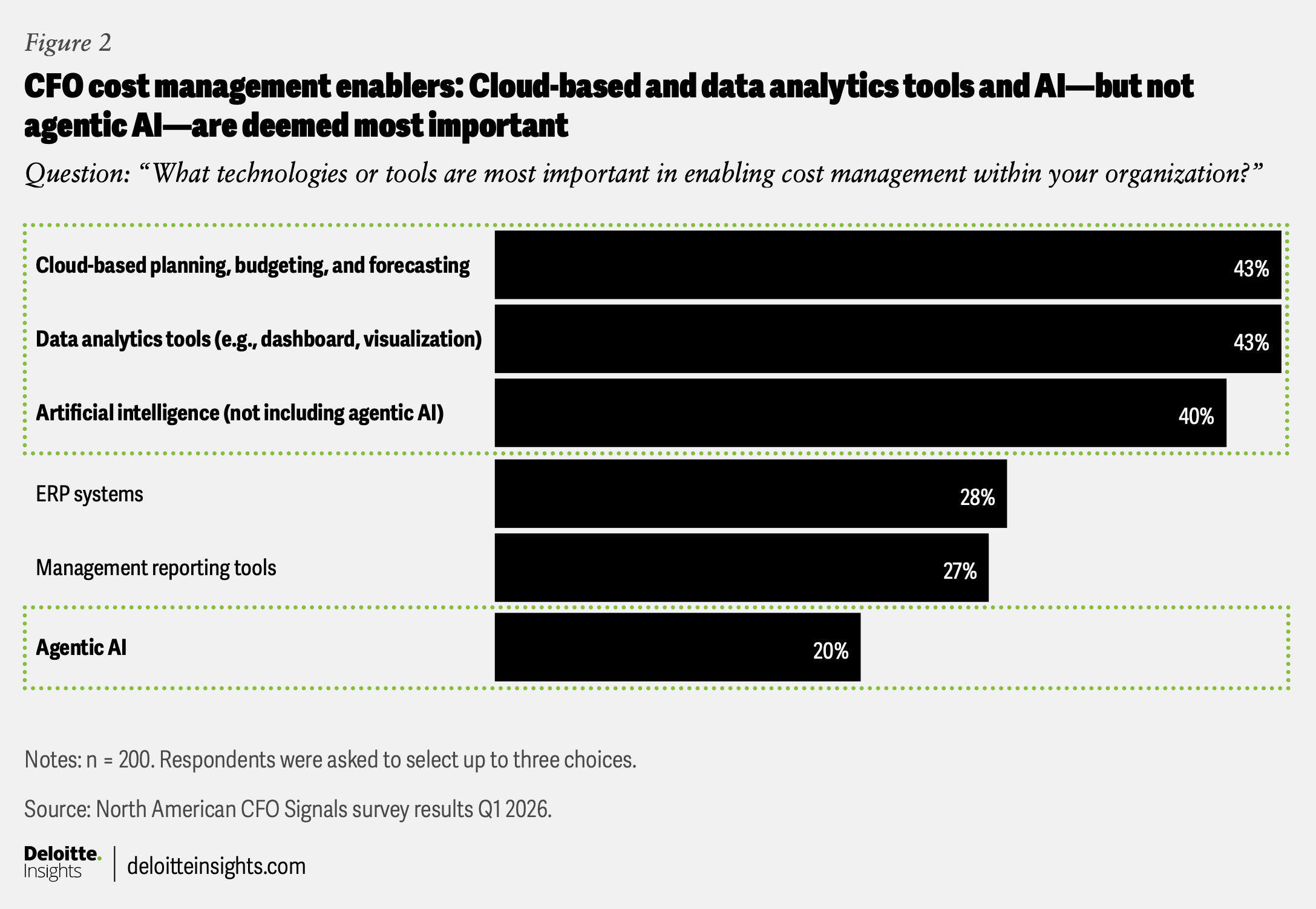
Deloitte’s Finance Trends 2026 survey, which polled 1,326 finance leaders around the world and across industries, shared similar findings. Among Finance Trends respondents who own expense oversight for their organizations, a majority (51%) cited cloud investment as their preferred cost management method.
Silos and autonomous business units can fuel overspending
Rapidly evolving technologies, such as cloud computing and AI, will most likely have a major impact on how organizations improve spending and efficiency. Nevertheless, finance chiefs still face sizable obstacles in managing costs—hurdles that technology alone may not be able to solve.
When asked about their organization’s biggest internal challenges to managing costs, 46% of respondents say siloed departments or autonomous or independent business units (figure 3). Meanwhile, 39% point to outdated tools and technologies, the second most-cited response.
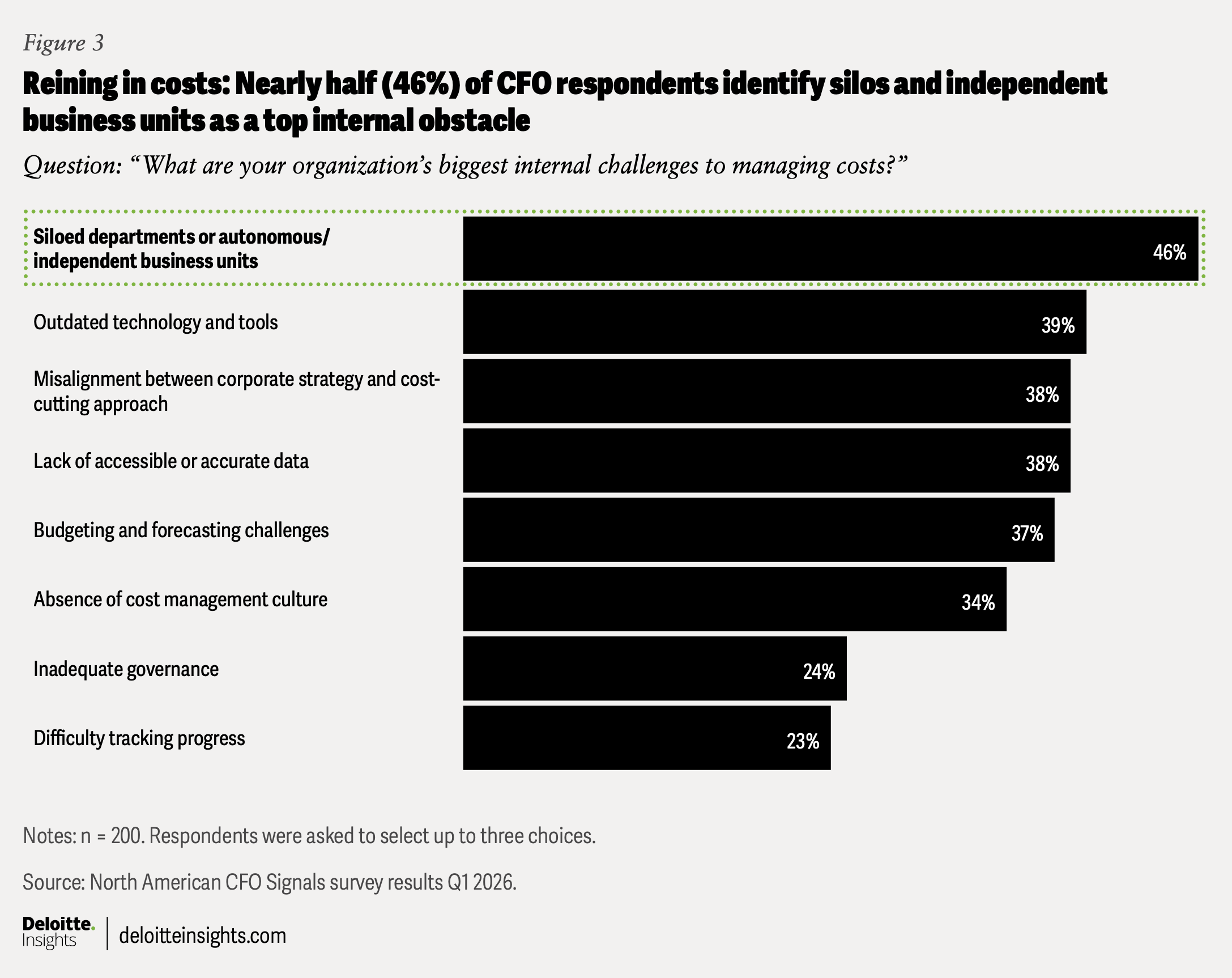
Other results also hint at more organizational and cultural factors. Ranking third, 38% of CFOs surveyed cite misalignment between corporate strategy and their approach to cost-cutting. And about one out of three (34%) CFOs cite an absence of a cost management culture.
That tone is set at the top. As such, CFOs may want to make sure employees are equipped with both the tools and the mindset to help reduce costs or boost efficiency.
Continue the conversation
Meet the industry leader
by
Steve Gallucci
John Goff
Laura Bauke
Many thanks to Fahad Salah-Ud-Din, Jon Woolfolk, and Darren Olson for their guidance in shaping this survey and article. Also, much appreciation to Laura Bauke, Abhinav Annapureddy, and Justine Barry for their indispensable contributions in producing the report. Additional thanks to Josh Hyatt for his always-excellent editing.
Editorial: Karen Edelman, Hannah Bachman, Anu Augustine, and Pubali Dey
Design: Harry Wedel
Audience development: Kelly Cherry
Cover image by: Harry Wedel
Knowledge Services: Rishitha Bichapogu