
2027 Investment Management Outlook
Investment managers face rising costs as they seek to expand their reach to new clients and products using AI
The investment management industry is in the early stages of a major transformation. In 2027, leading firms that capitalize on healthy industry economics will likely lean into new demand, reimagine their operating models, and optimize their use of data and artificial intelligence.
AI will likely also spur investment managers to rethink products and compete for capital across asset classes.1 AI-driven process improvements are enabling investment managers to work faster, cut costs, and analyze their operations differently. As the industry moves from AI pilots to large-scale adoption, the technology will likely differentiate investment managers. Over the next 12 months, competition is likely to grow rapidly. These shifts require continuous transformation and oversight. To help them succeed in 2027, leaders could explore emerging products and build continuous transformation into their operating models centered around governance and resilience.
Top takeaways
- Investment managers may need a revamped “balanced firm” operating model. Managers should integrate investment, distribution, product, data, technology, and agile ways of working to manage competing priorities such as growth, personalization, resilience, and margin protection.
- AI is moving from experimentation to enterprise-scale adoption. AI can improve efficiency, decision-making, client relationships, and cost management, but unmanaged usage, infrastructure choices, and weak governance could quickly undermine value.
- In 2027, firms that are better positioned may combine differentiated judgment, disciplined execution, and accountable governance. As analytics become more commoditized, competitive advantage may increasingly come from proprietary information, human validation of AI outputs, resilient infrastructure, and leadership through technology transformations.
Complexity is rising, and so are costs
Investment managers may need to continue to grow even as complexity increases and profits become more elusive. Recent expansion has been driven more by market returns than by organic asset flows: Between 2020 and 2025, the median manager saw only 8% of its asset growth generated as a result of net new inflows.2 Fee compression remains persistent, particularly across traditional strategies (–3.6% per year since 2020).3 Traditional managers continue to operate at margins near 30%, while the historically higher-margin alternative managers increasingly converge toward similar economics as their businesses expand.4 Other investment managers appear to be pursuing a blend of traditional and alternative investments to help diversify revenue and create more durable economics.
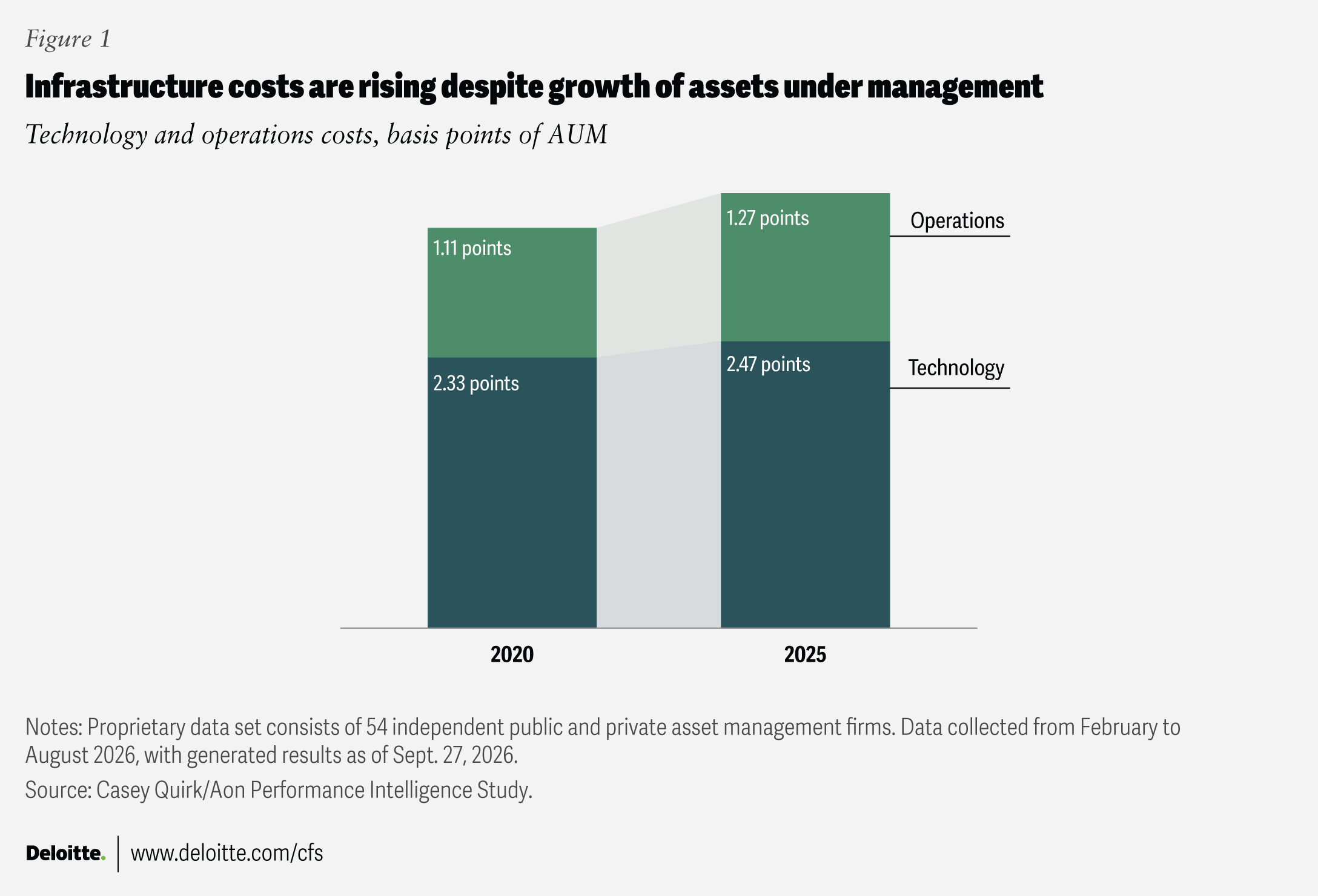
However, scale is becoming harder to translate into advantage. Enterprise infrastructure costs, which include technology and operations spending, are a clear example. As annualized growth of assets under management (AUM) reached a record high of 8%, enterprise costs have risen from roughly 3.4 to 3.7 basis points of AUM since 2020 (figure 1).5 Third-party, outsourced spending within operations is growing even faster, accounting for a fifth of operations budgets, rising from less than a sixth since 2020.6 Spending on data and analytics has more than doubled as a share of revenue over the same period, while core technology infrastructure has remained flat or declined.7
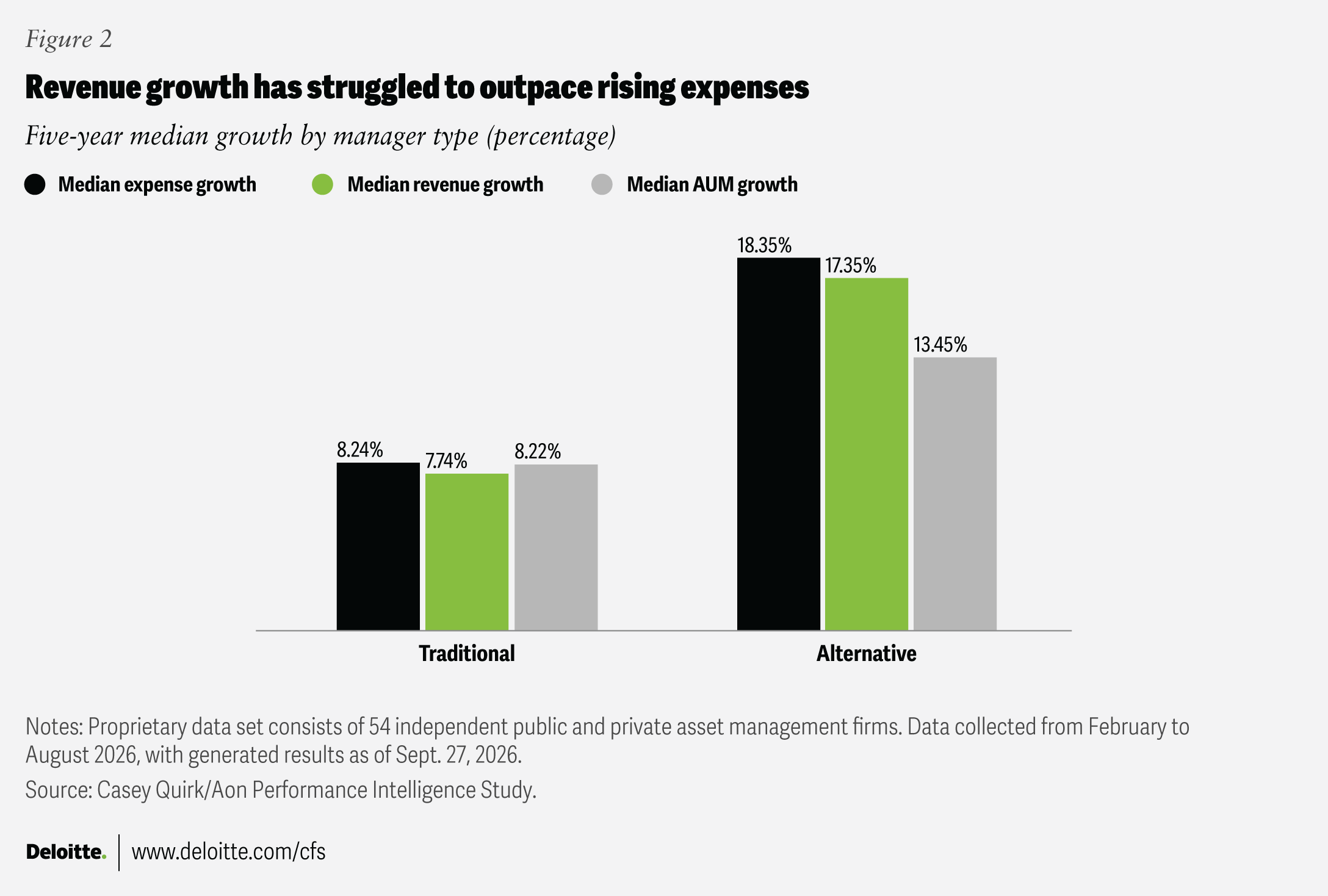
Median expenses have risen 8% for traditional managers and 18% for alternative managers, compared with revenue growth of about 7% and 17%, respectively (figure 2).8 Fee compression persists at an annualized average of 3.4% since 2020.9 Growth, therefore, is not always creating operating leverage: The incremental unit of asset raised is most often absorbed by complexity and cost, not converted into savings or profit. Productivity gains have not kept pace with cost growth: Revenue per person declined slightly (–0.9% annualized since 2020) while AUM per person continued to increase (+9.8% annualized over the same period).10 Meanwhile, product innovation, greater client customization, and growing tech debt across data lakes and tech stacks have increased operational complexity, expanding the cost base without corresponding productivity gains.
Growth is shifting toward newer, less established asset classes
With costs increasing, investment managers are exploring new opportunities for growth as some governments in the Americas, Europe, and Asia consider or implement regulatory changes and incentives intended to broaden citizens’ participation in their economies.
In the European Union, savings and investment accounts are gaining traction as a means of reducing the amount of unmanaged household bank deposits as a percentage of total wealth.11 The interest rates offered by bank accounts in the European Union often do not exceed the rate of inflation, meaning savers can lose purchasing power when they leave their assets in cash deposits.12 A hypothetical investor’s portfolio split evenly between a bond and an equity Undertaking for Collective Investment in Transferable Securities fund could have outperformed a bank deposit by 50% over the 11-year period ended 2025.13 The high take-up of savings and investment accounts in Sweden illustrates the potential to reach a wider investor base through simplified and tax-advantaged accounts.14
Trust can also play a role in consumers’ move away from bank deposits. To this end, the digital asset markets in Asia are prompting some regulatory agencies to strengthen consumer protections to better support retail investors.15 Some Asian markets are also opening up to broaden retail investors’ access to private markets. Regulators across Japan, Singapore, and Hong Kong are developing frameworks around enhanced accessibility for retail investors.16 Investment managers may compete for new inflows if these policy initiatives unlock additional capital.
Globally, the managers that capture the greatest share of new inflows will likely tailor products for regional markets and regulations. In the United States, investment managers could explore areas such as retail alternatives, digital assets, active exchange-traded funds, and exchange-traded-fund share classes of existing mutual funds, as well as expanded customization offerings of separately managed accounts, direct indexing, or model portfolios. Certain institutional client offerings, such as private credit, real assets, infrastructure, and private equity, will likely continue to present high revenue and growth potential. Legacy drivers, including active fixed income and active equity mutual funds, can provide higher revenues, but slower expected growth is often a challenge for these product offerings. A few investment managers with sufficient scale may continue to slowly expand their passive fixed income, passive equity, money market, and target-date flows. But the concentration of assets among established managers could make it difficult for smaller or newer investment managers to achieve scale in these categories.
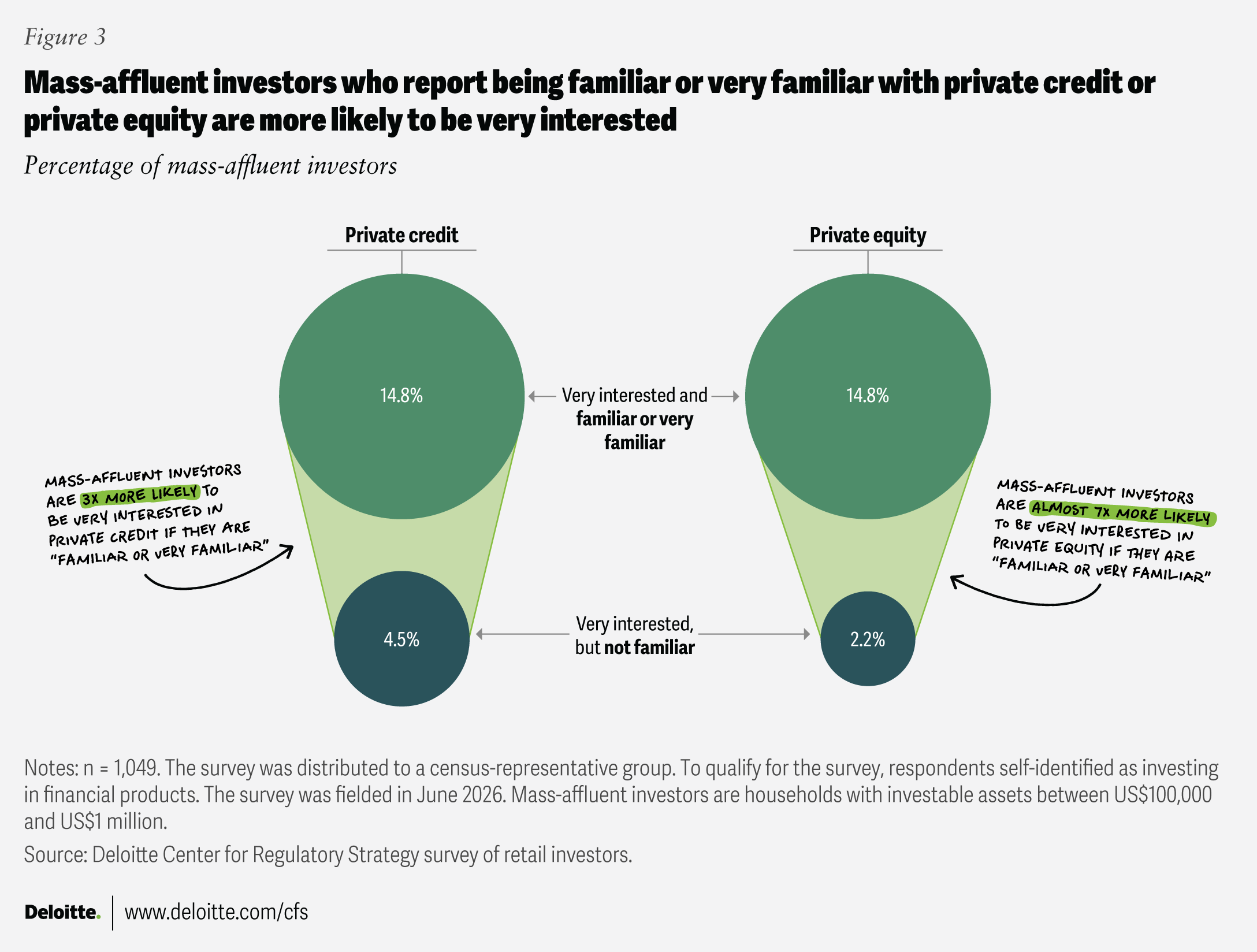
Offering private investments to retail investors could contribute to AUM growth for some US investment managers. While most retail investors currently lack access to private markets, many are interested.17 A recent survey showed that 19% of mass-affluent investors reported being very interested in private credit, while 17% said they were very interested in private equity (figure 3).18 When respondents reported being familiar or very familiar with private credit, they were three times more likely than those unfamiliar to be very interested in the asset class, and seven times more likely in the case of private equity.19 Investment managers who offer private-market education tools and make education an integral part of their strategy may be better positioned to engage this emerging investor group.
The balanced firm: Rebuilding the operating model for a faster industry
The traditional advantages of investment managers are being reshaped. Success includes strong performance, broad distribution, and steady margins, but increasingly relies on broadening capabilities. The new balanced firm brings together insight- and speed-driven investing, nimble and partnership-minded product teams, joint human- and machine-led distribution, and high-quality data that drives continuous transformation.
Investment managers are also seeking new ways to differentiate themselves, fueling mergers and acquisitions globally as firms consolidate to increase scale, expand to new geographies, add new product capabilities, and improve distribution.20 Deals could increase over the next 18 months. Some firms appear to be pursuing deals for broader product capabilities, deeper client relationships, or larger asset and revenue bases. Greater scale may also give firms more capacity to invest in technology and data that help them support investment analysis, serve clients, and manage risk.
That shift can involve integrating data, AI, and agile ways of working across investment, distribution, product, and technology. Firms may pursue multiple priorities, such as growing revenue while protecting margins and launching new products, delivering performance while streamlining operations, personalizing at scale without losing control, and building resilience without slowing progress. These tensions may be reflected in how firms are redefining their investment edge, distribution, and product strategy.
Sustaining this progress may depend on changing data, ways of working, and leaders’ attitudes. Data should be treated as a competitive asset, with clean, reliable information that every function can trust. Ways of working should be simple so that good data can translate into faster decisions. Change leadership should be shared across investment, distribution, product, strategy, finance, and technology. The investment managers looking to thrive over the next 12 to 18 months could consider embedding governance, incentives, and talent into their decisions, with continuous change in mind.
Operating-model redesign will likely make AI’s enterprise-scale adoption a business imperative
Operating-model redesign is likely to become increasingly important as investment managers move from experimenting with AI to deploying it at enterprise scale. By the end of 2028, the average AI budget at financial services firms, including investment management firms, could more than triple.21
Firms are reporting tangible benefits from AI investments. According to Deloitte’s State of AI Survey, 68% of financial services firms cited improved efficiency and productivity from AI investments, 48% noted better decision-making and data-driven insights, 46% cited stronger client relationships, and 40% reported cost reductions. 22 Although 18% reported increased revenue from AI, 75% hoped their AI initiatives would increase future revenue.23 As AI adoption accelerates, investment managers will likely need to gain greater control over costs, adapt to the latest sources of alpha, and manage emerging risks.
AI costs at leading firms could rise quickly over the next 12 to 18 months if not managed well
Costs at leading investment managers could rise quickly as AI moves beyond pilots into critical workflows and more demanding reasoning tasks, such as investment research, valuation, and due diligence.24 About one-third of financial services firms in Deloitte’s State of AI Survey said they were reimagining their organizations or undertaking deep transformation through AI.25 Although the cost per token is expected to decline as usage increases, total consumption is likely to increase sharply. Only 36% of financial services firms expected to use more than 10 billion tokens per month in 2026, compared with 70% planning to exceed that level in 2028.26 Unmanaged AI spending could place pressure on budgets. According to a recent Deloitte publication on how to navigate the economics of AI, approximately 7 billion tokens per month marked the point at which on-premises hosting becomes more cost-effective than application-programming-interface access, packaged products, or neocloud providers.27
As AI commoditizes analytics, the sources of alpha will likely shift
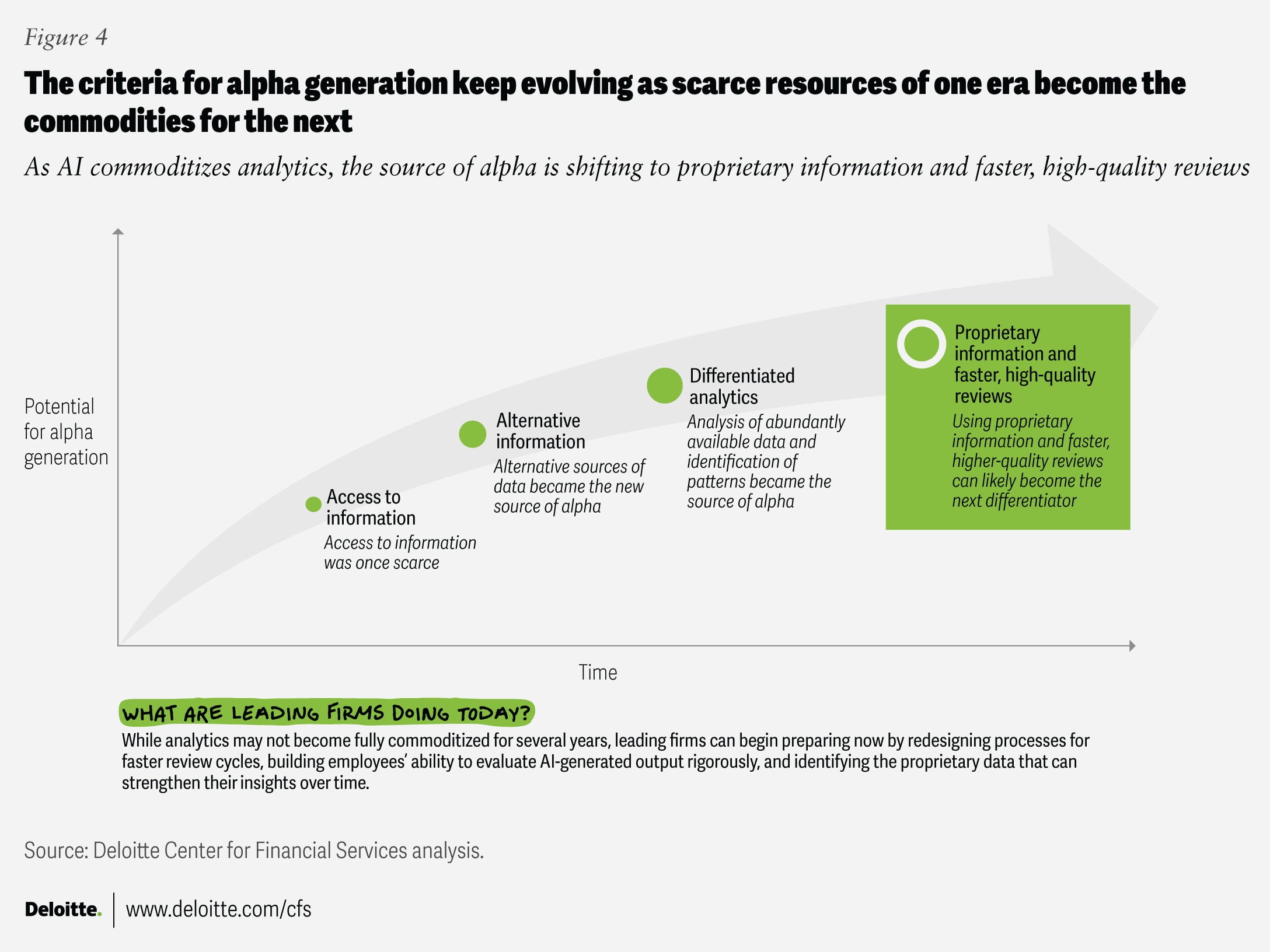
As investment managers embed AI more deeply in their processes, many may ultimately rely on the same few leading large language models for their research and analysis.28 This shared technology base could reduce differentiation in how investment managers interpret information and generate insights, potentially contributing to greater convergence of investment thinking and ultimately the commoditization of analytics.29 Differentiation may shift toward proprietary information and human judgment that competitors cannot readily replicate, including industry conversations, fieldwork, proprietary research, and institutional memory (figure 4).
Governance can increase the flexibility of future choices
Strong governance is likely to become increasingly important for managing the risks and choices that come with AI adoption. About one-third of senior information technology and business leaders surveyed at financial services firms believe that at least 10% of jobs will be fully automated within one year, and 81% expect that level of automation within three years, yet only 23% report mature governance models for autonomous agents.30
Frontier AI models can perform increasingly complex tasks. Without effective controls and human oversight, their use could increase the risk of incorrect outputs, faulty assumptions, flawed analyses, and unauthorized access to restricted information. Investment managers may also consider data and computing sovereignty when assessing AI vendors, particularly for critical capabilities. Only 11% of financial services firms surveyed from the Americas depend on overseas solutions for most of their AI stack, compared with 32% for firms in Europe, the Middle East, and Africa.31 Effective governance at investment management firms can include data traceability, keeping humans in the loop for investment decisions, talent and operating-model alignment, and thoughtfully designed system architecture.32 Investment managers that lead with governance may have more flexibility when scaling than organizations that introduce governance later, as the latter may be burdened by earlier choices that are difficult to reverse.33
Preparing for the next phase of growth
The investment management industry remains financially strong, but structural forces are becoming more challenging. Profitable growth depends on generating alpha from new capabilities and broader client delivery. AI transformation grounded in strong governance, data-driven insights, simpler operating models, and clear direction from leadership will likely be a priority. Leaders may need to decide where to compete, how to measure AI deployment, build permanent transformation capability, and align team incentives for long-term success.
Continue the conversation
Meet the industry leaders
Eric Fox
Jeffrey A. Levi
Paul Kraft
Tania Lynn Taylor
Sean Collins
BY
Eric Fox
Jeffrey A. Levi
Paul Kraft
Tania Lynn Taylor
Julia Cloud
Sean Collins
The authors wish to thank the following Deloitte professionals for their insights and contributions: Mohak Bhuta, Kevin Kozlowski, Anthony Skriba, Jeff Stakel, Lananh Nguyen, Patricia Danielecki, and Paul Kaiser.
Editorial (including production and copyediting): Aditi Rao, Aparna Prusty, Stacy Wagner-Kinnear, and Cintia Cheong
Design: Molly Piersol
Cover image by: Alexis Werbeck
Knowledge services: Rohan Singh
Visit the Deloitte Center for Financial Services
Access more insights for the banking & capital markets, commercial real estate, insurance, and investment management sectors.