
Easing regulatory outlook sparks growth potential for US investment managers
A less restrictive regulatory environment in 2027 is expected to drive innovation and reshape strategies across the investment management industry
Regulations for US investment managers are likely to ease for the rest of this year and into 2027, enabling industry executives to focus on growth opportunities, according to a Deloitte analysis of policy trends.
The Deloitte Center for Financial Services regulatory index (DREG), which measures changes in regulation for the investment management industry, estimates that regulation easing, which began in 2025 under the Trump administration, may continue in 2027.
So far, the index has been slightly higher in 2026, but it is likely to remain well below levels observed during the previous administration, when final rules were more restrictive. In 2025, the new administration introduced sweeping changes that included 13 final rules that reduced or removed regulatory requirements for investment managers (figure 1).1
Lower index values indicate greater deregulatory activity, while higher values reflect less deregulatory activity or a more intensive regulatory environment (see “About the Deloitte Center for Financial Services regulatory index (DREG)”).
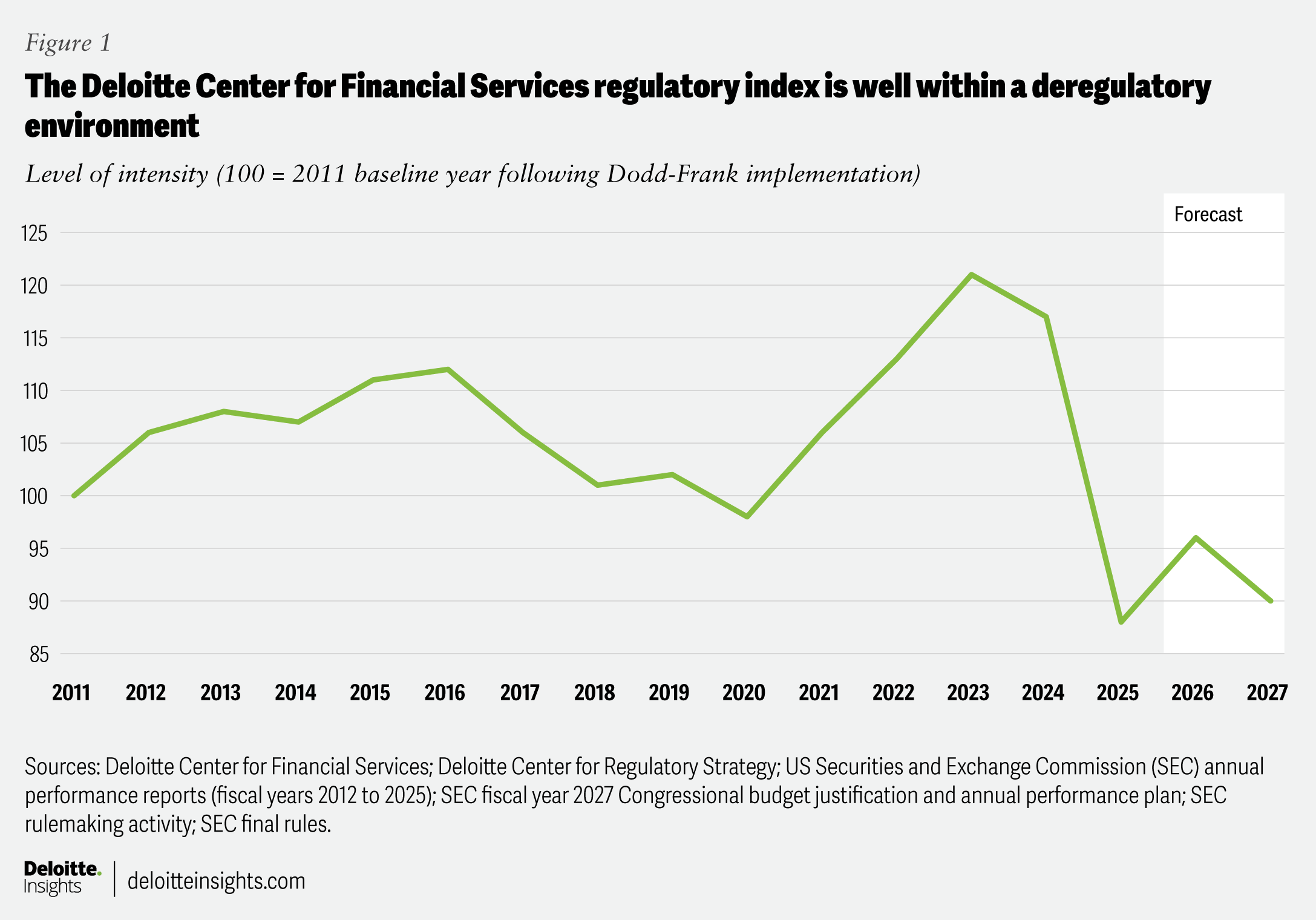
This year so far, the index has increased, reflecting advancing priorities from the Securities and Exchange Commission (SEC). Still, a DREG index value of 96 continues to reflect a deregulatory environment for investment managers. The SEC’s 2026 rulemaking agenda includes 38 proposed rules, most, if not all, of which could arguably be described as deregulatory in nature. This continued deregulatory focus is reinforced through the SEC’s direct references to regulatory “burdens” to be addressed or reduced in five more proposed rules in its 2026 agenda than it did in 2025.2
We expect the SEC to issue at least six deregulatory final rules over the next 12 months. In some areas, it is proposing to lift certain restrictions, which could spur additional innovation and growth.
We expect the index to show further weakening and recommend that investment managers continue to capitalize on the business-friendly environment to pursue high-growth opportunities as net-new mandatory compliance costs subside and new investors and distribution channels emerge. Potential opportunity areas may include:
- Tokenization and digital assets
- Retail access to private markets
- Dual share classes of mutual funds and exchange-traded funds (ETFs)
- New product development and client segment expansion, especially through retirement accounts and separately managed accounts
The SEC moved quickly in 2025, implementing a deregulatory agenda in which 13 final rules reduced or removed requirements and withdrew proposed rules. After an initial flurry, the SEC only issued one such final rule during the first eight months of 2026, prompting the DREG index to rise year over year from 88 to 96.
Strategic opportunities for investment managers
As the regulatory environment becomes more business-friendly, investment managers may be able to shift their focus from reactive compliance to proactive growth. Firms may want to engage regulators where business strategy aligns with existing regulatory requirements. Some potential opportunity areas include expanding retail access to private capital, leveraging innovation and new technology, and enhancing operational efficiency. In terms of product structures, the SEC continues to grant exemptive relief to mutual fund providers wishing to offer an ETF share class of an existing mutual fund.3 This trend is expected to continue over the coming months, with 20 to 25 investment managers launching an ETF share class by the end of 2026.4
One notable proposed rule on the SEC’s agenda, “Enhancing retail exposure to private markets,” would allow registered funds to charge a larger set of investors performance fees by possibly eliminating the “qualified client” requirement.5 Currently, investors may be charged performance fees, but only if they are “qualified,” defined as those with at least $1.4 million in assets under management with an adviser or a net worth greater than $2.7 million.6 Expanding the pool of investors eligible to participate in funds with performance fees will likely increase the number of private capital investment strategies available to retail investors. Given SEC Chairperson Paul Atkins’ focus on “democratizing” private markets alongside appropriate investor protections, this rule may be at the top of the agenda over the next few months.7 Even without any potential impact from this proposed rule, nearly one in six registered funds may have substantial exposure to private capital by 2030.8
Another area to watch is a clearer blueprint around crypto assets from the SEC with the release of the proposed rule “Regulation Crypto Assets.” This proposed rule seeks to provide exemptions around the sale of crypto assets, provide a safe harbor from the term “investment contract,” and define “qualified purchaser” to preempt state securities law registration.9 These new rules aim to encourage innovation and increase capital within the crypto industry while maintaining investor protections as efforts in Congress to pass crypto market structure legislation have stalled.10 In addition to its guidance on tokenized securities earlier in 2026, the SEC recently issued an Innovation Exemption aimed at facilitating the trading of certain tokenized stocks using distributed ledger technology.11 Investment management leaders may benefit from an in-depth review of the potential impacts of these proposed rules on their strategic growth plans.
Finally, AI-related operational disclosures have not been included in the rulemaking agenda since the SEC rescinded its predictive data analytics proposal last year.12 Nevertheless, investment management firms may want to ensure that their AI models’ decisions are traceable and explainable to regulators, auditors, and investors. Preparing to disclose any potential material impact of AI’s integration in operations and products may provide a level of transparency that differentiates firms from competitors and governs AI practices in case of potential future rulemaking.13
Compliance and risk considerations
This year’s index update reflects slowing momentum from 2025’s regulatory rollback and demonstrates that long-standing rules remain intact. Thus, investment managers should be cautious and not weaken compliance programs that safeguard their public reputation and regulatory adherence.
The opportunity for lower compliance costs should not lead to poor oversight. SEC enforcement remains focused on instances of fraud and investor harm, which can hide almost anywhere in a weak risk and compliance program. Common risk areas include fee and fiduciary practices, valuation, governance practices, cybersecurity, and marketing programs.
Advancing artificial intelligence use cases may present cost-saving opportunities. Firms should consider whether there may be opportunities for savings via responsible applications of agentic and generative AI. As a starting point, firms can holistically evaluate their risk and compliance programs and prioritize opportunity areas for AI-related enhancement based on a combination of cost and risk factors.
What’s next
Heading into 2027, regulation-ready investment management leaders can consider five focus areas to maintain and strengthen their compliance readiness that can support strategic growth opportunities as the deregulatory environment continues.
- Review product development opportunities tied to private markets, ETFs, mutual funds, and digital assets
- Align growth strategies with appropriate controls
- Engage regulators on areas of strategic importance
- Reassess compliance and risk management capabilities
- Strengthen enterprisewide AI programs and compliance platforms
Continue the conversation
Meet the industry leaders
Paul Kraft
By
Paul Kraft
Ryan Moore
Meghan Burns
Sean Collins
Editorial (including production and copyediting): Cintia Cheong, Aparna Prusty, and Anu Augustine
Design: Alexis Werbeck, Sonya Vasilieff, and Molly Piersol
Cover image by: Sonya Vasilieff; Adobe Stock
Knowledge services: Agni Wagh
Visit the Deloitte Center for Financial Services
Access more insights for the banking and capital markets, commercial real estate, insurance, and investment management sectors.