
Many retail investors want to invest in alternative assets—but don’t fully understand them
To capitalize on a coming wave of new investors, investment advisers and asset managers should focus on education and product structure
Many retail investors are bullish on alternative asset classes that offer tempting returns, but their investing preferences often conflict with how many of these strategies work.
A Deloitte survey of about 1,000 retail investors found that as many as three in four are open to investing in alternative asset classes like private equity, venture capital, private credit, and asset-backed finance (collectively referred to as “alternatives” in this article). Deloitte conducted the survey to learn more about the investing habits and preferences of individual, or retail, investors (see methodology).
The results show that many retail investors are interested in alternatives but need more education on the investing strategies, common product features, and unique risks. This is notable because some investment managers and policymakers have pushed to broaden access to alternatives for everyday investors. Historically, retail investors had limited access to alternative asset classes, but policy changes are expanding the investment opportunity set for everyday investors.1
The survey found that retail investors are willing to allocate cash and retirement savings, but their liquidity preferences, investment horizons, and investment amounts clash with how these products are typically structured. The findings reveal opportunities for investment managers to further educate this set of investors and to structure products that meet retail investors where they are.
Retail investors’ growing appetite for alternatives
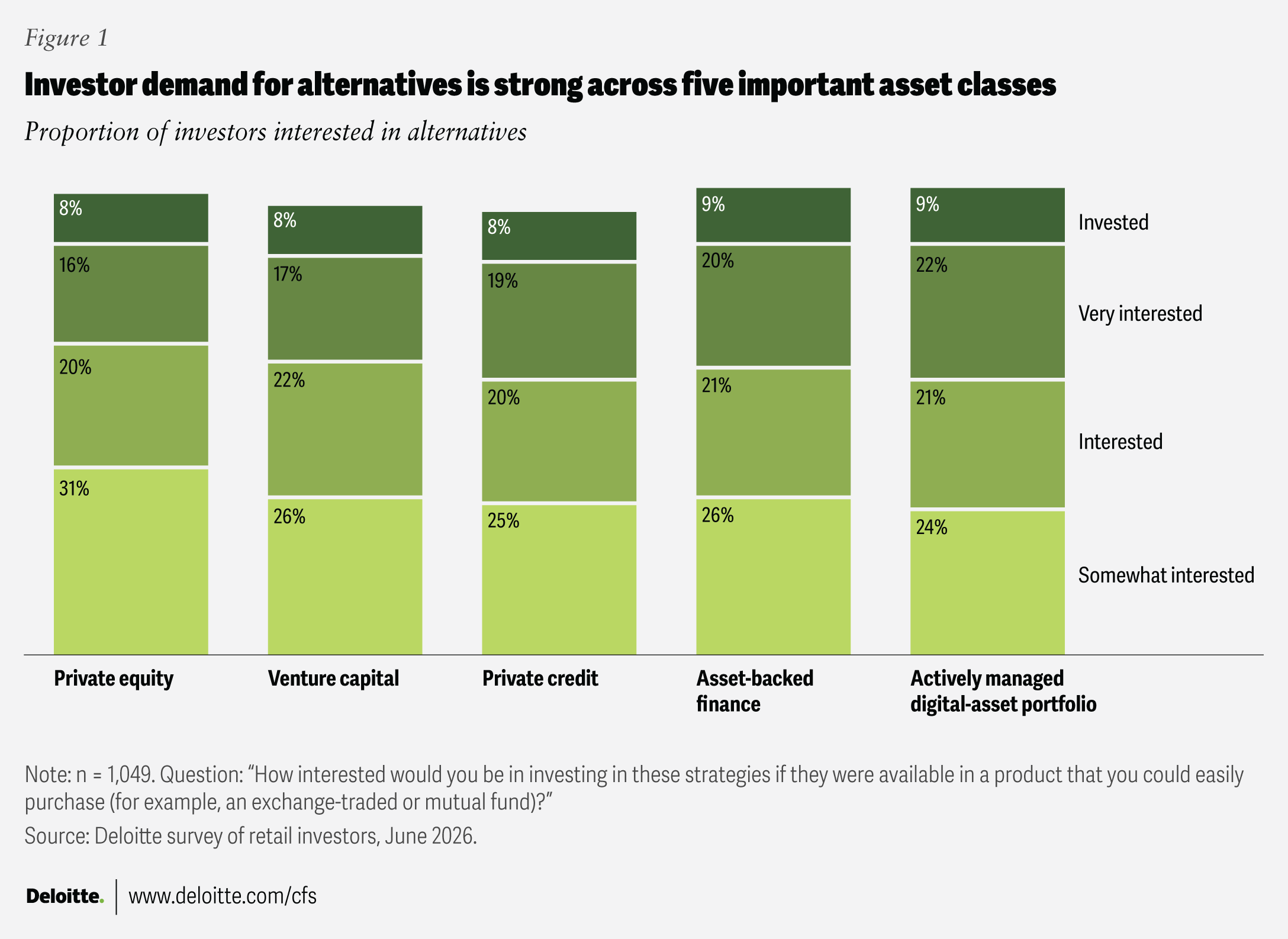
Of the roughly 75% of respondents open to investing in alternatives (figure 1), 30% indicated that they would consider investing in an alternative asset class if it were recommended to them by an investment adviser. This suggests that there is a large group of “persuadable” potential investors across alternative asset classes.
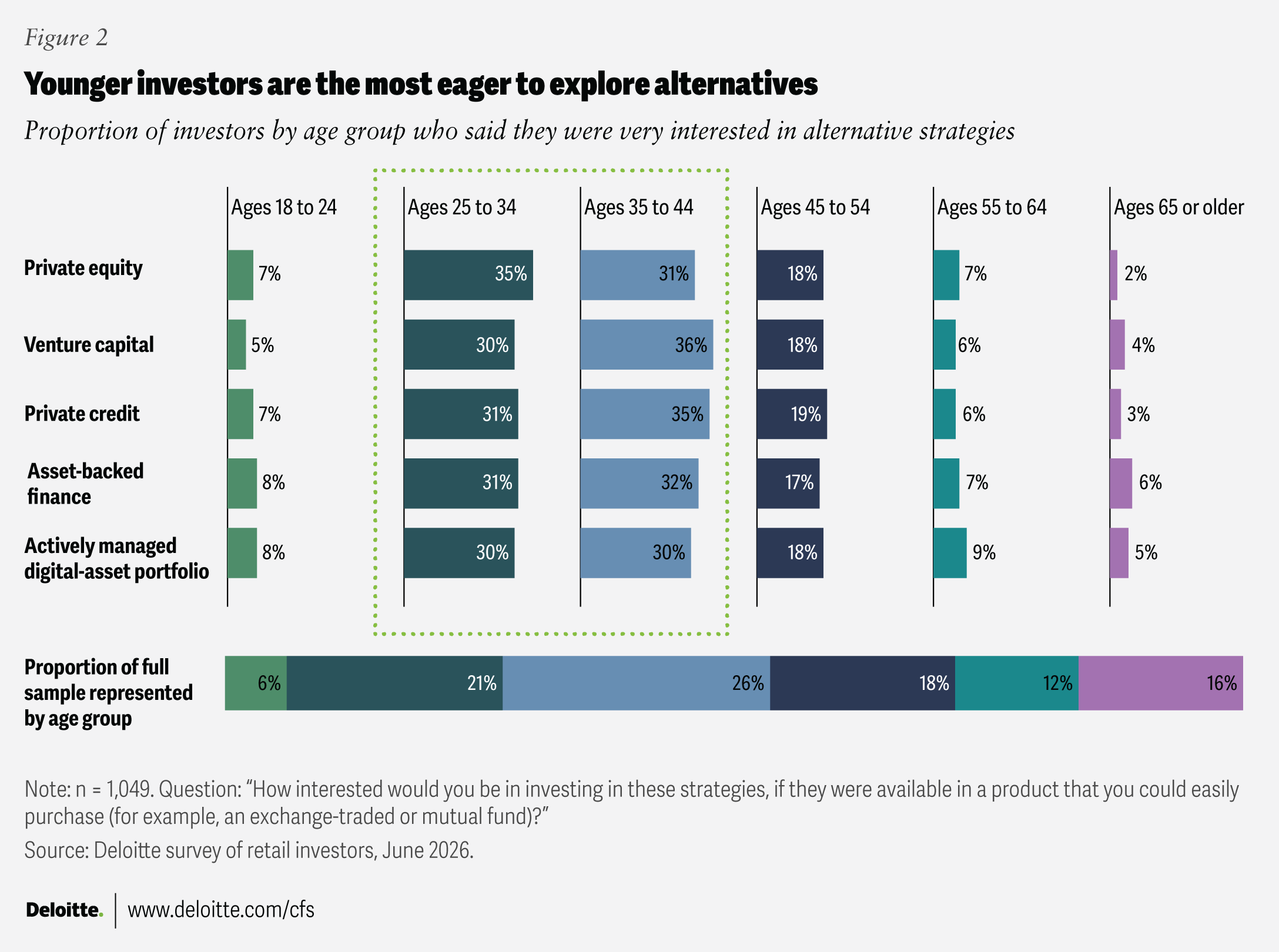
Younger investors seem especially interested in alternatives. Those ages 25 to 44 are overrepresented among the most interested investors, whereas those over 55 are underrepresented (figure 2).
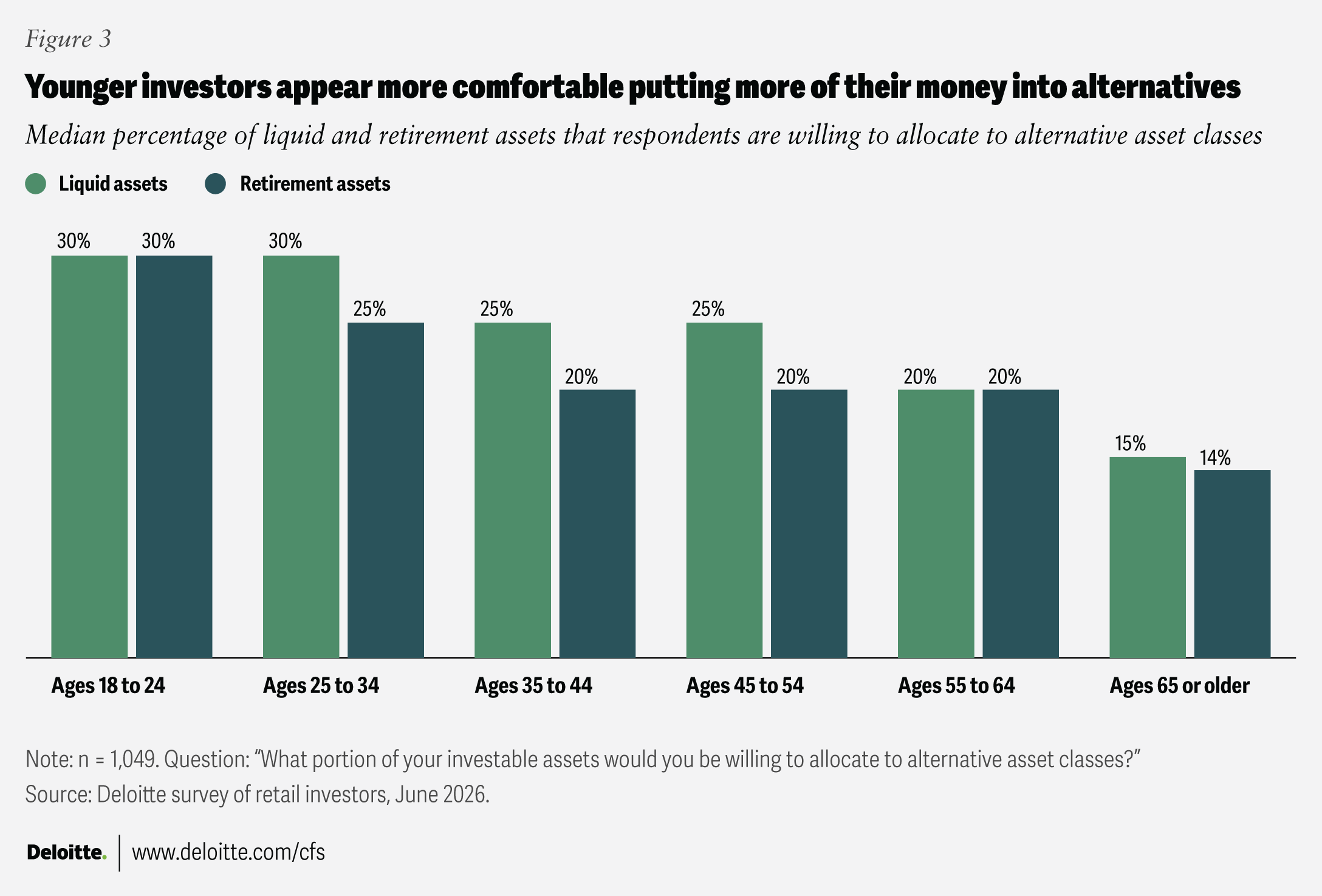
Younger people also seem to be more willing to allocate a bigger chunk of their money and retirement savings to alternatives. Among interested investors, the median target allocation of liquid assets to alternatives is 30% for people ages 18 to 34, and 25% for those ages 35 to 54. In comparison, the median target allocation of liquid assets for interested investors over age 65 is half that at 15%. Target allocations of retirement savings are overall lower, with a median target allocation of 20% for respondents ages 35 to 64 (figure 3).
Understanding the roadblocks for investors
Still, there is a significant gap between retail investors’ interest and their knowledge of these assets.
For instance, respondents identified illiquidity risk—the risk that the asset cannot easily or quickly be sold—as one of their top concerns when making an investment. But when asked about their tolerance for quarterly liquidation caps of different amounts, the proportion of respondents indicating that they would not invest in a product with this feature increased with the size of the cap. Since a larger cap allows for more liquidations, this finding suggests that at least some retail investors don’t fully understand the basics of how liquidation caps work.
Investors don’t necessarily perceive the knowledge gap, though—the survey found that an investor’s self-rated knowledge of an asset class was strongly correlated with their level of investment interest.
The findings also suggest that structuring products for these investors may pose challenges for today’s asset managers. High-net-worth and institutional investors have typically agreed to longer-term investments with alternative asset managers as a way to seek higher returns. In contrast, many financial products offered to retail investors are more liquid and do not require investment minimums.
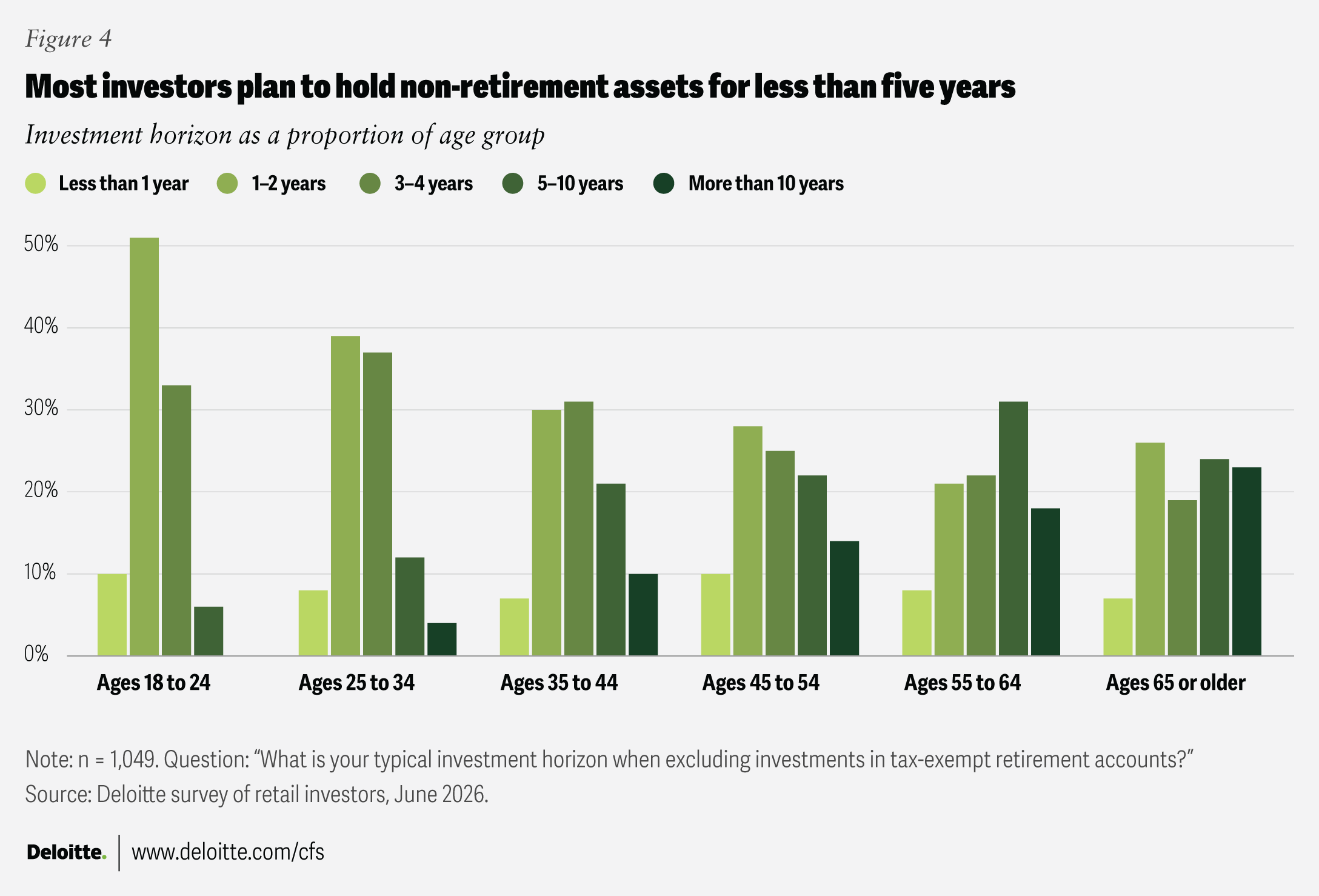
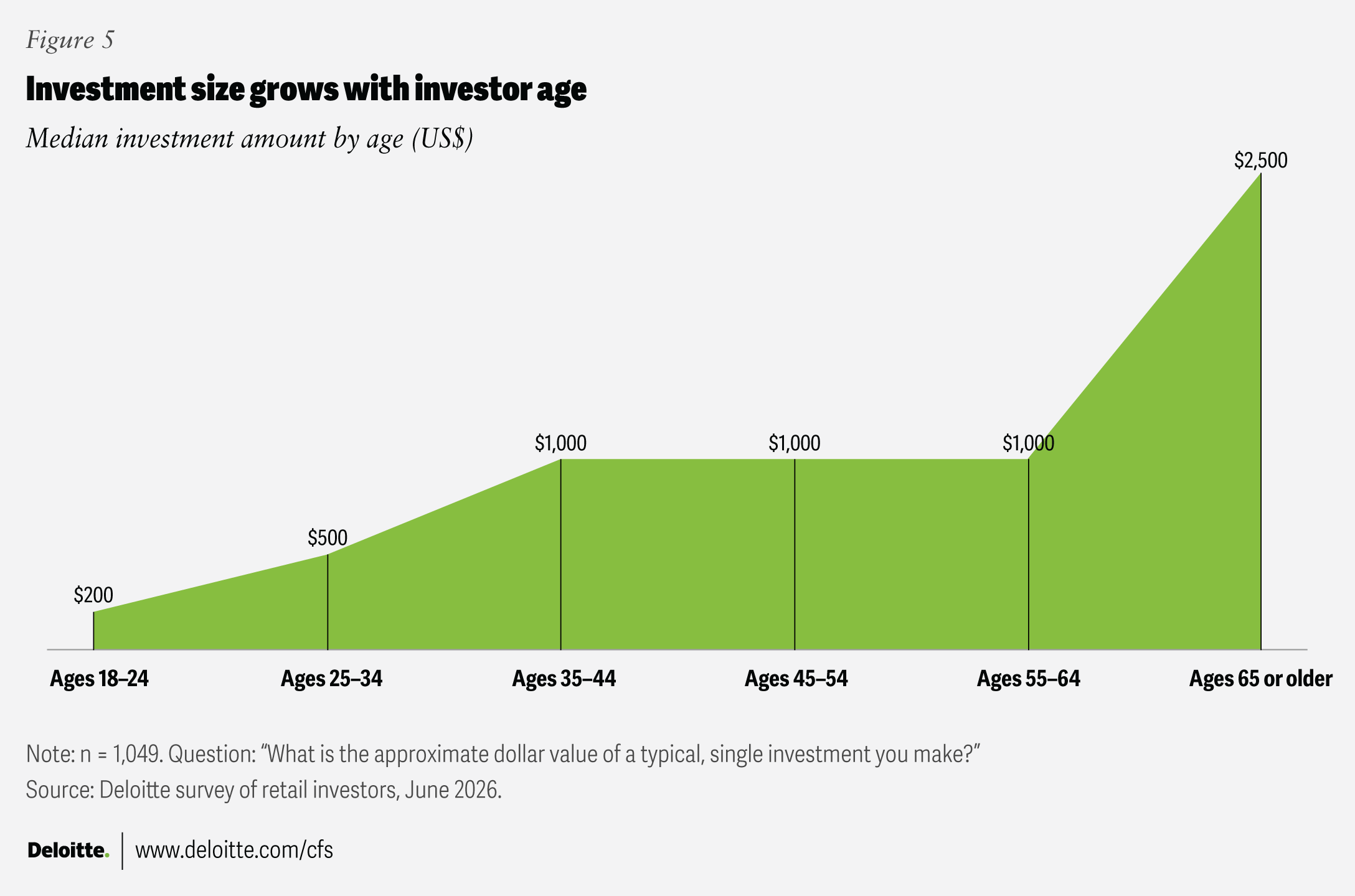
While younger investors appear to be the most interested in alternative assets, they also typically invest relatively small amounts and hold investments for two years or less. In fact, Deloitte’s survey shows 80% of retail investors have a typical investment horizon of less than five years for non-retirement investments (see figure 4 for a more detailed breakdown by age group).
Meanwhile, the median value of a single non-retirement investment is $1,000. For those under 35, the typical investment size is even smaller (figure 5).
The data also suggests that younger investors have mixed liquidity preferences. Despite having shorter investment horizons, they are more comfortable with the unique liquidity restrictions of alternative investments than those at or near retirement age. These investors also tend to hold more assets in their brokerage accounts than in their retirement accounts.
Catering to investor appetite
As access to alternative assets seems poised to expand across the investor landscape, it’s important for investment advisers and asset managers to recognize what makes retail investors unique—and how their needs, goals, and limitations are different from those of institutional and high-net-worth investors.
Firms catering to retail investors have many options, including educating target investors, considering alternate product structures, and forming alliances to create new products and reach new investors. These steps may help advisers and asset managers be well positioned to benefit from the democratization of these assets.
Continue the conversation
Meet the industry leaders
Eric Fox
Jeffrey A. Levi
Lananh Nguyen
BY
Eric Fox
Jeffrey A. Levi
Meghan Burns
The authors would like to thank Sean Collins, Mohak Bhuta, Kyle Cooke, and Neerav Shah for their insights and contributions to this article.
Editorial (including production and copyediting): Aditi Rao, Preetha Devan, Anu Augustine, and Arpan Saha
Design: Molly Piersol
Cover image by: Harry Wedel
Knowledge services: Rohan Singh
Visit the Deloitte Center for Financial Services
Access more insights for the banking & capital markets, commercial real estate, insurance, and investment management sectors.