
2027 Insurance Outlook
Insurers navigate how technology, customer expectations, and capital are rewriting the competitive playbook
The rules of insurance competition are being rewritten. Technology is advancing, customer expectations are shifting, risks are becoming harder to predict, and capital is shifting the sources of advantage. Insurers may risk being left behind if they are slow to adapt to the changing dynamics.
In 2027, Deloitte expects the following trends to emerge:
- Property and casualty (P&C) insurers that move beyond rate cycles could gain advantage if they implement smarter risk selection and prevention and continuous risk management.
- Life and annuity (L&A) providers may face growth challenges from narrowing distribution and customer demand.
- Artificial intelligence is likely to reshape business economics, from employee productivity to adviser capacity, product design, risk management, and customer service.
- Customers are likely to demand intelligent, connected journeys instead of traditional channels.
- Insurance mergers and acquisitions are expected to continue, but more selectively. Deals may take place as a way to quickly add capacity.
From rate-led to risk-led: The intelligent, connected future of P&C insurance
The future of P&C insurance may be “predict and prevent.” As exposures become more dynamic and interconnected and historical loss data becomes less reliable,1 insurers should anticipate how risks could evolve. This may require shifting from a model where profitability was often driven by price increases toward one that manages the cost of risk. By combining data, analytics, and connected ecosystems, insurers can detect emerging exposures, sharpen underwriting and portfolio decisions, and adjust pricing and coverage as risks evolve—as well as intervene earlier to help prevent or mitigate losses.
As homes and vehicles serve multiple purposes and liability shifts across players, insurers may need to follow risk across people, assets, and activities. In personal lines, insurers can connect vehicle data, aerial imagery, Internet of Things, and behavior signals to help track and influence risk at the property, driver, and policy levels. These insights can inform pricing and mitigation as conditions change, shifting underwriters and portfolio managers beyond individual transactions toward continuous exposure monitoring and portfolio insurability.
Commercial and specialty insurance may demand an even deeper reassessment. AI models, cyber threats, and supply chain disruptions often compress the time between emerging risk and loss.2 Autonomous systems and digital infrastructure call for new underwriting approaches, specialized expertise, and innovative sources of capital to help keep pace.
Partnerships could become critical to managing this changing risk landscape. Insurers, agents, and brokers can work together to interpret emerging signals and design coverage and mitigation programs, while technology, risk-engineering, and recovery partners could bring complementary data and capabilities. The systems they develop can help to avoid losses or speed up recovery while keeping decisions explainable. As more risk data sits outside insurers, these ecosystems could also become critical to accessing the signals needed to intervene, not just price risk.
Execution could separate leaders from laggards. The shrinking number of experienced professionals in underwriting, claims, and other areas is likely to require some insurers to redesign work around data, analytics, and automation using AI to augment human judgment.3
Insurers may shift from point-in-time transactions to always-on, resilient services.
As traditional tailwinds fade, L&A carriers look for new advantages
L&A firms face the challenge of securing durable growth as interest-rate driven tailwinds become less reliable. Swiss Re forecasts US life premiums will decline 0.1% in real terms in 2026 before edging up just 0.1% in 2027.4
Against this backdrop, some L&A leaders are pursuing innovation and shifting from discrete AI use cases toward AI-first redesign across the value chain. AI-native capabilities could shorten product development, improve personalization, modernize underwriting, and make it more profitable to serve more diverse demographics.
Distribution remains a critical area of competition
L&A remains a market in which consumers want human guidance alongside digital access.5 But carriers may need to improve data hygiene to integrate core systems involving both tech and humans to make the customer journey seamless.6
This presents an opportunity for agents, advisers, and wholesalers to use AI and connected workflows to help reduce friction across adviser and customer journeys, from onboarding through servicing, while improving customer insight and freeing advisers to provide more relationship-led advice. Deloitte predicts agentic AI in US life distribution could add US$2 billion in annual incremental premiums by 2030.7
Generative AI is also reshaping discovery—51% of consumers surveyed in LIMRA’s 2025 Insurance Barometer Study said they would use AI to research life insurance, while 55% said they would use it to shop for life insurance.8 Carriers may therefore need to vie for both adviser shelf space and visibility in AI-mediated discovery.
As insurers’ access to private capital broadens, advantage may shift to controlling the economics
Private capital has become embedded in L&A investment economics, raising the question of who captures the value. US life insurers held $807 billion of private and illiquid fixed-income assets at the end of 2025.9 Exposure is expected to grow further over the next one to two years, even as spreads remain tight and credit structures grow more complex.10 As access broadens, the advantage may shift from allocation to origination, manager selection, underwriting, liquidity, and capital discipline, playing a role in how much value insurers retain across asset-manager partnerships.
Group insurers are projected to navigate changes to tech and regulations
The group insurance industry faces a period of uncertainty going into 2027 as gen AI, rising healthcare costs, and regulatory pressures impact both revenue models and operating strategies.
Some carriers may consider bypassing multiyear core-system replacements in favor of AI-native, internally built capabilities and faster, API-driven modernization.11 The competitive advantage may shift from carriers with scale and legacy systems to those with data orchestration, and AI-enabled agility.
Insurers can develop an enterprise AI roadmap and evaluate where in-house AI capabilities can replace expensive third-party solutions. They can also accelerate API modernization.
GLP-1 costs are reshaping benefits economics
As healthcare cost pressures grow employers may weigh GLP-1 spending alongside other benefits priorities, which could affect allocations to group insurance products. While the drugs may drive long-term health benefits that could reduce insurance claims,12 these are likely to be realized longer-term for employers contending with near-term budget increases. For insurers, this may create near-term margin pressure, pricing uncertainty, and a need to help employers assess how GLP-1 coverage decisions affect the broader benefits portfolio.
In response, insurers can use persistence data to refine underwriting, claims forecasting, and product design.
Litigation and fiduciary scrutiny are increasing
Lawsuits targeting brokers over commissions and fiduciary obligations under the Employee Retirement Income Security Act signal growing pressure for greater transparency in pricing, commissions, and employer responsibilities in employee benefits. Although insurers are not primary defendants in these lawsuits today, they may consider reviewing commission structures, disclosures, and broker relationships.
They may also want to strengthen transparency about compensation and benefit value, prepare for heightened regulatory and reputational scrutiny, and participate in industry efforts to establish disclosure standards.
Insurers work to effectively integrate AI at scale while maintaining control
In 2027, the AI opportunity is likely to shift from how insurers use and scale AI to how they seamlessly integrate it into business without letting costs, vendors, or other constraints dictate the design.13
Some leading carriers appear to be moving beyond task automation to reimagine end-to-end underwriting, claims, billing, and product journeys with AI. By 2028, 28 of 35 insurance leaders surveyed by Deloitte expect AI agents to have a moderate to significant shift in the way work is done in their organizations.14 That could reshape operational capacity, cycle times, and unit costs, and widen the competitive gap.
Only 7 of the 35 of insurance technology leaders surveyed report high or very high ROI from AI investments.15 As copilots and agents scale, costs may become more variable, shaped by model choice, token usage, infrastructure, and vendor pricing. With 7 out of 11 surveyed insurance leaders expecting monthly token consumption to exceed 10 billion by 2028 (versus 4 in 2026), traditional IT budgeting may no longer be enough.16 CIOs and CFOs may need a shared view of cost, usage, and value, funding innovation while creating guardrails for cost overruns.17
As AI ecosystems expand, control becomes a strategic choice
As AI agents operate across carriers, brokers, customers, and third parties, and, increasingly, with one another, the control question arises: Who owns the data, orchestrates AI agents, and remains accountable?18 Thirty seven percent of surveyed insurance technology leaders already use agent-platform or orchestration capabilities, while another 57% plan to adopt them by 2028.19
At the same time, insurers should assess their technology investments. While multiple AI stacks may coexist, becoming too dependent on any one vendor’s ecosystem could limit future choices. Insurers may therefore want to avoid overdependence on any specific provider while retaining control over differentiating sources like data, workflows, and decisions.
Realizing true AI value through workforce reinvestment
In 2027, insurers that simply automate work will likely capture only incremental value. Making intentional decisions on AI capacity reinvestment may be the real opportunity. Deloitte estimates that an average of 48 to 50 total insurance workforce hours can be freed up each month with AI.20 Insurers that reinvest AI-created capacity can not only redeploy talent to higher-value work, but also intentionally reshape the function for the future—driving greater business outcomes and returns on their AI investments (figure 1).
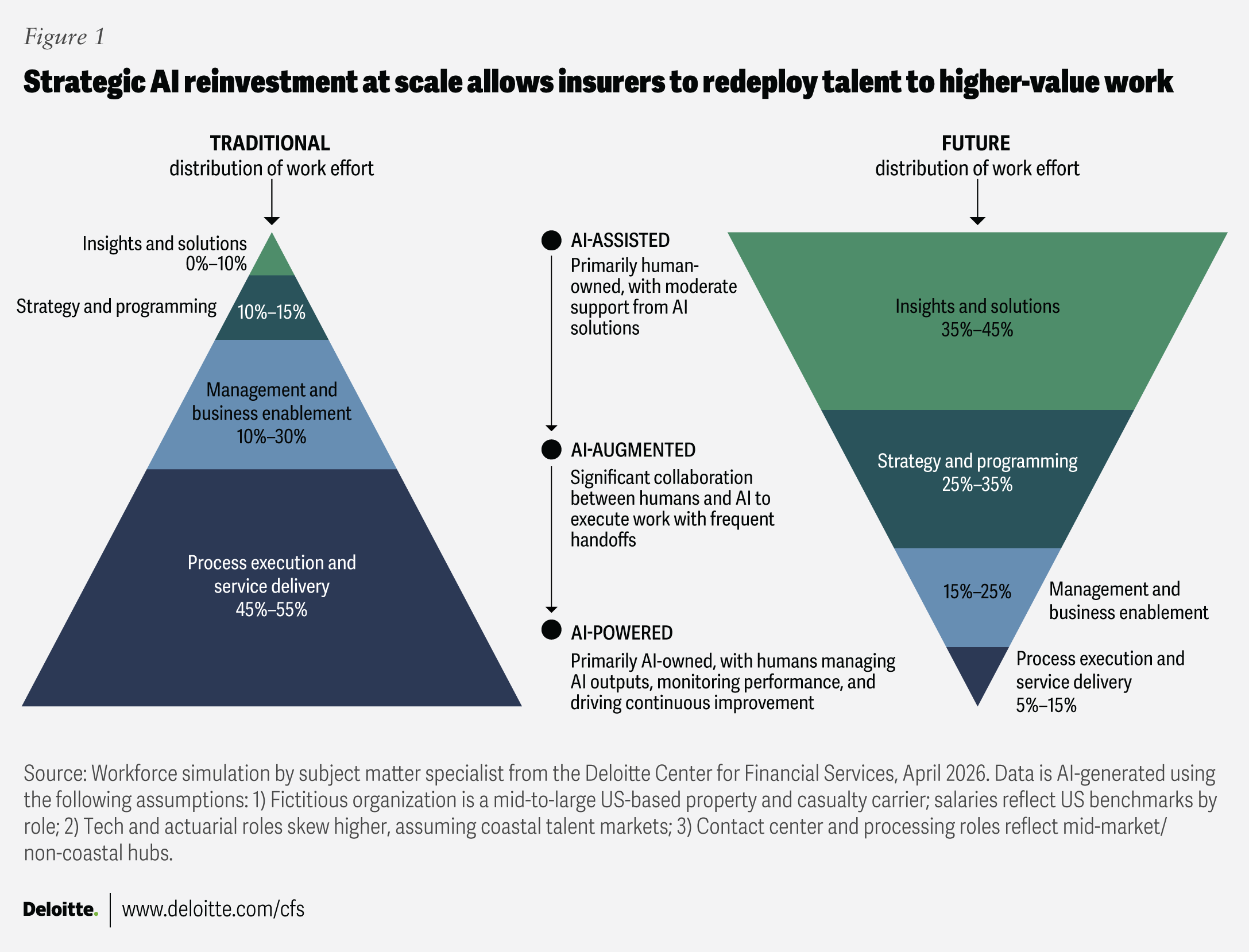
While AI is creating meaningful new organizational capacity, insurers will need to redesign jobs and develop their workforce to capitalize on it. Deloitte’s 2025 Global Human Capital Trends research highlights that while 90% of insurance executives agree on the urgency of reinventing the employee value proposition to reflect human-machine collaboration, only 25% have taken any tangible action to elevate human skills.21
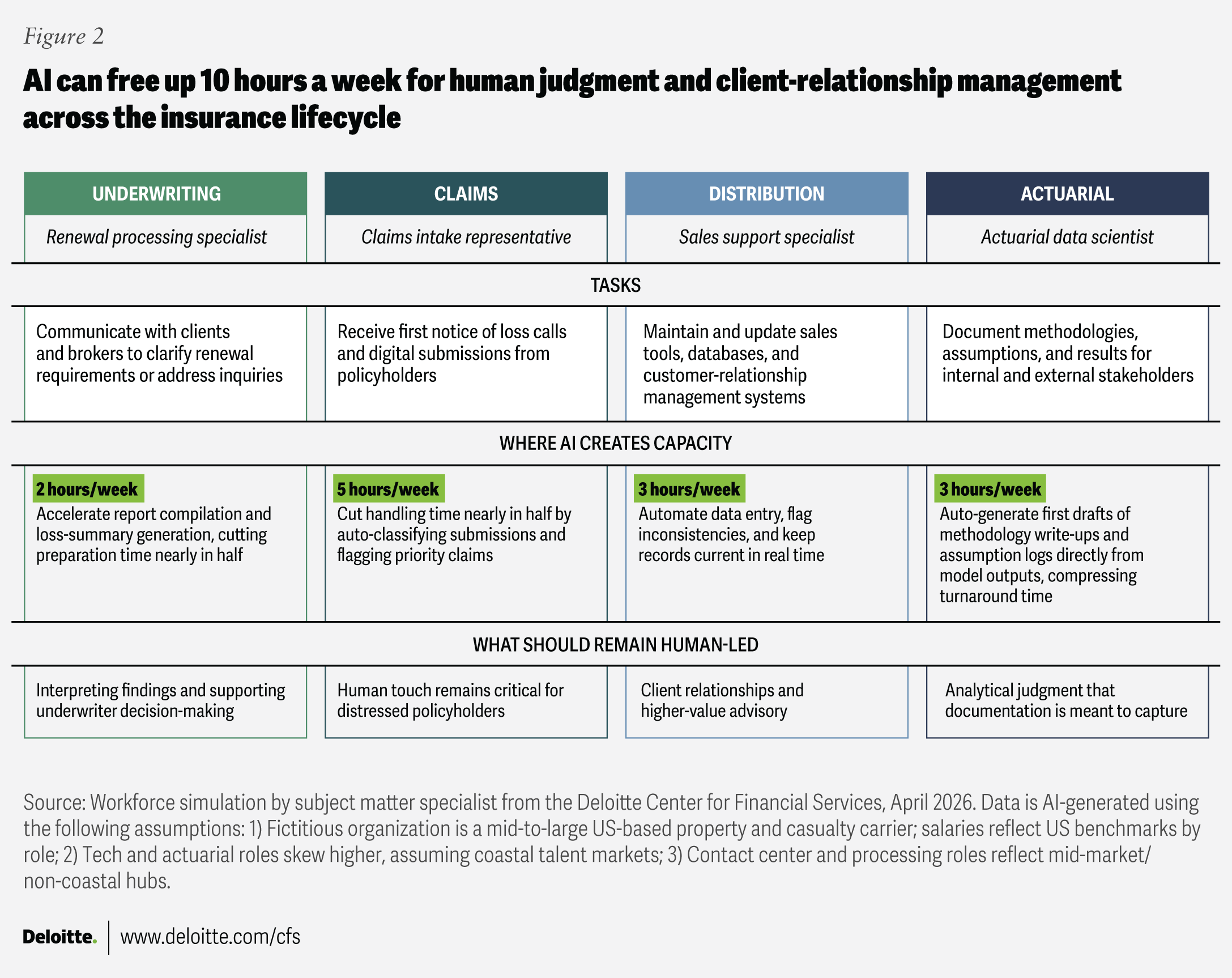
Insurers should understand which tasks and roles change and how much capacity exists. Insurance leaders should view freed capacity as a strategic asset and then create reinvestment strategies. They can deconstruct roles into core functional components with skills mapped at each stage. They should also need to understand where automation can add value and what should remain human led (figure 2).22
The “always-on” approach to workforce transformation
Traditional change management alone will likely be insufficient as modernization promises continuous change.23 Leadership alignment, organizational redesign, workforce planning, skills evolution, and change management should occur simultaneously and continuously. Workforce strategy should regularly be evaluated to match the speed of AI. Insurers can replace one-time transformation programs with an ongoing process that continuously evaluates AI capabilities, job redesign, organizational structure, and skills requirements.
The next insurance customer will likely judge the journey, not the channel
Insurance is entering an age of intelligent experience, where each interaction—human, digital, or AI-assisted—can work together to create a connected, coherent experience. Customer journeys could become agentic, with AI acting on customers’ behalf; ambient, anticipating needs as they arise; and multimodal, preserving context across every channel.
However, customer expectations continue to outpace industry capabilities. Sixty-two percent of buyers surveyed said they now use social media to discover, evaluate, and purchase financial or insurance products, according to LIMRA’s 2025 Insurance Barometer Study.24
The experience gap is already visible: Nearly half of new P&C policies are purchased digitally, yet digital shopping satisfaction remains low,25 and 21% of auto insurance customers report being forced to switch channels to resolve a single inquiry, according to JD Power.26 Insurers should focus on digital investments that simplify customer experiences, identify coverage gaps, provide proactive updates, and recommend relevant protection as their needs change.27
At the same time, the insurance operating environment is evolving rapidly. L&A insurers have traditionally used life milestones—marriage, home purchase, and childbirth—as entry points for customer engagement.28 As these milestones are increasingly delayed or skipped,29 insurers should consider shifting from event-based engagement to ongoing relationships built around customers’ evolving financial, household, health, mobility, and business needs. AI is accelerating this shift, as customers increasingly research protection and financial planning options before engaging an agent or adviser, raising expectations for personalized guidance.30
In P&C, these trends may signal a need for more effective management or mitigation of exposure due to extreme weather, connected-home vulnerabilities, mobility risks, and rising repair costs. The implication is a shift from digital-first to intelligence-first experiences. AI, real-time data, and connected ecosystems can help identify coverage gaps, personalize journeys, prevent losses, and embed advice across the customer lifecycle.
However, human support is essential, particularly in high-stakes moments. Deloitte’s research shows that knowledgeable, empathetic communication is a major driver of positive customer sentiment.31
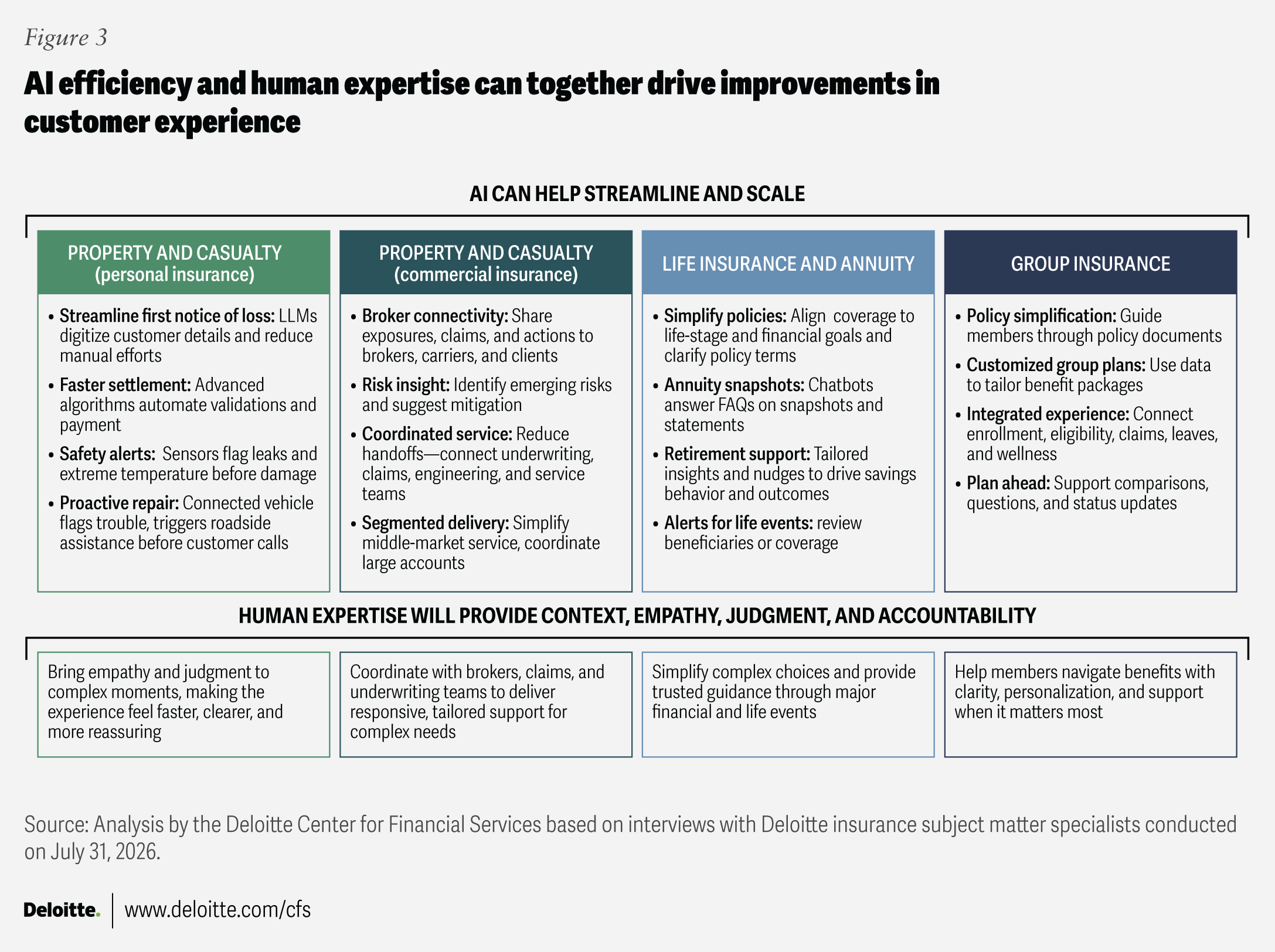
There may be an opportunity for insurers to make human interaction more intentional—offering digital pathways for simple needs, hybrid support for customers who want to research independently but also want value reassurance and adviser-led journeys for more complex decisions.
Improving customer experience may therefore involve making each journey more relevant, connected, and responsive to the customer’s next need (figure 3).
M&A outlook: Continued but selective deals
Through 2027, insurers, brokers, and investors may focus on targeted acquisitions that strengthen technology capabilities, specialty market positions, asset-management expertise, and capital efficiency.32
As the broader P&C rate environment softens, specialty lines that include excess and surplus, marine, and other niche commercial risks are expected to remain profitable longer, driving continued consolidation among specialty carriers and reinsurers.33 Transactions such as Howard Hughes Holdings’ $2.1 billion acquisition of Vantage Group illustrate growing interest from non-traditional investors seeking long-term insurance platforms.34
L&A continues to converge with asset management. Recent transactions, including the proposed combination of Corebridge Financial and Equitable Holdings (which has a 68.6% ownership stake in AllianceBernstein L.P.)35 and TIAA’s acquisition of Schroders,36 reflect insurers’ efforts to expand fee-based investment income, enhance assets under management, and deepen their relationships with asset managers. The distinction between L&A insurers and investment managers could continue blurring as firms seek diversified growth beyond traditional insurance products.
Buyers will also likely prioritize acquisitions that provide advanced AI, analytics, and automation capabilities to improve underwriting, pricing, claims, and operational efficiency rather than undertaking broad digital transformation programs.37 In July, Principal Financial Group announced its acquisition of AI-native Beam Benefits to accelerate digital capabilities and drive growth in small-to-medium business benefits.38
Distribution consolidation is likely to continue,39 with major transactions such as Aon’s $17 billion acquisition of USI and The Baldwin Group’s $7.7 billion take-private deal underscoring the scale of activity.40 As consolidation reshapes the landscape, private equity-backed independent distributors are gaining scale and bargaining power,41 increasing pressure on insurers to deliver customized products, faster innovation, and stronger technology integration.
As insurers look toward 2027, success may depend as much on preparation as on ambition. Organizations that clearly define their strategic priorities, maintain capital flexibility, and identify opportunities early may be well positioned to act with confidence. Equally important is operational readiness, including integration planning and governance alignment, which enables firms to execute quickly and capture value when opportunities emerge.
The bottom line for 2027
Insurance leaders are entering a market where yesterday’s sources of advantage may not be enough. Rate cycles, scale, legacy technology, and traditional distribution are giving way to a more dynamic competitive equation: Who can harness AI fastest, turn data into better decisions, and continuously reshape the business around changing risk and customer needs?
The challenge for 2027 is therefore not simply to adopt AI, cut costs, or pursue growth. It is to assess where technology can create value, where human judgment matters, and where freed capacity should be reinvested to build the organization of the future. At the same time, insurers should be selective about capital, partnerships, and M&A—acquiring capabilities that can accelerate transformation without surrendering control.
The industry will likely continue to shift from reacting to change to designing for it: predicting and preventing risk, reinventing how work gets done, anticipating customer needs, and using technology, talent, and capital to continuously reshape the enterprise.
Continue the conversation
Meet the industry leaders
Lananh Nguyen
Michelle Canaan
By
Joe DeSantis
Michelle Canaan
Namrata Sharma
Dishank Jain
The Center would like to thank the Deloitte professionals who provided additional insights and perspectives in the development of this outlook in the following areas:
US leaders
- Joe DeSantis
- Rich Godfrey
- Doug Welch
- Mark Yoest
- Chris Albert
- Kelly Cusick
- Dan Rosshirt
- Puneet Kakar
- Prashanth Ajjampur
- Gaurav Kumar
Subject matter specialists
- Property and casualty: Kelly Cusick, Puneet Kakar, Prashanth Ajjampur, Abhi Gupta, Rob Kaye, Malte Borkenhagen, Rohit Malhotra, Ankur Jain, Amy Allen
- Life insurance and annuities: Doug Welch, Puneet Kakar, Filip Vanderhaegen, Bill Jarmuz, Santosh Kutty, Malika Gandhi, Andy Ferris, Nathan Bernardi
- Group insurance: Mark Yoest, Bernard Tubiana, Bill Jarmuz, Bram Spector
- Talent: Tina Whitney, Andy Liakopoulos, Chelsea Earl, Seneca Smity
- Technology: Arun Prasad, Abhi Gupta, Santosh Kutty, Udit Narula, Stephen Casaceli, Deepak Jatwani
- Customer centricity: John Matley, Malika Gandhi, Bill Jarmuz
- M&A: Doug Sweeney
Editorial (including production and copyediting): Aditi Rao, Arpan Saha, Aparna Prusty, and Cintia Cheong
Design: Molly Piersol
Cover image by: Alexis Werbeck
Knowledge services: Agni Wagh
Visit the Deloitte Center for Financial Services
Access more insights for the banking & capital markets, commercial real estate, insurance, and investment management sectors.