
A poor claims experience can drive customers away. How can insurers use AI to help?
A Deloitte analysis of nearly 4,000 customer responses shows that claims experiences are a key driver of loyalty. Combining AI and human judgment can lower friction.
Insurance customers may shop around based on price, but the claims experience can determine whether they stay. A bad experience pushes many policyholders to rethink their provider. To learn more about what drives those reactions and how insurers can reduce friction in the claims journey, Deloitte analyzed about 4,000 property-and-casualty insurance customer responses collected by data and insights company HundredX.1
The findings: Many policyholders still experience complex, fragmented and unclear claims processes even after large investments by insurers in platforms and digital tools. This creates an opportunity for insurers to use AI more effectively to improve speed, clarity, and consistency across the claims journey. By investing in modern claims platforms, data infrastructure, and advanced analytics, insurers can equip claims professionals with technology that enhances high-stakes human interactions, builds trust, retains clients, and supports growth.
What drives positive customer sentiment and future purchase intent during the claims experience?
In our analysis of nearly 4,000 customer responses across 12 property and casualty insurance carriers, we assessed eight variables that most influence customer sentiment and future purchase intentions (figure 1).2 We found the claims process had an above-average influence on customers’ future purchase intentions but also ranked lowest in driving positive sentiment, signaling a significant opportunity for insurers to improve loyalty by enhancing the claims experience.
Meanwhile, the top four drivers of positive customer sentiment related primarily to human interactions: customer support, knowledge, communication, and attitude. Those factors strongly influence future purchases and reinforce trust in brands. Customers value knowledgeable and empathetic claims representatives who provide clear, consistent communication and support across channels (phone, website, and email, for example) to guide them through the recovery process.
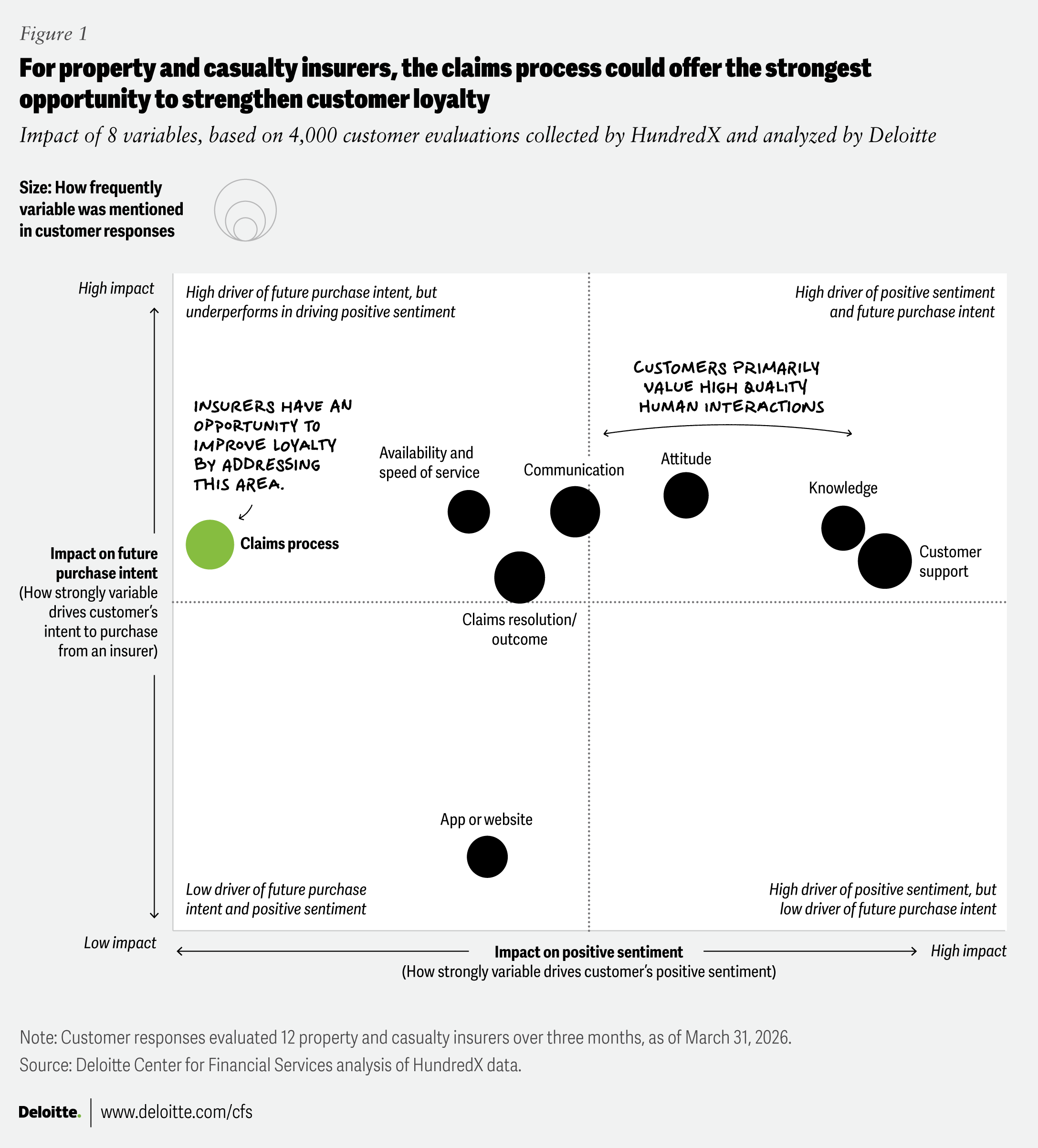
Customer responses further indicated that insurers’ apps and websites had the lowest influence on future purchase intent compared with the other drivers, suggesting these platforms, on their own, are not yet a major loyalty driver. But that finding may point to another opportunity: By making digital channels more intuitive and responsive, insurers can turn them into a meaningful mechanism for building customer loyalty.
Despite insurers’ investments in digital-first claims intake and support tools across interaction channels, many customers still encounter a disconnected experience. Poor orchestration often leaves customers discovering too late that their issue cannot be resolved through their preferred channel, driving frustration and increasing non-renewal risk. According to a JD Power survey of 5,958 evaluations provided by auto or home insurance customers, 22% of customers still use multiple channels to resolve a single query.3 And while customer satisfaction is highest when updates are delivered via mobile apps, only 36% of auto and 31% of homeowner customers receive updates that way; most still rely on emails, calls, or text messages.
In practice, sentiment can weaken when a customer encounters too many steps, slow processing, unclear processes or status updates, repeated information requests, or settlement delays. A seamless claims process should be a priority for insurers who want to avoid this scenario and gain loyalty.
5 ways insurers can use AI to improve the claims experience and boost customer loyalty
Artificial intelligence can help insurers anticipate needs, facilitate resolution options, reduce friction through seamless communications across channels, support human approvals, and equip adjusters with relevant insights to support decision-making and speed up resolution. To maximize the benefits of investing in AI for claims experiences, insurers can:
- Prioritize the highest-friction processes. Don’t just use AI to solve individual pain points. Instead, use it to replace or augment processes such as first notice of loss, mitigation services, and service-provider integration (towing or water mitigation, for example), improving speed, availability, transparency, and communication at the most critical moments of the claim. In some cases, insurers can even intervene early on, incorporating connected devices into the mix: Nationwide, for example, offers free or discounted water leak and fire detection devices to help customers mitigate risk before loss occurs.4
- Streamline behind-the-scenes decision-making. Automate intake including integration with auto or smart-home component manufacturers to trigger claims, collect documents, route cases based on skills and capacity, provide status updates, process payments, and coordinate repairs. Where appropriate, AI can also generate insights to help claims professionals complete tasks faster, enabling them to focus on the highest-value work: interacting with customers and making faster, more accurate decisions.
- Keep humans at the center of high-emotion moments. In previous research, Deloitte interviewed chief claims officers of leading property and casualty insurers and found that human soft skills like empathy and conflict management remain critical in managing complex claims, yet many adjusters struggle to develop or retain these skills. The findings further underscored the need for insurers to continue investing in immersive and personalized skill development, which can be enabled through AI-powered sentiment analysis training and simulations. Additionally, insurers can equip claims professionals with real-time insights to help them handle complex, high-stakes interactions. Zurich Insurance Group’s Voice IQ, for example, acts as a support layer to call-center teams, surfacing real-time guidance and tailored recommendations based on analysis of thousands of customer calls. At Sabadell Seguros, Zurich’s joint venture in Spain, the tool has increased customer retention by 20%.5
- Route customers to the right channel. Digital tools should guide customers to the right channels and include context across apps, web, text, phone agents, adjusters, or repair partners. For example, Allstate’s Good Hands Repair Network connects homeowners with approved contractors and uses direct billing and real-time updates to shorten the repair cycle and reduce back-and-forth.6 At the same time, when human engagement is most likely to deliver the best outcome and strengthen the customer relationship, it should be prioritized, over digital alternatives.
- Broaden claims metrics to include customer retention. Measure customer experience indicators such as trust, communication quality, channel continuity, future purchase intent, and net promoter scores. Add these metrics to the evaluation criteria for claims professionals and technology solutions alongside cycle time and loss adjustment expense impact, which are typically used to judge claims handling.
Digital transformation can improve customer sentiment when it makes the claims journey faster, more transparent, and reassuring in moments of uncertainty. Insurers that strike the right balance between AI-enabled improvements and human judgment can reduce costs and cycle time, while also handling claims in a way that builds trust and retains customers.
Continue the conversation
Meet the industry leaders
Kedar Kamalapurkar
Michelle Canaan
Namrata Sharma
by
Kedar Kamalapurkar
Malika Gandhi
Namrata Sharma
Sabyasachi Satapathy
The authors would like to thank Samia Hazuria (Deloitte Center for Financial Services manager), Akash Kumar (Deloitte Consumer Center assistant manager), and Annalyn Kurtz (Deloitte Insights editor) for their input.
Editorial (including production and copyediting): Elisabeth Sullivan, Annalyn Kurtz, Cintia Cheong, and Sayanika Bordoloi
Design: Harry Wedel
Cover image by: Rahul Bodiga and Sonya Vasilieff
Knowledge services: Vanapalli Viswa Teja
Visit the Deloitte Center for Financial Services
Visit the Deloitte Center for Financial Services for more research on the most complex issues facing the banking and capital markets, commercial real estate, insurance, and investment management sectors.