
The new ‘value menu’: Can school lunches be both affordable and healthy?
Rising costs and evolving health priorities may remake school lunches, from brown bags to cafeteria trays
Hurry up and get dressed. Finish your breakfast. Pack your bag. You’re going to miss your bus! Wait—what did we decide to do for lunch today?
It’s time for another school year. The hectic mornings of US families with kids in grades K-12 may get even busier as households try to balance budget realities with new ideas about what kids should eat for a healthy lunch. Grocers, food and beverage suppliers, and cafeteria food service companies may benefit from a better understanding of this shopper group’s changing needs.
The price of school lunch is a top concern for parents and caregivers. Based on our 2026 Deloitte Back-to-School Survey, 50% of caregivers said the cost of lunch on school days this year will likely be higher than last year’s.1 And even though data from our school lunch index (see methodology) shows only a moderate upswing, that trend may not hold through the year. Over the next few months, production pressures such as higher diesel and fertilizer costs may work their way through the supply chain to consumers.2
School lunch nutrition is another common concern. Even caregivers who might tolerate unhealthy options in their own lunches may draw a harder line for their children. Last year, 82% of those surveyed said they’d like their kids to eat healthier during the school day. Then, at the start of 2026, new federal dietary guidelines were released that prioritize protein and limit highly processed foods, changing how some families define healthy food.3
How will evolving financial and health concerns affect what’s for lunch this school year? It could come down to good value. In other words, it may depend on finding a combination of what consumers get for what they pay that feels “worth it.” What wins the lunchroom food fight won’t necessarily be driven by the absolute cheapest options, but instead the lunches (and brands) that offer more value for the price.4 According to our survey results, that added value is likely to involve health.
Unpacking the 2026 school lunch index
Whether their kids eat the cafeteria’s daily special or from a lunch box (and what goes into that box) is inherently an economic call for many parents, especially when the cost of groceries is 26% higher than it was five years ago across major US cities, according to US Bureau of Labor Statistics data.5 To assess how things are looking for the school year ahead, the Deloitte school lunch index tracked four years of lunch-related food and beverage prices.
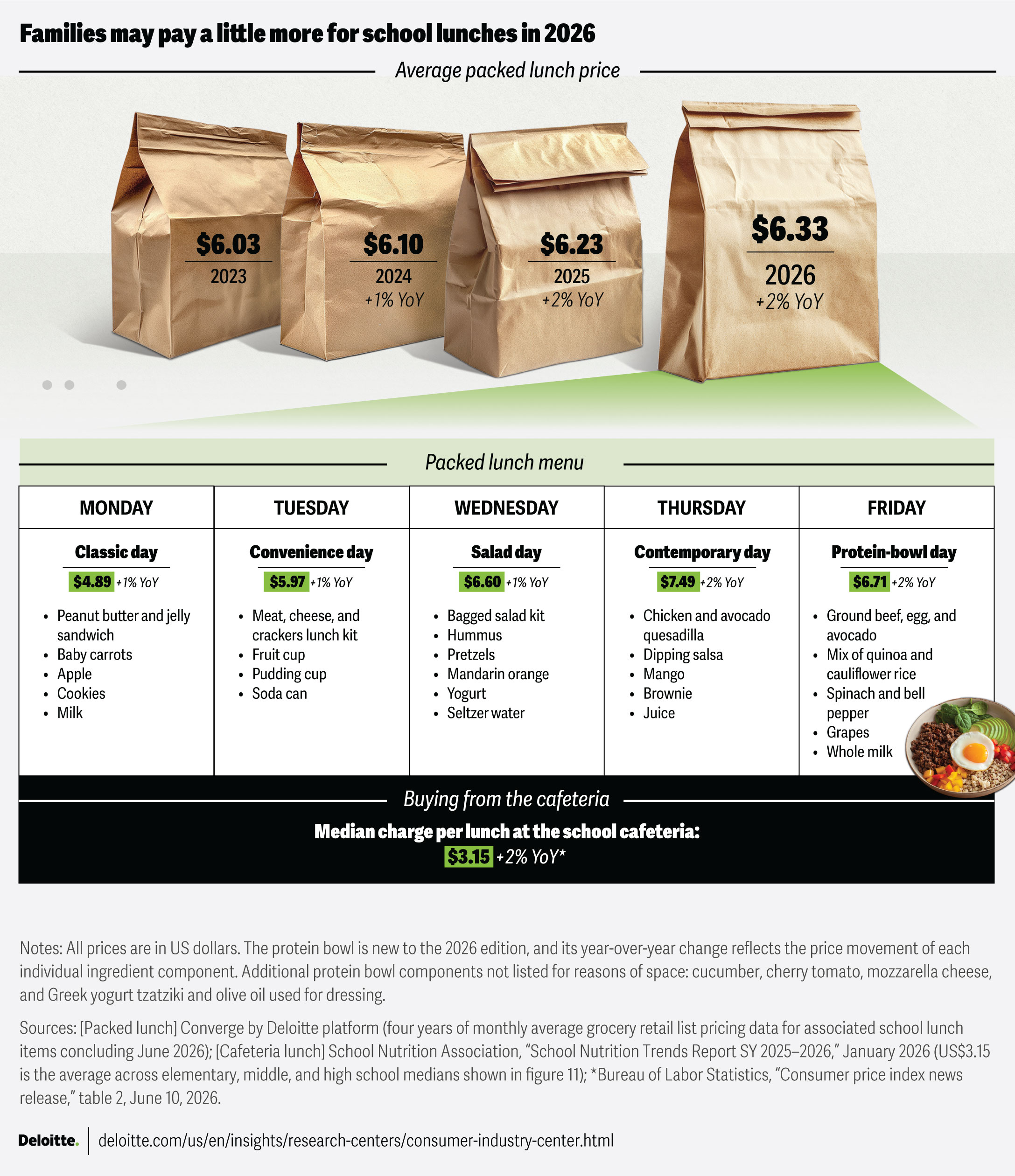
Kids’ dietary preferences and needs vary widely, so the index evaluates prices for five lunch types: classic with a peanut butter and jelly sandwich, contemporary with a chicken and avocado quesadilla, salad with hummus and pretzels, convenience with a meat and cheese lunch kit, and, new for 2026, protein in the form of a popular bowl-style lunch.
According to our index, the average daily cost across these lunch options hit US$6.33, up 2% from last year. Any price rise can be hard to swallow, but that’s somewhat less of an increase than overall food-at-home inflation, which was up 2.7% year over year as of the July consumer price index release.6
Drilling down to the index components, at US$6.71, the new protein bowl is the second-most expensive lunch and is tied with the contemporary lunch for the largest price increase at 2%. This new addition also retroactively revises our historical index lunch costs to slightly higher levels than previously published. For 2026, the rising cost of ground beef accounted for much of the increase. However, this lunch’s cost would have been even higher if it weren’t for the prices of ingredients (including eggs) that were especially elevated last year but dropped in 2026.
The contemporary lunch is still the most expensive (US$7.49), with its mango and juice box or pouch components posting the largest price increases. Our packed lunch cost hero, yet again, is the classic peanut butter and jelly lunch, which remains the cheapest option (US$4.89, up 1% YoY). It’s also the only brown bag lunch that isn’t more expensive than the median “reasonable cost” of US$5 suggested by surveyed consumers (up from US$4.50 last year).
But the most reasonably priced lunch of all is likely to come from the cafeteria. Averaged across elementary, middle, and high schools, a standard 2026 cafeteria lunch costs US$3.15, up 2% from the previous year.7 Affordability is likely nudging several consumers to obtain lunch from the school. Surveyed consumers with kids attending schools that offer free lunches to all children have 46% higher cafeteria lunch uptake than those attending schools that don’t. Respondents whose households earn less than US$49,999 annually are 69% more likely to get lunch from the cafeteria than peers with incomes over US$200,000. If prices continue to rise, more lunch-sack-to-lunchroom conversions may occur.
A healthy appetite for value
Deloitte’s ongoing ConsumerSignals survey indicates that 4 in 10 Americans are value seekers—consumers who regularly invest extra time and effort into making cost-conscious, deal-driven, convenience-sacrificing purchasing decisions.8 Their numbers don’t appear to be limited to any single income level. Nearly a quarter of households earning over US$200,000 now share the value-seeking mindset.9 Our earlier research also indicates that 75% of surveyed retail and consumer products executives believe that value seeking is a structural change in consumer behavior unlikely to ease even if general conditions improve.10
Despite the challenges this shift to a value-seeking mindset may pose for food companies, there are two potential pieces of milk-carton-half-full good news. First, even those respondents seeking value indicated they will open their wallets for brands they find worth it, and second, being worth it is not the same as being the cheapest.11 For school lunches, our survey data suggests that health can be a critical driver of value for consumers, for which many are willing to pay more.
Packing healthier ingredients
A little over 4 in 10 surveyed consumers say they’ll use the new federal dietary guidelines when preparing their kids’ packed lunches. That figure results from combining the 28% in the survey who say they’re making changes due to the new guidelines, and the additional 15% who say their meals are already aligned. But many families are either still figuring things out or are otherwise not on board. Thirty-four percent of respondents either aren’t sure whether they’ll follow the guidelines or aren’t yet familiar enough with them. An additional 23% say they won’t be using the guidelines.
However, since healthy brown bag lunches get their start at the grocery store, another way to measure the influence of new health trends and guidelines is consumers’ willingness to pay. Half (50%) of consumers say they’d pay an average of 7% more at the grocery checkout for food products reformulated to remove artificial dyes, additives, and ultra-processed ingredients or have added ingredients like protein. The survey also indicates that grocers that have pledged to reformulate their private-label offerings could sway a similar 50% of shoppers to choose their store over competitors.
Another indicator of consumer preference to pack healthier yet tasty meals is that a sizable minority is turning to artificial intelligence for help. In our survey, 37% of consumers said they use AI to research, plan, or spice up their kids’ packed lunches. Among that group, 67% use AI specifically to recommend healthier lunch ideas and ingredients. Food brands and grocers may do well to ensure their products’ nutritional information is discoverable by AI.
Upgrading to healthier lunchroom choices
Thirty-one percent of survey respondents think cafeteria lunches are healthier than packed lunches, even as national standards and professional oversight shape school meal menu choices. This perception may help explain why many caregivers want to see cafeterias improve their healthy offerings, even if it means a higher price tag. Nearly three in four (74%) surveyed want more fresh food and less processed food, 57% want more protein, and 54% want more locally sourced food in school-provided lunches, even after acknowledging that such changes could raise the cost.
Better communication may be the first step toward selling parents on the healthy merits of school-provided lunches. Seven out of 10 respondents already prefer the cafeteria for convenience, and, as discussed, it’s typically the lowest-priced option. If schools can continue addressing caregiver and student perceptions around health (and taste), they may see more students in the lunch line.
Regardless of whether parents and caregivers choose the cafeteria or home-packed lunches, when it comes to their children’s health, they may be looking for grocers, food producers, and food service providers to serve up more value for their lunch money.
By
Natalie Martini
Justin Cook
Lupine Skelly
Nimisha Mohanan
The authors would like to thank Brian McCarthy, Steve Rogers, Vivek Dogra, Manvi Verma, and Rithu Thomas for their contributions to this report. Special thanks to Natalie Groff and Clark Passino, along with the entire Converge by Deloitte team and data ecosystem, for fueling our school lunch index.
Survey coding, coordination, and data analysis: Sanjay Vadrevu
Editorial (including production and copyediting): Rithu Thomas, Preetha Devan, Arpan Saha, and Anu Augustine
Design and cover image: Harry Wedel
Knowledge services: Agni Wagh
Visit the Deloitte Consumer Industry Center
Access more insights for the automotive, consumer products, food, retail, wholesale and distribution, airlines and hospitality, and transportation sectors.