


A new era for leave entitlements in New Zealand
Tax Alert - September 2026
By Lauren Foster, Shirley Walls & Darren Wood
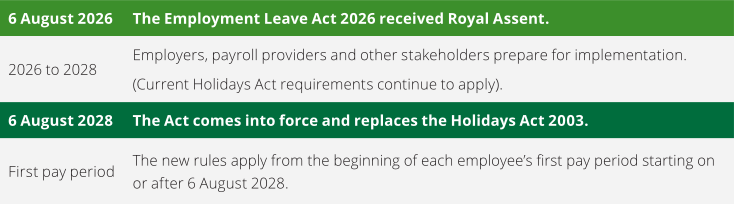
The Employment Leave Act 2026 received Royal assent on 6 August 2026 and will come into force on 6 August 2028, replacing the Holidays Act 2003. The Act introduces a new framework for how leave entitlements are earned, taken and paid, and includes a two-year transition period before commencement. Until then, employers must continue to comply with the Holidays Act 2003.
Why the change was needed
Documents from MBIE describe what is wrong with our current legislation as:
“Employers struggle to understand and apply the Holidays Act 2003 correctly, leading to employees not getting their correct entitlements. Administrative burden and compliance costs are high for employers, and despite good intentions, non-compliance is widespread and ongoing across both the public and private sectors. In the current legislation, many provisions are unclear, complex, difficult to apply for diverse working arrangements, and hard to systematise in payroll systems.
Fixing the system will reduce errors, save time, and lower costs for businesses. These changes will simplify how leave is earned, taken, and paid – so that employers know what they need to do, and employees know what they should be getting”
Implementation timeline
Key features of the enacted framework
The key features of the Employment Leave Act 2026 are broadly consistent with the proposals consulted on during the reform process. The Select Committee and public submission process resulted in several refinements that provide additional clarity and flexibility in the administration of the new framework, rather than fundamental changes to the overall policy intent.
1. Annual Leave based on hours worked
Employees earn Annual Leave, from day one, in direct proportion to contracted hours of work. Annual Leave accrues at a rate of 0.0769 hours (4/52) per ‘contracted’ hour.
2. Sick Leave based on hours worked
Employees earn Sick Leave, from day one, in direct proportion to contracted hours of work. Sick Leave accrues at a rate of 0.0385 hours (2/52) of Sick Leave per ‘contracted’ hour. There will be a cap of 160-hours, once hit, the cap will stop new accrual until the employee has used some of their stored entitlement.
3. Provision of Leave entitlements during unworked periods
Annual Leave and Sick Leave accrue when an employee is on paid leave under any legislation and when on parental, jury and volunteers leave. It does not accrue when an employee receives accident compensation and is not working or on any unpaid leave.
4. Using Annual Leave
Employees can use accrued leave hours to take any part of a day off work. Annual Leave is taken in hours against contracted hours. Leave can be taken on days an employee would have worked their contractual hours under their employment agreement, or a roster created when leave is requested. If an employee doesn’t have days of work in their employment agreement, they must agree to a ‘notional roster’ for leave purposes that would be used if a roster had not been created when leave is requested.
An employee can request to ‘cash up’ 25% of their Annual Leave as at their last 12-month employment anniversary in each 12-month period. This means that, where an employee has a large Annual Leave balance, there will be more flexibility to cash it up.
5. Using Sick Leave
For every hour an employee takes off work, they will use an hour of accrued leave. Employees can use accrued Sick Leave hours to take any part of a day off work.
Sick Leave can be taken on days, and against any hours, an employee would have worked under their employment agreement or that they had accepted at the time of the leave request. In practice this will mean any hours the employee has agreed to on a roster can be taken as leave if they request it.
Like Annual Leave, a notional roster will be used where an employment agreement doesn’t have specific days and/or hours of work.
6. Notional Rosters
Where the employment agreement includes a contractual obligation to work but doesn’t specify all of the information needed to determine someone’s leave entitlements (such as days of the week and times contracted hours are worked or the number of hours of work for a salaried employee) the employment agreement must include a notional roster that includes those details.
7. Salaried employee – working extra hours
In the situation where the agreement specifies salary will compensate the employee for some additional hours, there is no leave accrual or leave compensation payment payable.
If a salaried employee receives additional wages for those hours, the leave compensation payment will be payable at a rate of 12.5% of the ordinary hourly salary rate.
8. Waged employee – working extra hours
Any extra hours worked by a waged employee, on top of contracted hours, will not accrue Annual or Sick Leave, but a Leave Compensation Payment will be paid at the time the hours are worked. The rate will be 12.5% of an employee’s ordinary hourly wage rate.
9. Casual employees
All employees with no contracted hours will receive a Leave Compensation Payment instead of accruing Annual and Sick Leave for every hour they work. The rate will be set at 12.5% of an employee’s ordinary hourly wage rate and paid in every pay period. The Leave Compensation Payment is in lieu of accruing both Annual Leave and Sick Leave and is a calculation based on the value of both these entitlements (7.69% for Annual Leave and 3.85% for Sick Leave, with a small addition to recognise other factors (e.g. the insecurity of additional and casual hours of work). The Leave Compensation Payment will be a separate component of pay and must be shown separately in employee’s records and pay statements.
10. Payment of Leave
The same hourly leave pay rate will be used for all types of leave. It will be based on an employee’s lowest wage rate for the day of leave (for example, if an employee takes a contractual night shift as leave and would have received time and a half for the whole night shift, the hourly leave pay rate will be the time and a half rate).
For those on piece rates (where an employer is paid for the number of pieces produced, e.g. for the number of buckets of apples picked) the hourly leave pay rate will also include an hourly average of piecework wages calculated overpay periods starting in the previous 52 weeks.
In addition to the hourly leave pay rate, fixed allowances (such as an accommodation allowance) will be paid in full during leave, like normal.
Other components of pay, like bonuses, commissions and variable allowances (such as for ad hoc special duties) will not be included in the hourly leave pay rate.
11. Parental Leave
Employees will continue to accrue leave during Parental Leave based on the standard hours they worked immediately before commencing Parental Leave. Where an employee's hours were temporarily reduced prior to commencing Parental Leave, the temporary reduction will be disregarded and leave accrual will instead be based on the employee's standard hours before the reduction occurred.
When Annual Leave is taken after return to work, it will be paid like leave taken at any other time would be (which will be an increase in minimum entitlement compared with the status quo).
12. Bereavement and Family Violence Leave
All employees will be able to access Bereavement and Family Violence Leave from day one.
Leave entitlements will continue to be recorded as days-based entitlements, consistent with the current Holidays Act 2003 framework. Employees may take leave as whole days or partial days.
13. Public Holidays Observed
A day is an Otherwise Working Day (OWD) if an employee would have worked it under their employment agreement (including based on an agreed pattern of days of work).
There will be a new test for determining whether an employee would have worked on the day, when it is not clear in an employment agreement. The new test is based on whether the employee has worked on the day of the week the Public Holiday falls for 7 of the preceding 13 weeks.
A day will not, however, be considered an OWD, if it is reasonable to expect the employee would not have worked on it due to Parental Leave, Volunteers’ Leave, Accident Compensation or Unpaid Leave.
14. Public Holidays Worked
Employees will accrue Alternative Holiday hours at a rate of one hour for every hour worked on a Public Holiday, that is an otherwise working day.
Employees who work only part of their contracted hours on a public holiday will be paid time-and-a-half for the hours worked and public holiday leave pay for the contracted hours not worked. This leave payment will likely be recorded using a payroll code such as "Public Holiday Not Worked."
15. Pay Statements
Employers will be required to provide clear pay statements each pay period itemising pay and leave in a way that’s transparent and easy to understand.
Pay statements will need to include a subset of information from employees’ records - sufficient for employees to determine whether their pay and leave have been calculated correctly.
There will be flexibility around how an employer provides the pay statement - it could be provided directly in a physical or digital form or made accessible to employees via an online portal.
Workforce groups most impacted by the Employment Leave Act
While the Employment Leave Act will affect all employees, we expect the most significant impacts to be experienced by employees with variable hours or remuneration. This includes casual employees, employees with irregular or fluctuating work patterns, employees who regularly work additional hours, and those whose earnings include commissions, bonuses, incentives or allowances. These employees are expected to experience the greatest changes in the way leave entitlements are accrued, calculated and reported under the new framework.
What employers should do now
- Confirm governance and ownership across payroll, HR, employment relations, technology, finance, data and change.
- Complete an impact assessment across workforce groups, including salaried, waged, variable-hours, part-time and casual employees.
- Engage payroll, HRIS and time and attendance vendors on product roadmaps, configuration requirements and release timing.
- Review employment agreements, collective agreements, policies and rosters for information needed under the new hours-based framework.
- Assess payroll and leave data quality, including standard hours, additional hours, casual hours, work patterns, leave balances and pay elements.
- Design balance conversion, cutover and reconciliation approaches, supported by clear audit trails.
- Build a risk-based testing programme covering calculations, interfaces, employee records, pay statements and exception scenarios.
- Plan communications and training for payroll teams, HR, managers and employees.
- Continue to meet all Holidays Act 2003 obligations until the new Act takes effect, including addressing any known historical compliance issues.
Important transition point
There is no immediate change to employees' current statutory leave entitlements or the way leave must be calculated.
The current Holidays Act 2003 remains the law until 6 August 2028.
How Deloitte can help
Navigating legislative change can be challenging, but Deloitte is here to support you. Our team of payroll specialists can help you understand the Employment Leave Act 2026 and prepare your organisation for the transition from the Holidays Act 2003 to the new framework.
- Assess: Legislative briefings, readiness reviews, workforce and payroll impact assessments, system capability reviews, data and leave record assessments.
- Design: Future-state payroll processes, Leave policy design, employment and collective agreement reviews, operating model design and transition roadmaps.
- Implement: Requirements, vendor engagement, payroll and HRIS support, configuration assurance, testing support, balance conversion validation, cutover and programme delivery.
- Adopt: Change impact assessment, employee and manager communications, training, governance, stakeholder engagement and capability uplift.
- Assure: Go-live readiness, independent testing assurance, post-implementation health checks, controls reviews and ongoing compliance support.
September 2026 – Tax Alerts
- Latest tax bill continues the focus on incremental change
- Motor vehicle FBT reform: a new road map for employers
- The FIFth wave: the FIF reforms continue
- A fairer approach to taxing foreign-currency financial arrangements
- NRCT reform: less detective work for New Zealand businesses engaging offshore contractors
- New tax limits and concessions for charities
- Mutual understanding restored: Tax Bill provides welcome certainty for not-for-profits
- Pillar Two registration lessons and next steps
- Election tax policies part three
- An overdue software update: Inland Revenue turns its head to the cloud
- Counting the cost: Treasury lifts the veil on how tax policy proposals are costed and managed
- Ready, Set, E-invoice: new rules arrive in 2027 for B2G
- CRS 2.0: time to act


