


Election tax policies, part three
Tax Alert - September 2026
By Robyn Walker
Tax policy can decide elections, and Election 2026 may be no exception. Election campaigns inevitably involve fiscal promises, and those commitments must be funded through reprioritised spending, additional debt, higher tax or another mechanism.
With the election less than two months away, Tax Alert will be summarising what is on offer as details emerge. In the last two editions, we’ve covered the detailed policies released by the Green Party and The Opportunity Party, and the Labour Party. This month, we look at what new taxes Te Pāti Māori has proposed before considering the alternative of “no new taxes” offered by ACT and the National Party.
Te Pāti Māori
A range of new tax options is proposed in the Te Pāti Māori tax policy, some of which will be familiar from the Green Party proposals. The proposals seek to raise significant amounts of new tax revenue and partially redistribute that revenue through personal tax reform.
The new taxes
A progressive wealth tax would be introduced for anyone with net wealth in excess of $2 million. Those with wealth between $2 million and $5 million will be liable for a 1.5% wealth tax. Additional wealth between $5 million and $10 million would be taxed at 2% and wealth in excess of $10 million would be taxed at 2.5% per annum.
The company tax rate, for all businesses, would be increased back to 33%.
An “international profit transfer tax” of 5% would apply to the value of profits transferred offshore.
A land banking tax of 33% would be implemented, as would a 2% vacant house tax.
A 5% stamp duty would be introduced for residential property sales. There would be an exemption for first home buyers, if the home costs less than $1 million.
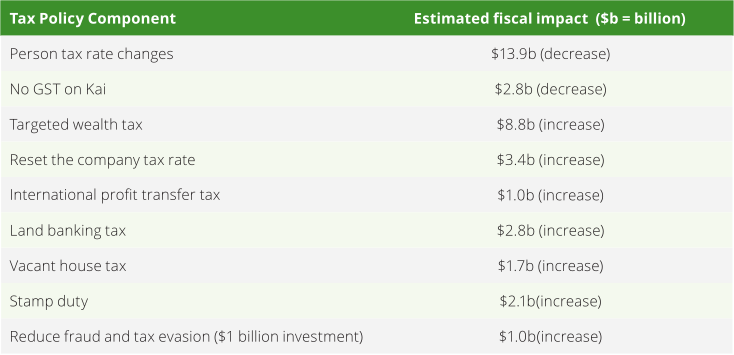
In addition to the new taxes, Te Pāti Māori proposes to increase investment into the Inland Revenue, Serious Fraud Office, the Financial Markets Authority and the NZ Financial Intelligence Unit. The policy indicates that funding would increase by $1 billion, however this amount may be the expected “gains” as a consequence of increased funding of a lower amount because it’s shown as an amount of additional revenue, rather than an expense, in the policy costing.
Spending
The majority of expected new revenues would be spent on personal tax rate changes. These rate changes are intended to result in lower taxes being paid by 97% of New Zealanders, primarily as a result of a tax-free threshold for the first $30,000 of income.
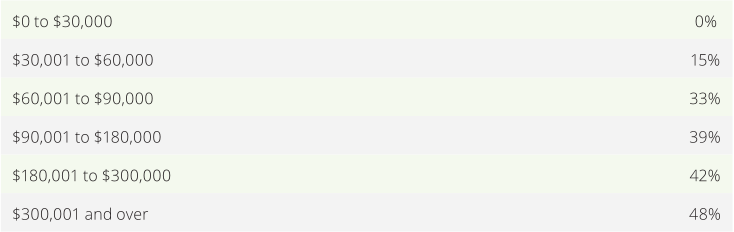
The second area of spending is referenced as “no GST on kai”. However, rather than proposing to remove GST from food, the policy would introduce a new targeted tax rebate for people earning $60,000 or less. The value of the credit is not specified, but the policy describes it as being “equivalent to 8 weeks of kai”.
Comment
It is difficult to comment on many of the policies due to the lack of detail provided as to what the tax would apply to and how. As covered in our first article in this series, wealth taxes are uncommon because they can result in capital flight, meaning mobile wealth would be likely to relocate out of New Zealand. This proposed wealth tax applies at a much lower level than proposed by the Green Party ($10 million) and therefore would impact on significantly more New Zealanders.
When it comes to stamp duties, these were recently analysed by Inland Revenue in its 2026 Long Term Insights Briefing (LTIB). The LTIB is broadly sceptical of stamp duties. It notes that stamp duties, which tax property and other transfers, raise only modest and volatile revenue because receipts depend on transaction volumes rather than underlying wealth or income. Their main drawback is economic inefficiency: by imposing a large upfront cost on moving, they discourage households and businesses from relocating even where doing so would be beneficial, creating "lock-in" effects similar to those associated with capital gains taxes. They also raise horizontal equity concerns because frequent movers bear far more tax than long-term owners.
From a tax policy perspective, delivering “no GST on kai” through a rebate, rather than removing GST from food, is a sensible approach. Previous studies have shown that GST exemptions are not a cost-effective way of targeting social assistance and, in many cases, the greatest benefit goes to higher-income earners, who often spend more on food.
The addition of $1 billion of funding to Inland Revenue and other agencies is significant. As noted above, the fiscal costings released by Te Pāti Māori show this amount as additional revenue rather than expenditure, so it’s either a mathematical error or expected additional revenue gathered rather than funding.
Generally political parties cost policies over four years, however it is unclear whether the Te Pāti Māori policy costing are over this period or on a single year basis. For example, the proposed changes to personal tax rates are forecast by Te Pāti Māori to cost $13.4 billion, however a Treasury tax rate calculator models the annual cost of the proposed thresholds as over $14 billion. Comparing some of the fiscal costings to those provided by the Green Party for similar changes supports the notion that all proposed amounts are annual estimates. The fiscal costing provided by Te Pāti Māori is set out below.
ACT Party and the National Party
Both parties are campaigning on a fairly simple promise of “no new taxes”. There isn’t much more to say on this policy, other than it inherently relies on a combination of reductions in some areas of government expenditure or growing the economy (and consequently increasing tax revenues) to fund new spending areas.
While many New Zealanders are content with the idea of paying no more tax (as a generalisation, most people are more comfortable with the idea of other people paying more tax), the “no new taxes” policy leaves some questioning whether this is appropriate when government expenditure on superannuation and health is expected to rise with an ageing population (not to mention the current debt situation). Ultimately, tax is not the sole solution to those challenges, but the policy places the onus on those parties to explain how looming demographic issues can be resolved by pulling other policy levers.
It’s likely that both parties will have more to say about taxes closer to the election. While there is a pledge for “no new taxes”, that doesn’t mean that there can’t be proposed changes to existing taxes. The ACT Party have already proposed some reforms to how cryptocurrency is treated and National has hinted there is a potential for favourable changes to the research and development tax credit and tax thresholds, if this fits with their Budget Responsibility Rules after the Pre-Election Economic and Fiscal Update is released on 29 September.
Conclusion
Tax reform is firmly back on the political agenda for Election 2026. Tax Alert will continue to monitor election tax policies as they are released.
September 2026 – Tax Alerts
- Latest tax bill continues the focus on incremental change
- Motor vehicle FBT reform: a new road map for employers
- The FIFth wave: the FIF reforms continue
- A fairer approach to taxing foreign-currency financial arrangements
- NRCT reform: less detective work for New Zealand businesses engaging offshore contractors
- New tax limits and concessions for charities
- Mutual understanding restored: Tax Bill provides welcome certainty for not-for-profits
- Pillar Two registration lessons and next steps
- An overdue software update: Inland Revenue turns its head to the cloud
- Counting the cost: Treasury lifts the veil on how tax policy proposals are costed and managed
- A new era for leave entitlements in New Zealand
- Ready, Set, E-invoice: new rules arrive in 2027 for B2G
- CRS 2.0: time to act

