


Motor vehicle FBT reform: a new road map for employers
Tax Alert - September 2026
By Robyn Walker
After more than 40 years of calculating fringe benefit tax (FBT) on motor vehicles in the same way, the Taxation (Annual Rates for 2026–27, FBT Simplification, Foreign Investment Funds, and Remedial Measures) Bill moves us one step closer to having a new set of rules from 1 April 2027. The reforms aim to reimagine the FBT rules by making them less complex, less prone to misunderstanding and more closely targeted to the benefit received and the remuneration substituted.
The reforms refocus the FBT rules away from taxing the mere availability of a vehicle for private use and instead seek to better quantify the actual private benefit provided, based on how the vehicle may be used. Rather than requiring logbooks to be completed continually, a vehicle will be categorised when it is provided to an employee, with the level of FBT payable changing only if there is a material change in the level of private use. The existing exemptions for work-related vehicles, business trips and emergency calls will be repealed.
Currently, eligibility for the work-related vehicle exemption is restricted by the vehicle’s physical characteristics, that is, it cannot be designed principally to carry passengers. Under the proposed rules, a “normal car” may also qualify for lower rates of FBT if it is used for business purposes.
At present, the quarterly taxable value of a motor vehicle benefit is based on the cost, or tax book value, of a vehicle, multiplied by the number of days in the quarter during which the vehicle was available for private use, after determining exempt days:
[GST-inclusive cost or tax book value] × [quarterly percentage] × [private-use days ÷ 90]
The new approach will simplify the equation by taking away the need to count days in the quarter or monitor exempt days:
[GST-inclusive cost or tax book value] × [quarterly percentage] × [inclusion rate]
The “inclusion rate” is a new percentage which represents the extent to which there is a benefit being provided which should be subject to FBT.
Categorisation approach
The motor vehicle categories are as set out in the table below.
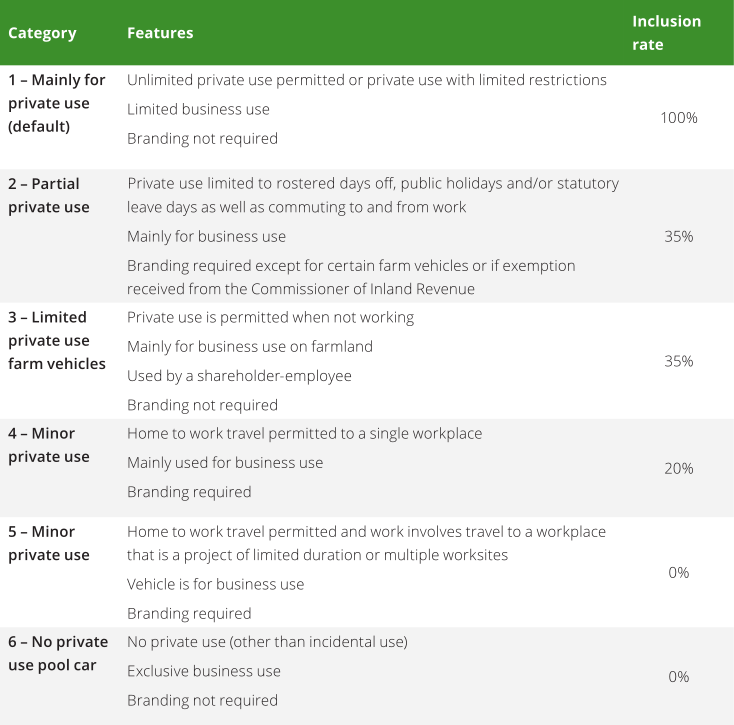
When considering which category is most relevant for a vehicle, some features will be more determinative of the outcome. For example:
- Branding: to qualify for categories 2, 4 or 5 the vehicle must be branded (subject to exclusions, discussed below)
- Main purpose: if the main purpose of a vehicle is to provide a private benefit, then the vehicle will fall into category 1.
- Business use: all categories other than 1 require the vehicle to have a business use purpose. This should be a purpose other than getting the employee to or from work; that is, the vehicle is used for some business purpose during the workday.
- Restrictions: categories 2 to 6 all require some level of restrictions on the level of private use by the allocated driver.
In all cases, incidental private use of a vehicle should not affect its classification. Incidental use is defined as travel that is “minor and secondary to travel between home and work” or “infrequent, or of short duration, for a limited purpose and not a substitution for remuneration”. In practice, this will mean that stopping at the supermarket on the way home, or an employee making a one-off request to use a work vehicle to help move furniture, will be incidental.
Branding
Branding is required for vehicles in categories 2, 4 and 5, subject to four exemptions:
- Grandparenting: to recognise that many vehicles are not currently branded, any vehicles owned or leased before 10 September 2026 (the date of introduction of the Bill) are exempt from branding requirements.
- Exemption: employers will be able to apply to Inland Revenue for a branding exemption. This may be granted if branding is not appropriate because of the sensitive nature of the employer’s business or the employee’s role in the business, or the nature of the vehicle’s operation.
- Farm vehicles: category 2 vehicles used in a farming or agricultural business do not need to be branded.
- Rental vehicles: if a business is temporarily renting a vehicle for up to three months, that vehicle does not need to be branded.
Branding is required to be prominent and permanent on the exterior of the vehicle and must show a form of identification that the employer regularly uses in carrying on their business.
Quarterly percentage
The “quarterly percentage” referred to above was last changed in 2009. Its purpose is to approximate vehicle running costs, including depreciation, maintenance, insurance and fuel. A major difference from the current rules is that variable rates will apply based on vehicle fuel type. This means lower percentages will apply to hybrid and electric vehicles.
Current rates (all GST inclusive):

Proposed rates (all GST inclusive):
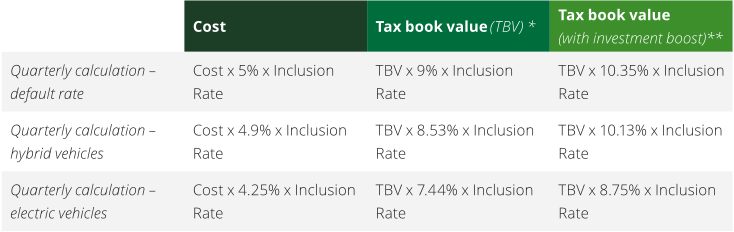
While the difference in percentages may seem small, they can add up to a significant difference in tax over a year (or longer) when combined with the categorisation approach.
Where to from here
The rules are intended to apply from 1 April 2027, so it is prudent for employers to start considering the potential impact on their vehicle fleets and the steps needed to ensure vehicles qualify for particular categories. Issues to consider include:
- What private use restrictions (if any) currently exist and how do these match the requirements for the new categories?
- Do any employment agreements and vehicle policies need to be altered?
- What vehicles need to be branded?
- Is it necessary to apply for a branding exemption?
For more information, please contact your usual Deloitte adviser.
September 2026 – Tax Alerts
- Latest tax bill continues the focus on incremental change
- The FIFth wave: the FIF reforms continue
- A fairer approach to taxing foreign-currency financial arrangements
- NRCT reform: less detective work for New Zealand businesses engaging offshore contractors
- New tax limits and concessions for charities
- Mutual understanding restored: Tax Bill provides welcome certainty for not-for-profits
- Pillar Two registration lessons and next steps
- Election tax policies part three
- An overdue software update: Inland Revenue turns its head to the cloud
- Counting the cost: Treasury lifts the veil on how tax policy proposals are costed and managed
- A new era for leave entitlements in New Zealand
- Ready, Set, E-invoice: new rules arrive in 2027 for B2G
- CRS 2.0: time to act
- Snapshot of recent developments

