If we have selected the wrong experience for you, please change it above.
The State of AI in the Enterprise
Deloitte's 2026 AI report tracking adoption and impact
Download the reportThe untapped edge
Organizations today stand at the untapped edge of AI's potential. Our 2026 AI report reveals that success hinges on the ability to move boldly from ambition to activation.
Download the reportKey findings from this year's AI report
Key findings from this year's AI report
What's top of mind when it comes to AI in the enterprise?
As they turn the corner to scale, leaders are asking about ROI, safe and ethical practices, workforce readiness, and tactical, go-to-market moves. Here are some of their most common questions about digital transformation with AI.
What does AI do for business?
Digital transformation with AI can yield a variety of benefits for businesses, from cost savings to service delivery. Improving productivity and efficiency top the list of benefits achieved from enterprise AI adoption so far, with two-thirds (66%) of organizations reporting gains. Other benefits organizations reported achieving include:
- Enhancing insights and decision-making (53%)
- Reducing costs (40%)
- Enhancing client/customer relationships (38%)
- Improving products/services and fostering innovation (20%)
- Increasing revenue (20%)
Revenue growth largely remains an aspiration, with 74% of organizations hoping to grow revenue through their AI initiatives in the future compared to just 20% that are already doing so. These numbers suggest AI is on the verge of breaking out and delivering a wide range of benefits that go far beyond efficiency and productivity improvements. Ultimately, however, success with AI isn't just about boosting efficiency or even growing revenue. It's about achieving strategic differentiation and a lasting competitive edge in the marketplace.
How is AI transforming business functions?
One-third (34%) of surveyed organizations are starting to use AI to deeply transform—creating new products and services or reinventing core processes or business models. Another third (30%) are redesigning key processes around AI. The remaining third (37%) are using AI at a more surface level, with little or no change to existing processes. While each are capturing productivity and efficiency gains, only the first group are truly reimagining their businesses rather than optimizing what already exists.
Additionally, different types of AI technologies yield different expectations for impact.
Generative AI (GenAI): The areas of GenAI that leaders believe will have the most impactful effects on their industries are:
- Search and knowledge management
- Virtual assistants/chatbots
- Content generation
Agentic AI: While agentic AI is expected to have the highest impact in customer support, use cases for supply chain management, R&D, knowledge management, and cybersecurity are also seen as having high potential. The enterprises we interviewed are already deploying autonomous AI agents across diverse functions:
- A financial services company is building agentic workflows to automatically capture meeting actions from video conferences, draft communications to remind participants of their commitments, and track follow-through.
- An air carrier is using AI agents to help customers complete the most common transactions, such as rebooking a flight or rerouting bags, freeing up time for human agents to address more complex matters.
- A manufacturer is using AI agents to support new product development initiatives, leveraging AI to find the optimal balance between competing objectives such as cost and time-to-market.
- In the public sector, AI agents are being used to cover workforce shortages, partnering with human workers to complete key processes.
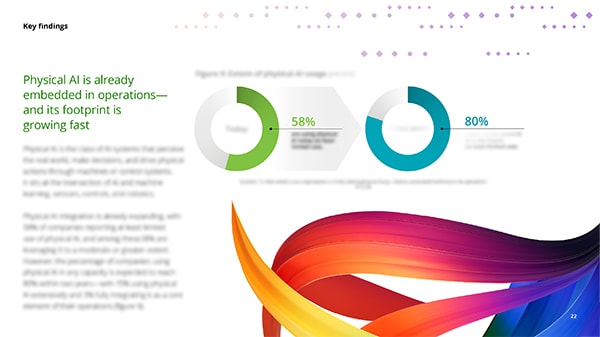
Physical AI: Physical AI applications span a wide range of industrial and commercial settings. Common use cases for physical AI include:
- collaborative robots (cobots) on assembly lines
- Inspection drones with automated response capabilities
- Robotic picking arms
- Autonomous forklifts
Adoption is especially advanced in manufacturing, logistics, and defense, where robotics, autonomous vehicles, and drones are already reshaping operations.
How do I manage AI model governance, data, and regulation?
As AI moves from experimentation to deployment, governance is the difference between scaling successfully and stalling out. Enterprises where senior leadership actively shapes AI governance achieve significantly greater business value than those delegating the work to technical teams alone. True governance makes oversight everyone's role, embedding it into performance rubrics so that as AI handles more tasks, humans take on active oversight.
Autonomous systems also heighten needs for data and cybersecurity governance. Organizations need to define where humans should remain in control, how automated decisions are audited, and which records of system behavior should be retained.
In terms of regulation, effective governance integrates with existing risk and oversight structures, not parallel "shadow" functions. It focuses on identifying high-risk applications, enforcing responsible design practices, and ensuring independent validation where appropriate. Leading organizations proactively monitor evolving legal requirements and build systems that can demonstrate safety, fairness, and compliance.
On the data front, legacy data and infrastructure architectures cannot power real-time, autonomous AI. As AI capabilities extend beyond software into devices, machinery, and edge locations, organizations need to evaluate if their technology foundations are ready to support potential physical AI deployments. Modernization should create a "living" AI backbone: an organization-wide, real-time system that adapts dynamically to business and regulatory change. Key ideas covered in the report:
- Leaders are enabling modular, cloud-native platforms that securely connect, govern, and integrate all data types. They break down silos with domain-owned data products and embed privacy, sovereignty, and security-by-design, while enforcing enterprise standards for quality, interoperability, and lineage.
- A unified, trusted data strategy is indispensable. Forward-thinking organizations converge operational, experiential, and external data flows and invest in evolving platforms that anticipate needs of emerging AI.
AI change management: How do I prepare my workforce for AI?
According to the leaders surveyed, insufficient worker skills are the biggest barrier to integrating AI into existing workflows. These are the top ways organizations are adjusting AI talent strategy:
- Educating the broader workforce to raise overall AI fluency (53%)
- Designing and implementing upskilling and reskilling strategies (48%)
- Assessing target talent acquisition levels and hiring specialized talent to drive AI initiatives (36%)
- Redesigning career paths and career mobility strategies (33%)
- Assessing changes to the anticipated supply and demand of skills (30%)
- Providing performance-based incentives for leveraging AI (30%)
- Combining or reimagining organizations based on new patterns resulting from AI usage (30%)
- Measuring worker trust and engagement (30%)
- Changing the balance between full-time, contract, and gig workers (19%)
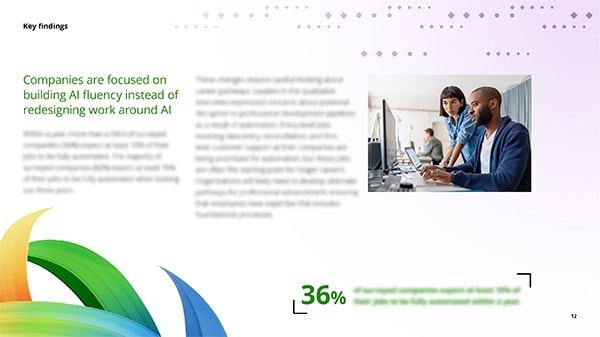
While most are focused on educating employees, far fewer are re-architecting roles, workflows, and career paths. The most successful organizations reimagine jobs to seamlessly combine human strengths and AI capabilities, ensuring both aspects are used to their fullest potential. New roles—AI operations managers, human-AI interaction specialists, quality stewards, and others—signal a deeper shift: AI is now a structural component of how work is organized. Advanced organizations streamline workflows that AI can execute end-to-end, while humans focus on judgment, exception handling, and strategic oversight. The goal isn't replacing humans or merely assisting them, but creating complementary working partnerships between humans and AI—where the combined output exceeds what either could achieve alone.
Organizational structures are beginning to flatten as AI absorbs routine execution tasks. Some companies are merging technology and people-leadership functions to ensure that systems and workforce design evolve together. The pace or AI change management varies by industry, but the direction is consistent: roles, skills, and career paths should be rebuilt, not simply adjusted. Organizations must redesign work holistically rather than layering AI onto legacy processes.
Enterprise AI adoption by industry
Trends and insights about AI in the enterprise vary from sector to sector, company to company. Get a tailored snapshot of your industry to understand where AI is making the biggest impact in your industry.
More insights about the state of AI
The Deloitte AI Institute
We collaborate with academic groups, startups, entrepreneurs, innovators, mature AI product leaders, and visionaries to explore AI risks, policies, ethics, and use cases.
Learn morePress release
Organizations in 2026 are standing at the untapped edge of AI's true potential, survey finds.
Get the full storyPulse Check
A survey series chronicling the latest AI developments, perspectives, and predictions.
Discover insightsThe AI Dossier
A collection of more than 80 high-impact use cases organized by industry, function, and AI type.
Explore use casesAgentic enterprise 2028
A blueprint for savings, job creation, and growth through agentic AI over the next three years.
Read the report
About the State of AI report
The State of AI in the Enterprise is a research series by the Deloitte AI Institute™ exploring trends, practices, and challenges in scaling AI.
Methodology: To obtain a global view of how AI is being adopted by organizations on the leading edge of AI, Deloitte surveyed 3,235 leaders between August and September 2025. Respondents were senior leaders in their organizations and included board and C-suite members, and those at the president, vice president and director levels. The survey sample was split equally between IT and line of business leaders. Twenty four countries were represented. Download report for full methodology.
Source: Deloitte's State of AI in the Enterprise 2024-2026 reports and associated research.