
The ecosystem advantage: How tech leaders can turn partnerships into enterprise value
As artificial intelligence reshapes technology partnerships, leaders should decide what to own, where to commit, and when to preserve flexibility
As external technology vendors play a larger role in building and operating AI capabilities, technology leaders will likely need to manage what crosses organizational boundaries and what stays within them.
Deloitte’s 2026 Global Technology Leadership Study explores an expanding tech leadership mandate, evolving operating models and workforces, strengthening risk and resilience, and demonstrating technology value. AI is extending more of that work beyond the boundaries of the enterprise.
Ecosystem relationships themselves are evolving: Increasingly, they combine products, services, platforms, proprietary capabilities, and ongoing innovation rather than a discrete technology purchase or implementation. For chief information officers, this can introduce a broader set of decisions: What exactly is the enterprise buying? What will the technology vendors own, operate, or continuously improve? Which capabilities and knowledge should the enterprise retain? How will the solution integrate with the broader ecosystem? And what happens when business priorities, technologies, or economics change?
AI capabilities are increasingly being delivered through networks of model providers, enterprise software vendors, startups, data partners, and services organizations. As these relationships become more integral to enterprise operations, decisions about external partners can shape the capabilities, knowledge, workflows, and intellectual property (IP) that organizations develop and retain.
This need to manage those relationships more deliberately is becoming more urgent as reliance on external technology vendors is already growing. Sixty-three percent of executives surveyed in Deloitte’s 2026 Global Technology Leadership Study say their reliance on external technology vendors has increased. Yet, only 20% have fully operationalized a curated ecosystem of external vendors, and just 31% report high or very high returns from ecosystem and partner platforms.1
AI also raises the stakes of familiar ecosystem decisions. Frontier-model dependency could create new IP exposures that are more pronounced than in many traditional software-as-a-service relationships.2 Agentic AI can introduce interoperability questions that vendors may be hesitant to answer.3 Platform vendors might tighten legal and contractual terms, as competition intensifies.4 Cybersecurity controls and governance often aren’t evolving at the speed of business risk. And AI can also require organizations to orchestrate the life cycle of their tech-partner ecosystems differently.
The leadership challenge extends beyond selecting individual vendors or accessing the latest AI capabilities. As external technology vendors play a greater role in how technology is built, delivered, and continuously improved, CIOs should consider not only what these relationships provide today, but what they enable the enterprise to become tomorrow. The opportunity is to translate external innovation into lasting enterprise capabilities and business value through deliberate decisions about ownership, strategic commitments, shared outcomes, and adaptability.
1. Decide what to own and where to partner
Many tech leaders are being asked to answer a familiar question in a more complex environment: What should the enterprise build, buy, partner for, or codevelop? The right decision starts with identifying which capabilities create meaningful differentiation that the enterprise should own, and which capabilities the enterprise can strategically access through a vendor or partner, where external dependence is an intentional choice rather than an unmanaged consequence.
- Buy: Organizations could buy commoditized or frontier AI capabilities to get the capabilities up and running more quickly, but should plan for ongoing costs through AI tokens, access fees, or other tollgates.
- Build: Organizations could choose to build AI capabilities tied to proprietary data, differentiated workflows, and IP to avoid handing over the prompts, data, fine-tuning signals, or other knowledge that contribute to the organization’s differentiation. Those considerations should be a first-order input to the buy-versus-build decision, not an afterthought.
- Partner: For capabilities that are strategically important but do not warrant internal ownership or joint development, organizations can establish deeper relationships with selected technology providers. These relationships can provide earlier access to innovation, greater influence over product road maps, and opportunities to align investments and capabilities with longer-term enterprise priorities.
- Codevelop: Codevelopment can bridge the gap when an enterprise needs a partner’s hard-to-access AI technology or engineering capability but wants to retain control of the knowledge, workflows, and IP that create differentiation. Strong arrangements can establish shared product road maps, dedicated cross-functional teams, and clear accountability for outcomes, not just implementation milestones. They can also define up front who owns newly created IP, training signals, evaluation assets, and reusable components, so the relationship builds enterprise capability rather than creating a deeper dependency.
As one example of AI capability codevelopment, Morgan Stanley recently worked with OpenAI to develop an internal assistant that applies GPT-4 to the firm’s curated research and advisory content rather than buying a generic tool or building a frontier model from scratch.5 Rolled out to about 16,000 financial advisers, the solution illustrates one approach to partnering for model capability while retaining control of the proprietary knowledge, workflow design, evaluation, and compliance controls around it.
Deloitte’s 2026 Global Technology Leadership Study suggests that codevelopment could become more prominent. Among 660 global technology leaders surveyed, 11% of respondents reported using co-innovation as a vendor-selection approach now, while 25% expect to do so in the next contract cycle.6 Yet, current selection criteria remain weighted toward security and compliance, cost and time-to-value, and integration and interoperability, while innovation and codevelopment rank lower. For capabilities for which ownership and differentiation are particularly important, codevelopment may warrant greater consideration alongside traditional selection criteria.
2. Decide where to commit and where to preserve flexibility
Enterprises can rely on a vendor to own and operate much of the tech stack; pay for on-demand access to systems of record and capabilities through tollgates based on application programming interfaces (APIs); or own, operate, and manage much of the infrastructure themselves. Each approach involves different trade-offs among cost, control, and speed. Leaders should make the ecosystem work as a whole: a platform’s architecture, a model provider’s road map, and an implementation partner’s decisions can collectively shape outcomes.
Agentic AI raises the stakes. Many enterprises are connecting vendor-provided and custom-built AI agents across workflows: According to Deloitte’s 2026 Global Technology Leadership Study, 90% of tech leaders surveyed are using or building single-agent solutions, and 85% are doing the same with multiagent systems. Connecting more vendor-provided and custom-built agents can create a growing web of technical, commercial, and operational dependencies.
AI agent interoperability is one important consideration. It’s critical to understand whether technology providers are building agents that operate primarily within their own platforms or agents that can work across applications. The more tightly an AI agent is bound to a single platform, the more expensive and difficult it may be to switch providers later.
Tollgating can create another form of dependency. A vendor that owns much of the tech stack can offer speed and simplicity. But as platform providers tighten legal and contractual terms to protect their position, that convenience can convert into a toll on access, pricing, or data rights after the enterprise has already committed to the relationship.
Deeper commitments to selected technology vendors can offer advantages through pricing, access to innovation, and closer alignment on strategic priorities. The challenge is determining when those benefits justify greater dependency and where preserving the ability to switch technologies or providers creates more long-term value.
As enterprises orchestrate multiple AI models, agents, applications, data sources, and technology vendors, the goal is not necessarily to eliminate dependence. Tech leaders need to make decisive choices about where vendor concentration is acceptable, and where the enterprise should maintain flexibility to shift workloads, capabilities, or partners later.7
These decisions become more consequential when technology vendors are responsible not only for providing technology, but also for operating and continuously improving enterprise capabilities. CIOs should understand who controls the underlying architecture, how improvements are prioritized, what happens when the partner's road map diverges from enterprise needs, and whether the organization can adapt or transition the capability without disrupting critical operations.
A large pharmaceutical company that made a significant cloud computing commitment later recognized the need for greater flexibility as technology and AI capabilities evolved.8 This example illustrates risks associated with large vendor commitments, the importance of preserving optionality, and the speed at which technology strategies may need to evolve in the AI era.
3. Measure what partnerships deliver and what the enterprise retains
Despite increased reliance on external technology vendors, only 31% of surveyed technology executives report high or very high returns from ecosystem and partner platforms. But value should extend beyond near-term financial returns to include the capabilities, knowledge, and competitive advantage these relationships help create.
When AI agents learn, or processes are developed through a partnership, does that knowledge become a portable enterprise asset or remain with the provider? Strategic partnerships should strengthen the enterprise’s ability to create value, whether through the capabilities it builds, solutions it codevelops, or external platforms it deliberately relies on. The critical question is whether the enterprise retains sufficient influence and flexibility to shape its technology agenda as business needs evolve.
AES, a US energy company, provides an example of measurable value from a multi-agent architecture. Multiple AI agents review safety audit documents of up to 400 pages across multiple languages, coordinate to accelerate report generation, and handle half the audit workload while a human stays in the loop for the rest. The team’s audit capacity doubled, and accuracy improved by 20%.9
Beyond near-term financial returns, CIOs should consider the lasting capabilities these relationships help create, including enterprise knowledge, workforce skills, reusable technology components, differentiated workflows, and the ability to innovate over time. These capabilities can create value whether they are developed internally, cocreated with external vendors, or accessed through external platforms.
When negotiating for ecosystem value, organizations may have varying levels of leverage to secure flexibility from major technology vendors.10 Greater flexibility may come at the expense of better pricing, earlier access to innovation, product road maps, or other commercial advantages. The goal is to make trade-offs explicit and decide which forms of flexibility matter most to the enterprise.
As ecosystem decisions increasingly span technology, finance, procurement, legal, security, and business leadership, coordination across functions becomes as important as the individual vendor decisions themselves.11 Managing these choices is rarely the responsibility of a single leader (see “Orchestration requires shared accountability”).
These expectations also change what enterprises should demand from their most strategic ecosystem relationships. Technology vendors should bring perspectives on emerging capabilities and market alternatives, collaborate on innovation priorities and product road maps, and help build transferable enterprise knowledge and skills. As relationships become more integrated into how enterprises operate and innovate, leaders should clarify who is responsible for continuous improvement, how newly created knowledge and IP are managed, and how accountability for sustained business outcomes is shared.
4. Know when to double down, diversify, or exit
Orchestrating ecosystem advantage requires more than periodic contract reviews. AI ecosystems should be revisited as value, risk, and market conditions change. Leaders need clear evidence to decide when to scale relationships that deliver differentiated value, diversify when concentration becomes a concern, or exit when value, economics, or strategic rationale no longer justify continued commitment.
Some signals can indicate that the original bet deserves reconsideration:
- Tollgating: When AI vendor restrictions tighten, it could signal growing dependence even when current economics still look fine. By the time higher costs or tighter restrictions make the relationship untenable, switching providers may already be expensive and disruptive.
- Security posture drift: An AI vendor’s engineering maturity and speed in remediating known vulnerabilities can affect operational continuity. If a vendor’s patch response to vulnerabilities across its attack surface slows down, it could be another signal that the relationship should be reassessed.
- Interoperability erosion: If a previously open integration or agent-federation path closes, it could materially change the value and portability of an AI vendor relationship. Leaders should treat interoperability erosion as an early warning sign, not a contract-renewal footnote.
AI capabilities, pricing models, vendor strategies, and architectures can change quickly enough that the rationale for a multiyear commitment may change well before the contract ends. Ecosystem portfolio management, therefore, shouldn’t be an annual procurement exercise, but an ongoing capital-allocation discipline in which leaders continually assess whether each bet still earns its place in the portfolio.
What should CIOs expect from their strategic technology vendors?
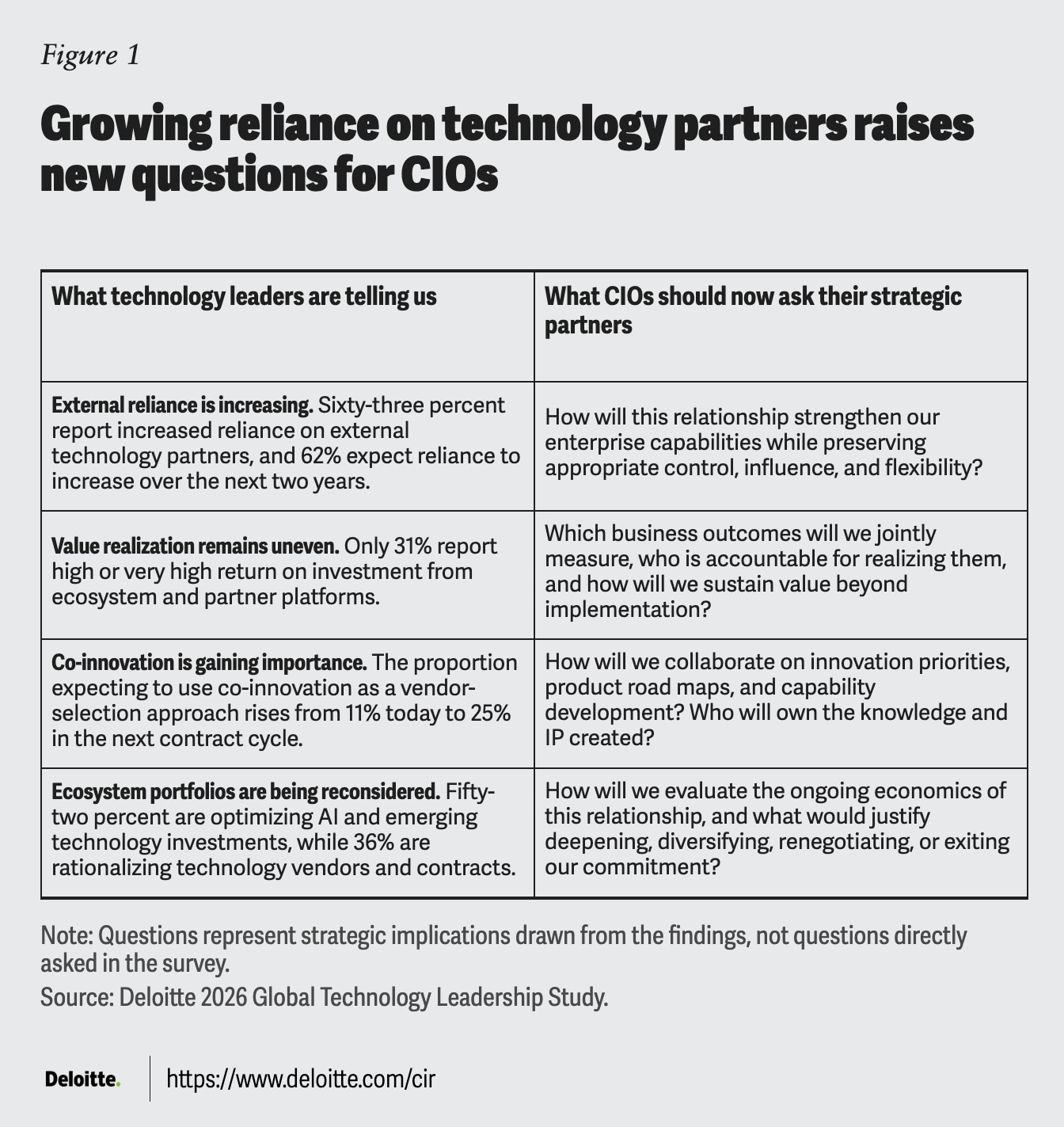
Deloitte’s 2026 Global Technology Leadership Study suggests that expectations for technology partnerships are evolving. While security, cost, and interoperability remain central to vendor selection, the proportion of technology leaders expecting to use co-innovation as a vendor-selection approach increases from 11% today to 25% in the next contract cycle.
As technology partnerships increasingly combine products, platforms, services, proprietary capabilities, and ongoing innovation, CIOs may need to expand the questions they ask of their most strategic partners.
Figure 1
Growing reliance on technology partners raises new questions for CIOs
Leading beyond the boundaries of the enterprise
As technology capabilities increasingly extend beyond organizational boundaries, CIOs may need to exercise the same strategic judgment over their external ecosystems that they apply to internal investments, architectures, and operating models.
The goal is not to minimize dependence on external technology vendors, but to make deliberate choices about which capabilities the enterprise should own, where strategic relationships create advantage, and how much flexibility to preserve as technologies and markets evolve.
Ultimately, the next phase of ecosystem leadership will be defined not simply by how effectively organizations access external innovation, but by how deliberately they translate that innovation into lasting enterprise capabilities, measurable business outcomes, and the flexibility to adapt as technology and market conditions evolve.
Continue the conversation
Meet the industry leaders
Steve Pratt
Anjali Shaikh
BY
Anjali Shaikh
Steve Pratt
Brett Davis
Dounia Senawi
Noah Horton
Monika Mahto
The authors would like to thank Diana Kearns-Manolatos and Erika Maguire for their significant contributions to the research and development of this article. They’d also like to thank Elliott Boerding and Dana Wrigley for their thoughtful inputs during the review.
They also extend their appreciation to Ayush Kumar for his support in data analysis, as well as to marketing team (Jennifer Rood, Saurabh Rijhwani, Akshay Poojari, and Jennifer Popovich) for their support in amplifying the impact of these insights.
Editorial (including production and copyediting): Corrie Commisso, Shyamili M, Arpan Kumar Saha
Design: Alexis Werbeck and Sonya Vasilief
Cover image by: Manya Kuzemchenko
Knowledge services: Rohan Singh
Visit the Deloitte Center for Integrated Research
Access more insights on some of the most complex issues facing businesses today.