
Fund, scale, or stop? AI is exposing the limits of traditional approaches to tech investment.
As AI changes tech investing, CIOs should connect investments to value. Here’s how an investment portfolio approach could help CIOs determine where capital should go next.
For much of the cloud era, technology financial management focused on a relatively well-defined challenge: understanding and optimizing tech consumption. Chief information officers have become experienced at consumption economics, moving infrastructure to the cloud, and converting fixed costs into variable costs while continuing to invest in transformational business capabilities.
Artificial intelligence is changing the investment equation. Every prompt, token, application programming interface call, model, and agent can introduce new forms of consumption. Organizations are now managing variable consumption alongside investments in reusable software, platforms, data products, and autonomous capabilities whose expected value can evolve quickly and become difficult to track. Expecting AI costs to rise, 60% of respondents in Deloitte’s Finance Trends 2027 plan to get savvier about AI cost management.
The stakes are rising as technology leaders direct more of their budgets toward growth and transformation. Deloitte’s 2026 Global Technology Leadership Study of 662 technology executives found that 61% of tech budgets are directed toward growing or transforming the business, compared with 38% directed to running it. Yet demonstrating the return on those investments remains difficult: Only 44% of respondents reported moderate or very high return on investment from their AI investments in the last 12 months.
The cloud era taught CIOs to optimize consumption. The next era might require them to apply that discipline to investment decisions, balancing near-term economics with longer-term value creation. CIOs will likely need to make explicit choices about where to place bets, how much to invest, what value to expect, and when to scale, redirect, or stop—shifting their role from managing tech budgets and consumption toward actively managing a portfolio of investments based on the value they expect to create.
The core challenge is value lineage
Managing technology as a portfolio starts with connecting investment to capability, adoption, business outcome, and ultimately enterprise value. CIOs should understand what they spend, what capabilities those investments create, how those capabilities are used, and whether they are delivering the outcomes the business expected. That line of sight can be thought of as value lineage: An investment builds capability and requires adoption, which then leads to a business outcome, which ultimately drives enterprise value. For example, an organization might invest in coding agents that improve software development speed; if half of the engineering workforce adopts them, teams using those tools might see faster new feature deployment times and improved customer satisfaction, ultimately contributing to new revenue. Given that 54% of those surveyed in Deloitte’s Finance Trends 2027 say they now play a leading role in cross-enterprise AI and technology capital allocation, this is becoming a shared enterprise investment discipline, not simply a better technology business case.
Our findings suggest that many organizations are still working to establish those connections. Most respondents say they’re working to create feedback loops to measure and share AI value realization (figure 1).
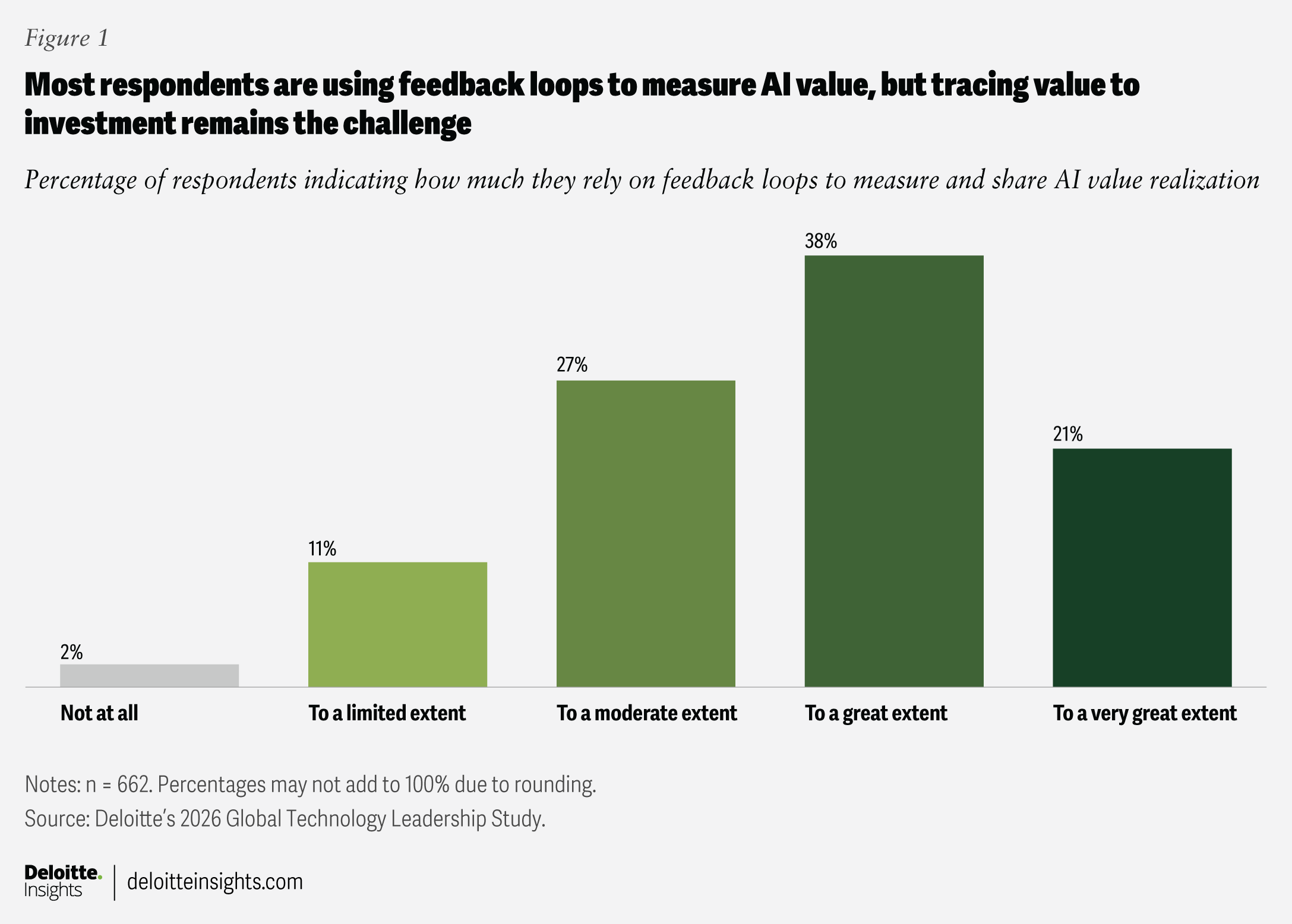
The challenge is being able to trace value back to the investments that produced it. Without that connection, CIOs have less evidence for deciding which investments to scale, adjust, or discontinue.
Traditional ROI measures might not tell the full story. The value of a tech investment could show up through revenue, productivity, customer experience, workforce capacity, risk reduction, or competitive advantage, while the costs could span infrastructure, software, data, AI consumption, talent, and external partners. CIOs should have a way to connect tangible and intangible inputs to direct and indirect outcomes so they can assess enterprise value, instead of evaluating tech investments as isolated projects.
“AI shouldn't be managed as an IT budget or a collection of technology projects,” said John Marcante, former global CIO of Vanguard and current US CIO in residence at Deloitte, in an interview. “It should be managed as an investment portfolio.” He explains that each investment should carry an expected return, understood risk, measurable business outcomes, and regular portfolio reviews.
Turning value lineage into portfolio decisions
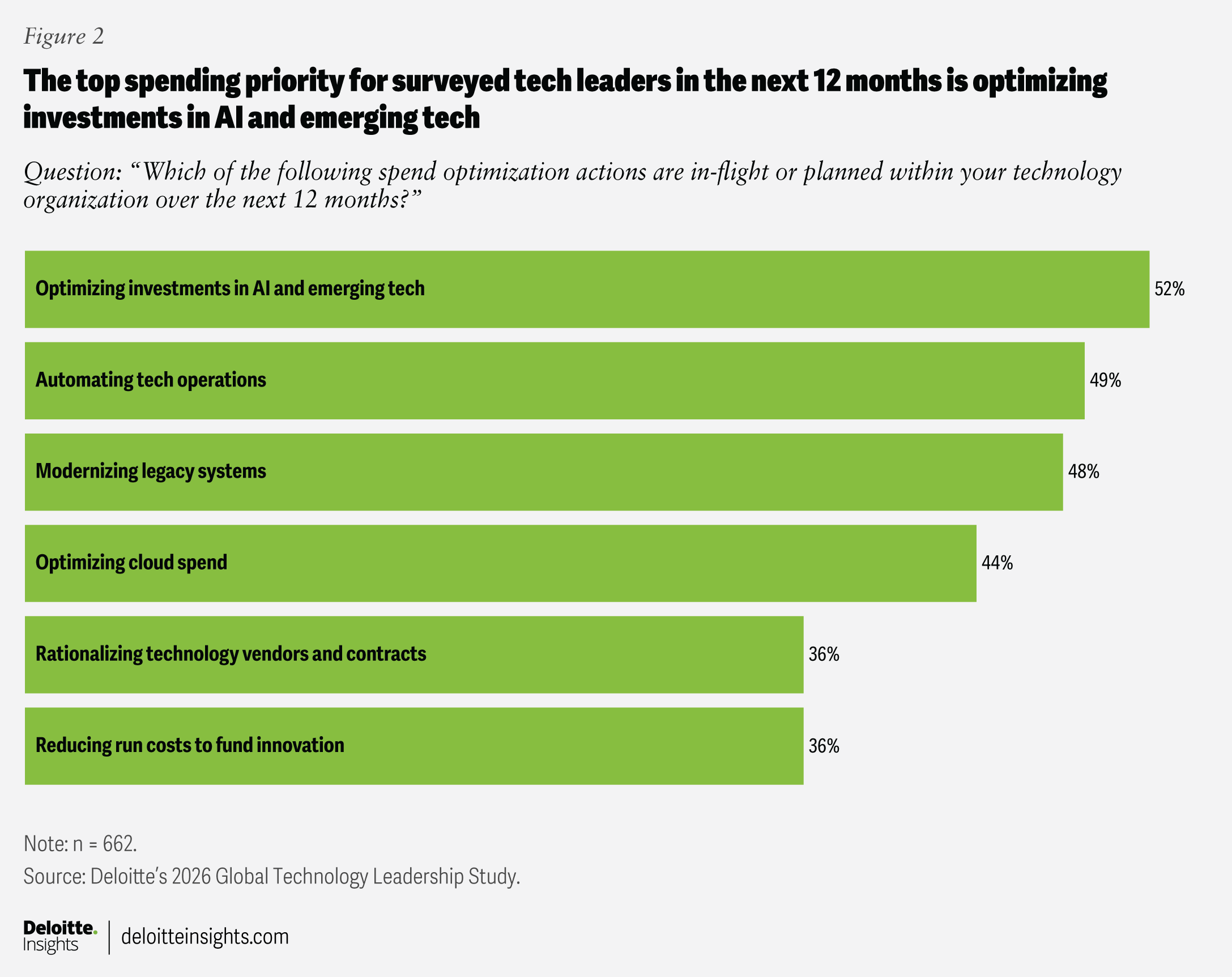
Over the next 12 months, tech leaders say they plan to optimize investments in AI and emerging tech, modernize legacy systems, and automate technology operations (figure 2). Yet only 59% of surveyed leaders say they are prepared or fully prepared to make the necessary investments to modernize core platforms and build AI capabilities over the next two years.
Those competing priorities already require CIOs to make trade-offs across the tech portfolio. AI makes that challenge harder.
Traditional technology portfolio management assumed that major costs were largely known at the time of the investment decision and that capabilities would evolve over predictable, multiyear cycles. AI challenges both assumptions. Costs can rise sharply after deployment as usage, tokens, agents, and autonomous workflows expand,1 while capabilities can improve faster than budgeting and planning cycles. The teams funding AI might also differ from those realizing the value, making it harder to connect investment decisions to business outcomes.
When costs, capabilities, and value can all shift after an investment is approved, CIOs should have a more continuous approach to capital allocation across a dynamic portfolio of models, platforms, data products, and use cases. Organizations need an investment discipline that can rebalance spending, match capability levels to business value, and redirect resources as economics, risks, and opportunities change.
CIOs need to evaluate each investment in relation to the rest of the portfolio: its expected value, economics, risk, and ability to scale. For AI, CIOs should make deliberate choices about which capabilities to invest in, which models and platforms are fit for specific use cases, and where to scale, diversify, or redirect investment as economics and value change.
Consider an enterprise scaling AI tools across thousands of workers. Using a single frontier provider for every user might be simpler, but it could also become expensive as adoption grows. An investment portfolio approach could help organizations reserve the most capable and expensive models for work that requires them, while routing other tasks to lower-cost or already licensed tools.
Effective portfolio management also requires an understanding of the different economic profiles of the technologies being deployed. For example, organizations might use a mix of usage-, credit-, and seat-based pricing models to balance cost predictability, capability, and scale across different use cases (figure 3).
Figure 3
Matching AI economics to the use case

Technology investments can differ in how their costs are recognized financially by the organization as well. Some spending that creates longer-lived software capabilities might qualify for capitalization—meaning the cost is recorded as an asset and recognized over time rather than expensed all at once—while ongoing consumption is generally expensed as it is incurred. How costs are recognized can affect the economics CIOs and CFOs consider when comparing investments, although accounting treatment should not drive the investment decision itself.
The point is not to maximize the number of tools or choose a single technology strategy, but to manage the portfolio deliberately—matching capabilities to use cases, balancing cost and performance, and recognizing that different investments might need to deliver value over different time horizons. Value measurement can then move from a reporting exercise to an investment discipline that can inform where to scale, redirect, or stop spending.
FinOps can provide the visibility that tech investment decisions need
Managing technology as a portfolio often depends on having enough financial and operational visibility to connect spending and consumption to capabilities, outcomes, and risks. FinOps has traditionally focused on understanding and optimizing tech consumption. As technology investments become more dynamic, its role can expand to support the broader tech portfolio.
As Daniel Torunian, former vice president of employee technology at PayPal and former CIO at Adecco, explained in in interview, “Over the past decade-plus, much of technology financial management shifted toward consumption management and expense optimization. Those disciplines remain critical, but AI adds back the need to make deliberate, multiyear strategic investment decisions.”
Seventy-four percent of respondents say demonstrating strong financial and operational discipline is a strategy priority for their tech function in 2026. AI makes that harder: Costs depend on pricing models, usage volumes, and the number of steps in a workflow. Costs can rise quickly as adoption grows, placing pressure on tech and finance leaders alike. TIAA, for example, is applying FinOps-style governance to AI, treating tokens as a managed enterprise resource by closely tracking consumption, monitoring usage patterns, and steering employees toward the most cost-effective models and prompts for each task, instead of allowing unrestricted use.2
Significant transformation might be needed to bring AI tokens into strategy and management processes. However, better financial and operational visibility can provide CIOs and their finance and business partners the information they need to determine where investment is creating value, where costs are scaling faster than expected, and where technology decisions might be increasing future cost and complexity. It can also provide the data needed to demonstrate the tech’s impact on the business.
Technical debt illustrates why this issue matters. Today, 61% of respondents estimate that the cost of wasted IT resources across people, processes, and technology—known as technical debt—is equivalent to 21% to 40% of their organization’s revenue. A similar proportion of respondents (59%) expect their technical debt overhead to be up to 20% of revenue by 2028 as they work to remediate it. Yet a meaningful share still expects technical debt to remain above 20% of revenue, as agents introduce new inefficiencies (figure 4). For CIOs, then, technical debt has become an investment allocation issue. What organizations spend today on modernization, remediation, or short-term workarounds can affect how much capacity and capital remain available for future priorities. The CIO story is not simply controlling AI consumption. It is understanding the economics well enough to make portfolio decisions about where to scale, optimize, redirect, or stop.
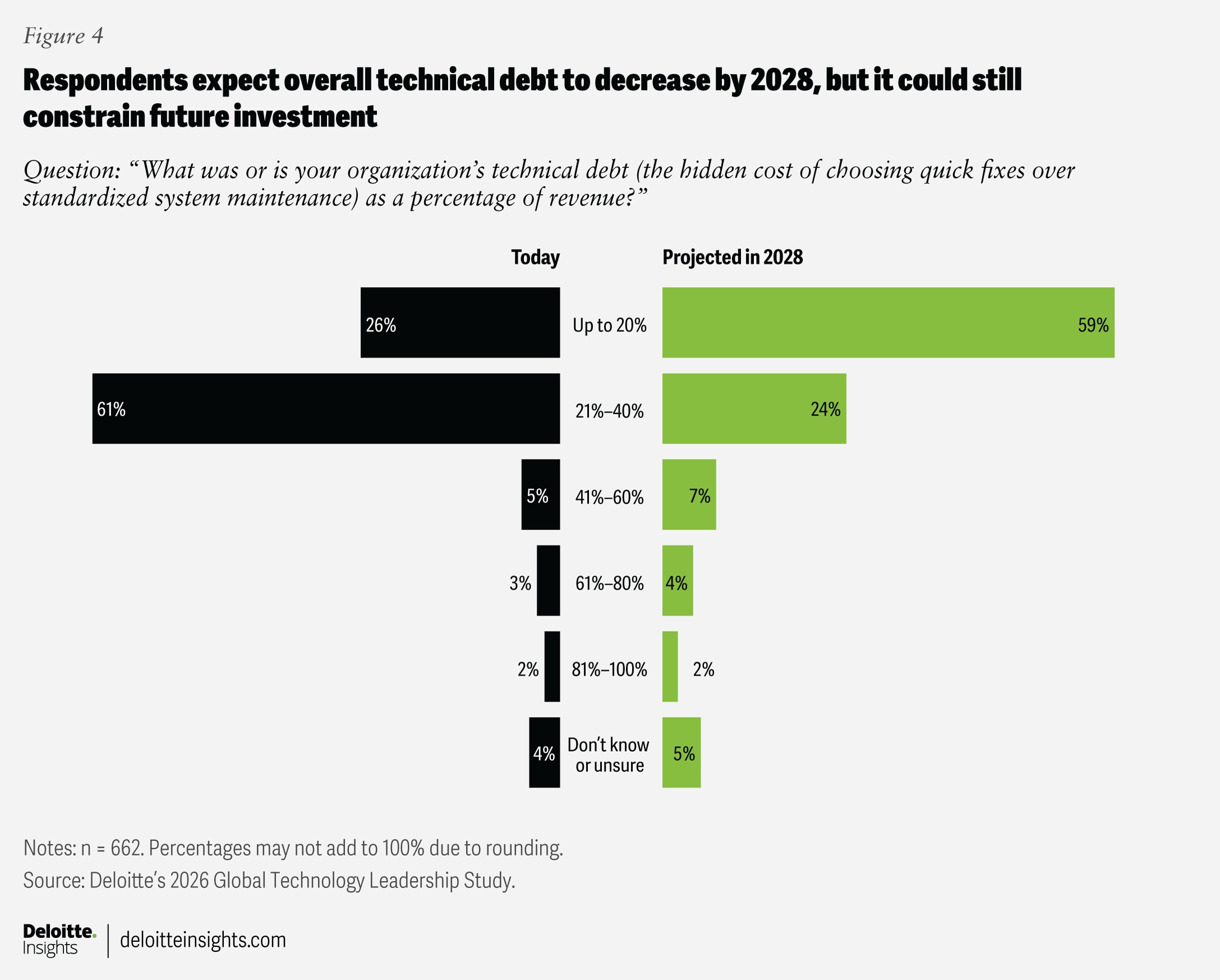
The same visibility that helps CIOs understand consumption can therefore support better portfolio decisions: which investments to scale, which to optimize, where to address technical debt, and where to redirect capital toward higher-value capabilities.
Make every tech investment earn the next dollar
The payoff from better value measurement is better portfolio decisions. CIOs can use a shared view of value, stronger financial and operational visibility, and regular portfolio reviews to direct investment toward the capabilities that matter most, scale what is working, address what is not, and create capacity for what comes next.
The cloud era taught CIOs to manage tech consumption with discipline. The AI era will likely require the same discipline in deciding where capital goes next. The real test might not be whether an investment delivered on what was originally promised, but whether, based on what leaders know now, it has earned the next dollar.
Continue the conversation
Meet the industry leaders
Steve Pratt
Anjali Shaikh
Tim Smith
by
Michael Wilson
Anjali Shaikh
Baris Sarer
Tim Smith
Diana Kearns-Manolatos
The authors would like to thank Monika Mahto and Erika Maguire for their significant contributions to the research and development of this article.
We’d also like to thank Nikhil Roychowdhury, Gaurav Churiwala, and Chris Chiriatti for their thoughtful inputs during the review.
We extend our appreciation to Ayush Kumar and Abha Kulkarni for their support in data analysis, as well as to the marketing team—Jennifer Rood, Saurabh Rijhwani, Akshay Poojari, and Jennifer Popovic, for their support in amplifying the impact of these insights.
Editorial (including production and copyediting): Corrie Commisso, Shyamili M, and Cintia Cheong
Design: Molly Piersol
Cover image by: Sonya Vasilieff, Manya Kuzemchenko
Knowledge services: Viswa Teja Vanapalli
Visit the Deloitte Center for Integrated Research
Access more insights on some of the most complex issues facing businesses today.