
Rethinking skills-based talent models: 4 paths to business value
Skills-based models can fall short if they aren’t anchored to clear outcomes. Deloitte research highlights actions that can help translate skills investments into measurable value.
Organizations are increasingly focusing on what people can do—their skills—rather than relying on traditional proxies such as job titles. More than half (55%) of 2,300 business leaders in a 2024 Workday survey said they had already begun the transition to a skills-based talent model, with an additional 23% planning to start within the next 12 months.1 And 81% believe that adopting a skills-based approach increases an organization’s potential for economic growth.2
But recent Deloitte research shows that many organizations are struggling to realize tangible value from their skills-based approaches. To better understand this gap, we analyzed 87 organizations (see methodology) implementing more than 28 different skills strategies across four key areas: skills demand identification and mapping, skills supply data gathering and assessment, skills activation and governance, and skills-based talent management. Building on our 2022 research, we’ve also deepened these insights through client work—clarifying where to start, how to progress, and which actions matter most for achieving value quickly.
What we found runs counter to the common narrative that organizations should pursue a wholesale, one-size-fits-all shift to a skills-based organization, where skills replace jobs as the foundation for talent decisions. In practice, few have actually achieved this—only 2% of 80 human resources leaders polled by Gartner say their organizations have successfully adopted skills-based approaches across all their processes.3
Instead, the organizations in our analysis that are achieving value are taking a decidedly different approach. The vast majority start with the business outcomes they want to achieve and then apply specific skills-based practices to support those goals.
In short, they start with outcomes, not with skills.
The good news is that organizations don’t need to tackle everything related to skills at once. For each path to value our analysis identified, a small set of targeted actions—tailored to the outcome being pursued—can unlock value quickly. In addition, our analysis suggests that leading organizations treat skills as one piece of the puzzle, marrying skills-based approaches with other levers designed to achieve their specific objectives.
Four outcomes-based paths to value with skills
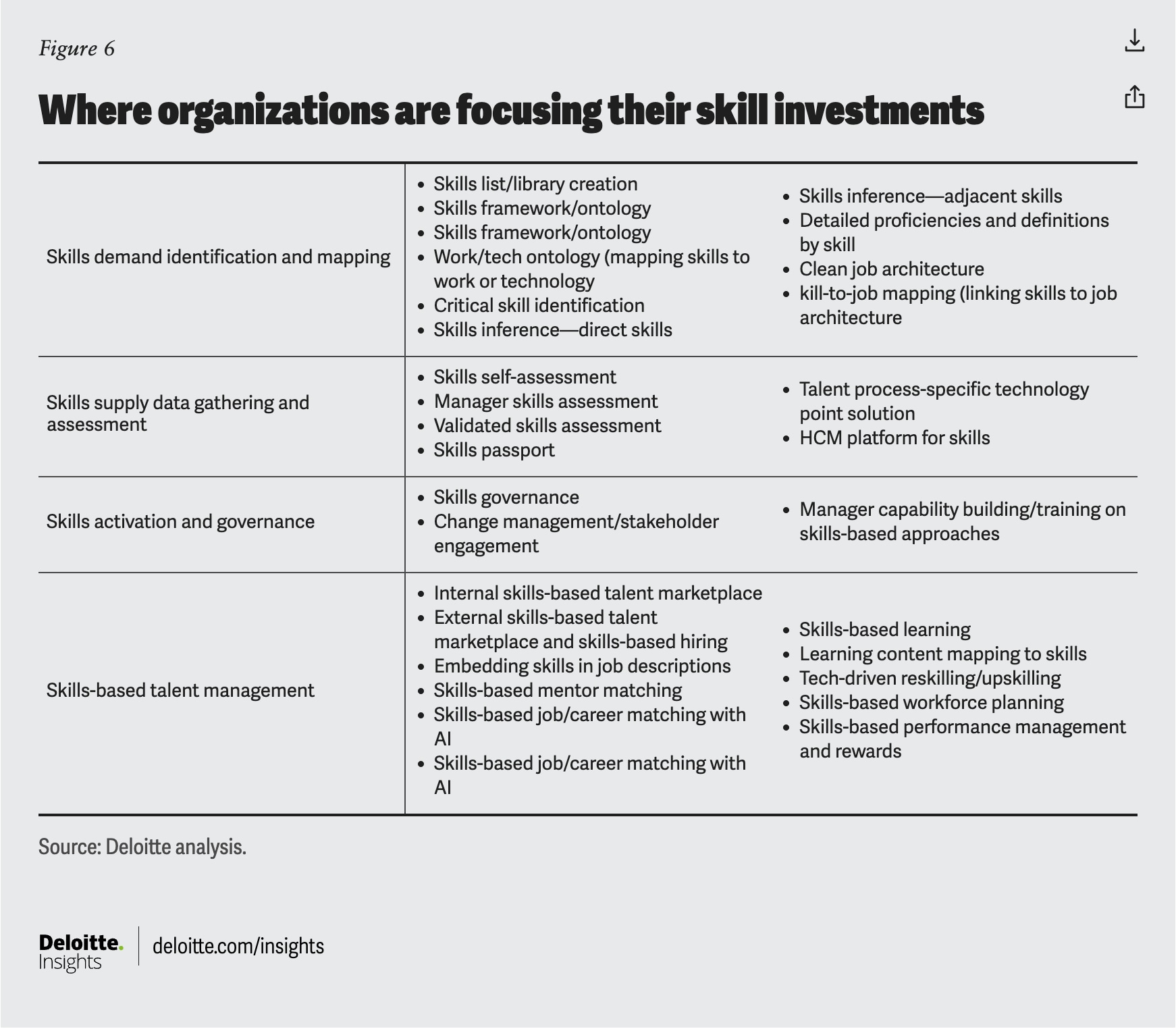
Our analysis revealed four primary outcomes organizations can pursue with skills-based approaches: attracting and retaining talent as an employer of choice, optimizing productivity and efficiency, creating greater organizational agility, and boosting innovation and growth (figure 1).
Figure 1
Where organizations are focusing their skill investments
${optionalText}

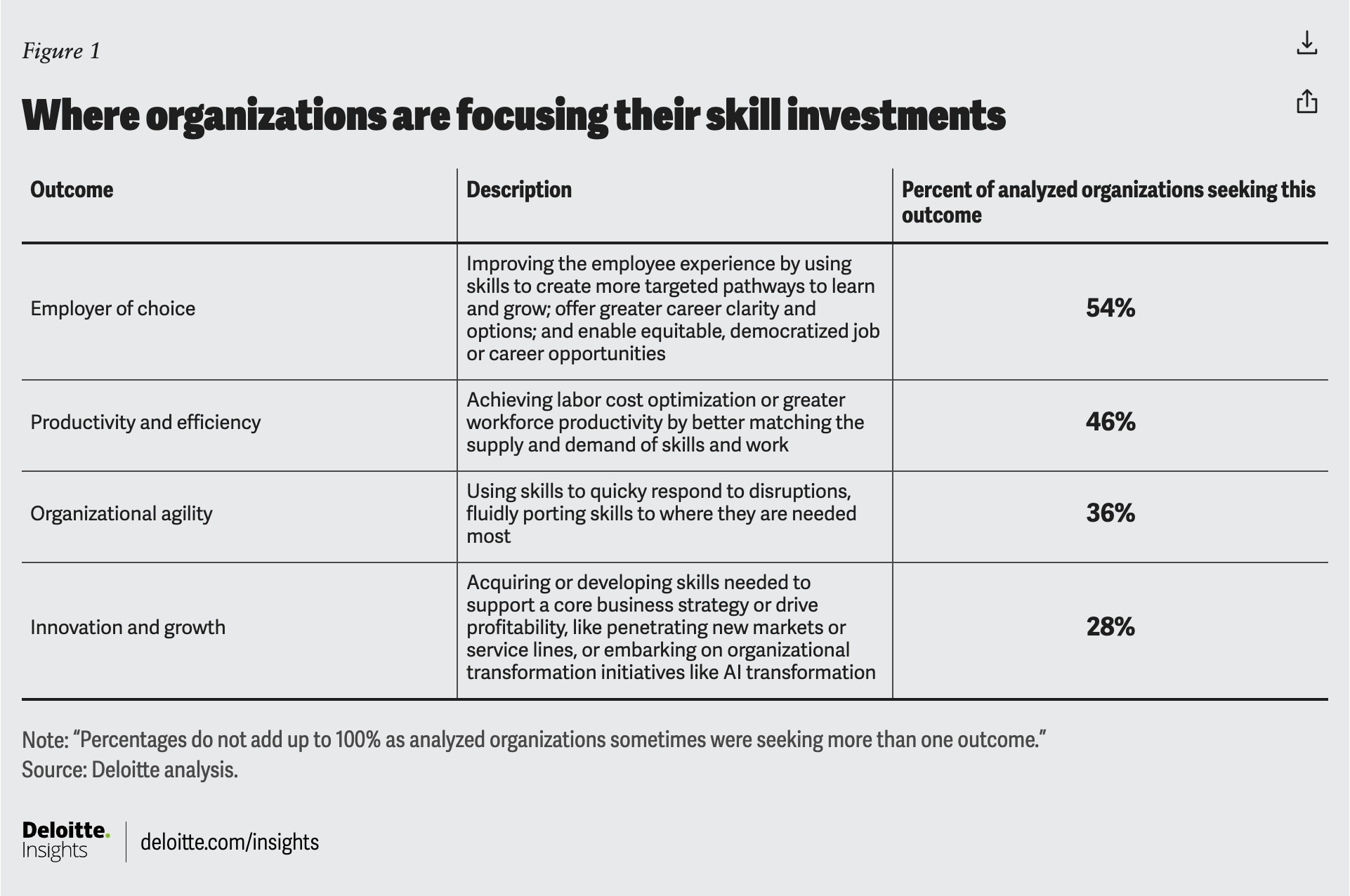
When the desired outcomes differ, the approach to skills strategies should as well. The organizations we studied that are creating value with a skills-based approach demonstrated a sharper focus on the practices that matter most for their specific goals.
Across more than 28 potential skills-related strategies in our research, however, we noticed that organizations consistently take the same core foundational actions, regardless of the outcomes they pursue.
A clear and simplified job architecture. Foundational to all four outcomes is a clean job architecture. Organizations need a solid understanding of work and roles to connect skills to how work actually gets done. This may entail simplifying architectures by creating fewer, broader roles, making skills easier to map to jobs. Rigid, highly detailed titles and siloed roles can obscure and hinder internal mobility.
A skills list or library. Organizations in our research that see results are far more likely to have a list or library of both the critical skills needed for their organizational success (the demand side of the equation) and their workers’ skills (the supply side of the equation).
Critical skill identification. Rather than tracking thousands of skills, leading organizations prioritize the skills most essential to their strategy. By concentrating on a defined set of high-priority skills, they reduce complexity, sharpen decision-making, and ensure investments in talent are aligned with what drives value.
Effective change management strategies. Our research shows that skills strategies don’t often fail on design or technology; they are more likely to fail due to adoption, trust, and behavior change. Building trust, driving engagement, and embedding skills into how decisions are made help sustain impact.
These “no-regrets” moves form the foundation across all four paths. From there, organizations can tailor their approach depending on the desired outcomes, adding targeted skills-based practices that align with their specific goals.
Strategies for the ‘employer-of-choice’ path
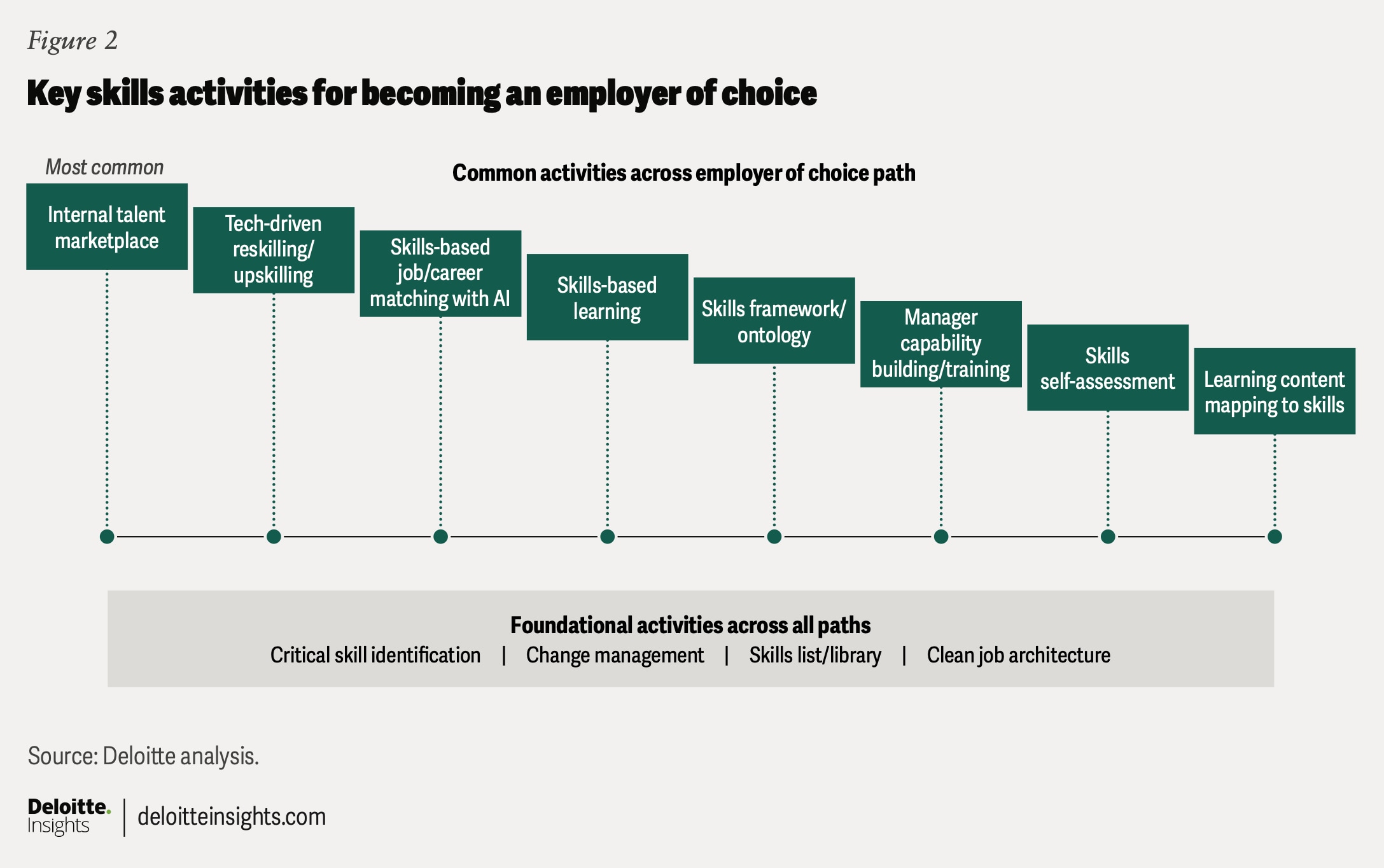
The most common outcome organizations choose to pursue with skills-based approaches is becoming an organization people actively choose to join and stay with because of a compelling workforce experience—what we call the “employer-of-choice” path. Leaders cite increased access to job opportunities for employees (82%), higher workforce equity (72%), and lower unemployment (61%) among the key benefits of this approach.4
Organizations pursuing this path focus on making opportunities more visible and accessible, primarily using technology like artificial intelligence to match workers’ skills to projects, roles, careers, learning, and reskilling or upskilling opportunities (figure 2). They are also more likely than those pursuing other outcomes to train managers to actively connect workers to these opportunities.
Delta Air Lines, for example, used a skills-based approach to enhance its employee value proposition by enabling internal mobility for its frontline population, according to Natalie Tincher, general manager of talent, skills, and performance management, who has led Delta's ambitious skills journey. Starting with a clean job architecture and a skills taxonomy, Delta aligned critical skills to all high-volume frontline roles and provided visibility into functions, roles, and skills through its new career development platform, Talent Hub. In combination with competitive pay increases, profit-sharing, listening programs, and recognition, Delta continues to see strong retention, internal mobility, and an overall positive workforce experience.5
State Street took a similarly focused but pragmatic approach. They first defined a narrow set of critical skills for each role within a skills library and enabled workers to self-report their skill proficiency levels to explore personalized learning and career pathways on a digital platform. Supported by manager-led development conversations, the organization increased employee engagement scores by 11%, leadership readiness scores by 15%, and made 1,200 internal promotions in the first six months of the program. Notably, these outcomes were achieved with a commonsense approach and simple architecture, which didn't require heavy skill intelligence or an expensive third-party talent marketplace.6
Organizations in our analysis that reported they are seeking outcomes related to being an employer of choice are twice as likely as those pursuing other paths to engage in skills-based hiring with external talent marketplaces and embed skills in job descriptions. They’re also more likely to experiment with skills passports: portable, worker-owned records of verified skills, experiences, and credentials that can improve transparency and access to opportunity across roles and employers. Walmart, for example, is working with other employers through the Skills-First Workforce Initiative, a collaboration led by the Burning Glass Institute, to create a cross-employer framework of skills that could underpin future portable skills passports.7
Unlike those pursuing other outcomes, those on the employer-of-choice path are three times less likely to rely on detailed skills definitions, detailed proficiency levels, or advanced technology that infers workers’ skills. Instead, they often prioritize trust, participation, and engagement. Self-reported skills, supported by manager input, are typically sufficient, especially when the goal is to use skills to enable growth and mobility rather than to make high-stakes decisions about pay or performance.
Strategies for the ‘productivity and efficiency’ path
The next most common outcome organizations often pursue with a skills-based approach is improving productivity, efficiency, and cost savings. This is achieved by better matching the supply and demand of skills to work, aligning skills with the highest-value work, and reducing costs associated with hiring, training, and turnover (figure 3).
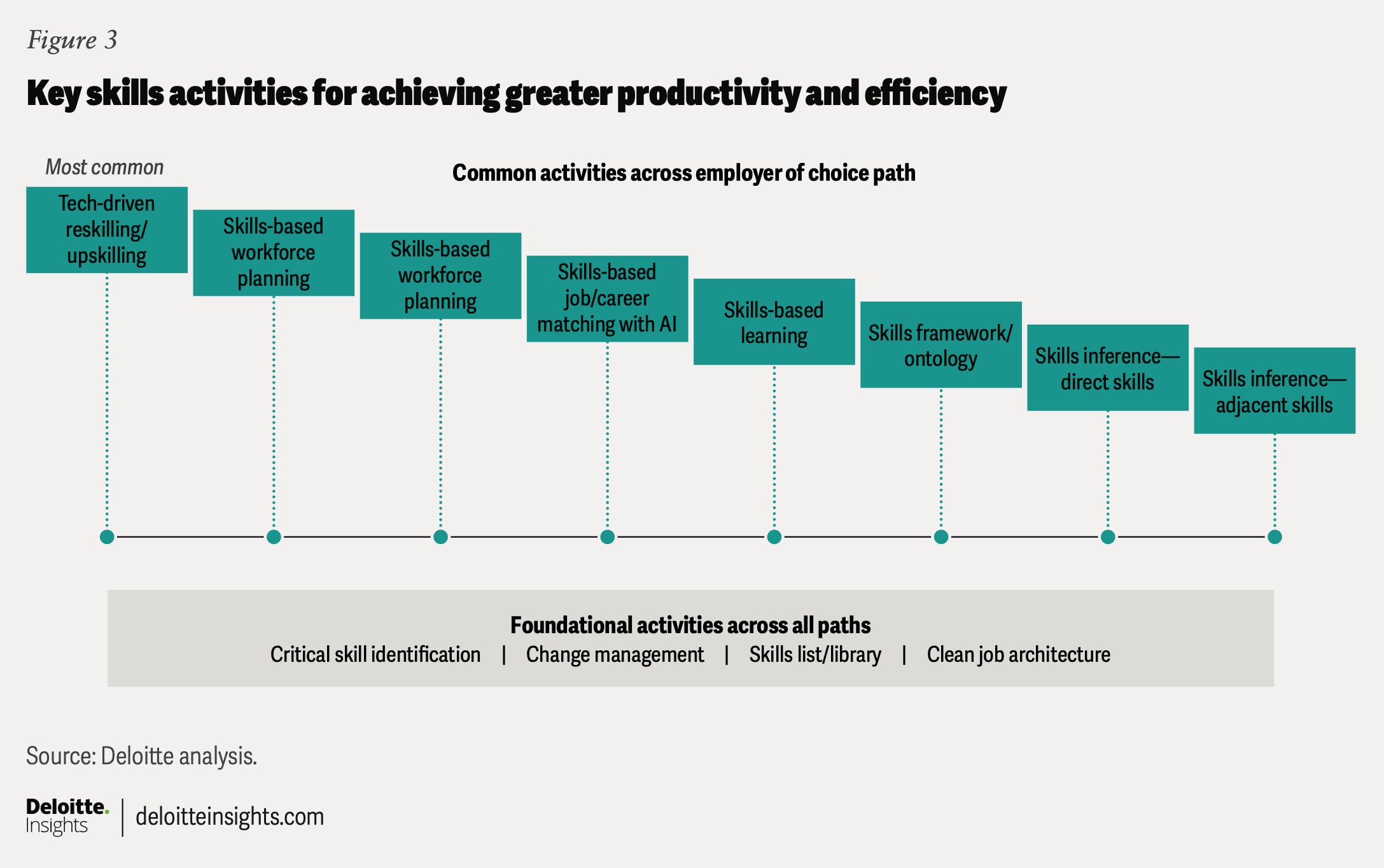
A key shift in this approach is moving from workforce planning based on headcount, which can lead to overstaffing in some areas and shortages in others, to planning based on skills, which enables better matching of capability and capacity with demand.
One large technology firm, for example, took an inventory of the skills needed and those existing in its current workforce and discovered that nearly 40% of existing employees possessed skills that weren’t being utilized in their current roles. The organization launched an internal talent marketplace where managers with open positions could search for skills rather than external candidates. The marketplace also introduced transparent career pathways to show workers exactly which skills they needed to develop for lateral moves or promotions. Within 18 months, the organization reduced critical time-to-fill from 127 days to 47 days, increased internal mobility by 45%, reduced turnover, and improved productivity from better role fit—reducing external hiring costs by US$14.3 million annually and achieving a 340% return on investment within two years.8
Organizations achieving value through this path are also more likely to redesign work itself. One emerging practice is to couple an understanding of skills (through skills ontologies) with an understanding of work (through task analysis or work ontologies). Health care provider Cleveland Clinic, for example, broke down work performed in critical roles into component tasks and assessed whether each task could be automated, performed remotely, reassigned, or rescheduled—in part based on an understanding of skills. For medical assistants, this analysis led to shifting most tasks to lower-credentialed or nonclinical staff with the necessary skills and automating or augmenting others. The result was freeing up the equivalent capacity of 430 full-time employees, generating more than US$2 million in cost avoidance, and creating more time for staff to spend on patient care.9
Tech-driven reskilling and upskilling are also a common way to achieve efficiency and productivity outcomes in this path. One oil and gas company, for example, reskilled and upskilled its oil rig technicians and inspectors after automating most of their physical work, transforming their roles from physical tasks to higher-value analytical work. Despite wage increases of 7% to 13% associated with higher skill requirements, the company improved profitability per rig by 45%.10
Skills-based learning plays a similar role, enabling targeted learning tied to specific skills gaps rather than generic role-based learning. This reduces wasted training spend, accelerates skill acquisition, and allows organizations to better utilize existing talent rather than relying on external hiring.
Finally, compared to the employer of choice and innovation and growth paths, organizations seeking efficiency and productivity are more likely to use technology to infer both direct and adjacent skills. Understanding adjacent skills can enable faster and more cost-effective upskilling, helping workers build on existing capabilities to become productive more quickly.
Strategies for the ‘organizational agility’ path
For many organizations, skills-based strategies are a pathway to agility. Sandra Loughlin, chief learning scientist at EPAM Systems, explains in a Digital HR Leaders podcast: “The why [of skills] is a business agility play. … As your strategy changes, as technology evolves, as your competitive landscape evolves, you need to continually understand who you have in the organization relative to the work that needs to get done. … A lot of companies still think about skills from the perspective of optimizing HR, as opposed to optimizing business.”11
How organizations apply skills to unlock agility can vary. Some envision a future where work is dynamically assembled around fractionalized skills, tasks, and projects rather than around jobs as the rigid, primary organizing units. Home appliances and consumer electronics company Haier, for example, operates with a fully fractionalized work model in which workers are deployed through an internal talent market into self-organizing, fluid microenterprises, each with 10 to 15 employees.12 Coupled with its “zero distance to the customer” philosophy (enabling frontline workers to access customer data and respond quickly to feedback), and shared cross-functional goals and performance metrics,13 Haier has produced measurable agility outcomes, including substantial market share gains,14 sustained revenue growth,15 and a decade-long market leadership position.16
But organizations do not need to adopt such radical models to achieve agility. In fact, our research reveals that the single most common skills activity surveyed organizations take to achieve organizational agility is mapping skills to jobs (figure 4).
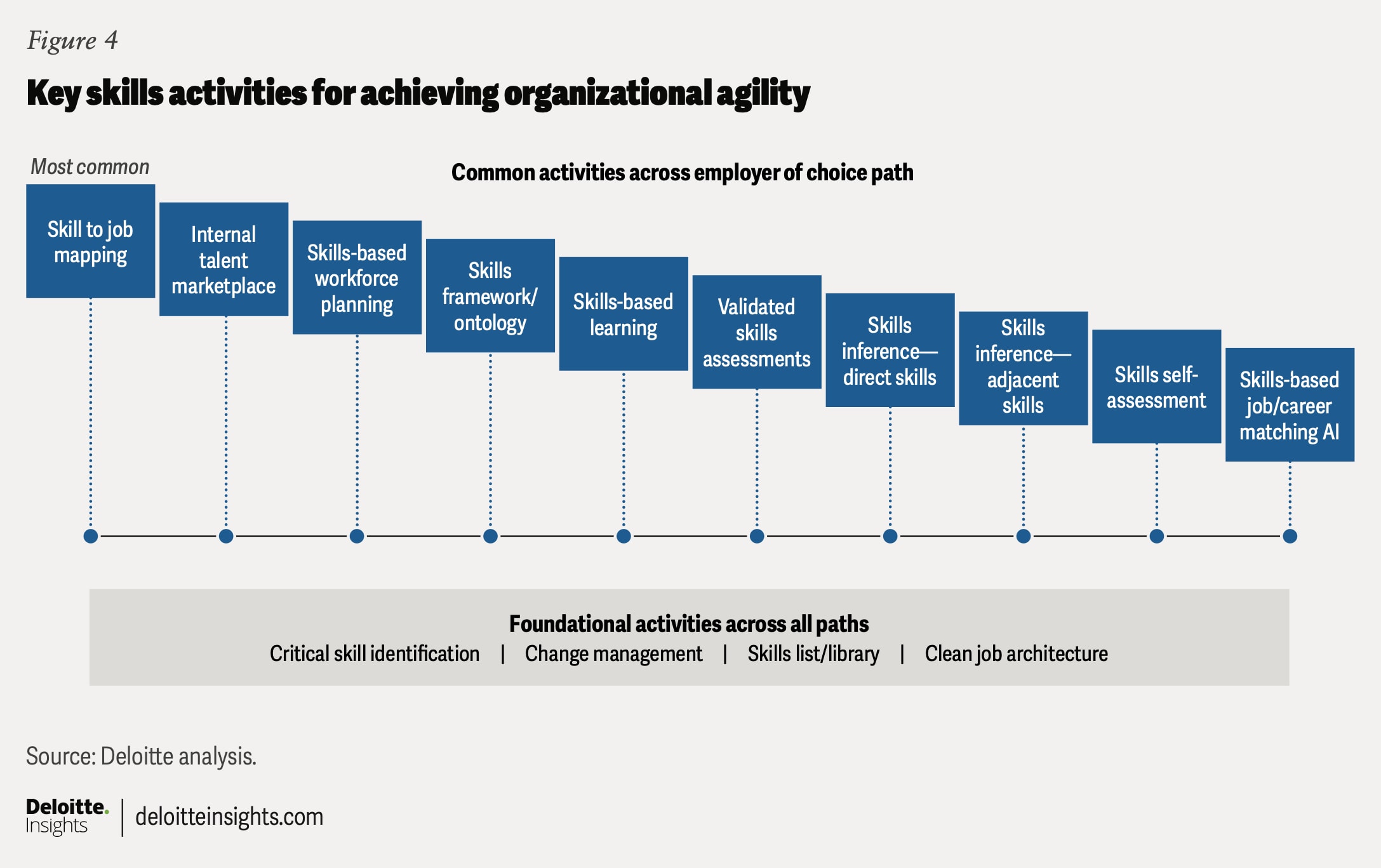
Many organizations retain traditional structures of work; mapping skills to jobs creates an important translation layer between static structures (jobs) and dynamic capabilities (skills), allowing skills to flow more easily to where they are needed. Without this connection, skills remain abstract and jobs remain rigid, limiting both adaptability and talent movement.
When combined with internal talent marketplaces, this approach can enable skills to flow across roles, jobs, projects, and tasks as demand shifts. Skills frameworks and ontologies are helpful in this too, as they allow roles to evolve as the work changes.
Organizations pursuing an agility path are more likely to invest in validated skills assessments. Because agility depends on quickly redeploying workers to work that may be new or unfamiliar, confidence in skills data becomes important. Moving workers without ensuring they have the right skills to perform the work can slow response times and increase risk. As a result, these organizations are more likely to use formal assessments or other validated methods, rather than relying solely on self-reported skills like those used in the employer-of-choice path.
Some organizations are extending this approach by combining skills data with a deeper understanding of the work itself—breaking roles into tasks and exploring how work can be redesigned, automated, or reassigned. Emerging platforms, such as Gloat’s Mosaic technology, combine skills, tasks, and directories of AI agents to dynamically match workers and work in real time, further accelerating adaptability.17
A public sector example illustrates the potential value of this kind of agility. During the pandemic, Belgium’s Federal Public Service Health realized a critical gap in its crisis readiness: it lacked visibility into who had the skills needed for rapidly evolving demands. Ad hoc approaches to identifying specialized skill sets proved unsustainable. To solve this, the organization partnered with Techwolf to use AI to infer skills, creating individual, employee-owned skills profiles and a public-sector-specific skills ontology shared by other government agencies. It now proactively maps skills to potential crisis roles and runs simulations to prepare for future disruptions, enabling identification and mobilization of workers with critical capabilities in minutes rather than days. This use case ultimately led to the adoption of skills as a foundational element for all operational and strategic HR processes within the organization.18
Strategies for the ‘innovation and growth’ path
To achieve innovation and growth—whether by expanding into new markets, launching new products, or building new capabilities—organizations need to build, acquire, or deploy the skills required to execute the new business strategy. Yet many struggle with this: according to a survey conducted by Orgvue, 60% of surveyed businesses say skills gaps are holding back transformation initiatives, and 72% of CEOs say talent gaps lead to critical business challenges.19
Our research shows that the most important skills practice for achieving value in this path is skills-based workforce planning, enabled by skill-to-job mapping (figure 5). Unlike other paths, organizations pursuing innovation and growth are less likely to rely on technology to infer workers’ skills. Since estimates are sufficient when generally determining if the organization has the skills to meet a new strategy, they tend to identify both skills supply and demand data in less tech-focused ways, such as relying on managers or workers to self-report workforce skills and leaders to identify needed future skills.
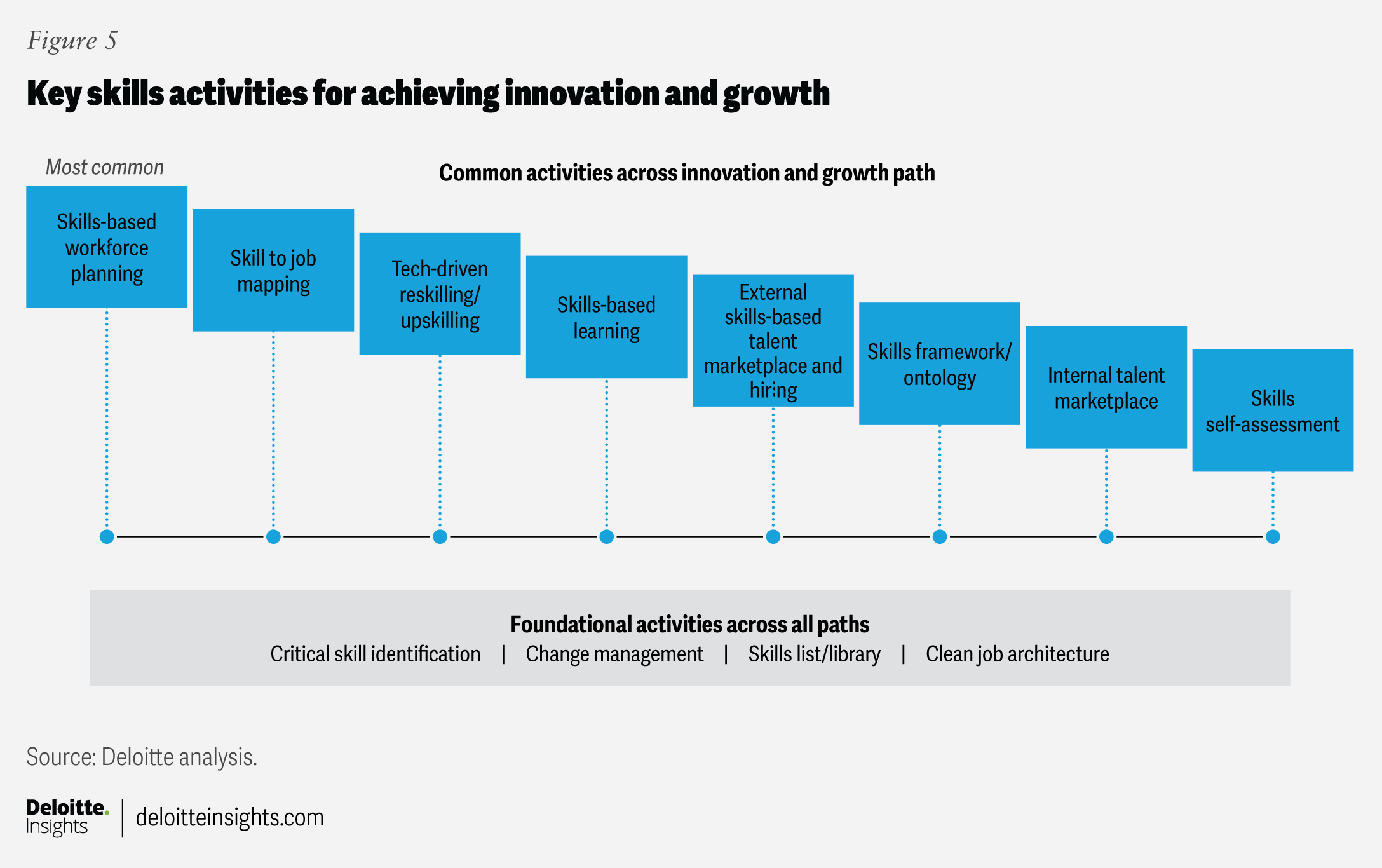
Bank of Canada, for example, shifted from reactive hiring to strategic capability planning to support its corporate strategy. The bank started by deliberately taking a low-tech, leader-led approach, using structured workshops with senior leaders to identify the skills and tasks needed to execute its strategy over the next several years before advancing to more tech-enabled solutions. Leaders prioritized gaps based on business impact and aligned them with a simplified job architecture, enabling clearer pathways for mobility and development.
The process focused on future skill needs for its strategic objectives, not exhaustive inventories of current skills. The Bank of Canada then determined how to address gaps through building, borrowing, buying, or automating bot capabilities. It redirected learning and development investments toward a small set of enterprise-critical skills, including data literacy, digital capabilities, and adaptability. Katherine Murray, managing director and chief human resources officer, explains, “This approach allowed us to invest where it mattered most, operate within headcount constraints, and build the capabilities needed to support our strategic priorities.” The Bank of Canada is now leveraging AI to look at coupling skills analysis with task analysis as the next iteration of its approach, helping it understand how AI will disrupt skills, tasks, and roles as it pursues its objectives to make work simpler, smarter, and faster.20
Organizations like the Bank of Canada that are pursuing AI transformation usually follow a similar sequence: start with the business outcome, identify where AI can impact these outcomes, redesign work, tasks, and roles accordingly, and then determine the skills needed to execute that work. Creating a clean, simple job architecture is also critical. Organizations such as British multinational communications company WPP, for example, have consolidated tens of thousands of job titles into clearer, outcome-focused roles, enabling targeted AI implementation and clearer reskilling pathways to develop the skills needed to perform the newly designed work.21
Aligning skills to outcomes is where value begins
Where should organizations start with a skills-based approach?
Not necessarily with skills.
Our research shows that the organizations creating value with skills usually begin with the outcomes they want to achieve and then apply skills-based approaches selectively to support those goals. Whether the priority is retention, productivity, agility, or growth, each path is best served by a unique set of actions.
Skills don’t create value on their own. They create value when they are applied with intention—aligned with strategy, embedded in how work gets done, and focused on what matters most to the organization.
Figure 6
Where organizations are focusing their skill investments
${optionalText}
Continue the conversation
Meet the industry leaders
Matt Stevens
Lucas Watanabe
Frances Symes
by
Sue Cantrell
Frances Symes
Lucas Watanabe
Virginia Dillon
Hannah Caplan
The authors would like to thank Matt Stevens, Michael Griffiths, and Farah Naim of Deloitte for their continued support and contributions to the Skills-Based Organization practice and research.
We would also like to thank Stephen Harrington, Emily Bar-Mashiah, Victor Reyes, Ina Gantcheva, Stephanie Baele, Rachel Stellmach, Nicole Scoble-Williams, and Gildas Poirel of Deloitte for their contributions to this article.
Editorial: Corrie Commisso, Hannah Bachman, and Pubali Dey
Design: Alexis Werbeck and Harry Wedel
Audience development: Maria Martin Cirujano
Cover image by: Alexis Werbeck; Getty Images
Knowledge Services: Rishitha Bichapogu and Vanapalli Viswa Teja