
The board’s role in bolstering tech resilience: 4 takeaways from our research on leadership
In a Deloitte Global survey of board and C-suite leaders, technology governance emerged as a top strategic priority—and a top challenge to strengthening organizational resilience
In June 2025, Deloitte Global surveyed 739 board and C-suite leaders from 59 countries and conducted in-depth interviews with 15 board directors and executives to learn what they’re doing to help bolster organizational resilience (see methodology).1
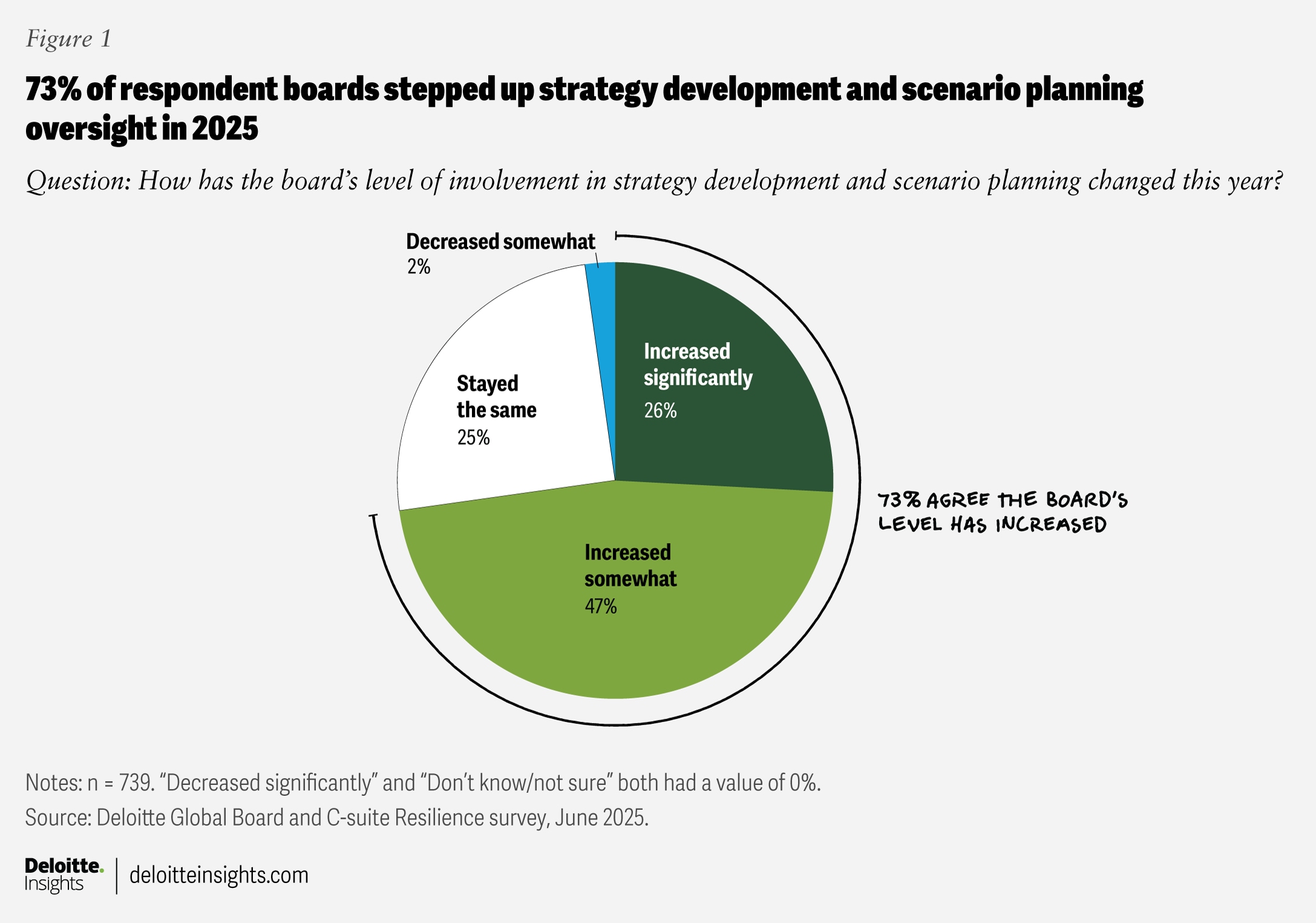
1. Ramping up oversight: 73% of respondent boards are collaborating more with the C-suite on strategy development and scenario planning
Overall, the survey found that many boards are collaborating more with C-suite leaders on strategy development and scenario planning—two areas respondents identified as most important for navigating the risk and opportunity landscape. Nearly three-quarters of respondents (73%) said their boards spent more time on both those priorities in 2025 (figure 1).
2. Pillars of resilience: Lower confidence levels in technology and human capital resources highlight opportunities for leaders to help strengthen both areas
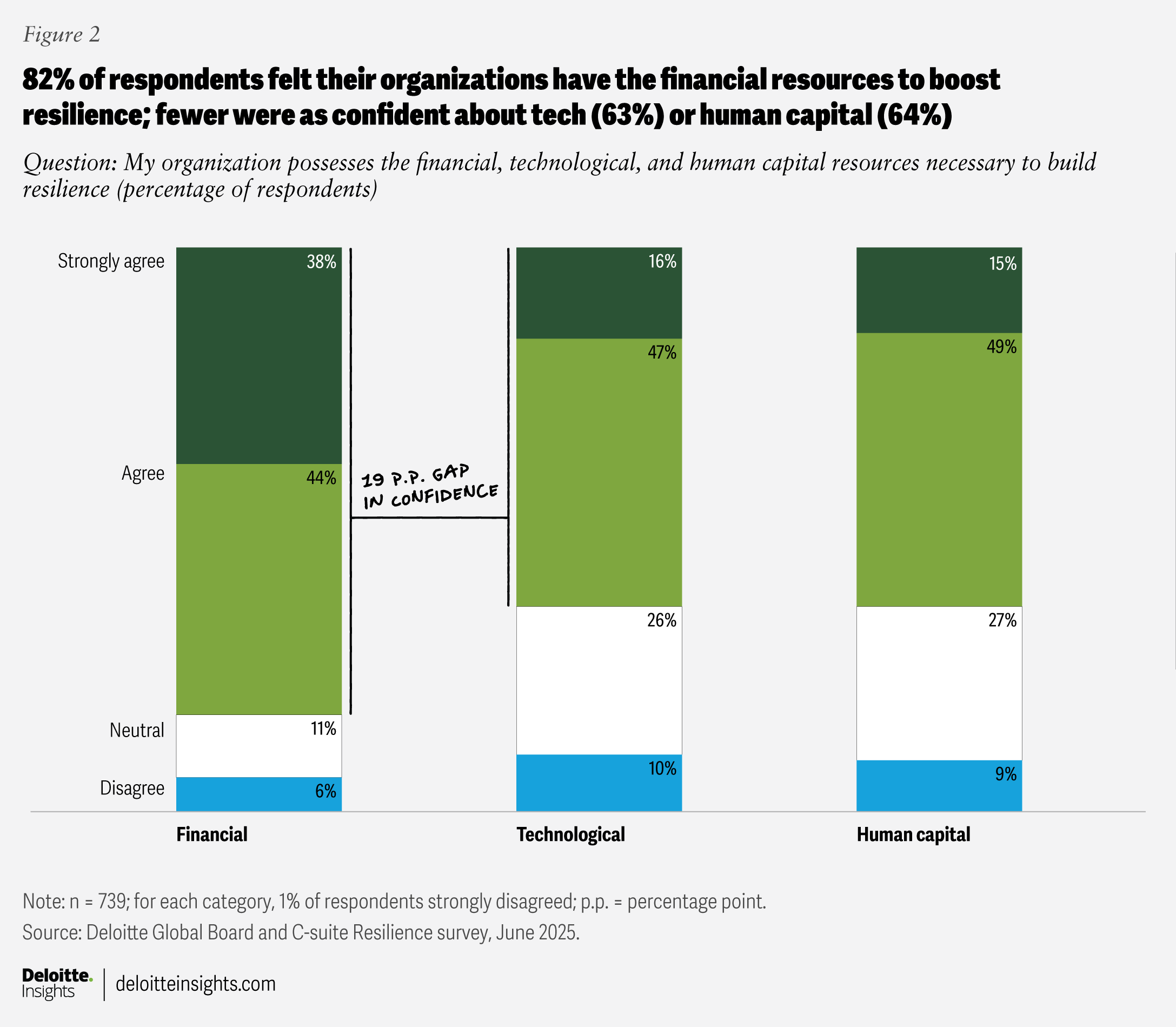
Most respondents believed their organizations possess enough financial, technology, and human capital resources to build resilience. But confidence varied across these pillars: While 82% of respondents felt they had the financial resources they needed, only 63% said the same for technology resources, and 64% for human capital resources—a nearly 20 percentage-point difference (figure 2).
3. Rapid tech advancement tops the list of respondents’ priorities for 2026 and beyond
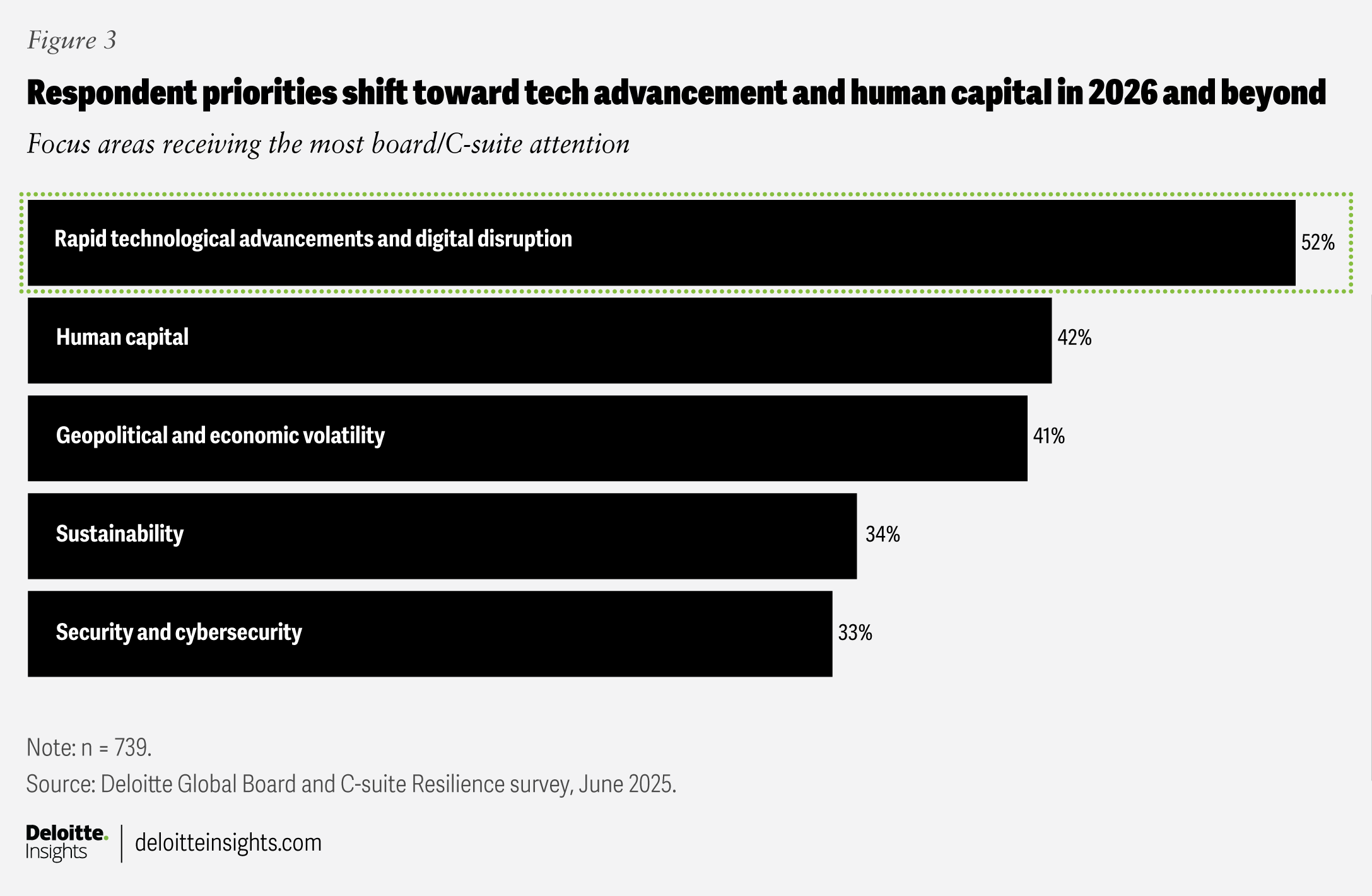
Relatedly, respondents’ ranking of their top priorities suggests that many may see the need to shore up their organizations’ tech resources. When asked to identify their top longer-term priorities (2026 and beyond), two of the top five most-cited focus areas were tech-related (figure 3). Respondents indicated a clear priority among these: rapid tech advancement and digital disruption. This area ranked 10 percentage points higher than human capital, the second highest-ranked priority for this period (52% versus 42%).
Among these technologies, recent surveys show that boardroom discussions around artificial intelligence and data governance are accelerating.2 But what about quantum computing, a potential game-changer on the horizon? Even though these capabilities will likely not be market-ready for several years, new Deloitte US research makes a case for boards and C-suite leaders to start planning for quantum now.3 The research shows quantum could mature sooner than some may anticipate, which may leave some organizations scrambling to catch up. Early planning, however, can help organizations mitigate this risk and advance their learning, build talent models, and identify future use cases. As is the case when any potentially transformative technology emerges, directors will need to learn enough about how quantum works—and its potential risks and opportunities—to ask the right questions and help C-suite leaders map out implementation strategies.
4. Are boards tech-savvy enough to bolster resilience? That may depend on whom you ask
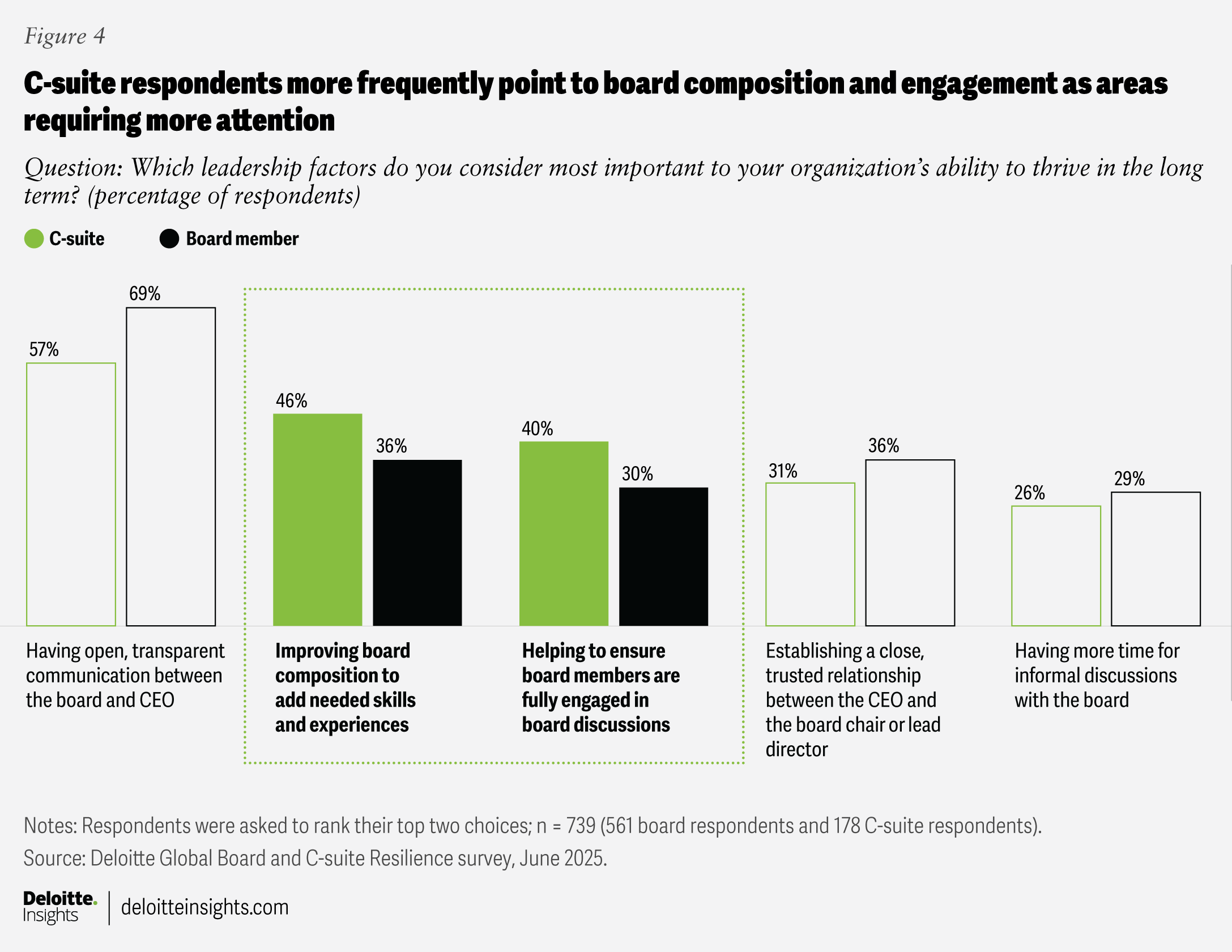
The survey uncovered a divergence in sentiment regarding board effectiveness and whether respondent boards are providing enough support to management. Nearly half of C-suite respondents (46%) ranked improving board composition to add needed skills and experiences as a top concern, making it their second most important leadership factor impacting resilience. But only 36% of board respondents felt the same, revealing a 10 percentage-point difference in sentiment (figure 4).
Overall, our research highlights why it’s important for boards to regularly review and evaluate directors’ skills and experiences to find potential gaps—and then recruit new members, provide internal training opportunities, or bring in outside experts to help fill those gaps. Since technology was cited as a top priority, boards should be tech-savvy enough to understand how these technologies work to provide strong governance.
In the interviews, several leaders noted that their boards are shifting away from recruiting tech experts to help improve the board’s tech acumen. Instead, they’ve refreshed the board with leaders who bring a breadth and depth of skills that add to the diverse set of experiences the board collectively possesses. They also stressed that, while board chairs should provide guidance and learning opportunities, every board member is responsible for ensuring their level of tech fluency meets current demands.
When directors have the knowledge to ask smart questions, help C-suite executives navigate risks and opportunities, and keep the focus on building long-term value, they can play a pivotal role in helping their organizations thrive.
Read the full report.
Continue the conversation
Meet the industry leaders
By
Prof. Dr. Arno Probst
Kevin Tracey
Karen Edelman
Editorial: Karen Edelman, Hannah Bachman, Annalyn Kurtz, and Anu Augustine
Design: Molly Piersol and Govindh Raj
Audience development: Maria Martin Cirujano
Cover image by: Molly Piersol