
Ready for a redraft: Why airline loyalty programs need a new playbook
Traveler expectations and market realities are reshaping the loyalty equation
Few industries have shaped consumer loyalty as much as airlines. Long before the quest for engagement, assessment of lifetime value, and cultivation of partner ecosystems became core consumer growth levers, frequent flyer programs helped pioneer a model for customer relationship building. Airline rewards became so psychologically attractive to consumers that airlines were among the first businesses to turn loyalty currency into a financial product, sold in bulk to banks to help anchor their credit card programs. In 2025, full-service US carriers attributed 11% to 13% of their revenue to loyalty programs.1
But pressures have been building on airline loyalty programs. Demographic shifts and business realities combine to challenge airlines’ ability to meet the expectations of highly loyal flyers while also cultivating the next generation. And airline distribution has gotten more optimized and dynamic, leaving fewer unsold seats and upgrades available to reward loyal flyers.
Pressures have been building on airline loyalty programs. The conditions that once made traditional loyalty models so effective have changed, challenging airlines' ability to meet the expectations of highly loyal flyers while cultivating the next generation.
Airlines may have helped invent the modern loyalty playbook, but now they need to rewrite it. To shore up their loyalty programs’ value proposition—as revenue drivers from credit card partners and as consumer levers to both tip the balance of choice and drive incremental spend—airlines need to consider rerouting their strategic approach to meet the moment.
Tuned in, but not bought in
Programs aren’t driving spending among their most loyal members
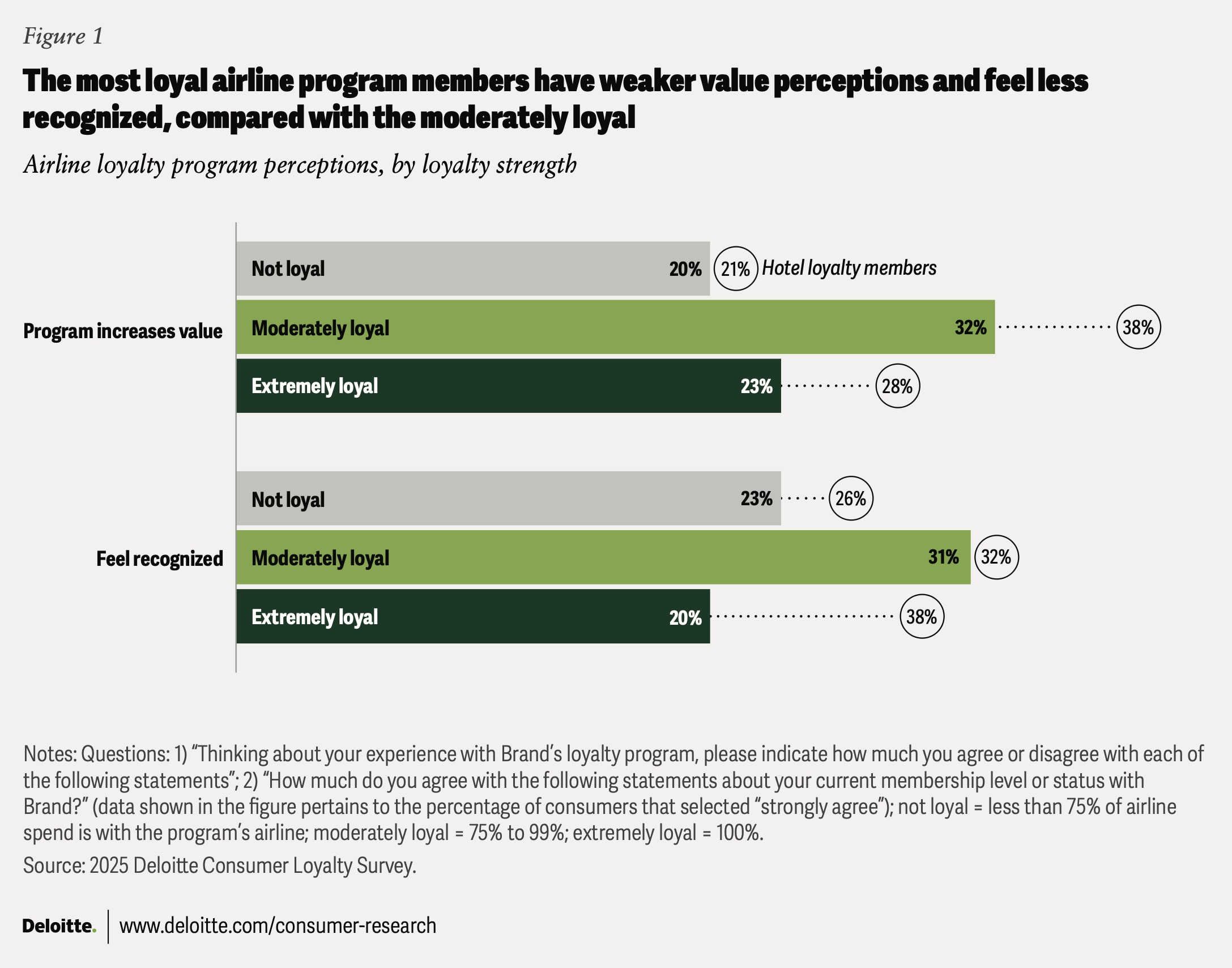
The most concerning metric for airlines is simple: According to the 2025 Deloitte Consumer Loyalty Survey, their most loyal program members—those who say that 100% of their annual airline spend goes to the associated carrier—are the least likely to report that programs add value (figure 1). When flyers move from a low level of loyalty into a moderate level (75% to 99% of airline spend with the associated carrier), that value perception jumps. But among the extremely loyal (all airline spend goes to the associated carrier), that figure falls to a level much closer to non-loyal flyers.
Additionally, only 1 in 5 of the most loyal flyers report feeling recognized by the carrier (figure 1). Even non-loyal program members (those who do not meet the threshold of 75% spend) feel more recognized. And across loyalty levels, airlines lag hotels in perceptions of value and recognition.
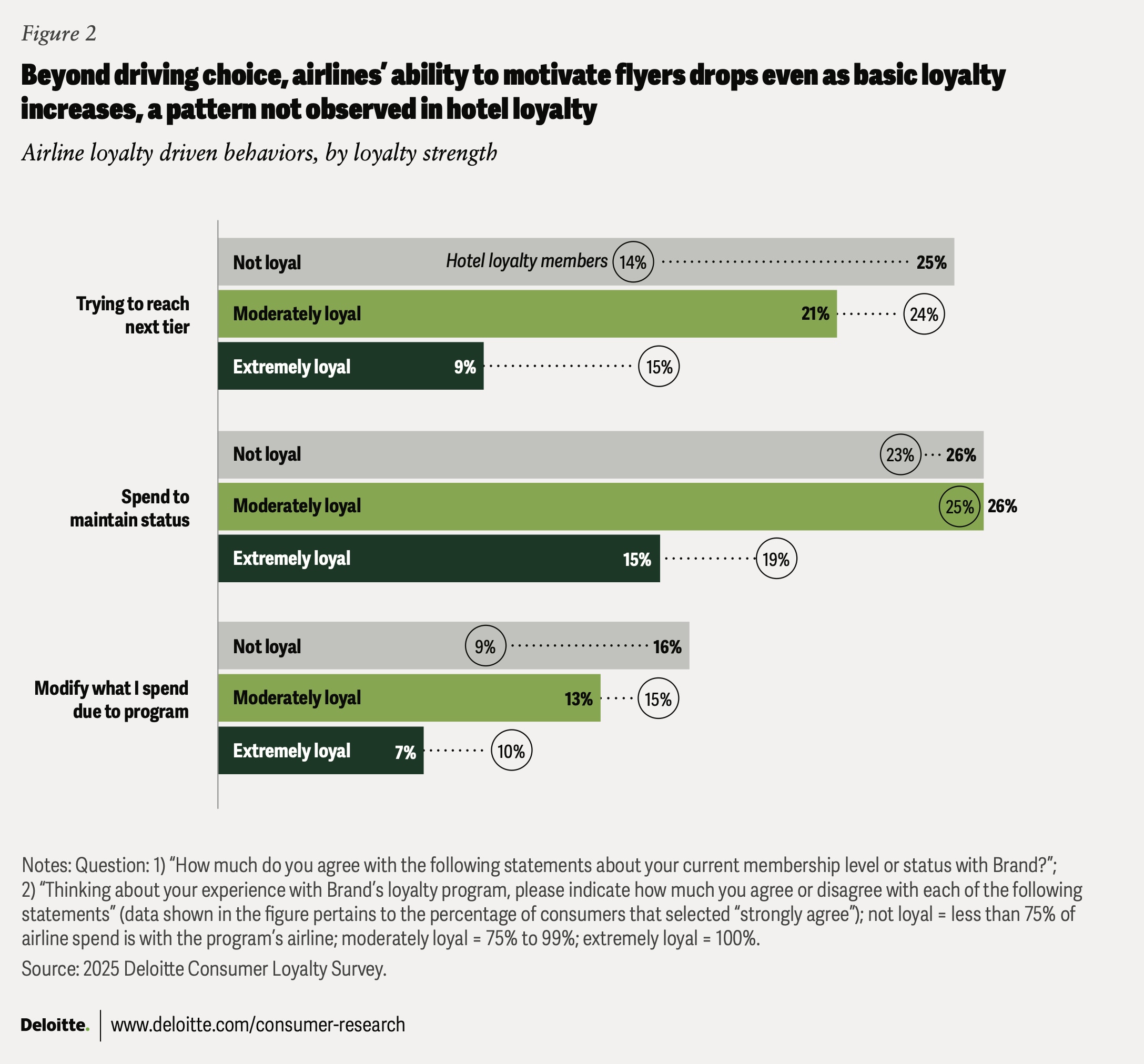
The pattern of emotional disaffection seems to translate into inaction. Extremely loyal flyers indicate that, beyond the repeated choice to fly with their chosen carrier, programs do little to drive incremental spend. The most loyal are half as likely as moderately loyal members to report pursuing the next tier (figure 2). They are also the least likely to say they spend to maintain their status (15%) or modify their spend due to the program (7%).
Is this because their loyalty has earned them top-tier status and they can’t climb any higher? On the contrary, 37% of extremely loyal flyers describe their program status as entry level, and another 41% describe it as mid-tier. More than three-quarters of extremely loyal travelers surveyed appear to have something to aspire to, and yet, they say that airline loyalty programs have a negligible impact on their spending behavior.
Airlines enjoy the total share of wallet for these flyers, but they may be missing the opportunity to expand the size of that wallet through incremental trips or ancillary purchases. Combined with the limited sense of recognition and value reported by these travelers, this suggests loyalty programs are not creating enough stickiness to deepen engagement or discourage switching.
The end of aging in?
Among younger generations, loyalty is not building with experience
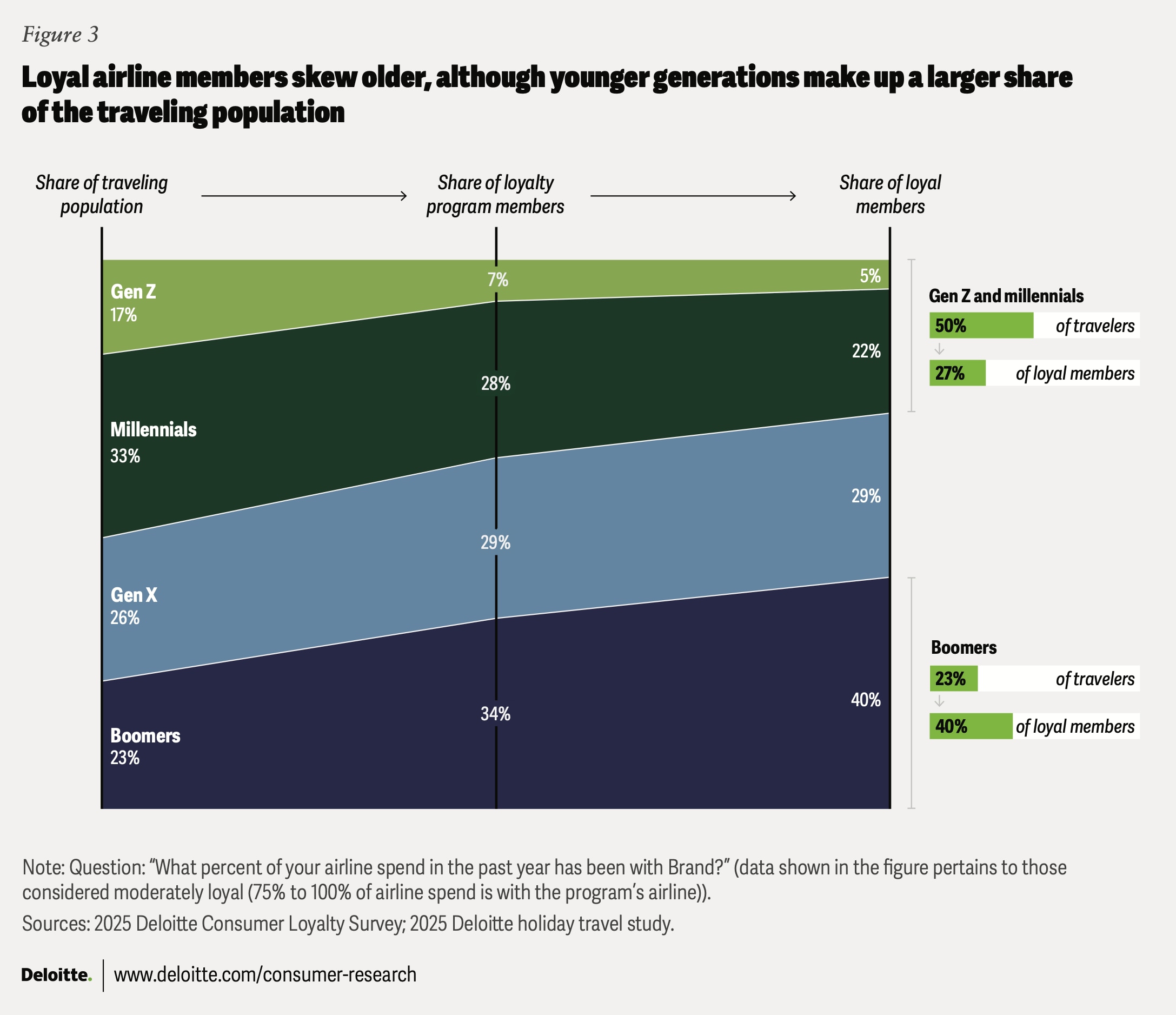
Pressure on airline loyalty programs is more likely to intensify than to recede over the next few years. Among respondents to Deloitte’s 2025 Consumer Loyalty Survey, Gen Z and millennials, who account for a growing share of travel spend,2 join programs at a lower rate and are less loyal than other generations. Despite representing about half of the traveling population, these two generations combine for just over a third of loyalty program members, and just 27% of loyal members (including moderately loyal plus extremely loyal members, figure 3). Among Gen Z air loyalty members, 65% say that less than half of their airline spend goes to their “preferred” carrier.
Strengthening with age is nothing new to airline loyalty. The tendency is explainable: Over years of leisure and business flights, travelers hone their preferences and accumulate points. They also tend to gain spending power and learn how loyalty pays off. They experience the satisfaction of redemption and the perks that can accompany a higher status.
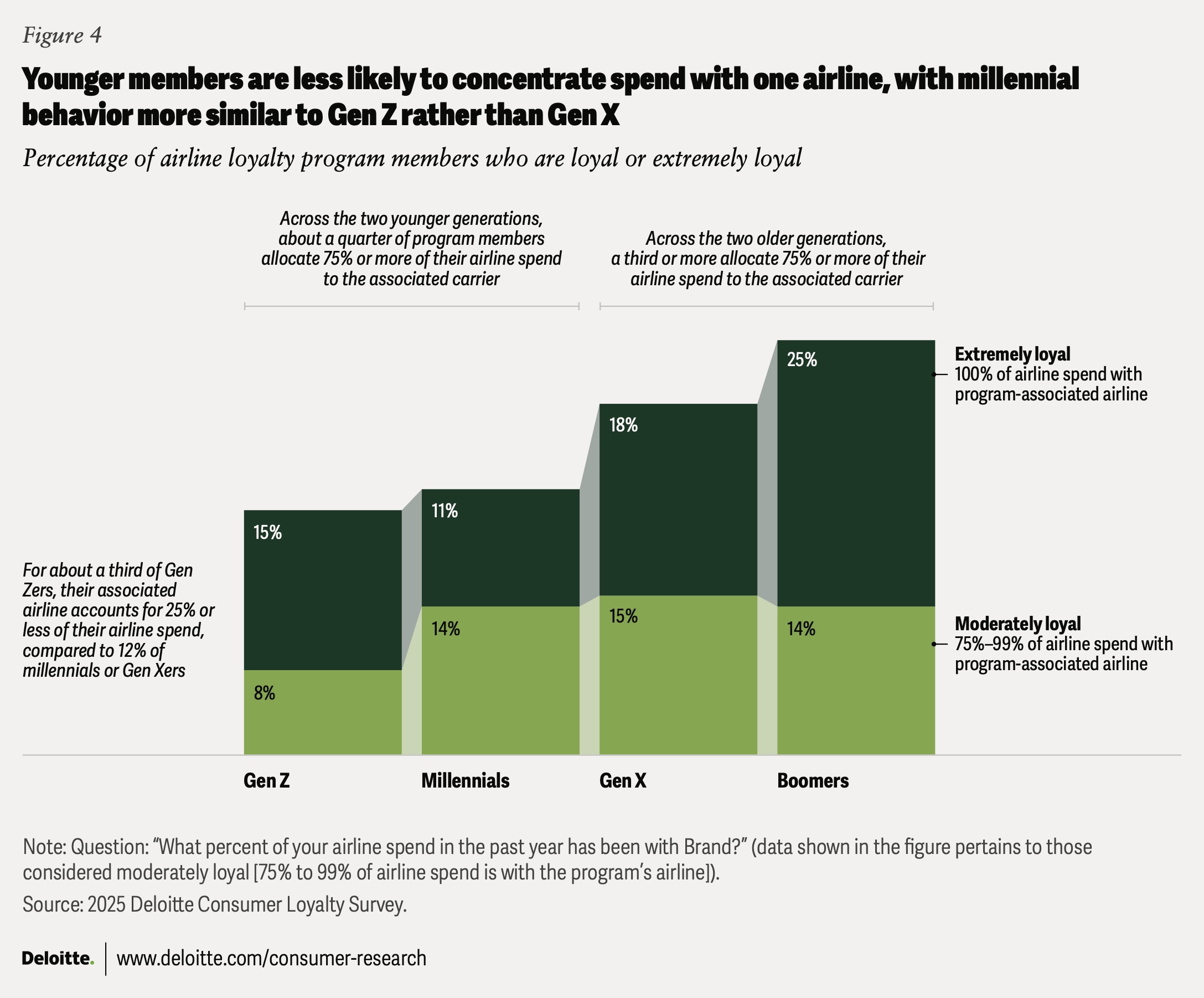
But the size and nature of the current generation gap suggest that airlines can no longer count on loyalty gaining traction with age. Millennials are currently in the age group of 30 to 45 years, old enough for meaningful experience with corporate travel. Yet they are much closer to Gen Z’s level of loyalty than to Gen X’s loyalty level (figure 4), with roughly 25% of loyal millennials allocating 75% or more of their spending to a single carrier compared to at least a third of older generations (figure 4). Millennials may not age into loyalty at the rate of previous generations, and Gen Z could follow a similar pattern.
Loyalty in a fully booked world
As airlines get better at selling every seat, there’s less in reserve for rewards
While some generational tendencies may influence loyalty patterns, broader industry changes may also be placing millennials and Gen Z on a path toward weaker airline loyalty. Post the COVID-19 pandemic, fewer business travelers fit the old “road warrior” profile,3 which used to help young professionals rack up points and expose them to meaningful redemption experiences.
Ironically, some of the same commercial advances that have buoyed airlines’ bottom lines may also be making loyalty harder to sustain. Network optimization and strong demand have pushed US carriers’ average load factors from 72% in 2000 to 82% in 2025.4 Airlines have also become increasingly effective at selling premium-cabin inventory.5 Together, these trends leave fewer seats available for award redemption and reduce opportunities for complimentary upgrades—two of the most visible signals of loyalty program value.
At the same time, airlines have steadily unbundled the travel experience. Over the past 15 years, many benefits that were once included as recognition for loyal customers have become products available for purchase.6 The growth of co-branded credit cards has further reshaped the value proposition. While these partnerships have become highly lucrative for airlines, they may also contribute to the perception that frequent flying alone is no longer sufficient to unlock meaningful program value.7 Further complicating matters, airlines have fewer natural customer touchpoints compared to hotels and other consumer categories.
Taken together, these trends point to a growing tension at the heart of airline loyalty. Many of the innovations that have strengthened airline economics have also made traditional loyalty benefits less exclusive and harder to attain through flying behavior. If younger travelers increasingly see loyalty as offering limited incremental value, airlines may need to rethink how they create emotional engagement and reward customer commitment in the future.
Rewriting the playbook
Moving from rewarding past behavior to actively shaping future behavior
Airlines helped invent the modern loyalty playbook, pioneering many of the strategies that industries around the world later adopted. But the conditions that made those models successful have changed. As travel behaviors evolve, customer expectations shift, and commercial economics continue to evolve, airlines have an opportunity to once again redefine loyalty and recreate their value proposition.
Next steps to consider:
- Invest in future elites. Identify and nurture younger travelers with the potential to become high-value customers over time. Targeted accelerators, limited-time status benefits, and early recognition can help demonstrate the value of engagement before travelers establish habits elsewhere.
- Rebuild the loyalty pipeline. Move beyond traditional frequency- and spend-based measures to identify and reward travelers demonstrating high commitment and long-term value. Recognize concentrated share of wallet, premium leisure travel, household spending, co-brand engagement, and other signals that suggest future spend potential beyond today’s road warriors.
- Make loyalty meaningful throughout the pyramid. Programs that become synonymous only with top-tier status and upgrades risk alienating the vast majority of members. Delivering personalized recognition, differentiated treatment, and tangible value across all tiers can help reinforce loyalty behaviors and build long-term habits. At the same time, continue to surprise and delight elite flyers with exclusive experiences and new sources of value.
- Shift benefits from aspirational rewards to immediate travel utility. While aspirational redemptions remain important, younger travelers increasingly value benefits that solve real travel problems today. Prioritize features such as disruption protection, baggage benefits, simplified change and cancellation policies, and other forms of friction reduction that can create value on every trip.
- Design loyalty for an increasingly fragmented commerce landscape. As travel discovery and booking shift toward AI agents, social platforms, and new intermediaries, loyalty should remain visible and valuable across channels. Winning programs will ensure that recognition, benefits, and engagement travel with the customer regardless of where or how a trip is planned and booked.
The next generation of loyalty programs won’t win by simply personalizing offers or optimizing rewards. They will win by recognizing value earlier, delivering relevance more consistently, and creating reasons for travelers to choose the airline long before they earn high status. In doing so, airlines can ensure loyalty remains a competitive advantage rather than a fading legacy asset.
By
Maggie Rauch
Michael O'Brien
Brendan Boerbaitz
Jenny Spiel
The authors would like to thank Upasana Naik, Lupine Skelly, and Anup Raju for their contributions to this report.
Editorial (including production and copyediting): Rithu Thomas, Preetha Devan, and Pubali Dey
Design: Harry Wedel
Cover image by: Adamya Manshiva and Tushar Barman
Knowledge services: Agni Wagh
Visit the Deloitte Consumer Industry Center
Access more insights for the automotive, consumer products, food, retail, wholesale and distribution, airlines and hospitality, and transportation sectors.