
From digital to physical: Transforming the public sector with robotics and physical AI
Deloitte analysis shows 24% of federal task hours are tied to physical work, signaling an area where AI-powered robots could unlock gains digital AI alone cannot deliver
Governments at every level are under pressure to do more with less, and while artificial intelligence is starting to deliver some desired productivity gains, its impact can only go so far. Many AI deployments have focused on information-processing tasks, but most government tasks—like fixing highways, delivering supplies, and caring for patients—involve physical actions. This means that the next wave of efficiency will involve bringing AI’s capabilities into the physical world—with robots leading the way.
And the timing matters. Robotics has moved well beyond single-purpose machines on factory floors. Paired with AI, robots can now operate in dynamic environments, adapt to variation, and support work that is hard to staff or inherently hazardous. The real opportunity for government potentially lies in identifying where these capabilities can drive the greatest efficiency gains, what it takes to deploy them successfully, and how to target use cases that deliver measurable impact.
The physical dimension of government work is too big to ignore
Government organizations do a wider range of work than almost any other organization in the world, and that breadth shows up in the physical tasks workers perform every day—from plowing snow and battling forest fires to caring for patients and cleaning parks.
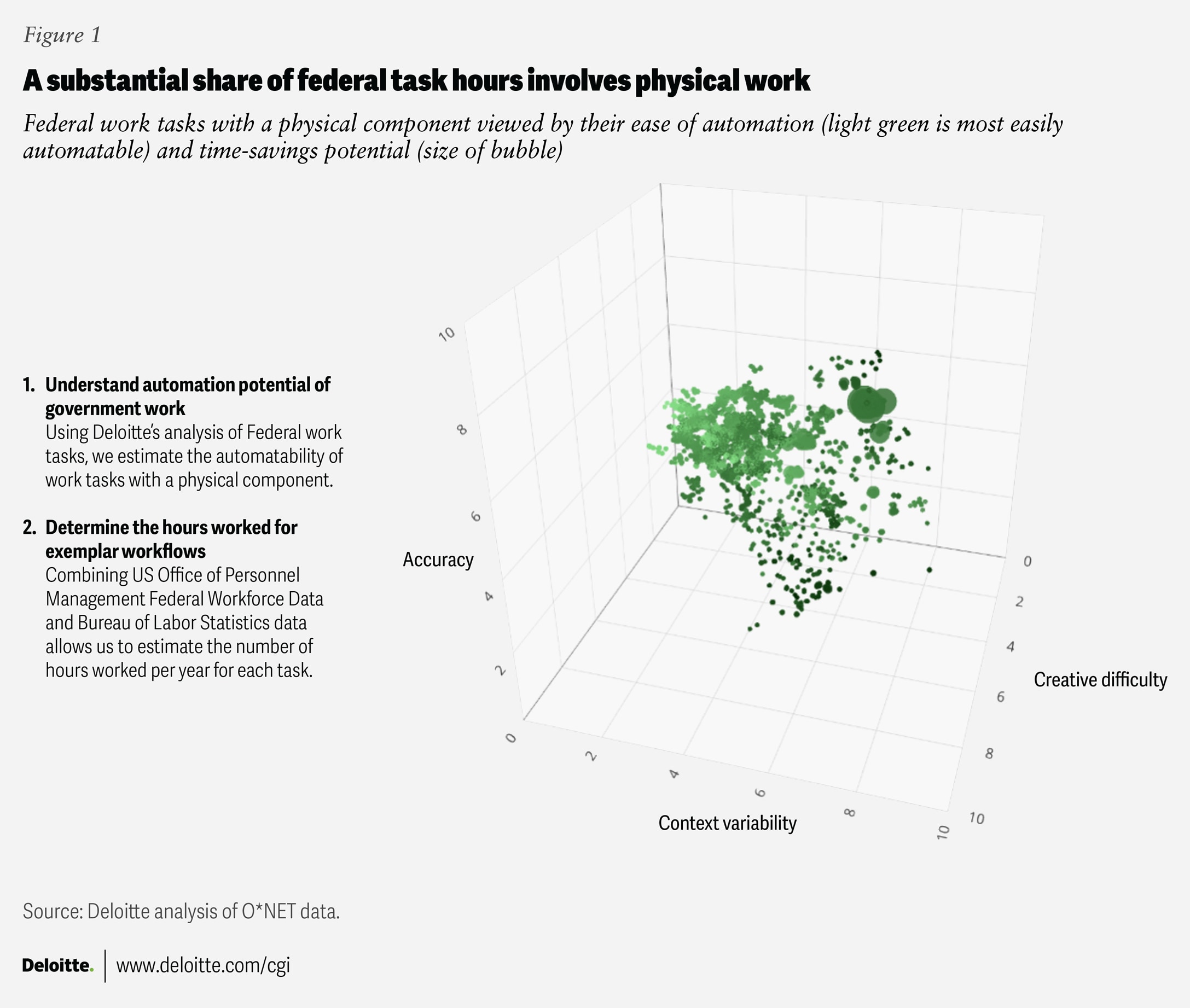
Physical work represents a massive opportunity to improve government performance. Many government organizations may find it difficult to achieve their efficiency goals if AI is applied only to information and not to physical work. In 2024, Deloitte examined more than 19,000 tasks collected by the US Department of Labor to understand which were amenable to different types of automation,1 such as robotic process automation and generative AI. Our analysis shows that about 24% of total task hours across the federal government involve physical work (figure 1).2 Chatbots and large language models alone can’t deliver meaningful efficiency gains to workflows that depend on physical tasks.
The type and nature of physical work can vary greatly from one agency to another, but the opportunities for time savings are significant (figure 2). For example, the Department of Veterans Affairs (VA) runs one of the largest hospital systems with 170 hospitals, 1,193 outpatient clinics, and 9.1 million enrollees.3 Naturally, much of this work is physical. Workers spend more than 4 million hours annually administering basic health care and another 2 million hours preparing medical equipment or work areas for use.4
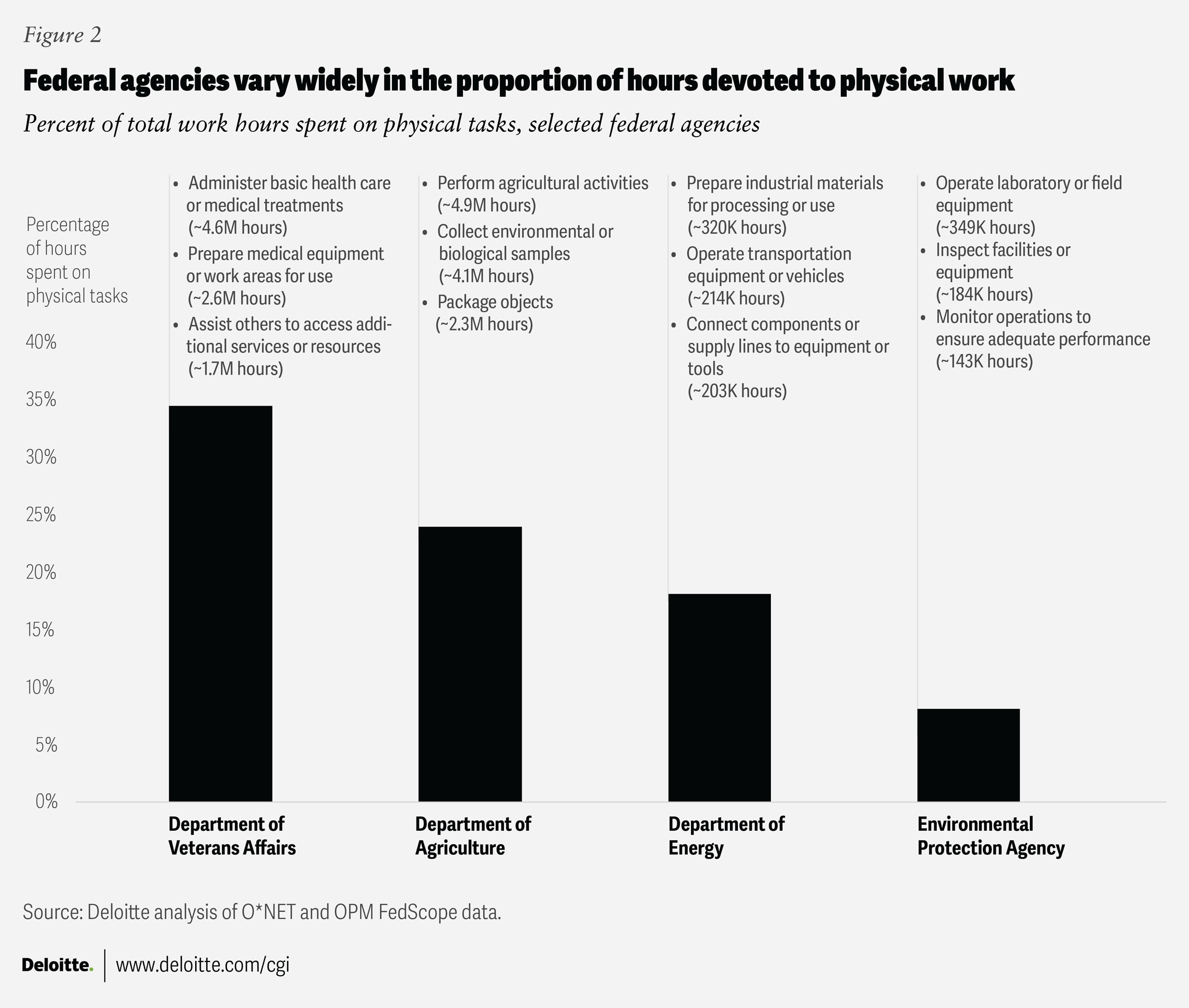
Many of these tasks may be suited to physical robots. The VA is beginning to explore a few uses for robots, including robotic assistance in orthopedic surgeries,5 robotic beds to improve patient mobility, and autonomous carts for transporting medical supplies.6 These use cases can not only improve patient care, but also free up workers to spend more time on human-centered activities like seeing patients.
However, not all physical tasks are equally automatable. Many of the tasks that take up the most time are also the hardest to automate. According to our analysis, only about 5% of physical tasks are easily automatable, compared with roughly 84% that have moderate automation potential and roughly 12% that have low automation potential.7
Why now? The breakthrough making physical AI practical
The nature of physical government work largely remains the same as it has been for years. So why are we suddenly talking about robots? The short answer is that technology is finally improving to a level where robotics may finally be financially viable.
For some, the term “robotics” may conjure visions of R2-D2, Wall-E, or Rosey (the Jetsons’ maid). But recent advancements in edge computing, AI, and precision engineering are making robotics and physical AI increasingly common in everyday life (see “Tech trends 2026 AI goes physical”).
In this document, robotics refers to “all physically embodied, adaptive machines that interact with their environment and possess a degree of autonomy.” This definition reflects three essential elements:
1. Physical embodiment: Robots operate in the real, physical world, not just digital environments. They move, manipulate, sense, and act directly on the environment.
2. Adaptation: Robots can adjust their behavior to navigate complex, dynamic spaces.
3. Autonomy: Robots perform tasks with varying levels of independence, from low autonomy (tele-operated) to high autonomy (self-directed with human oversight).
New technology is advancing each of these elements. Just as generative AI has transformed many of the cognitive tasks performed in government, physical tasks are poised for a similar transformation. “The next wave of AI is physical AI,” said Jensen Huang, founder and CEO of Nvidia, at the 2024 COMPUTEX technology conference in Taipei.8
The global robotics industry is experiencing substantial growth, with both robots shipped and revenue expected to double between 2024 and 2030, and by 2030, as many as 1 million robots shipped and over $21 billion in revenues.9 A few growth catalysts may create a turning point for increased adoption of robots:
1) Better technology: Exponential advancements in computing power and the emergence of specialized foundational AI models—called vision-language-action models—are accelerating the development of AI robots and embodied AI systems.10 Multimodal vision-language-action models integrate computer vision, natural language processing, and motor control. Like the human brain, these models help robots interpret their surroundings and select appropriate actions.11
2) Cheaper technology: As technology advances, costs have been coming down. The Bank of America Institute projects that the material costs of a humanoid robot will fall from around US$35,000 in 2025 to between US$13,000 and US$17,000 per unit over the next decade, and Goldman Sachs reports that humanoid manufacturing costs dropped by 40% from 2022 to 2023.12
3) Significant need: Persistent labor shortages due to an aging population may push companies to increase adoption to help offset workforce gaps.13
Technological advances allow today’s robots to perform a far wider range of tasks across diverse form factors: humanoids, quadrupeds, aerial and aquatic drones, autonomous ground vehicles, autonomous mobile robots, robotic arms, and task-specific service robots. These systems exhibit a growing degree of flexibility, autonomy, and real-world interaction capability, enabling them to operate in unpredictable, unstructured, or hazardous environments (figure 3).
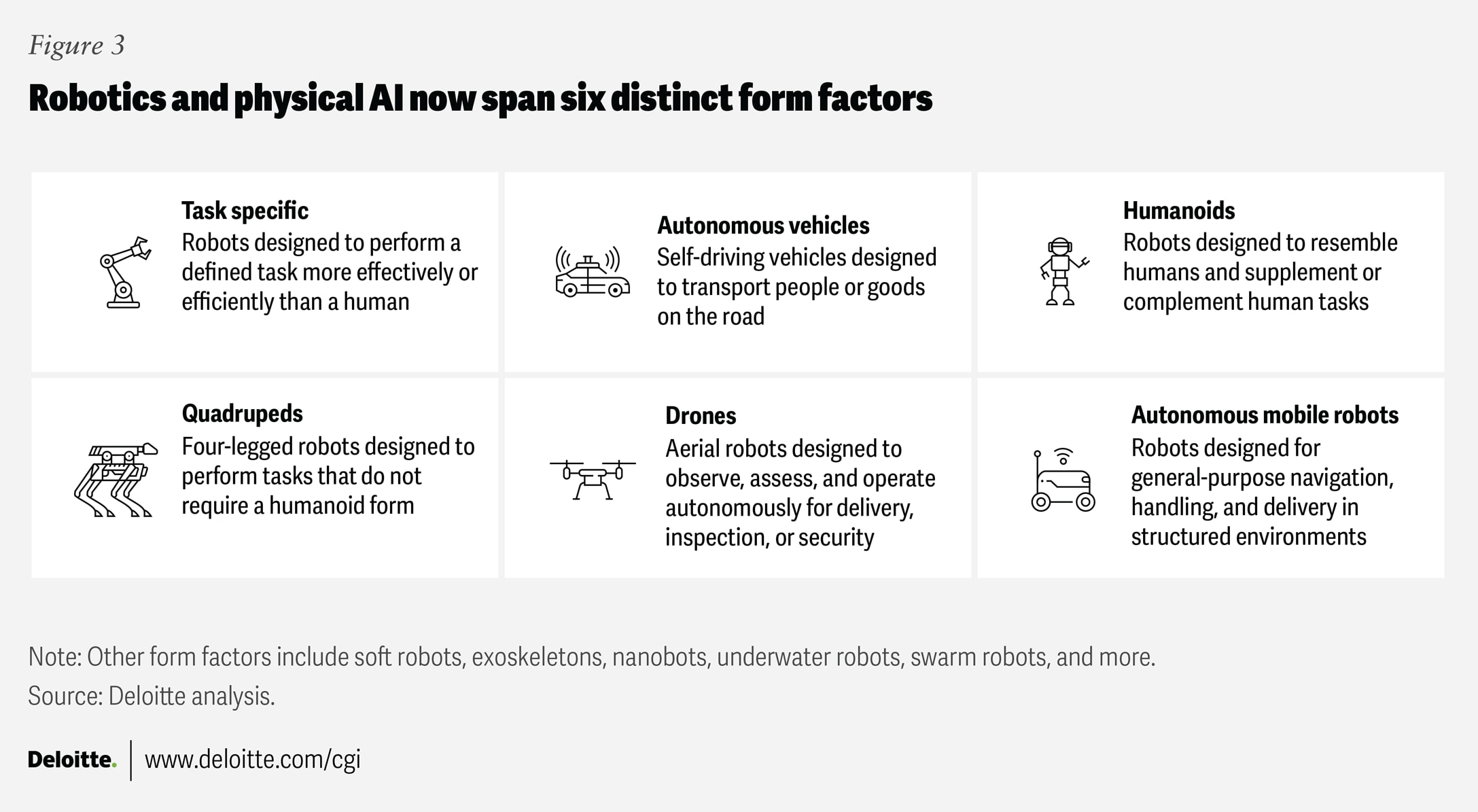
The growing maturity of robotics and physical AI technologies is pushing governments to take action. The current US federal administration is reportedly considering issuing an executive order on robotics in 2026, signaling growing national-level attention to the strategic importance of the technology.14 South Korea’s National AI Action Plan explicitly prioritizes physical AI,15 and the Singapore government is partnering with industry and academia to foster an innovation ecosystem and support the growth of AI and robotics companies.16 Taken together, these signals suggest robotics is shifting from a niche innovation to a strategic policy priority.
What are the biggest opportunities for robotics in government?
More capable and less expensive robots mean that there are many opportunities to support government work. But specifically, where should they be used? Are robots right for your agency? That depends on how your work aligns with the capabilities of today’s robots (figure 4).
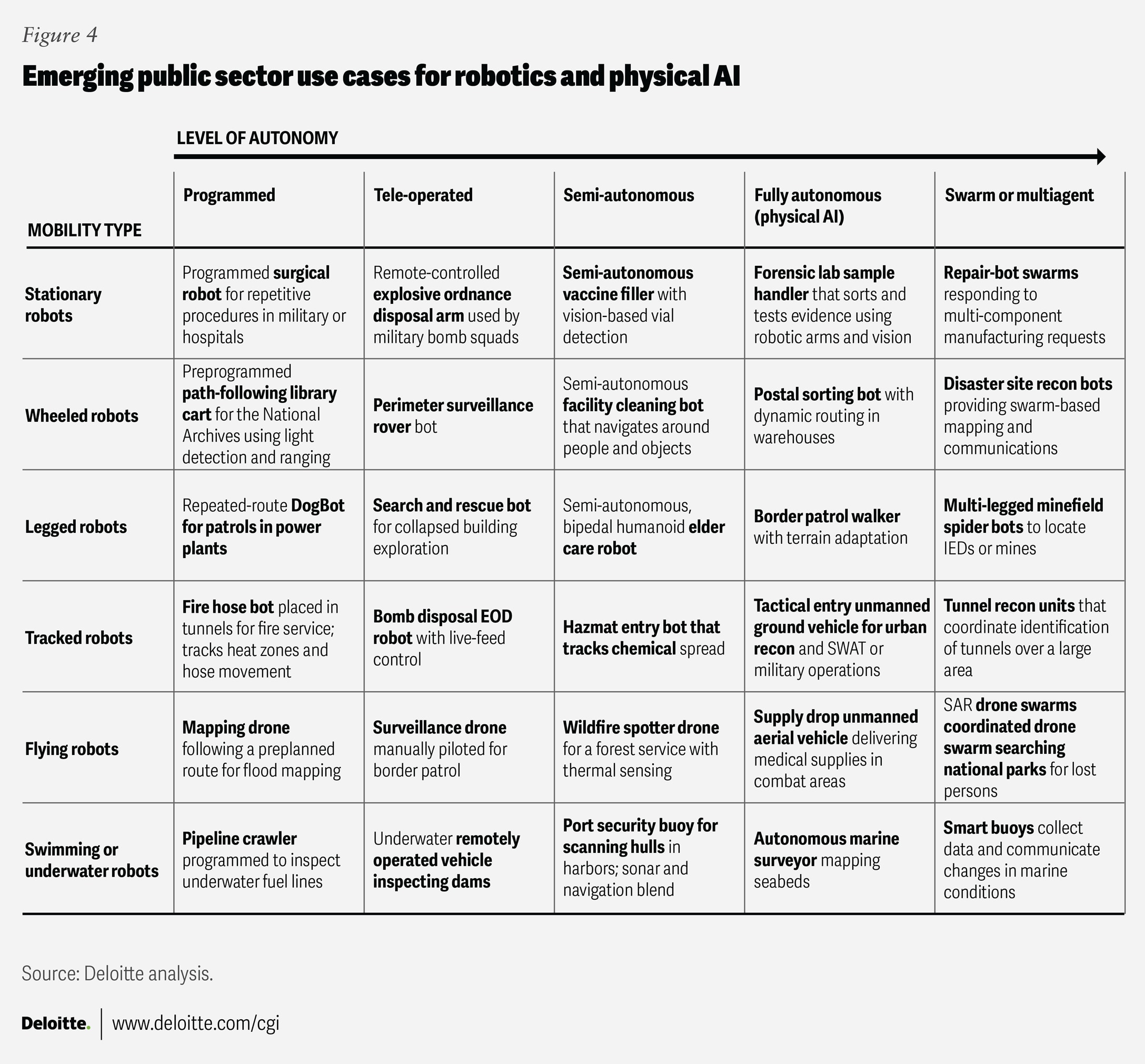
While each of these use cases can automate individual tasks, they can also be combined to automate entire workflows. For example, imagine a future in which the US Army’s organic industrial base is supercharged: 3D printers produce critical parts, autonomous mobile robots move them into storage, robotic arms drive exponential efficiency gains on munitions lines, and repair bots automatically fix damaged equipment using real-time data from sensors and digital twins of facilities.
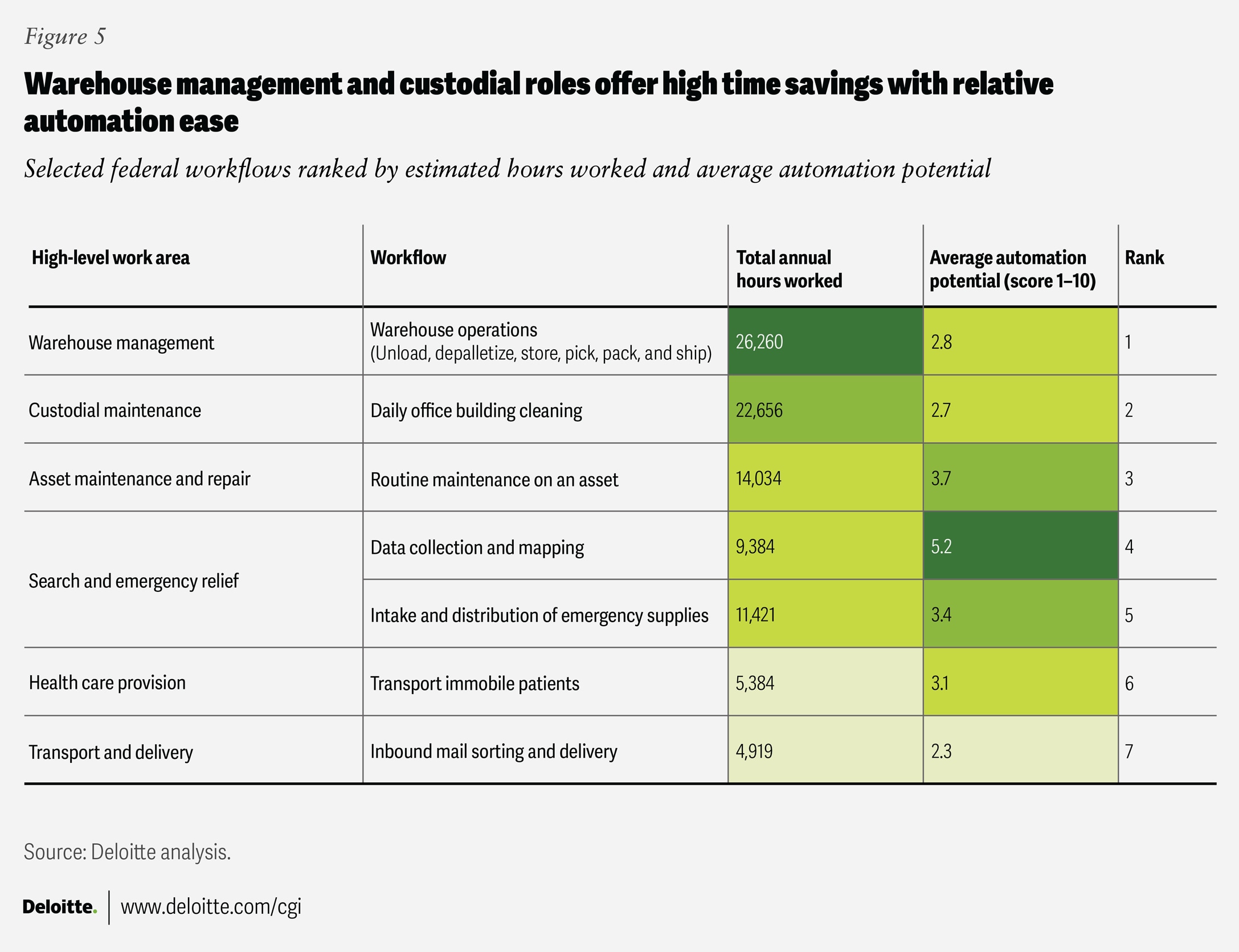
However, just because a task can be automated doesn’t mean it should be. Some physical tasks may be too costly or difficult to automate, such as highly variable manufacturing processes, while others may be undesirable to automate, such as doctor-patient interactions. Government leaders will have to evaluate each opportunity. The strongest candidates are those that balance meaningful time savings with relative ease of automation. Our analysis of government tasks shows six areas that are likely to represent the most practical starting points (figure 5).
Beginning with non-public-facing use cases may have added benefits. It would allow governments to build operational experience and pave the way for broader citizen-facing adoption as people see the technology working in practice. A nationwide survey in Taiwan on attitudes toward robotics in government in 2023 found lower acceptance of robotic physicians and police officers due to the perceived power distance and higher consequences of error in these roles.17 People may be less likely to trust robots with highly critical tasks such as medical care and law enforcement. Before expanding robotics and physical AI into public-facing roles, government organizations should proactively evaluate public attitudes and address trust concerns.
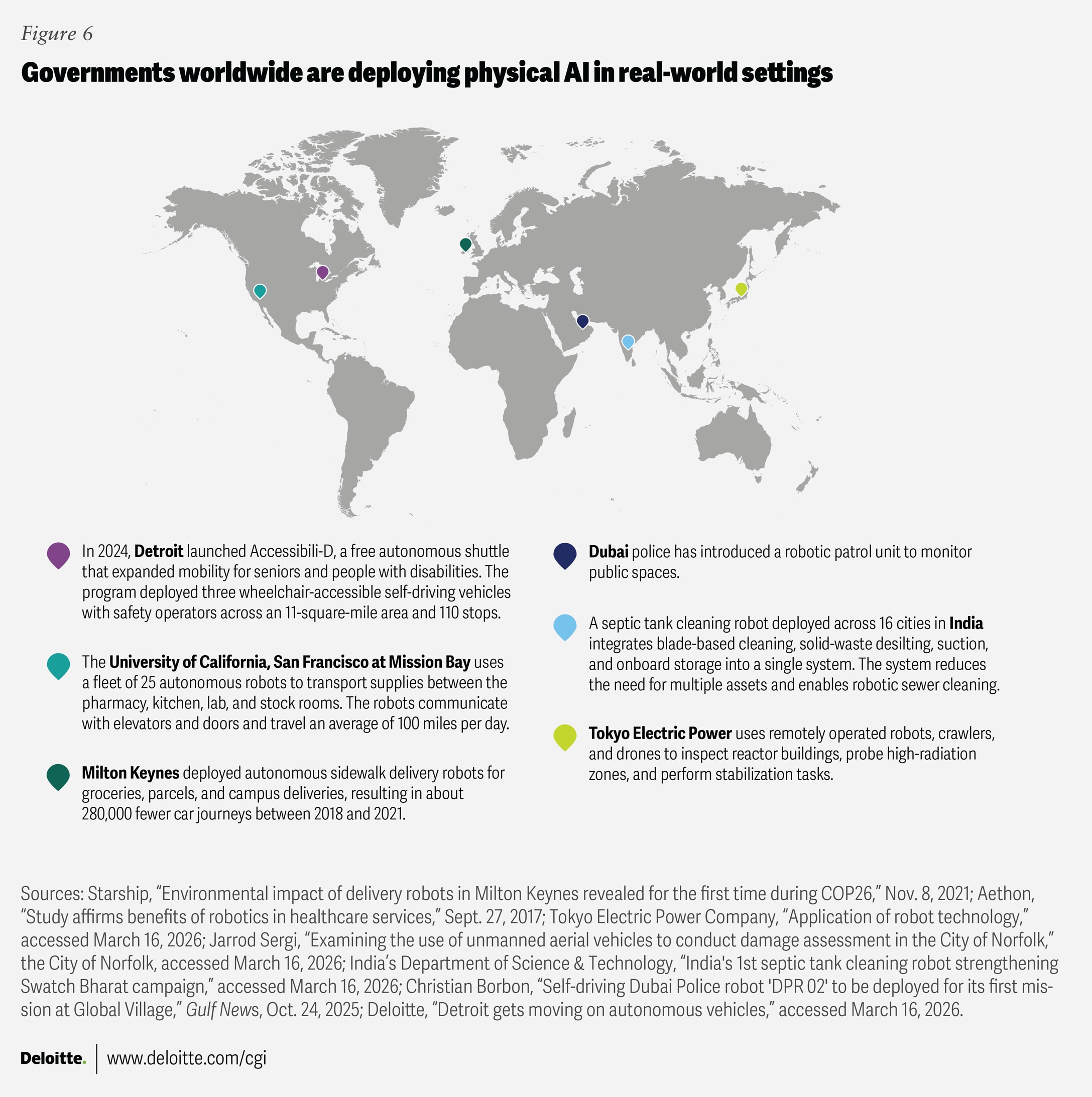
For public-sector institutions, physical AI provides a rich menu of possibilities, and some forward-leaning organizations are already experimenting with how robotics and physical AI can drive greater efficiency, improved security, and enhanced mission outcomes (figure 6).
What could a robot-assisted future look like?
The sun hasn’t yet risen over the city’s municipal operations center, but activity is already underway. Inside a 200,000-square-foot government warehouse—home to emergency supplies, public works equipment, and medical reserves—autonomous mobile robots glide across the floor in coordinated motion. Some transport pallets of bottled water and sanitation kits to a staging area for an incoming storm. Others scan inventory, updating the digital supply chain dashboard in real time. A drone lifts off to survey the upper shelves for misplaced items.
Meanwhile, across town, a four-legged inspection robot climbs down into a maintenance tunnel beneath a busy transit corridor. Equipped with sensors and AI-driven navigation, it examines structural supports, flags a section showing early signs of stress. A human engineer receives the alert and schedules preventive maintenance, avoiding what could have been a costly disruption.
At a city hospital, a small fleet of assistive robots delivers medication from the pharmacy to patient floors. One disinfects high-touch surfaces in waiting rooms. A telepresence robot allows a rural specialist to consult with a patient without traveling hours into the city.
Later that afternoon, a wildfire erupts in the nearby hills. As firefighters mobilize, autonomous aerial drones rapidly map the fire’s spread, feeding live data to emergency command. A ground robot enters a hazardous zone to search for stranded hikers, while an autonomous delivery system delivers supplies to a temporary shelter.
The stories above are not science fiction. Rather, they offer a glimpse into a future shaped by robotics and physical AI—one that is already being realized across industries. For public-sector organizations that maintain critical infrastructure, transport goods, respond to emergencies, and keep citizens safe, robotics can augment human labor, reduce risk, accelerate throughput, and enable entirely new service models, potentially transforming operations in fundamental ways.
A roadmap for public sector robotics adoption
So how can your organization get started? A systematic approach is important for public sector leaders preparing to deploy robots and physical AI. A rough checklist can help organizations develop the right capabilities and ensure the technology delivers tangible value (figure 7).
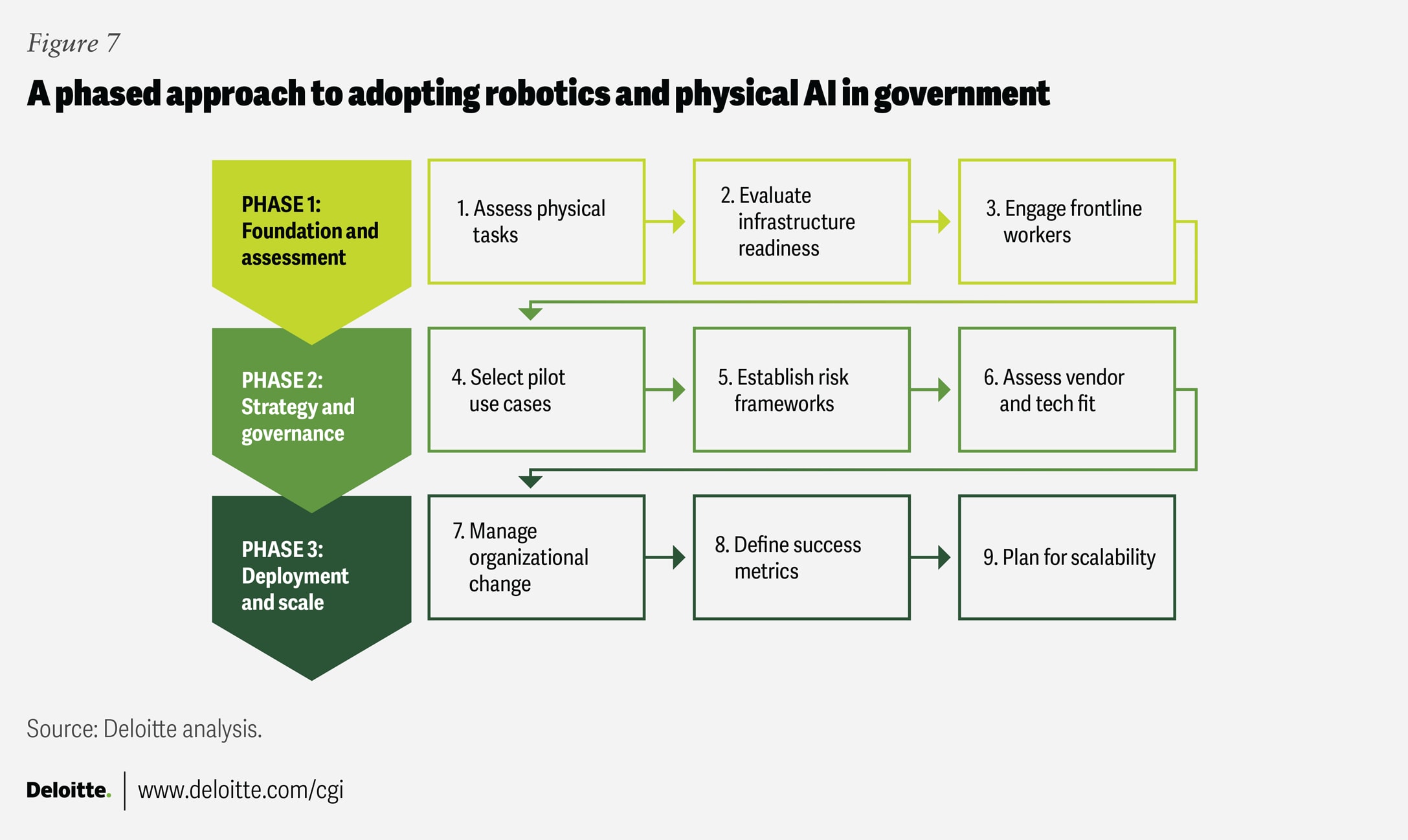
Phase 1: Foundation and assessment
- Conduct a physical task inventory: Agencies should identify pain points that constrain mission delivery (for example, staffing gaps, safety risks, and service delays) and determine which physical tasks either consume the most amount of time or present risks or physical limitations for a human actor. Labor shortages, safety risks, and workload surges are strong indicators of where robotics may add value. Agencies can then compile an inventory of time-consuming, risky, or physically demanding tasks that may be suited for robotics. Workflows should then be redesigned to integrate physical AI with human roles. Robotics can deliver great value when aligned with specific workflow changes, not generic automation goals.
- Evaluate the operating environment and infrastructure readiness: Robots rely on workable physical and digital environments. Early evaluation of environmental conditions helps determine which use cases are feasible, and what robotics modalities and features will be most useful to invest in. Factors to be considered include site layout and navigation paths, wireless internet coverage options and reliability, charging availability, and security and access control mechanisms.
- Start with the frontline: The most useful solutions often come from the people closest to the problem. Ukraine’s experience during the war is an example of this in practice. Frontline units did not wait for formal requirements or long approval cycles. Instead, they spoke directly with engineers, sharing problems as they emerged. That direct connection allowed commercial innovators to respond quickly with practical, fit-for-purpose solutions.18 Government agencies can learn from this approach. By giving frontline workers a direct voice in identifying problems—and a simple way to engage technologists—agencies can ensure physical AI solutions are shaped by real operational needs.
Phase 2: Strategy and governance
- Identify high-value, low-complexity pilot opportunities: Effective robotics programs start small and share three characteristics:
1. Clear, measurable outcomes (for example, hours saved, faster delivery times, or fewer inspections missed)
2. Low implementation risk and complexity, and controllable testing environments
3. High repeatability, enabling robots to build reliability quickly
- Plan for risks: As physical AI moves out of software and into the real world, the risks change in important ways. These systems can affect safety, operations, and public trust. That makes it critical for organizations to clearly understand what could go wrong and how they will respond when it does. Having a structured way to think about risk helps. Frameworks like the National Institute of Standards and Technology’s AI Risk Management Framework can provide a practical starting point to identify risks, make informed trade-offs, and put the right guardrails in place.
- Assess vendor landscape and technical fit: The robotics market evolves rapidly. Agencies should compare vendors on capabilities, interoperability, safety, and contracting flexibility. Demonstrated success in similar environments, support for Robots-as-a-Service procurement, and cybersecurity considerations such as software interoperability should also be prioritized.
Phase 3: Deployment and scale
- Change management: Frontline staff and supervisors are essential partners in robotics adoption. Leaders should assess how implementation will affect day-to-day responsibilities and routines. They should also determine who in the organization needs to know about a deployment, what new responsibilities may arise, and how staff will interact with the robotic actor.
- Establish clear evaluation metrics: Robotics implementations should have transparent, quantitative metrics focused on three areas: impact (if the robot is improving outcomes), technical success (if the robot is functioning reliably), and adoption (if staff are using it as intended).19
- Plan for scale from the beginning: Even small pilots should anticipate future expansion. Agencies should consider how robotics will operate across multiple facilities, agencies, or regions. Multi-year budgeting, training programs, and safety protocols should be implemented from the beginning.
This checklist may seem daunting, but it is simply an approach organizations can use to consider their robotics-enabled future. Public demand for better services at lower costs is not going away. To meet that demand, the physical nature of much government work will require robots. Unlike the robots of science fiction, government organizations have an opportunity to craft their own robotic future: a robot-assisted future that can help deliver services, cut costs, and support workers.
This article contains general information only and Deloitte is not, by means of this article, rendering accounting, business, financial, investment, legal, tax, or other professional advice or services. This article is not a substitute for such professional advice or services, nor should it be used as a basis for any decision or action that may affect your business. Before making any decision or taking any action that may affect your business, you should consult a qualified professional advisor. Deloitte shall not be responsible for any loss sustained by any person who relies on this article.
About Deloitte
Deloitte refers to one or more of Deloitte Touche Tohmatsu Limited, a UK private company limited by guarantee (“DTTL”), its network of member firms, and their related entities. DTTL and each of its member firms are legally separate and independent entities. DTTL (also referred to as “Deloitte Global”) does not provide services to clients. In the United States, Deloitte refers to one or more of the US member firms of DTTL, their related entities that operate using the “Deloitte” name in the United States and their respective affiliates. Certain services may not be available to attest clients under the rules and regulations of public accounting. Please see www.deloitte.com/about to learn more about our global network of member firms.
Copyright © 2026 Deloitte Development LLC. All rights reserved. Member of Deloitte Touche Tohmatsu Limited
Continue the conversation
Meet the industry leader
Alan Holden
by
Alan Holden
Joe Mariani
Jason Bowers
Sushumna Agarwal
Oniel Cross
Jason Wainstein
The authors would like to thank Kannan Thirumalai for this support on the data analysis. They would also like to thank the Deloitte Insights team, Kavita Majumdar and Sayanika Bordoloi for editorial and production support; and Sonya Vasilieff, Molly Piersol, and Govindh Raj for the art and design on this piece.
Editorial (including production and copyediting): Kavita Majumdar, Sayanika Bordoloi, and Cintia Cheong
Design: Sonya Vasilieff, Govindh Raj, and Molly Piersol
Cover image by: Sonya Vasilieff; Shutterstock
Knowledge services: Rishitha Bichapogu
Visit the Deloitte Center for Government Insights
Access more insights for the defense, security and justice, government health care, state and local government, transportation and infrastructure, human services, and higher education sectors.