
Setting up data governance bodies to boost mission value
How organizations can unlock greater data efficiency and value through clear direction, effective guidance, and a well-defined structure set up by a data governance body
In today’s data-driven world, government organizations generate vast amounts of data and increasingly rely on it to create information products—such as reports, dashboards, and data visualizations—that enable them to better compete, innovate, and improve operations. However, without the right direction, guidance, policies, processes, standards, and structure in place, these information products can quickly overwhelm an organization and become a source of confusion, inefficiency, lost potential, and risk, ultimately undermining their value.
To avoid such a scenario and unlock the true value of organizational data, a coordinated effort led by chief data officers (CDOs) is essential. CDOs must advocate for appropriate authority, organizational structures, and budgets that position them to effectively manage data as a strategic asset, maximizing its usage and mission value. When empowered, CDOs can establish and enforce an accountability framework of policies, standards, and procedures to promote data quality, accuracy, availability, and security—a process known as data governance.
In Deloitte’s 2023 CDO Survey, 85% of respondents identified data governance as a top mission priority, and it remains one of the top three focus areas in a recent follow-up survey.1 Despite this prioritization, 57% of respondents reported that they are still struggling to mature data governance within their organizations.
Setting up a data governance body takes teamwork, purpose, and steady focus
Implementing an agencywide data standard is not an easy feat, nor is it something a CDO can do alone. Data governance requires a collaborative, cross-functional approach that engages the entire organization. This creates the need to establish a data governance body—a formal group empowered to develop, oversee, and improve data management practices throughout the organization—thereby supporting its strategic priorities.
As directed in Title II of the 2018 Evidence Act,2 and further emphasized in the 2025 Phase 2 Implementation of the Evidence Act,3 US federal departments and agencies are required to establish data governance bodies to improve data management practices.
Effective data governance bodies provide a coordinated structure to oversee the management of data throughout its lifecycle. These groups are established by the CDO, with active participation from data stewards, data owners, and business leaders responsible for specific data domains such as policy, finance, human resources, information technology, and cybersecurity (figure 1).
The work of a data governance body spans three key levels:
- Strategic: The CDO sets the vision, goals, and overall direction for data governance, ensuring it aligns with the organization’s mission and priorities.
- Tactical: Business leaders and subject matter experts translate strategy into action. They define data ownership and stewardship roles and facilitate collaboration across departments.
- Operational: Data stewards and technical staff implement data governance standards in daily practice, embedding them into each stage of the data life cycle and all relevant workflows.
When aligned with strategic priorities, governance bodies can empower agencies to advance their unique mission objectives. These objectives may include enhancing public safety and national security, safeguarding public health, or supporting safe and efficient transportation systems.
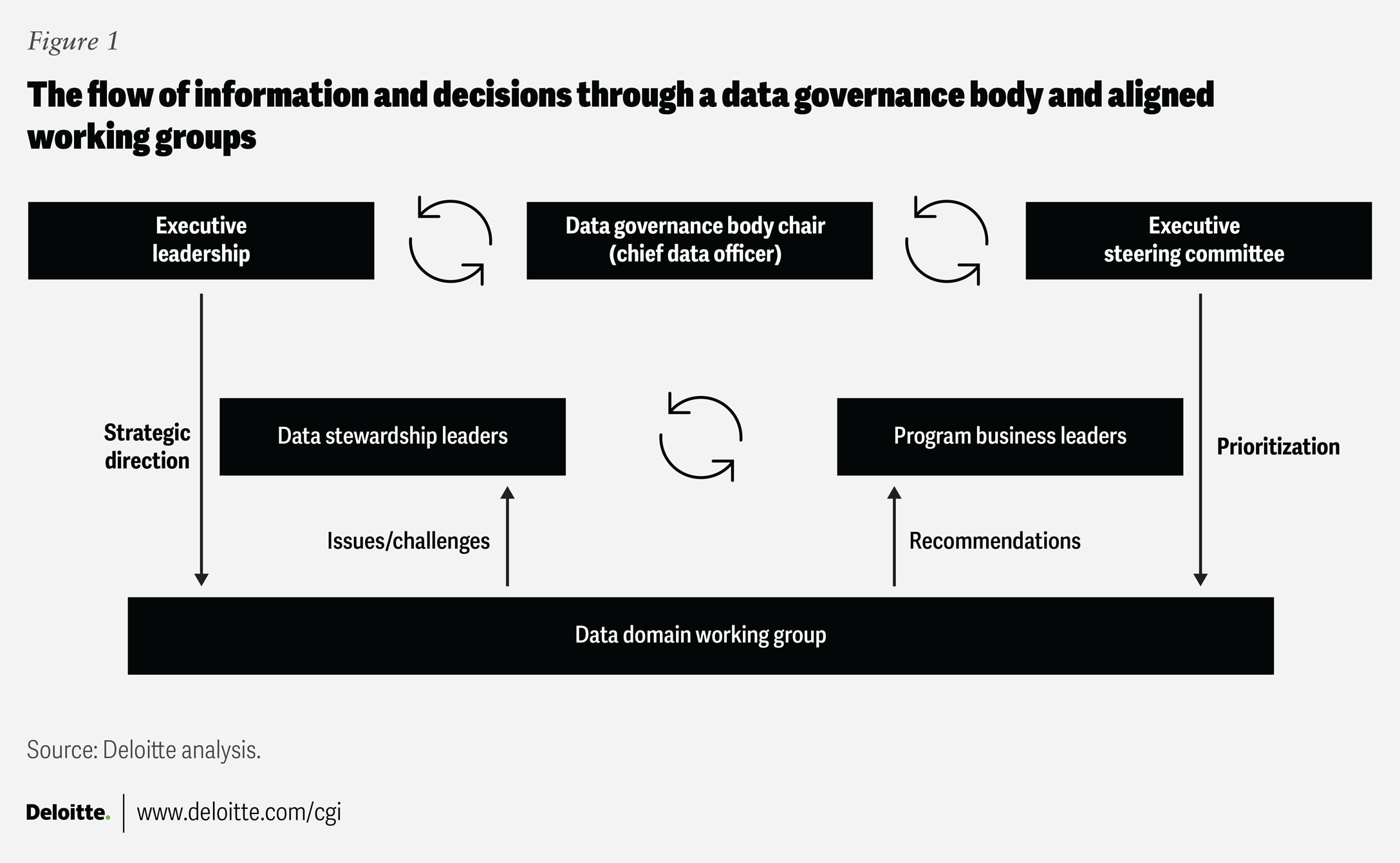
A data governance body brings together executive, tactical, and operational teams to ensure accurate data is readily available. With a shared goal of responsible data management aligned with mission and strategic business priorities, organizations can make data-driven decisions that deliver value quickly and improve mission success.
How to institute a supported data governance body
A well-supported data governance body is characterized by early and ongoing stakeholder engagement, strong executive advocacy, and clear alignment with business priorities. Such bodies foster a data-driven culture in which members’ voices are heard and their work is actively supported. CDOs and governance leaders set the vision, establish formal charters, and champion efficient data management as a shared enterprise responsibility, maximizing value, credibility, and return on investment.
Culture and communication: Establish the center of excellence
- CDO campaign strategy: Engage stakeholders at every phase to cultivate collective ownership of data management. Early, visible support builds trust and lays the groundwork for sustained commitment throughout the organization.
- Stakeholder engagement plan: Prioritize ongoing, two-way communication with executive sponsors and committee members to ensure leadership understands their enabling role and feels invested in driving governance efforts.
- Training and development: Build governance capabilities by identifying training pathways and establishing a core curriculum, offering accessible, relevant education opportunities that empower members and help embed data stewardship within the organizational culture.
Management framework: Develop a management approach for CDO operations
- Portfolio and governance plan: Link governance objectives to business priorities, ensuring efforts are purposeful and visible to executive sponsors for increased credibility and alignment.
- Organizational design: Integrate the CDO and governance champions into decision-making committees to ensure data is incorporated into enterprise decisions and prioritized as a strategic asset.
- Organizational structure design: Clarify the purpose and expectations for each member by setting strategic priorities, establishing roles and responsibilities, and developing a change management plan. A robust approach ensures alignment with broader organizational goals and supports adoption and resilience.
- Talent acquisition and sourcing: Recruit skilled leaders who can drive governance strategy forward and facilitate effective collaboration across people, processes, and technologies.
- Analytics demand strategy: Align analytics efforts with enterprise needs, demonstrating how governance supports key initiatives and delivers tangible value.
- Results and risk: Establish metrics for evaluating governance decisions, define measurable outcomes, and regularly report progress and ROI to build trust and promote future funding opportunities.
Finance: Develop resource needs and an approach for budget justification
- Talent resourcing plan: Develop a talent and budget plan that aligns resourcing requirements with strategic goals. Collaborate to manage constraints and maximize the impact of available talent and funding.
- Technology: Evaluate software and hardware costs by assessing automation and AI capabilities for data management, optimizing both cost and quality so that governance leaders can focus on value-add activities.
- Strategic planning and budget: Develop a five-year strategic plan that lays out a compelling case for continued investment by demonstrating long-term ROI and linking governance success to business outcomes.
Governance framework: Create a strategy for data and analytics application governance
- User agreements: Implement policies that support trustworthy, compliant use of data and analytics across the enterprise.
- Centralized data environment: Conduct an inventory of high-priority dashboards to build and maintain high-impact, accessible analytics that audit and improve key dashboards in support of the organization’s strategic goals.
- Define and implement key operational processes: Develop and document repeatable processes to drive operational excellence, placing governance at the core.
- Data dictionary and needs assessment: Standardize core definitions and identify data requirements for the center of excellence campaign priority initiatives to drive clarity and enable more effective cross-functional data initiatives.
- Data and analytics strategy implementation: Roll out and continually refine the strategic governance plan, integrating automation and AI as resource availability and complexity increase.
What are the challenges of setting up a data governance body?
Establishing a data governance body is a critical step in managing organizational data, but it often encounters resistance because it involves cultural and operational changes that are not always welcomed.
In the 2024 Federal CDO Survey, CDOs emphasized the need for data governance that extends beyond the scope of their own offices, frequently citing this as a barrier to achieving the goal of establishing a data-informed organization.
Breaking through silos and reluctance
Data governance necessitates cooperation and participation across departments that often have distinct priorities, cultures, and established processes. As a result, implementing data governance can be seen as burdensome or even threatening if its value is not immediately clear to all participants and stakeholders, or if it lacks active endorsement and support from executive sponsors.
Securing leadership buy-in and clarity
Senior leaders who are part of the committee or council often do not fully understand their role in data governance, nor why their involvement is necessary given their already limited bandwidth. Furthermore, they may showcase resistance due to perceived increased oversight and loss of autonomy. Leadership may also be concerned about losing ownership of work or data as roles and responsibilities become more defined and standardized through data governance.
Overcoming resource gaps
A hurdle that CDOs face when establishing a data governance body is one that has persisted for many years: Historically, data leaders have had limited access to resources, a problem especially pronounced for federal CDOs.
Limited resources—be it budget, personnel, time, or technology—can significantly hinder the effectiveness and sustainability of data governance. Without sufficient funding or staff, launching data governance and establishing the necessary frameworks, policies, and tools can be slow, incomplete, or inconsistent.
Operating in survival mode
If a CDO does manage to successfully set up a governing body, limited resources will likely restrict the scope of work the committee or council can tackle. They may be forced to direct resources toward “keeping the lights on” or focus solely on compliance and the most critical data assets. This leaves other data and important areas of work unmanaged, increases risk, and ultimately limits the governing body’s ability to achieve organizational goals and deliver on its mission.
Additionally, insufficient funding affects data leaders’ ability to hire the experienced talent needed to manage the growing workload associated with data management and modernization. As a result, data governance leaders are often compelled to be hands-on in daily data operations rather than providing strategic direction, leading to a reactive committee rather than a proactive one.
Data governance can unlock organizational success—supported by AI
Data governance is the foundation of efficient data use, and establishing a supported governance body is essential for unlocking sustained business value.
Stakeholder engagement, strong leadership, and a well-defined strategy provide organizations with the structure and direction needed to transform ordinary data into a powerful driver of enterprise success.
As data volumes continue to grow and resources become increasingly limited, organizations need to embrace automation and AI to strengthen governance efforts. Although people remain central—championing culture, setting priorities, and upholding team accountability—AI-enabled data management can help overcome resource constraints, improve data quality, and increase user productivity, allowing participating members to focus their efforts on high-priority strategic initiatives where they can deliver greater mission impact.
Data governance bodies play a crucial role in providing leadership, accountability, and coordination. Data governance has evolved beyond a set of policies to become active and effective practices that deliver value throughout the organization. By uniting strong leadership, clear strategies, and AI-enabled tools, organizations can future-proof their data governance, consistently deliver value, and accelerate mission success.
Qualtrics survey
by
Warren "Lorenzo" Ross, Jr.
Dr. Adita Karkera
Uday Katira
The authors would like to thank Alexandra Maddox, Adeeba Zaidi, Kanika Sarma, Ashley Hall, Ayrton Miles, Courtney Johnson, and the entire GPS Office of the CDO team for their assistance in drafting and editing.
Editorial (including production): Pubali Dey, Kavita Majumdar, Anu Augustine, and Aparna Prusty
Design: Govindh Raj and Harry Wedel
Cover image by: Sofia Laviano
Visit the Deloitte Center for Government Insights
Access more insights for the defense, security and justice, government health care, state and local government, transportation and infrastructure, human services, and higher education sectors.