
2026 Higher Education Trends
America’s higher education sector is poised for reinvention as declining enrollment, university funding cuts, advancing AI, and evolving regulations reshape the college landscape
America’s higher education system is facing intense pressure from all sides. Enrollment is declining, public confidence is weakening, and policymakers are questioning the sector’s business model and overall return on investment. Yet, even amid this scrutiny, the core value of higher education has never been more apparent.
As artificial intelligence reshapes how, where, and by whom work is done, colleges and universities are uniquely positioned to guide society through this transition. Institutions can play a critical role in preparing the next generation with the skills needed for a rapidly changing world. As former New York Times columnist David Brooks observed, AI will remind us who we are by “revealing what it can’t do,” underscoring the enduring importance of fundamentally human skills—communication, judgment, and teamwork.1 Developing those capabilities is squarely within higher education’s mission.
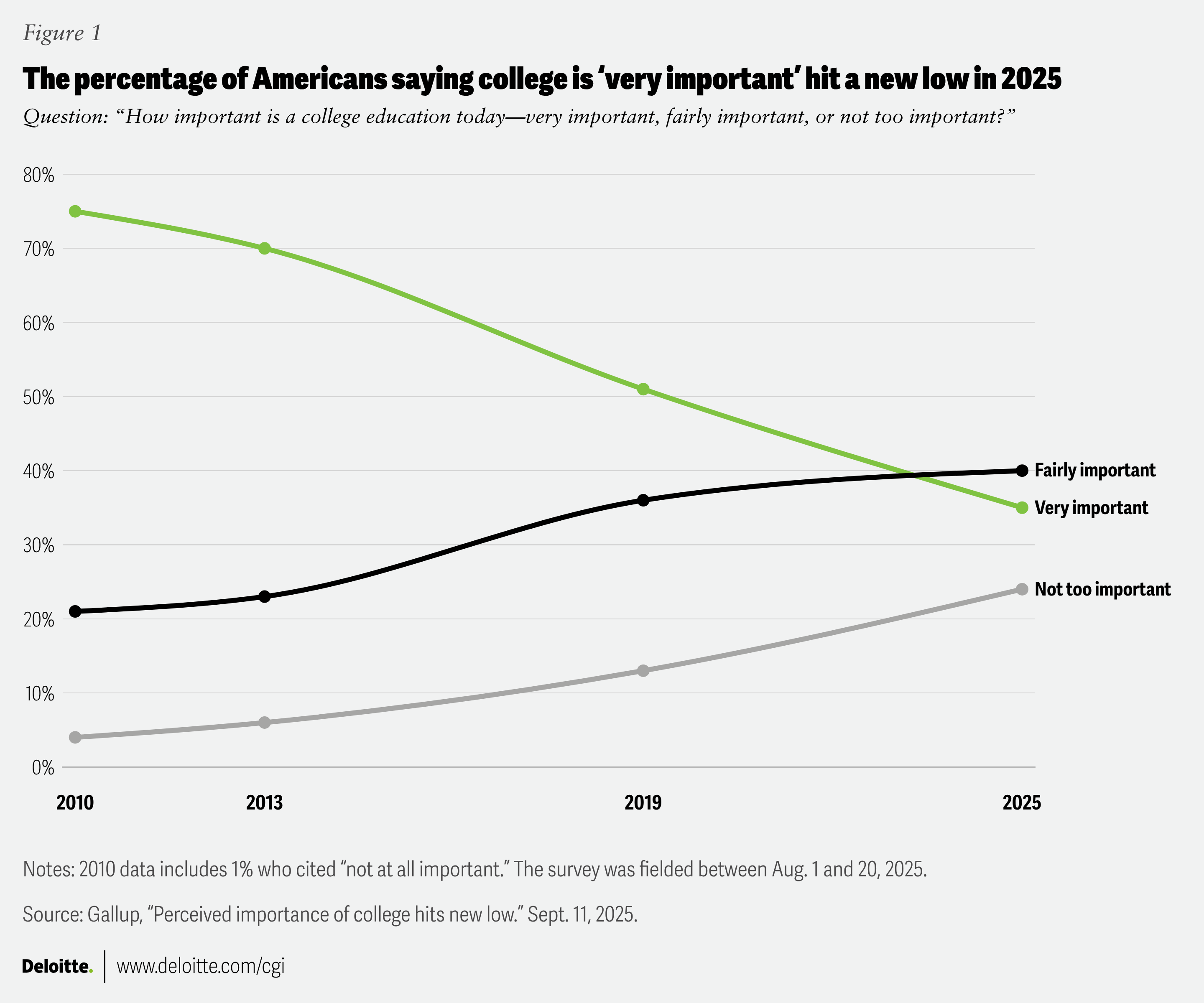
While this portends renewed importance of a liberal arts education, the continued erosion of Americans’ trust in US higher education highlights the need for higher education to work toward reestablishing itself as an engine for upward mobility (figure 1). The fundamental partnership between higher education and government forged after World War II to promote access has deteriorated as the correlation between education and wealth has grown.2
These challenges, combined with growing financial pressures, represent a pivotal moment. Institutions willing to rethink long-standing assumptions have an opportunity to chart a more sustainable path forward. To do so, leaders must reconcile two realities: Students overwhelmingly seek degrees that lead to meaningful employment, and employers need graduates who not only have immediate skills but also the agility to adapt as work continues to evolve—especially under the influence of AI.
This creates a tension between today’s focus on measurable ROI, which often favors vocational programs, and the long-term need for a broader liberal arts foundation that builds adaptable, human-centered capabilities. Calls for increased accountability are unlikely to fade, but that need not forestall university leaders from charting a new path that is both transparent in approach and aspirational in terms of what higher education can help society achieve.
The trends that follow point to a crucial need for institutions to redefine how to deliver on the promise of American higher education as both an engine of economic mobility and a powerhouse of innovation critical to national competitiveness.
- Leverage unprecedented uncertainty as a means to finally impact the cost structure of the modern university in ways that bolster teaching and research.
- Shift the conversation from the “cost of college” to the “return on a credential” to reassert the value of degrees.
- Rethink the funding models and operational efficiency of scientific research at a time of pullback of federal support.
- Consider a future with fewer but stronger US colleges as more institutions choose to merge or form strategic partnerships.
- Proactively seek new ways to adapt to the changing global higher education landscape.
The overall negative sentiment toward higher education and pressure on most sources of funding provide a rare opportunity to break through heretofore insurmountable inertia and resistance to change. In the pages that follow, we outline several areas where opportunities exist for fundamental reform and reset.
About our research
Deloitte’s Center for Higher Education Excellence convened college and university presidents in November 2025 at Deloitte University in Westlake, Texas. This fourth annual forum on the New Era of Higher Education was designed to foster conversations on trends driving disruption in the field and to help leaders understand key issues and the opportunities they create. The goal of the New Era Forum is to allow institutional leaders to share successes and lessons learned to achieve lasting and positive change. This article describes and prioritizes trends identified by discussions with the New Era Forum community.
Trend 1: Erosion of the revenue model for higher education
For many US universities, including some of the most selective and well-resourced institutions, 2025 brought significant challenges, including sharp reductions in staffing and research activity.
The culmination of reductions in sponsored research, limits on student loans, new taxes, and the arrival of the demographic cliff forced many college leaders, including those leading institutions thought to be insulated from external pressures, to change their operating models.
The size of the reductions in some cases has been substantial: The University of Southern California laid off more than 900 employees; Stanford University cut 363; and Northwestern University laid off 424, amounting to about 5% of its workforce.3
While some of the rollbacks of federally sponsored research have been challenged in the courts and may be reversed, college leaders are preparing for reduced federal support and increased policy uncertainty going forward.
The prevailing wisdom in prior years had been that the top research universities have the ability and security to weather any storm, with diversified funding sources, endowments to backstop, and a healthy pipeline of students to buffer headwinds. However, recent actions have impacted these strengths: International and graduate enrollment, endowments, and research funding are at the heart of current uncertainty.
Over the past decade, institutions have bolstered revenue with lucrative graduate programs, offering adult learners a path to new careers, many of which were made possible by the use of affordable debt. A new headwind for graduate programs is the elimination of the Grad PLUS loan option beginning on July 1, 2026, which may reduce institutions’ pricing power.4 The lifetime cap on borrowing amounts for graduate and professional programs will make it harder for many students to get financing, which in turn will likely depress enrollment. Currently, 1.8 million US borrowers hold outstanding Grad PLUS debt. The change to loan policy would have affected 22% of current student loans.
There are some signs that a steep decrease in graduate school ranks has already begun. While enrollment in graduate programs across the board remained steady in 2025, PhD programs, which comprise roughly a third of the graduate student population and are traditionally a net cost to institutions to maintain, have been particularly impacted by the reduction in federal funds for sponsored research, resulting in smaller cohorts at many institutions.5 And, many graduate programs are seeing significant declines in international student enrollment. The Institute of International Education reported a 17% drop in new international student graduate enrollments this past fall.6
Changes in how university endowments are taxed are also leading some of the wealthiest US campuses to reduce workforces or institute hiring freezes.7 While the changes currently only impact about a dozen universities, many more institutions are on the edge of the cutoff in endowment size. And those institutions that are affected are feeling the squeeze of this policy change, facing millions in new and unexpected tax burdens at a time of other budget challenges.
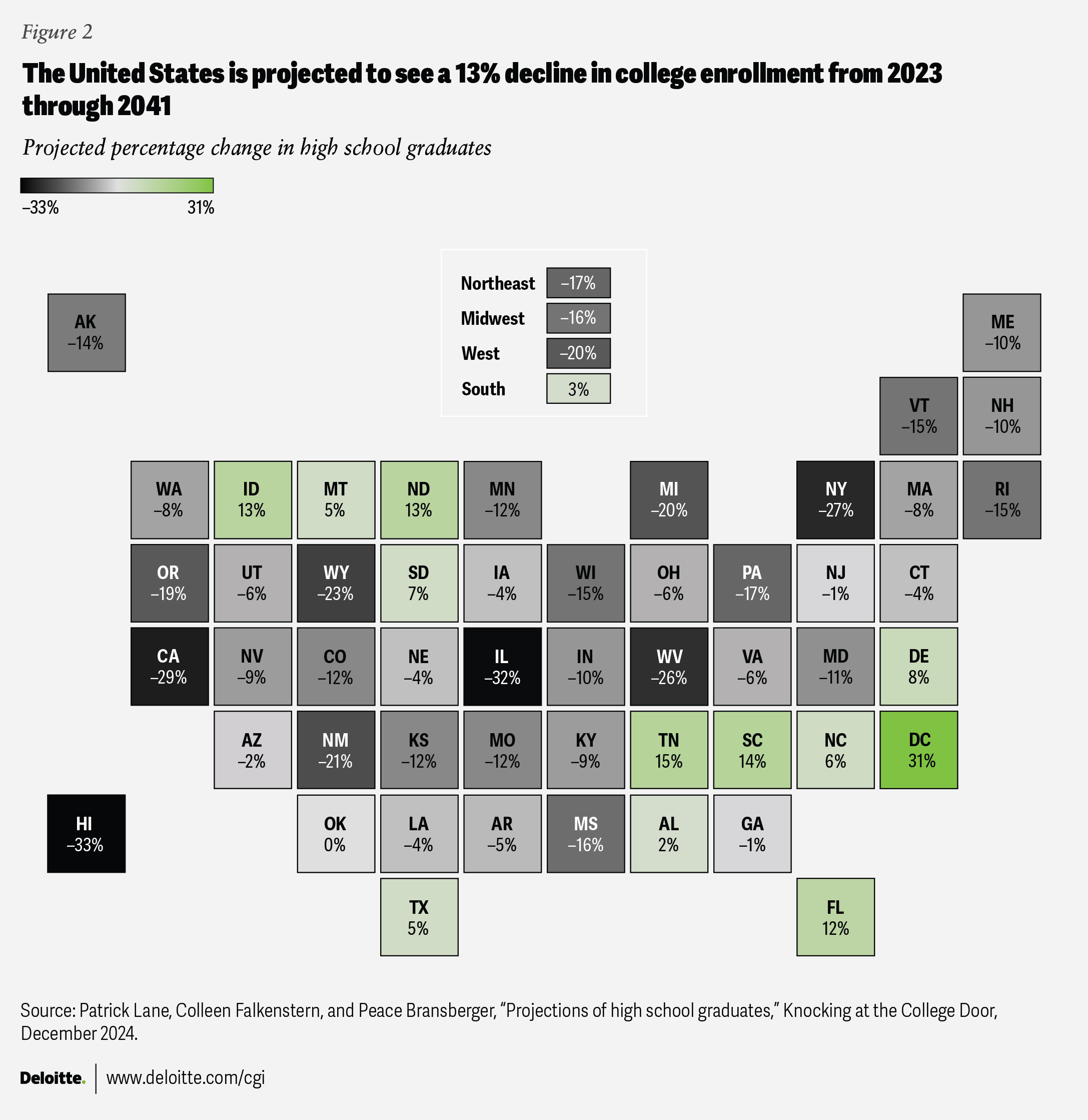
While the impact on elite institutions is new, many universities outside of this group were on shaky financial footing even before recent federal policy changes. In 2024, more than half of private universities rated by S&P Global generated operating deficits, which is up from the year before, and the early 2025 results look even weaker. Meanwhile, a recent analysis of 44 midsize universities with enrollments between 1,000 and 8,000 students showed a weak financial outlook, with many at risk of becoming insolvent in five to 10 years if enrollments fall by 1% to 3% per year in that time. The nation is projected to see a 13% decline in college enrollment from 2025 through 2041 (figure 2).8
In 2024, more than half of private universities rated by S&P Global generated operating deficits, which is up from the year before, and the early 2025 results look even weaker.
During previous periods of financial strain, states have taken steps to address shortfalls in higher education funding. In 2025, at least 15 states proposed or implemented notable reductions to public university budgets.9 As federal funding becomes more limited, colleges and universities may decide to collaborate with state leaders to clarify the role states may play in supporting higher education.
As colleges continue to navigate uncertainty, maintaining financial flexibility is key. Some institutions are working to increase liquidity, including accessing capital markets to strengthen their cash position. At the same time, there is a significant move toward rethinking the academic program array—at the institution and system level—to reduce programs in low-enrollment areas.10
While leaders are taking steps to head off a deeper crisis, there is a focus on avoiding making drastic cuts that later prove to be unnecessary.
Institutions to watch
- State leaders are stepping in to push colleges to eliminate programs that no longer appeal to a significant number of students. Ohio State University cut eight low-enrollment majors and merged 20 others.11 And in Oklahoma, the state board of regents voted to eliminate 41 academic programs with low enrollments and put another 21 programs on probation after a monthslong review aimed at better aligning offerings with workforce needs.12 The flagship University of Oklahoma is slated to remove eight bachelor’s degrees and six graduate degrees after a teach-out period, allowing current students to complete their studies.13
- In Kentucky, the state Council on Postsecondary Education has developed new guiding principles aimed at streamlining the process used by state universities to set up new degree programs in response to labor market shifts.14
- In California, three campuses in the California State University system have proposed merging administrative functions, including accounting and human resources, to save money. The goal is to gain efficiency without negatively impacting students or academic programs.15
Key quotes
“While more uncertainty and challenges may come, we are optimistic that creativity and openness to new models will enable us to meet the current moment and our future.” –Boston University President Melissa Gilliam and Provost Gloria Waters, in a letter to the community announcing a round of layoffs16
“How do we hope for the best and plan for the worst? Nobody wants to be the leader that makes a cut that turns out to be unnecessary. But also one wants to be the one who didn’t make cuts and ends up forcing drastic moves later on.” –Robert Kelchen, professor and head of the Department of Educational Leadership and Policy Studies at the University of Tennessee17
Trend 2: Shifting the conversation from the ‘cost of college’ to the ‘value of a credential’
In a time of growing skepticism of higher education, colleges are looking for ways to better demonstrate the value of their degrees and credentials.18
Increasingly, that means talking about jobs, and the wage payoff of higher education—focusing on the “return” rather than the “investment” of return on investment.
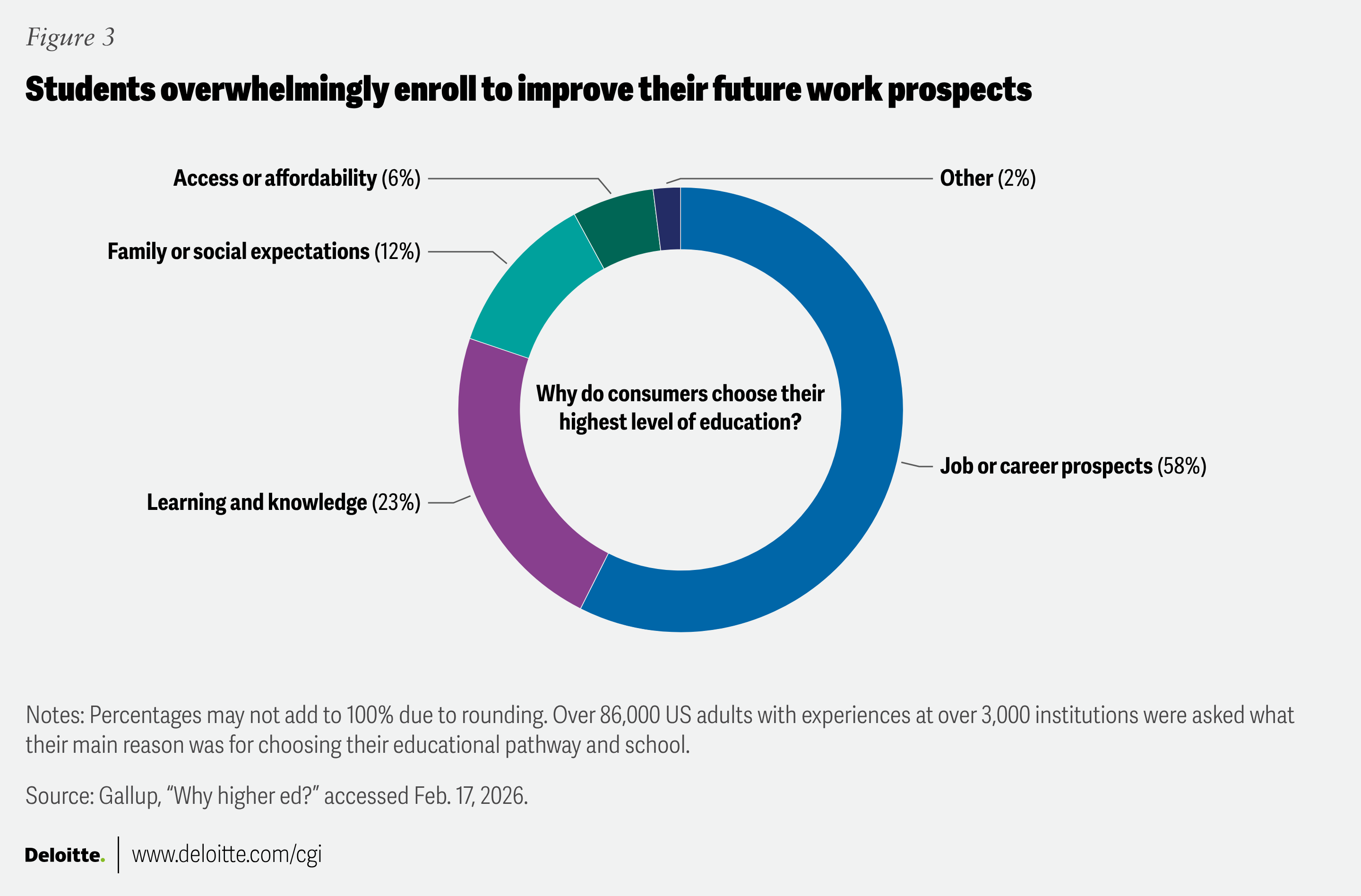
There is broad bipartisan agreement that a college education should lead to improved wages in the job market. That’s not to say that jobs and wages should be the only output of colleges: Colleges have an opportunity to prepare students for civic responsibility and to build skills beyond immediate employment. But a growing movement argues that offering “degrees of value” should be table stakes for institutions as they communicate with prospective students, lawmakers, and accreditors. This also aligns with the No. 1 reason students cite for pursuing a post-secondary degree: to improve job and career outcomes (figure 3).
Some states are taking this charge head-on: In 2024, Texas lawmakers, for example, forged a new funding formula for community colleges that focused on outcomes for students rather than how much time students spent in classes. Leaders say that the shift led to broader and deeper student support. In the end, Texas lawmakers approved a 30% increase in spending for community colleges, with strong bipartisan backing.19
And an upstart college accrediting agency, the nonprofit Postsecondary Commission, is leading the charge to reform how colleges are evaluated, with a focus on lifetime earnings and economic mobility of graduates. The federal rule changes enacted in 2020 make it possible for colleges anywhere in the country to choose a national accreditor rather than a regional one, creating new accreditation pathways, although the approval process remains lengthy.
Data has long shown that people who earn college degrees get a big boost in earnings compared to those without one. The latest data from the Bureau of Labor Statistics shows that workers age 25 and older make 80% more per week than those with only a high-school degree.20 While that’s true on average, the situation for individuals varies widely depending on a person’s major and other factors.
Adding to the challenge of calculating ROI is the reality that colleges now offer more credentials than ever. Nearly 1.1 million credentials are offered in the United States, which is more than the number of headwords in the Oxford English Dictionary.21 But the vast majority of nondegree credentials don’t lead to higher paychecks, with only 12% of credentials delivering significant wage gains, according to the Burning Glass Institute.22
Despite variation in labor market returns on credential attainment, there is interest in these programs. The July 2025 passage of H.R.1 may further encourage students to pursue nondegree credentials through a provision that allows what is known as Workforce Pell, which stipulates that low-income students will be able to use Pell Grants to pay for credential programs as short as eight weeks in length. While details must be worked out before the program goes into effect in July 2026, the change is expected to bring further interest in nondegree credentials.23
A key challenge, however, is figuring out how to accurately measure economic return on degrees and credentials—and deciding what to measure. Some universities have begun to put their measurement approaches to the test. The University of North Texas recognized that just because degrees in some professions may take a decade or more to translate into higher-paying jobs, that doesn’t make them bad investments. That reality led the schools to factor in what officials call “time to value” when they assessed each of the 114 bachelor’s degrees they offer.
Some college leaders also worry that emphasizing the salary payoffs of their offerings may discourage colleges from offering degrees in fields with historically low pay that, nonetheless, carry great social value, such as early childhood education. Broad accessibility of this data may prompt a significant public policy debate considering a range of solutions, from exempting some fields from performance-based funding programs, to offering targeted loan repayment programs, or changing the pay for these jobs.
Another challenge is that data on economic return on degrees is not always available. Officials for the Postsecondary Commission have said that, in many states, there isn’t yet enough available data for their model to work.
Of course, the rise of generative AI is also shaking up employment at a rapid rate that makes it more challenging for colleges to align their offerings with careers. A study released in November 2025 by the Massachusetts Institute of Technology found that nearly 12% of the US workforce could be replaced by AI tools.24 To keep up with the evolving job market, colleges should look for ways to review programs more frequently and seek out opportunities to foster real-time communication between employers and faculty to better match the skills and capabilities students develop to jobs.
Expanding internships and apprenticeship programs has also proven helpful in bridging college and work. Recent research by the Strada Education Foundation found that 73% of graduates who completed a paid internship landed a first job that required a degree, compared with 44% of those without an internship.25
The rise of AI may lead to a rebound in interest in humanities fields. Liberal arts degree attainment declined in recent years due to the high cost of college and rising interest in technical fields such as STEM and computer science that were seen as safer bets for finding jobs. The number of history majors fell by 35% between 2009 and 2020, while computer science degrees spiked 47% from 2015 to 2020.26 Proponents of the humanities say that, as AI tools reshape jobs, critical thinking skills and ethics and judgment will become more highly valued, while the number of jobs in areas such as coding will shrink.
Ultimately, college leaders should take the time to communicate the critical “human” skills (communication, teamwork, and critical thinking) they impart and how their degrees more directly align with the jobs of today.
Institutions to watch
- A new credential value index compiled by the American Enterprise Institute and the Burning Glass Institute analyzed more than 23,000 nondegree credentials to assess the earnings returns for graduates. The results were mixed: Only about 12% of nondegree credentials led graduates to earn significant wage gains of 10% or more compared with similar workers. But the top 10% with the high-return degrees earned nearly US$5,000 more than those without such degrees in the first year after graduation. Proponents of the approach show that giving students this kind of data will put pressure on institutions to better align their credential programs with the job market.27
- The University of Wisconsin-Madison plans to create a new College of Computing and Artificial Intelligence, the first new academic division since 1983. The vision is to reorganize existing departments, including computer science, statistics, and the Information School, into a new college that will forge cross-campus partnerships to explore how AI intersects with a range of areas as disparate as veterinary science and political science. Officials say the move will position the institution as a leader in AI and align its offerings to meet the changing realities of the workplace.28
- The University of Georgia runs a Student Industry Fellows Program that offers hands-on skill development in market research, business modeling, and other workforce-friendly skills to students from a range of majors.
Key quotes
“The challenges of measuring it [ROI] well are immense because the data systems literally are not there.” –A participant at the 2025 Forum on the New Era of Higher Education, Deloitte University
“You have to make sure people have access to the ability to continue to acquire skills over time. There’s no reason to surrender that market to a bunch of online training providers.” –A participant at the 2025 Forum on the New Era of Higher Education, Deloitte University
Trend 3: A reset for sponsored research
The model for funding research at American colleges and universities that was born during World War II is going through a dramatic reset.
2025 was marked by an unprecedented change and a reduction in federal research dollars after decades of steady growth, including amendments to previously awarded grants, workforce reductions, and incentivized early retirements of thousands of workers at federal agencies that produced research and proposals to reduce future federal research funding.29
Changes in the sponsored research compact between universities and the federal government represent a challenge to the funding model of institutions in the immediate term. The Leiden Rankings, from the Centre for Science and Technology Studies, assess both the quality and volume of research produced by universities worldwide. In the most recent publication, the United States holds only three of the top 25 spots, while China dominates the rankings with eight of the top 10 spots.30
Changes to funding may further erode this as US institutions consider the amount of high-quality research they are able to produce. While some grant cancellations were later overturned by legal decisions, and final research budgets at many federal agencies largely held flat, the unexpected withdrawals of previously approved funds have left colleges looking for ways to quickly adapt to the changing fiscal outlook.31
In the short run, we have seen funding reductions, with many of the top research institutions reducing their workforce. Many colleges have trimmed research budgets, frozen hiring, and pulled back on PhD admissions, actions that will likely have ripple effects.
To prepare for a new landscape going forward, college leaders across the sector are looking for new sources of funding, ways to reduce administrative costs, and new opportunities to communicate the value of their research to government leaders and the public.
Philanthropic groups have emerged as one potential source of additional funding in 2026.32 Philanthropists are not new to funding research: Roy and Diana Vagelos made a historic US$400 million donation to Columbia University in 2024 for basic biomedical research,33 and the Howard Hughes Medical Institute, which has a longstanding pledge to support college research in biomedical sciences, has given out more than US$7 billion to researchers since 2004.34
However, despite preexisting philanthropic relationships and the potential for additional funding, philanthropic dollars cannot make up the gap left by reduced federal funding. The level of federal research support is 10 times what philanthropy now provides—with US$50 billion coming from the federal government compared with US$5 billion in philanthropic support as of 2021.35 And seeking out philanthropy may require a change in university practices and may prompt more collaboration with industry, potentially narrowing the focus of research as big tech and pharmaceutical companies emerge as significant funders.
The shift in research funding may not just be a matter of “who,” but also a matter of “what.” As universities pursue grants from philanthropic and corporate sponsors, research may shift to applied work over basic science. Though the rise in industry-college research partnerships may yield new opportunities to prepare students for immediate entry into a career, the pullback from basic science could negatively affect American innovation and, in turn, economic growth. Companies are less likely to support such research, and even if they do, the results may not be made openly available to all scientists to build on.
Meanwhile, other global powers are ramping up their efforts: The Chinese government increased research support by 10% in 2024.36 The European Union is debating plans to double the funding for its flagship program for research, Horizon Europe, to more than US$200 billion between 2028 and 2034.37 If US colleges fail to find new models for research support, some experts worry about a brain drain of top science talent to other countries.
In addition to pursuing alternative funding sources, college leaders and academic groups have been making their case in Washington to win back preexisting channels of support. Their pitch: In exchange for restored dollars, they’ll make reforms in the research funding model.38 A key issue is what portion of federal dollars can be spent on indirect research costs, including on facilities, equipment, and research administration staff. This year, multiple federal agencies have moved to try to cap such costs at 15%, though judges have so far blocked such efforts.39 The revised proposal aims to more transparently communicate indirect costs and to illustrate how these are critical research inputs.
However the indirect research cost issue is resolved, colleges are under pressure to streamline the administrative costs of conducting research. Some leaders are betting on emerging AI tools to meet reporting requirements on grants more efficiently so that grant recipients can spend more of their time on core research activities.
Institutions are also considering new strategies for hiring and supporting researchers to meet the new realities of reduced science funding. Models in which principal investigators (PIs) are employed by both the university and industry are increasing in popularity—enabling PIs to draw a larger salary from the portion of their work conducting research for industry while continuing to support the mission of their institution for a lower pay rate.
University leaders are treading carefully to preserve the integrity of scientific discovery, avoiding politicizing the selection of research topics, while also preserving the United States’ ability to lead in scientific exploration and innovation.
Institutions to watch
- Carnegie Mellon University is among the universities that are rethinking their approach to seeking research grants. Officials say they are being encouraged by leaders at federal agencies to find arrangements where the federal government is a co-investor with a corporate partner and potentially a philanthropic donor as well, rather than the sole supporter. They see a future where the university might also need to promise more institutional investment in research projects as a requirement for winning federal support.40
- The Schmidt Family Foundation runs a program called Schmidt Postdocs that funds people rather than individual research projects, offering US$100,000 or greater stipends to recent PhD graduates doing interdisciplinary research involving AI.41 It’s an example of a philanthropic group offering significant support for a broad area of scientific inquiry.
- The University at Albany, State University of New York created a new President’s Advisory Board for Industry and Economic Development this year that includes representatives from major employers in the region, including IBM, GlobalFoundries, and Regeneron. The primary goals are to better align the university’s research with workforce needs and refine approaches to translating research into commercial products. Leaders say that quarterly meetings are deepening relationships that could lead to new partnerships and corporate support for research at the university.42
Key quotes
“Federal funding is not and should not be our only source of funding at universities. We’ve got to have a diverse portfolio.” –A participant at the 2025 Forum on the New Era of Higher Education, Deloitte University
“We all need to … tilt toward talking about the value of research and what it's done for society.” –A participant at the 2025 Forum on the New Era of Higher Education, Deloitte University
Trend 4: More colleges explore mergers and partnerships to preserve core missions amid demographic and financial pressures
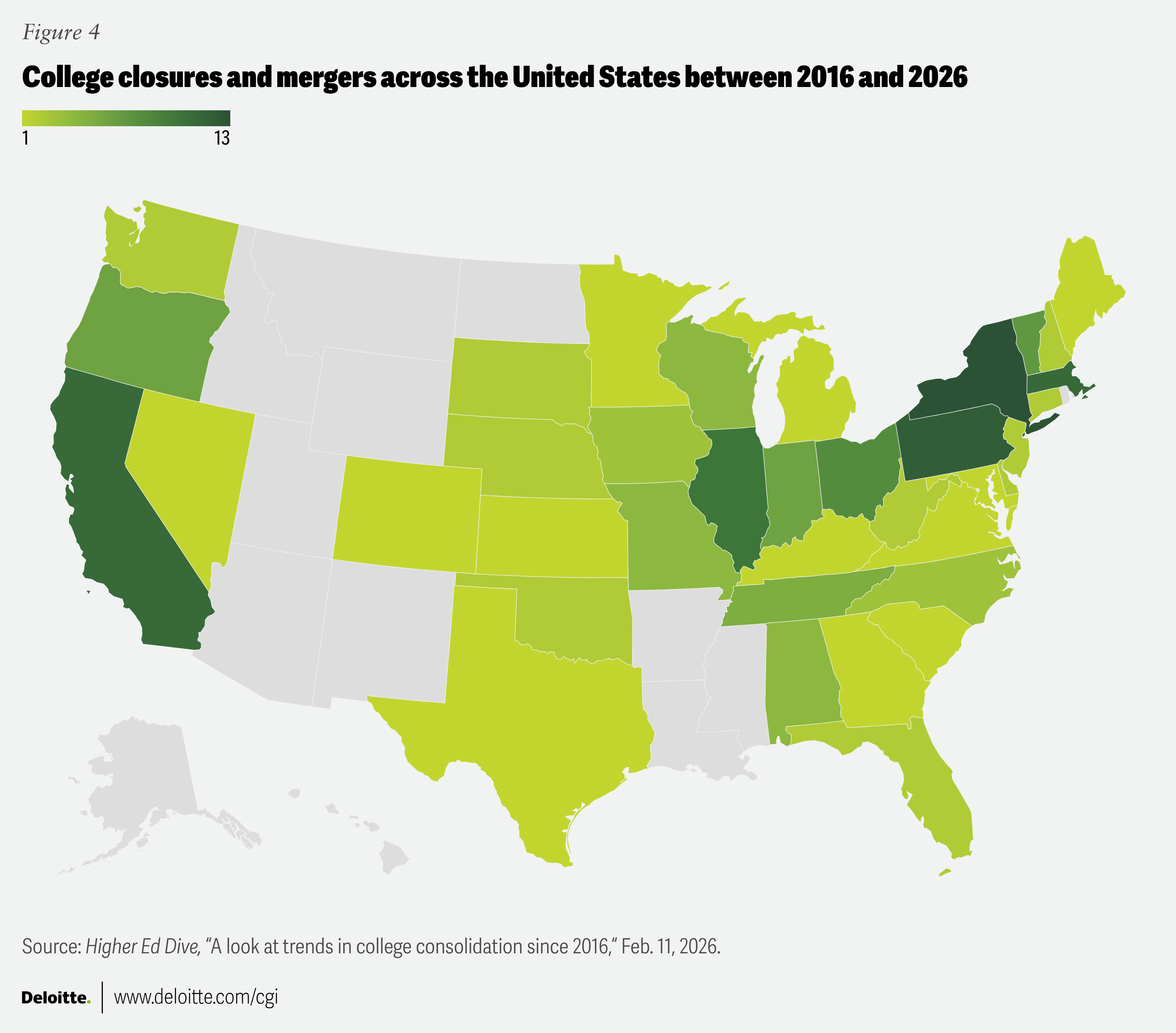
College leaders once saw mergers as taboo, akin to admitting failure. Attitudes seem to be shifting, however, with higher education entering what some call a “consolidation era” (figure 4).43
While the number of mergers held steady in 2024 compared to recent years, there are signs that more college leaders and boards are open to the possibility and are exploring potential pairings. Nineteen percent of senior college leaders surveyed by Inside Higher Education this year say they have had serious internal conversations about merging with another institution, compared with 16% in the previous year’s survey.44 And 19% of college presidents in the most recent survey called it somewhat or very likely that their institution will merge or be acquired in the next five years.45
Nearly 20% of college presidents called it somewhat or very likely that their institution will merge or be acquired in the next five years.
A key driver of M&A activity boils down to supply and demand. Changing demographics mean a projected 13% decline in 18-year-old high school graduates nationwide by 2041.46 And fewer students will likely lead to fewer colleges, as laid out in the book Peak Higher Ed.47
New federal policies to cap student loans will likely put further downward pressure on enrollments, especially at the graduate level. That means it will be harder to increase enrollments by tapping a nontraditional market segment and spinning up new graduate programs, as institutions have done in the past when seeking new revenue sources.
Considering that future, institutions that wait too long to begin exploring their options risk hitting a point of such financial instability that they are no longer an attractive target for merger or acquisition. And a growing number of colleges are, in fact, hitting that point of no return. Roughly 80 nonprofit colleges and universities have shuttered or merged in the past five years—not only reflecting an increase in activity, but also seeing a shift from for-profit closures to nonprofit closures, as well as the first instances of a public institution shuttering (not merging).48 Planning for a possible merger early can make the move a strategic win rather than a last-ditch effort.
Merger success stories are starting to bubble up. Some colleges have combined while preserving the mission of each of the two institutions and gaining the benefits of combined assets and cooperation through scale and efficiency. And mergers have proven a viable path to growth.49
Where are consolidations most prevalent? Public universities have been steadily consolidating in recent years, often with campuses in areas of declining populations merging with other campuses in the system.50 Many other colleges that are merging are religiously affiliated.51 And colleges and universities in other countries saw waves of consolidation recently, with some lessons for US colleges. In Europe, for instance, 100 mergers and alliances were formed between 2000 and 2015.52 Larger institutions offer opportunities to capitalize on lower costs of scale and offer some protection from diverse offerings and markets to weather downturns.
Pulling off a merger of higher education institutions is a complex process that takes leadership and regulatory approval, so careful planning is key. Securing support from boards and public officials and developing consistent leadership and clear goals are key to success. Equally important is establishing how long the financial runway is and articulating, honestly, what your institution has to offer in any merger negotiation. Finding the right partner is also crucial. Institutions should consider alignment with mission, culture, and complementary academic offerings.53 Failure to act as a single entity, with a shared strategy, common goals, and shared structures, can result in a merged entity that destroys more value than it creates—ultimately to the detriment of students and the communities it serves. To succeed, leaders on both campuses are challenged to clearly communicate the benefits and the financial realities that led to a merger and build a cohesive vision of the path forward.
Institutions to watch
- Antioch University and Otterbein University cofounded the Coalition for the Common Good in 2023, keeping distinct undergraduate brands while collaborating on graduate programs and shared services.54
- Gannon University in Erie, Pennsylvania, is in the process of merging with Ursuline College near Cleveland. Even though the institutions are only about 100 miles apart, the fact that they reside in different states is key, as state policies provide a financial incentive to students to stay in-state when it comes to seeking financial aid. Both colleges say they are financially healthy for now, but see strengths and greater potential for enrollment growth by combining.55
- Two of the biggest universities in Australia—the University of Adelaide and the University of South Australia—are set to merge in 2026.56 The integrated Adelaide University will be one of the five largest in the country, with some 70,000 students.57 Leaders see benefits in being financially robust and resilient in a time of change and uncertainty, and they hope the institution can rank among the top 100 in global rankings.
- Pomona College, a private liberal arts college with around 1,700 students, is reportedly in talks to acquire Claremont Graduate University.58 This arrangement is unusual in US higher education, as large universities typically are the ones to buy up smaller institutions. However, the graduate university, which has an enrollment of about 2,200 students, has been operating with a deficit for more than a decade and has been seeking a partner since 2024.59
Key quotes
“I do expect to see more rural institutions with financial strength trying to get urban footholds, possibly by acquiring existing institutions.” –Robert Kelchen, professor and head of the Department of Educational Leadership and Policy Studies at the University of Tennessee60
“Queens has things that Elon doesn't have. For example, they have degrees in music therapy, in design and architecture. And we have some degrees that they don't have that are very successful here—performing arts, music, theater. We're going to be able to offer those programs on each other's campuses.” –Connie Book, president of Elon University, in a recent interview about the merger of Elon University and Queens University of Charlotte61
Trend 5: A changing global higher education landscape necessitates strategic shifts by American universities
The United States has long been the most desirable place in the world for higher education. A college education has long been one of America’s top exports, bringing in more revenue than natural gas and coal combined.62 Many leaders from around the world have earned their degrees from US universities and colleges.
Many American colleges and universities have come to depend on international students as a key revenue source. Students from abroad now make up about 6% of total enrollment at US colleges, or nearly 1.2 million students.63 At elite institutions in particular, these students typically pay the full posted tuition rates, which often works out to two to three times what an average domestic student pays. Many college leaders had hoped to grow those numbers to offset a shrinking pool of domestic high school graduates.
In addition to tuition dollars, a vibrant cadre of top students from across the globe brings intangible benefits to a campus’s culture. In fact, many regional colleges, both public and private, offer scholarships to top students from abroad because of the cultural richness they add to campus life.
New international enrollments have recently faltered, however, in part due to new restrictions and heightened scrutiny of student visas. The number of international students enrolling in American colleges fell for the first time in fall 2025 by 17%, according to a survey by the Institute of International Education.64 This decline has been estimated to cost the US economy US$1.1 billion, according to an analysis by the National Association of Foreign Student Affairs: Association of International Educators.65 The vast majority of colleges seeing a decline cite concerns about obtaining student visas as a key factor, with two-thirds of those colleges pointing to travel restrictions as a reason.
However, it turns out that the number of international students has been falling due to other headwinds too. Enrollments of new international students in fall 2024 fell 7% compared with the previous year, with the greatest decline in master’s and professional programs.66 Experts say factors contributing to that decline include a slowing global economy, increased competition from other countries, and fallout from previous federal efforts to more closely scrutinize global researchers.67
The decline in international enrollment did not affect all institutions or programs equally, since non-American students comprise an especially large segment of the student population of some universities; the 200 universities that have the highest foreign enrollments attract more than 30% of their student populations from abroad. Campuses most impacted by these trends also tend to be research universities, because a majority of international students pursue degrees in STEM fields. Across all science and engineering fields, 47% of graduate students and 58% of postdocs are international.68 Many of these students intend to remain in the country after graduation to work in science and tech fields.
In response to this decline, higher education systems in other countries appear to be landing many of the students who would otherwise have studied in the United States. For instance, universities in Asia and Europe recently reported increases in new international student enrollment.69 Some universities are adopting aggressive strategies: Hong Kong University of Science and Technology offered an “open invitation” to international students enrolled at Harvard University to continue their studies there, and Sunway University in Malaysia welcomed Harvard students to “immediately transfer.”70 Plus, institutions in the region, including China, Vietnam, and Japan, have been expanding their higher education systems and offering more courses taught in English to attract more students from at home and abroad.71 If this trend continues, it could lead to a shift in higher ed enrollments from west to east.
The changing landscape is also leading American universities to consider strategic shifts. Many US colleges remain committed to supporting international students and are looking to diversify the mix of countries where they recruit.
Online options may grow as well, providing a way to attract more international students, some experts say. A recent survey of international student recruiters found a jump in interest from international students in seeking entirely online degrees from US colleges.72 And 21% of US colleges recently surveyed by the National Association of Foreign Student Affairs expect to increase online offerings aimed at international students.73
More US colleges may also choose to bring their educational offerings to other parts of the world by, for instance, adding branch campuses abroad. India is a particular area of interest, since it is the top sender of students to the United States. Nearly a third of international students at American campuses come from India, which in 2020 adopted a policy paving the way for more foreign campuses.74
But Indian students aren’t the only demographic colleges are targeting for enrollment. Georgetown University recently renewed its contract for its long-standing campus in Qatar for another 10 years, though Texas A&M closed its campus in the country in 2024, citing instability in the region as a reason.75 US colleges already have more branch campuses abroad than any other country, with 97 satellite campuses in 40 countries, according to new data from the Cross-Border Education Research Team.76
Colleges should also be prepared for future swings in federal policy. For instance, President Trump recently signaled openness to changing course and expanding the number of international students at US colleges. In a recent interview, President Trump proposed the idea of allowing 600,000 students from China, about twice as many as those currently studying at American campuses. “You don’t want to cut half of the people, half of the students from all over the world that are coming into our country—destroy our entire university and college system—I don’t want to do that,” he said.77
Even if the current administration changes course on international policy, students and families abroad appear to be looking for more stable options. An international student recruitment organization, IDP Education, noted that US colleges dropped from first to second position this year in terms of which destination users seeking higher education are searching.78
Institutions to watch
- Officials in India have set a national goal of drastically increasing the number of college students by 2035. Leaders have set a target of a 50% gross enrollment ratio, or the rate of how many available young people are enrolled in higher education, which experts say would mean admitting an additional 86 million students to the nation’s universities.79 Attaining this would mean adding more than 5% capacity each year for the next decade.80
- In May 2025, the Illinois Institute of Technology in Chicago became the first US university to announce plans to set up a campus in India, joining institutions from Australia and the United Kingdom that have recently done so.81
- In the United Arab Emirates, officials have announced plans to invest more than US$1.2 billion to build the National University of Dubai. The institution would be one of the largest in the region, with a goal of becoming one of the top 200 universities in the world in 20 years.82
Key quotes
“People from around the world, international students and scientists, are thinking twice about the US and a career in the US because of H1B visa issues, the green card issues.” –A participant at the 2025 Forum on the New Era of Higher Education, Deloitte University
A call to action
The promise of higher education—to act as both an engine of economic mobility and the primary innovation engine of our society—has never been more essential, nor more contested. As trust erodes and external pressures mount, this is a watershed moment for bold action and principled leadership. Institutions that can find a path to embrace both the depth of their historic mission and the demands of a changed world have an opportunity to craft a new contract with students, families, employers, lawmakers, and the broader communities in which they exist.
To deliver on this mission and restore faith in higher education’s value, leaders must move beyond business as usual. That means actively shaping—rather than passively absorbing—the realities of today.
By embracing today’s transformative trends, higher education leaders have a remarkable opportunity to reimagine their institutions as agile, resilient centers of learning and innovation. Rather than seeing uncertainty as a barrier, leaders can use it as a catalyst to refresh structures and partnerships, demonstrating the enduring value of higher education credentials and expanding the reach of their impact.
Through strengthened collaborations, creative resource-sharing, and renewed global engagement, colleges and universities can unlock new pathways for research, fuel student achievement, and cultivate diverse, interconnected communities. By building on these possibilities, higher education will continue to deliver on its vital promise, shaping a brighter future for individuals and for society as a whole.
Continue the conversation
Meet the industry leaders
Betty Fleurimond
Tiffany Dovey Fishman
By
Cole Clark
Megan Cluver
Tiffany Dovey Fishman
Hayley Glatter
Thanks to the following colleagues and collaborators who contributed to the development of this year’s report: Jeff Young, Scott Friedman, Andrew Blau, Amy Wittmayer, Betty Fleurimond, Tamara Askew, Jen Tutak, and Maria Demeke.
Editorial (including production and copyediting): Kavita Majumdar, Aparna Prusty, Sayanika Bordoloi, Cintia Cheong, and Pubali Dey
Design: Jim Slatton, Harry Wedel, and Govindh Raj
Cover image by: Jim Slatton; Adobe Stock
Knowledge Services: Agni Wagh
Visit the Deloitte Center for Government Insights
Access more insights for the defense, security and justice, government health care, state and local government, transportation and infrastructure, human services, and higher education sectors.