


India and New Zealand are opening their doors: what does the FTA mean for your business?
Tax Alert - October 2026
By Bart de Gouw, Hiran Patel, & Sirina Sobti
Are you thinking about expanding your New Zealand business offshore, or looking for a new export market? The ability to access the market in India is about to become easier with the implementation of a new free trade agreement.
On 20 October 2026, the New Zealand-India Free Trade Agreement (FTA) came into effect, bringing with it lower tariffs and reduced barriers to trade. The FTA creates opportunities for New Zealand businesses already trading with India and those looking to enter the market. Lower tariffs can help exporters compete more effectively in India, while the removal of tariffs on qualifying Indian goods that New Zealand businesses import could mean lower prices for New Zealand consumers in the long run.
India’s population of 1.4 billion offers New Zealand businesses an enormous market to tap into. By 2030, India’s GDP is expected to reach around NZ$12 trillion, and is expected to be one of the largest economies in the world. Its growing middle class is also projected to reach 715 million, offering New Zealand businesses a consumer market larger than the European Union. New Zealand’s experience with the New Zealand-China FTA shows how access to a large emerging market can encourage businesses to pursue opportunities where there is access to favourable trade terms via an FTA.
However, greater market access is only part of the story for businesses looking to expand in the Indian market. Turning that opportunity into growth also means understanding the tax and compliance questions that come with doing business across borders.
So, what changes with the FTA?
While the FTA provides a number of benefits, a key highlight is the reduction in tariffs. A high-level summary of the tariff reductions is as follows:
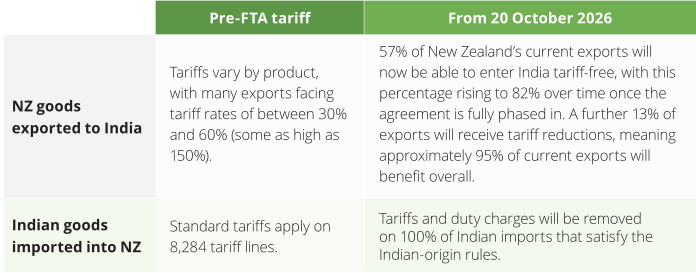
While there are tariff reductions across a number of industries (mainly the industries that already export to India), not all industries benefit from tariff reductions. Therefore, it is important to check whether your industry qualifies for a tariff reduction under the FTA.
What’s in it for you? - Lower barriers, greater opportunities
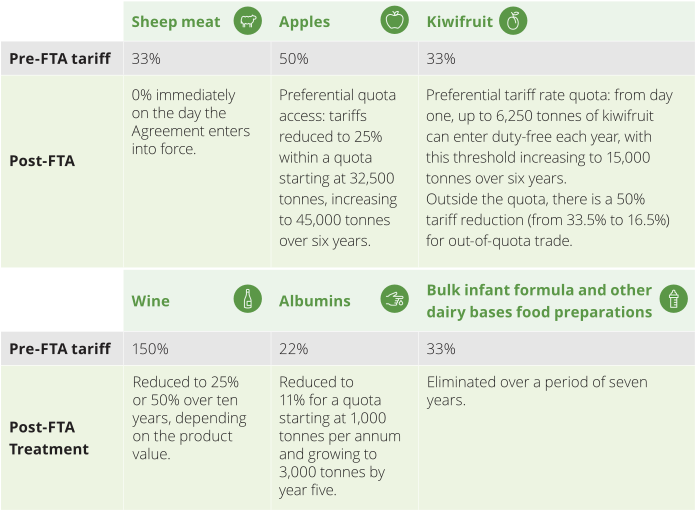
New Zealand exporters should have more competitive access to India, and opportunities to diversify their sales. The Ministry of Foreign Affairs and Trade estimates annual tariff savings of approximately NZ$43 million for New Zealand businesses, scaling to NZ$62 million once the second round of tariff cuts occurs from 1 January 2027. For certain products, including apples, kiwifruit and albumins (milk protein product), benefits come through preferential quota access rather than unrestricted tariff elimination.
However, it is worth noting that benefits also extend beyond goods. Improved access for services exporters, including fintech, tertiary and private education providers, will help NZ businesses compete on a more level playing field in India.
Which industries will benefit the most?
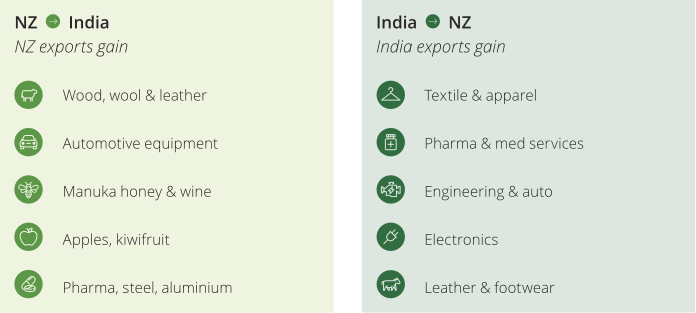
Forestry and wood exporters: More than 95% of existing forestry and wood exports (including pulp and paper products) will enter India tariff-free from day one, with tariffs on almost all existing trade phased out over seven years.
Apple and kiwifruit exporters: Exports of apples and kiwifruit will be subject to preferential quota access, resulting in lower tariffs and duty-free access for kiwifruit. Kiwifruit exports outside the quota will also receive a halving of tariffs, subject to applicable conditions.
Dairy exporters: The FTA introduces phased tariff elimination for bulk infant formula, specified dairy-based preparations and peptones, alongside preferential quota access for albumins (instead of broad tariff elimination for core dairy products such as milk, cheese and butter).
The FTA also commits to a fast-track mechanism under which New Zealand exporters will be able to supply Indian businesses with inputs from New Zealand, duty-free for use in the manufacture of products for export from India – the timing is yet to be determined.
Key tariff changes include:
Looking beyond tariffs: what tax questions to ask when doing business in India?
Lower tariffs can make India a more attractive market to enter for New Zealand businesses, but tariffs are only one part of the consideration. The existence of an FTA does not necessarily mean a lower compliance burden for New Zealand businesses.
Whether you are entering the market or expanding an existing presence, here are four questions you should be asking:
1. How will the business operate in India?
- What operating model fits your plans? While you might be exporting through your existing NZ entity, you will need to think about how you structure your affairs if you expand and look to do business in India. Some options could involve working with a local distributor or joint venture partner, or establishing an Indian entity to carry out your operations.
- What needs to be in place? If you are expanding to India, you need to consider which legal, foreign investment and tax registration requirements apply, including Indian GST where relevant. Registration requirements are a key point to consider, so ample time is required before launching into the Indian market.
- How will returns reach New Zealand investors? Dividends, interest, royalties and service fees can all be used to repatriate funds to NZ but have varying tax consequences, and some may give rise to withholding tax obligations. Therefore, it is important to consider the existing New Zealand–India Double Tax Agreement (DTA), and how it would apply to any payments that are repatriated to New Zealand.
2. Could your business activity create a taxable presence?
Even if you aren’t setting up an entity in India, consideration is required as to whether activities of your New Zealand business create a taxable presence in India.
Sending employees to India, using a local agent, or concluding contracts in India can create a taxable presence in India. You do not necessarily need your own office to create a permanent establishment (PE). Certain local agency arrangements can be enough for your business to be considered as having a PE, which can lead to the profits relating to the Indian operations of a New Zealand entity being taxed in India.
Hence, the practical questions are straightforward: who will represent your business, where will they work, and what authority will they have? These topics should be considered as part of your expansion strategy, rather than being left until the arrangements are already in existence. The benefits of tariff savings can quickly be eroded by tax obligations if your activity is not managed properly.
3. How will your related-party transactions be priced?
Easier trade conditions may increase transactions between related businesses in New Zealand and India, including transactions such as:
- Product sales/purchases
- Management and support services
- Royalties and intellectual property charges
- Financing and interest.
All cross-border related-party transactions must be priced at arm’s length, meaning the terms (including the price) must be comparable to what an independent business would agree to. If your business does qualify for a tariff reduction, this could mean that exporters have higher post-tax profitability following implementation of the FTA. This impact should be monitored actively for forecasting and also for tax planning and future payments of tax.
4. Will your goods actually qualify for the tariff reductions?
Shipping goods from New Zealand or India does not automatically make them eligible for preferential tariffs. The outcome depends on the product’s tariff classification, whether it meets the relevant rules of origin and the evidence supporting the claim.
For businesses with a complex supply chain, this means it will be important to understand where the goods are manufactured, what processing takes place in each jurisdiction and whether or not the finished product qualifies for preferential treatment under the FTA.
What should businesses do now?
The FTA creates a new pathway into India, but each business will have a different starting point. 20 October 2026 is not simply the date the tariff reductions begin but should be considered a useful trigger for businesses to revisit their business plans for supply to and from India. To discuss what the FTA could mean for your business, or if you consider there is an opportunity for you to expand to India, please contact your usual Deloitte adviser.
October 2026 – Tax Alerts
- GST at 40: policy, politics, and public reaction
- GST at 40: the same tax, but a very different world
- GST at 40: the case for keeping it simple
- GST at 40: what does the future hold?
- GST at 40: simple by design, complex in practice
- Election Tax Policies, part four
- Low-value assets: understanding the rules behind the $1,000 threshold
- India and New Zealand are opening their doors: what does the FTA mean for your business?
- A permanent establishment in jandals and shorts? the 2025OECD Model in full
- Snapshot of recent developments


