

If we have selected the wrong experience for you, please change it above.
Generative AI will not solve Switzerland’s workforce problem: it will only partially cushion the retirement wave
Zurich, 22 October 2026
Over the next ten years, 900,000 people in the labour force will reach retirement age. That is one in five members of the working population. In many cases, however, generative AI is largely unable to take over core tasks. In nursing and care professions, skilled trades and the transport sector, AI can certainly make administrative tasks easier, but it can only go some way towards offsetting demographic replacement demand. This is shown by a new Deloitte analysis of 279 occupations in Switzerland. In software and marketing occupations, on the other hand, high AI transformation potential is coupled with low replacement demand. Job cuts cannot be ruled out in this area, and entry-level roles could disappear.
In total, more than 900,000 people in the labour force will reach retirement age over the next ten years. This corresponds to around 20 per cent of today’s working population. Replacement demand due to an ageing workforce is particularly high in occupations involving direct contact with people, service provision and hands-on work. This concerns qualified nursing professionals, for example, where just under 22,000 people – or 23 per cent of the occupational group – are aged 55 or over. In healthcare support roles, the proportion stands at 30 per cent; for bus and tram drivers, it is 35 per cent; and for domestic helpers and cleaners, it is 33 per cent. Various occupations in the fields of education and teaching also have above-average replacement demand due to demographic change.
In these kinds of occupations in particular, the potential for direct automation using the generative AI systems that are currently available is limited, as shown by an analysis carried out by the audit and consulting company Deloitte. AI can make tasks related to documentation, planning, administration and information retrieval easier. However, current AI systems are unlikely to be able to care for the elderly or the sick, teach children or carry out physical labour for the foreseeable future. Despite AI, the labour shortage in these occupations is therefore likely to persist and become even more acute in the coming years.
Job vacancies and growing pressure to adapt
Deloitte’s analysis combines data on demographic replacement demand with a newly developed index of AI transformation potential. This shows which occupations today’s AI systems are already particularly relevant to and where they can significantly speed up tasks (see the figure on the next page). Four different scenarios emerge.
“The main danger is not that AI will replace jobs. There is a greater risk that companies will leave their jobs unchanged and simply overlay them with AI. Anyone who uses AI merely to write emails more quickly or to automate administrative tasks is wasting a large part of its potential. The real opportunity lies in redesigning entire business processes and fundamentally questioning which tasks will still need to be carried out by humans in the future. Particularly in light of the shortage of skilled workers, we shouldn’t just be talking about how people can work more efficiently, but about how businesses can create significantly more value using AI,” says Antonio Russo, Innovation Leader at Deloitte Switzerland.
Coping with scarcity and change at the same time
The greatest challenge, therefore, is not simply a matter of ‘man versus machine’. The real risk is that labour shortages and major upheaval will occur simultaneously. In Switzerland, many vacancies may remain unfilled in occupations where AI is unlikely to be able to take over core tasks, while AI is automating tasks and creating new requirements in other, often knowledge-intensive office-based roles.
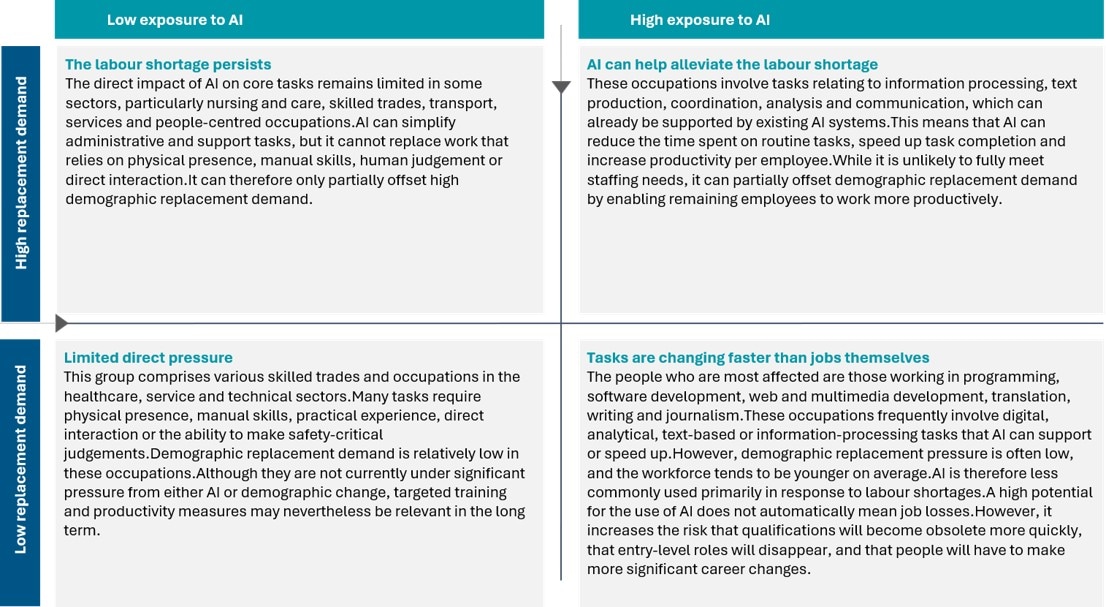
Figure: A comparison of demographic replacement demand and AI transformation potential reveals different starting points. High replacement demand does not necessarily go hand in hand with a high potential for the use of generative AI.
“Switzerland must not mistake AI for a simple solution to the demographic labour shortage,” says Michael Grampp, Chief Economist at Deloitte Switzerland. “Generative AI is transforming knowledge-intensive and administrative tasks in particular. Yet high demographic replacement demand often arises in sectors where physical labour, personal care or practical on-site tasks are essential.”
For Michael Grampp, this also raises a fundamental question regarding training. “If we increasingly view academic careers as the ideal path, and if vocational training loses its status as a result, we are sending out the wrong signals. In view of demographic change and the transformations brought about by generative AI, Switzerland does not need the highest possible proportion of graduates, but a balanced mix of vocational and academic qualifications. Businesses, educational institutions and policymakers must strengthen vocational training and, in occupations such as nursing and care, catering, logistics and skilled trades, not only make it easier for people to switch careers, but also open up attractive career paths.”
Workforce planning and AI strategy go hand in hand
For businesses, this means that traditional workforce planning is no longer sufficient. They need to analyse the tasks that make up each role and how generative AI is changing them. The key factor is to identify where retirements, recruitment difficulties and the potential of AI coincide – and where they do not. In occupations facing a shortage of skilled workers, AI should relieve staff of administrative or repetitive tasks. In office jobs and knowledge-based occupations, on the other hand, the main focus should be on further training and role development.
Supporting the next generation of workers will be particularly important. In occupations such as programming, legal consultancy, translation and administration, AI is increasingly taking over simple, routine tasks. It is precisely by carrying out these kinds of tasks that young professionals often gained experience in the past. Companies must continue to provide these learning pathways in the future to enable young people to acquire experience.
“Switzerland’s competitiveness depends on how quickly and effectively companies integrate generative AI into their day-to-day operations,” says Michael Grampp. “They must use it to become more productive and train their staff to carry out new tasks. At the same time, there needs to be a sufficient number of young people entering occupations where personal care, practical skills and human presence remain crucial.”
About the survey
For its study on “Ageing Switzerland: How AI could transform the Swiss labour market”, Deloitte consolidated demographic and occupational data from Switzerland with international data on the use and potential applications of AI. The proportion of employees aged 55 and over in each occupation serves as an indicator of demographic replacement demand. The AI transformation potential index combines data on the actual use of generative AI with assessments of which tasks large language models can speed up or support. A total of 279 occupations were analysed.
Deloitte offers integrated professional services that include Audit & Assurance, Tax & Legal, Strategy, Risk & Transactions Advisory and Technology & Transformation. With around 2,500 employees at six locations in Basel, Berne, Geneva, Lausanne, Lugano and Zurich (headquarters), Deloitte serves companies and organisations of all legal forms and sizes across all industry sectors in Switzerland.
Our people deliver measurable and lasting results that help reinforce public trust in capital markets and enable clients to transform and thrive. Building on its over 180-year history, Deloitte spans more than 150 countries and territories with approximately 470,000 professionals worldwide.
Note to editors
Deloitte refers to one or more of Deloitte Touche Tohmatsu Limited (‘DTTL’), its global network of member firms and their related entities (collectively the ‘Deloitte organisation’). DTTL and each of its member firms and related entities are legally separate and independent entities, which cannot obligate or bind each other in respect of third parties. DTTL and each DTTL member firm and related entity is liable only for its own acts and omissions, and not those of each other. DTTL does not provide services to clients. Please see www.deloitte.com/ch/about to learn more.
Deloitte AG is an audit firm recognised and supervised by the Federal Audit Oversight Authority (FAOA) and the Swiss Financial Market Supervisory Authority (FINMA).
The information in this media release was correct at the time of publication.
Press contact(s):
Michael Wiget
External Communications Lead
Tel: +41 58 279 70 50
mwiget@deloitte.ch
Kevin Capellini
External Communications Specialist
Tel: +41 58 279 59 74
kcapellini@deloitte.ch