
The hidden drag, quantified: Technical debt’s penalty on value and growth
New Deloitte analysis shows that targeted action across enterprise architecture, infrastructure, and data can reduce technical debt and unlock latent technology potential
It may be tempting to treat technical debt as a back-office nuisance, or as an invisible cost of doing business. But Deloitte research suggests that technical debt suppresses a company’s “latent potential”—which we define as the value already paid for in existing tech that remains obscured by tech debt’s complexity. While the average firm may see its debt accumulate over time, a company that prioritizes modernization efforts that remediate tech debt can break this cycle, recovering more than half of its trapped technology value over five years through targeted structural changes.
To quantify the effects of tech debt and the potential it can stifle, Deloitte built a system dynamics model to track five years of strategic technology trade-offs made by two simulated enterprises: an “ambitious” organization that prioritizes keeping its tech foundation streamlined and modernized, and an “average” organization that layers new tools—like AI—onto an aging foundation (see methodology). This analysis uncovered how two levers, infrastructure modernization and data transformation, can fundamentally alter a company’s tech capabilities by driving down technical debt and unlocking latent potential. Infrastructure modernization alone can reduce tech debt by 18% over five years. Data transformation, which could come in the form of improved data-asset strategies and an enhanced ability to convert data into business outcomes, showed a 52% improvement in latent potential over a period of five years in our model. Together, the findings suggest that the most direct path to growth is the systemic optimization of tech and infrastructure capacity that the enterprise has already paid for.
A tale of two hypothetical enterprises
In the Deloitte Insights article, “Tech decisions can drive big earnings-per-share gains,” we found that companies that increase investment across IT, data, and AI can nearly double earnings per share (EPS), potentially unlocking up to $277 million in competitive advantage.2 While these gains highlight the upside of bold technology strategies, leaders need to balance them against persistent pressures on operating costs, margins, and profitability.
As AI and automation ambitions accelerate, two questions arise regarding enterprise strategy: How can organizations pursue bold technology transformation without compounding future technical debt? And, how can leaders unlock latent value that already exists within their technology footprint? For example, tech leaders may have ideas for how to use existing tech more effectively but have limited influence or incentive to share them. Or, an organization may have processes that could be automated by AI capabilities already paid for but not currently used.
We compared two simulated S&P 500 companies to examine the potential impact of different strategic choices on technical debt and latent potential. In our analysis, both companies start with the same level of technical debt and latent potential, but the first treats its debt like many companies do in our experience: It allows debt to accumulate faster than it’s remediated. The second company takes action to improve infrastructure maturity or data maturity through actions like cloud migration or data cleansing, resulting in dramatically different outcomes.
The first simulated company is an S&P 500 organization with a median IT budget, moderate digital maturity, a fairly-strong (but not exceptional) ability to manage change, and limited AI activity beyond pilots. Its strategy is to keep infrastructure and AI and data capabilities broadly stable with the company’s current reality (reflected in the model by an average starting score for each attribute). Based on historical S&P 500 patterns, this company starts at an EPS of US$2 in year 1 and grows steadily to US$5.17 by year 5, reflecting typical market performance.
The second simulated company has a strategy related to infrastructure modernization or data value to help provide leaders with a clearer picture of how specific decisions related to bold technology strategies may affect tech debt and latent potential in the next two to five years.
Here’s what we learned.
How infrastructure interventions impact tech debt
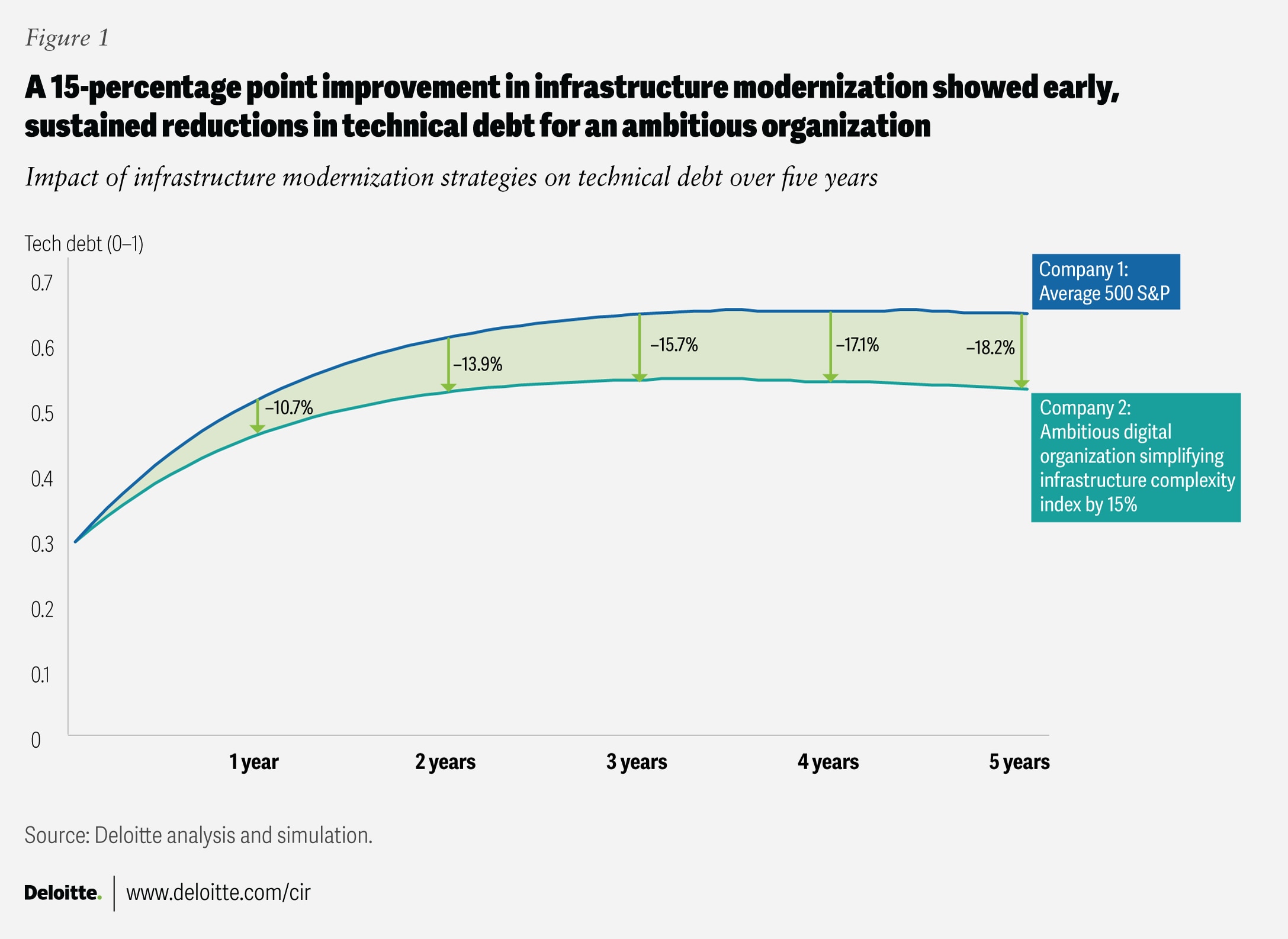
Infrastructure modernization often leads to long-term reductions in technical debt. When we compare the two hypothetical enterprises, the second company that has a more robust infrastructure modernization strategy (leveraging solutions such as multicloud or microservices) reduces tech debt by 10% in the first year, reaching 18% over five years relative to company 1. The difference between the two examples is the leap in technical maturity. While the average company operates at about 65% of its potential (a 0.65 on our scale), the leading enterprise pushes its capabilities 23% higher than that baseline through aggressive modernization (figure 1).
Legacy infrastructure has been one of the top challenges to successful digital initiatives for the past three years, according to Deloitte’s annual Tech Value survey.3 It’s widely considered to have an impact on progress and be a contributor to technical debt. This challenge seems to only be getting more significant as new hybrid infrastructure models take hold to keep pace with AI transformation. Leaders are facing ballooning cloud costs, the move to neo-clouds (specialized AI infrastructure that’s cloud based), and the evolution of self-hosted options.
eBay undertook a platform modernization effort to address challenges resulting from its legacy infrastructure. Users had been experiencing latency during payments and checkouts leading to a subpar customer experience. Technical debt also constrained the company’s ability to scale and innovate. To resolve this, the company transitioned to an application programming interface-centric model and modernized both its tech stack and compliance standards. eBay also refactored middleware into microservices to drive scalability. This modernization enabled a more seamless user experience along with a 100% improvement in buyer satisfaction scores.4 In addition to improved operating performance, the infrastructure modernization enhanced developer productivity, allowing eBay to more rapidly deliver features and improve customer engagement across the platform.
How data transformation can reduce tech debt
When leadership makes deliberate investments in data modernization and simplification—rather than assuming that data-driven value creation will naturally overcome underlying technology constraints—organizations tend to be better positioned to reduce technical debt and unlock sustainable value. Data transformation is not simply about replacing legacy systems; it typically involves reconfiguring and optimizing existing assets to generate new business impact. That’s exactly what we found when comparing an organization that maintained average data maturity with one that strengthened its data capability.
Organizations can make deliberate investments in data modernization by cleaning up how data is managed and governed. This in turn improves business results across three core areas:
- Assets: The tools that drive an organization’s technological base
- Methods: The capability and process levers that determine how efficiently assets are converted into business value
- People: The human capacity to sustain transformation
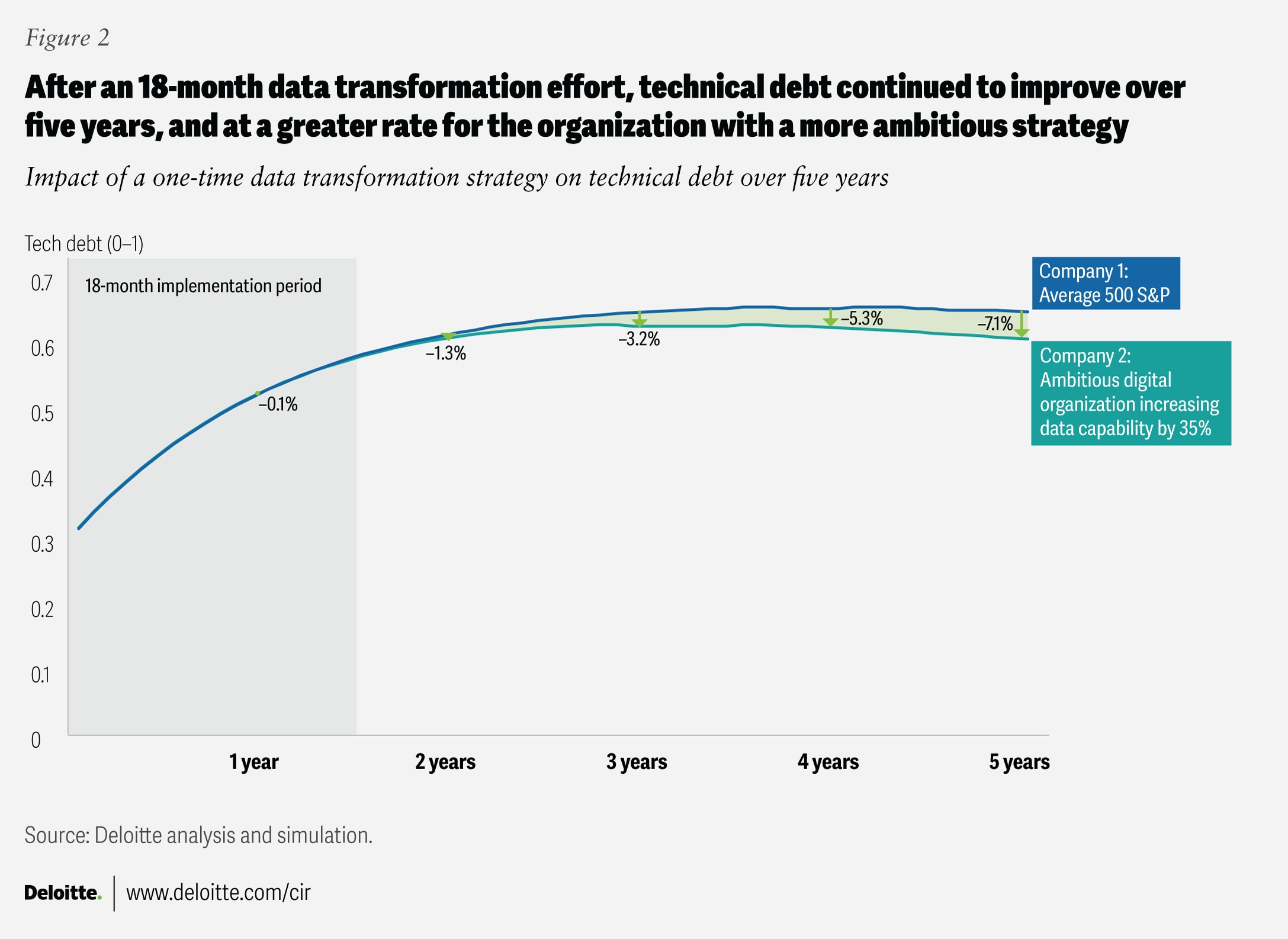
During an 18-month gradual implementation period, increasing data capability by 35% in our model was associated with a progressively larger—but still incremental—reduction in technical debt relative to an average organization: By year 2, our ambitious company had approximately 1.3% less tech debt than the average company, 3.2% less by year 3, 5.3% less by year 4, and 7.1% less by year 5 (figure 2).
In one example, a global retailer migrated to centralized control over data assets (permissions, auditing, and lineage), striving to improve transparency and trust. By decommissioning legacy code and patterns, the retailer reduced technical debt and streamlined operations.5
How data transformation can unlock latent potential
Latent potential can be unlocked when organizations strengthen their data capabilities—even when they don’t tackle technical debt first. This might be achieved through better data governance, quality, access, and data reuse to improve decision velocity and execution effectiveness across the enterprise.
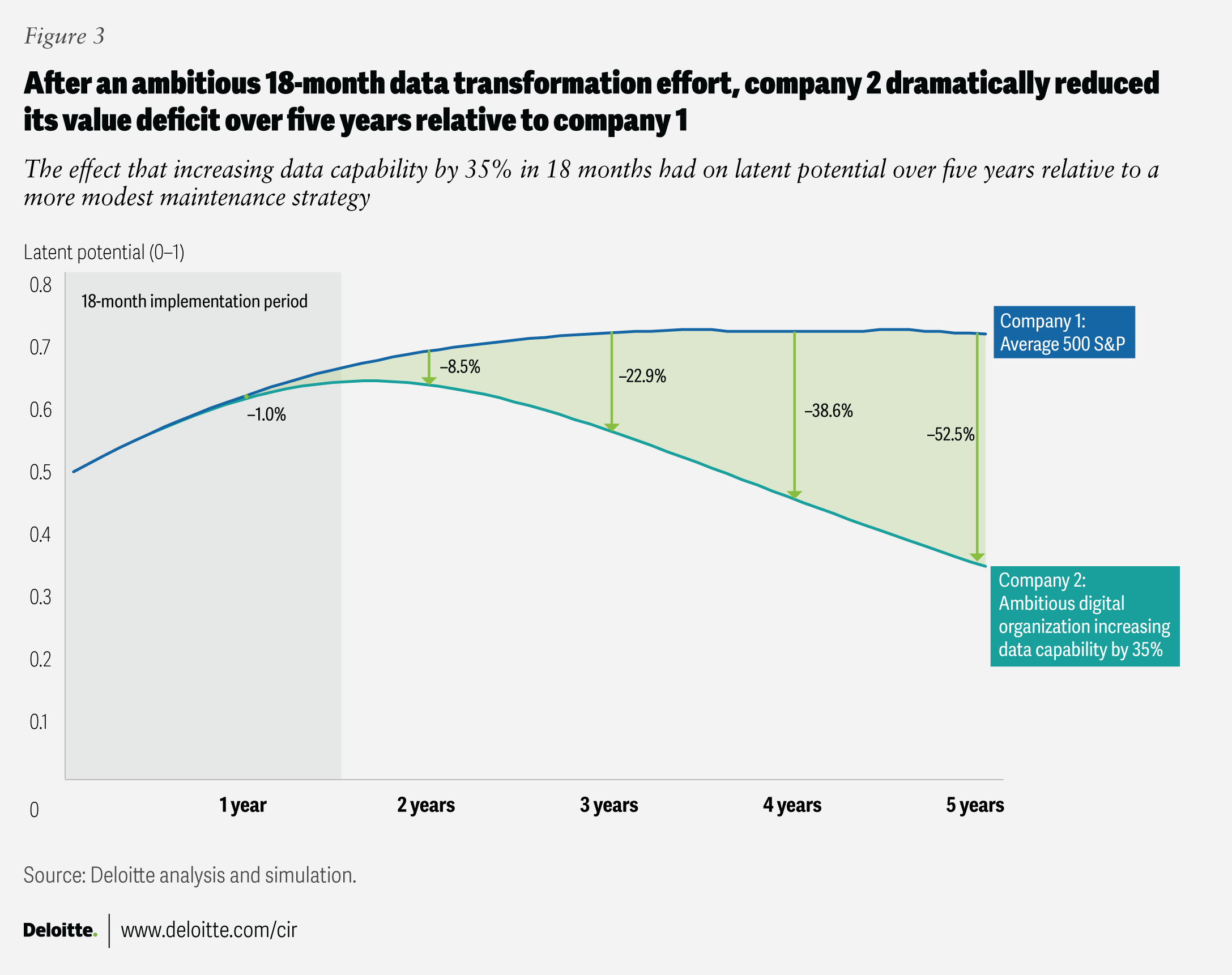
In the model, a 35% increase in data capability produced a material reduction in latent potential relative to an average organization after an 18-month gradual implementation period. In this case, less latent potential is a good thing, as it shows that less value is being “hidden” within the tech stack. While reductions in latent potential were modest early on—about 1% less than the average company by year 1—the effect then compounds as data-driven operating capacity scales: Company 2 saw approximately 8.5% less latent potential than the average company by year 2, 22.9% less by year 3, 38.6% less by year 4, and 52.5% less by year 5 (figure 3).
As one leader we interviewed noted, the value of technology isn’t static; organizations often discover new sources of upside only after capabilities and data foundations are in place.
Optimizing the tech estate
Most organizations can’t “AI their way out” of technical debt. Infrastructure modernization is necessary as well as strong data strategies. C-suite leaders should consider how they make technology-strategy decisions—moving beyond isolated initiatives to understand their organizations as interconnected systems, where each decision shapes multiple downstream outcomes.
This analysis demonstrates that targeted, sustained interventions—particularly in infrastructure modernization and data capability—can materially reduce technical debt and unlock latent technology potential. While infrastructure investments play a critical role in stabilizing and simplifying the tech estate, strengthened data capability can drive compounding value over time, improving decision velocity, execution effectiveness, and ultimately financial performance.
Effectively managing technical debt is not simply a matter of cost control or operational hygiene. When approached deliberately, it can become a lever for new revenue creation, improved profitability, and increased earnings per share. For leaders navigating AI-driven transformation, the opportunity lies not only in deploying new technologies but in reshaping the system that determines how value is created—and sustained—over the next two to five years.
Continue the conversation
Meet the industry leaders
Diana Kearns-Manolatos
Monika Mahto
by
Subodh Chitre
Tarun Sharma
Diana Kearns-Manolatos
Monika Mahto
The authors would like to thank Louis DiLorenzo Jr. for his support and guidance, which were pivotal in framing the research article and the direction of the storytelling.
We would like to thank Ahmed Alibage for his key contributions to the analysis and model development. We would also like to thank Tim Smith, Nikhil Roychowdhury, Michael Wilson, Mike Caplan, and Sid Seshadri for their valuable insight and knowledge sharing that have been pivotal in shaping the core model.
We extend our appreciation to the marketing team – Akshay Poojari, Ireen Jose, and Saurabh Rijhwani – for their guidance and leadership in amplifying the impact of these insights.
Editorial (including production and copyediting): Andy Bayites, Prodyut Borah, Shyamili M, Cintia Cheong
Design: Molly Piersol
Knowledge Services: Rishitha Bichapogu
Cover artist: Jaime Austin, Sofia Laviano
Visit the Deloitte Center for Integrated Research
Access more insights on some of the most complex issues facing businesses today.