
Moving from protecting enterprise value to creating it
Findings from Deloitte’s 2026 Chief Sustainability Officer Survey indicate that sustainability is becoming embedded, but also defensive
Deloitte’s 2026 Chief Sustainability Officer Survey suggests that sustainability is becoming more embedded across the enterprise, but is more concentrated on defensive measures such as disclosure, compliance, and operational efficiency—all areas where surveyed chief sustainability officers report mature capabilities. Regulatory compliance and adherence to disclosure regulations remain the top priorities for these executives, reflecting one of the function’s roles as a steward of credibility, controls, and enterprise risk. But this work alone is unlikely to meet C-suite and board expectations, and risks missing the greater opportunities for business impact that sustainability can bring. And many see the potential, with more than half of surveyed chief sustainability officers citing sustainability-driven value measurement and business case development as areas about which they should learn more. These executives face a strategic imperative to expand their focus to how sustainability can create value across the enterprise, not just protect it.
“More than half of surveyed chief sustainability officers cite sustainability-driven value measurement and business case development as areas about which they should learn more. These executives face a strategic imperative to expand their focus to how sustainability can create value across the enterprise, not just protect it.”
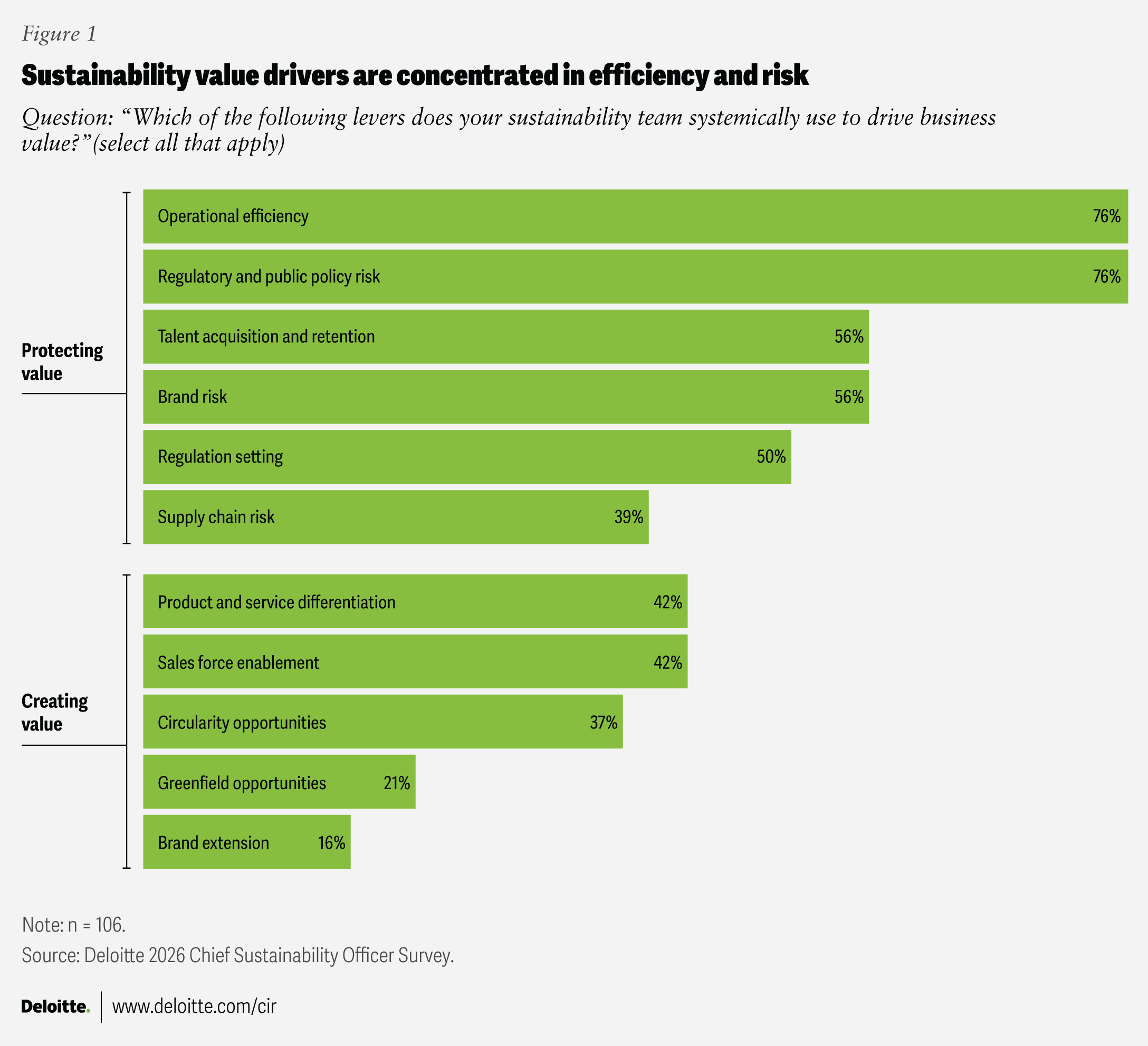
Survey results (see methodology) indicate that a defensive orientation is consistent with how chief sustainability officers describe sustainability’s contribution to overall business value. Operational efficiency and regulatory or public policy risk are the two most frequently named value levers, each cited by 76% of respondents. These are critical, material business outcomes, but they are also primarily protective. Growth-oriented levers are less developed: Only 42% cite differentiation of products and services as a value driver, and the same percentage cite sales force enablement. CSOs have helped make sustainability more embedded in the enterprise, but its strongest applications remain concentrated around efficiency, compliance, and risk management (figure 1).
The next question for the sustainability agenda is whether this foundation can be converted into a broader value-creation orientation—one that connects sustainability more directly to customers, products, innovation, and growth.
A fast-changing operating environment has impacted CSOs’ posture
CSOs’ emphasis on value protection is in part a reaction to changes in the broader market. In the last year, 52% of respondents increased investment in compliance, legal, or risk management activities due to EU policy changes; 40% did the same in response to US policy changes. CSOs navigate a shifting policy environment, multiple disclosure expectations, and ongoing scrutiny from stakeholders. In that context, a greater focus on compliance, legal, risk management, and reporting discipline is likely to be expected.
However, while this response may be prudent in the moment, it can create a longer-term risk: What begins as an incremental and temporary reaction to uncertainty can become a permanent operating model. Organizations focused on legal, compliance, and reporting may underinvest in the next stage of value creation. The challenge is to maintain discipline without allowing defense to fully define the sustainability agenda.
An operating model biased toward data and disclosure
Resource allocation is a clear signal of strategy and priorities. In our survey, a defensive posture is visible in how sustainability functions allocate people, budget, and management capacity. On average, CSOs surveyed have twice as many full-time employees working on reporting and disclosure management as on developing sustainable products or services, and the three largest spend categories after headcount relate to data collection and management, measurement, and reporting.
That pattern suggests the sustainability operating model is built primarily around credibility and disclosure readiness. While necessary in a shifting policy and reporting environment, these allocations can shape—but should not limit—what the function does or can do. With people and discretionary spend concentrated around measurement, reporting, disclosure, and compliance, fewer resources are available for growth-oriented priorities like product and service innovation and new markets.
Most CSOs surveyed are not expecting significant new resources: Fifty-seven percent expect no budget change next year, 22% expect a decrease in proportion with other belt-tightening, and only 13% expect increases. Yet 76% describe their allocated budget as at least somewhat adequate, suggesting the issue may be less about whether budgets are sufficient and more about what CSOs perceive their remit to be and whether existing resources can accomplish a more expansive sustainability mandate. If sustainability is expected or desired to contribute to growth and enterprise value, is that expectation reflected in the operating model? The next phase of the sustainability agenda will likely require more deliberate allocation of headcount, budget, and management attention toward value creation.
Technology deployment is also anchored in compliance
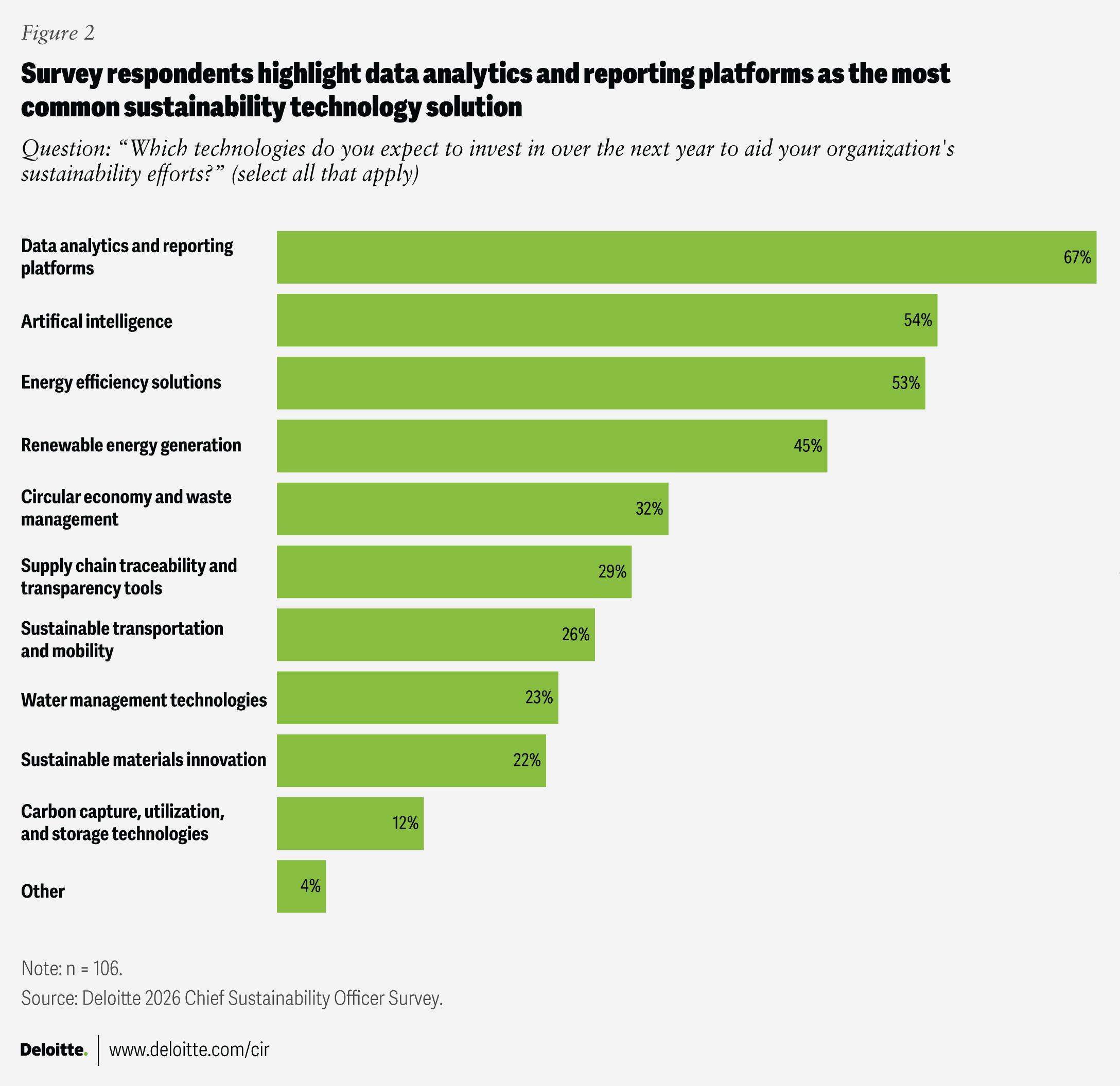
Compliance-centricity is also visible in how sustainability functions are deploying technology and artificial intelligence. As with headcount and budget, technology investment appears to be reinforcing the current operating model rather than reshaping it. Among surveyed CSOs, data analytics and reporting platforms are the most common type of sustainability technology solution, selected by 67% of respondents (figure 2). That puts reporting infrastructure ahead of AI (54%), energy efficiency solutions (53%), and renewable energy generation (45%), among other solutions.
For CSOs surveyed, the largest share of technology deployment remains directed toward the reporting and data infrastructure that underpins compliance. AI adoption follows a similar pattern. The most common sustainability-related AI use case is increasing the efficiency of sustainability team members’ work, cited by 70% of respondents; the next is advanced sustainability reporting and analytics, cited by 57% (figure 3). These practical applications likely help sustainability teams manage rising reporting complexity with greater speed and consistency, but they are extensions of the current defensive agenda. CSOs can look to harness more reliable and useful sustainability data to unlock additional sources of value, from improved risk identification and management to improved supply chain efficiency.1
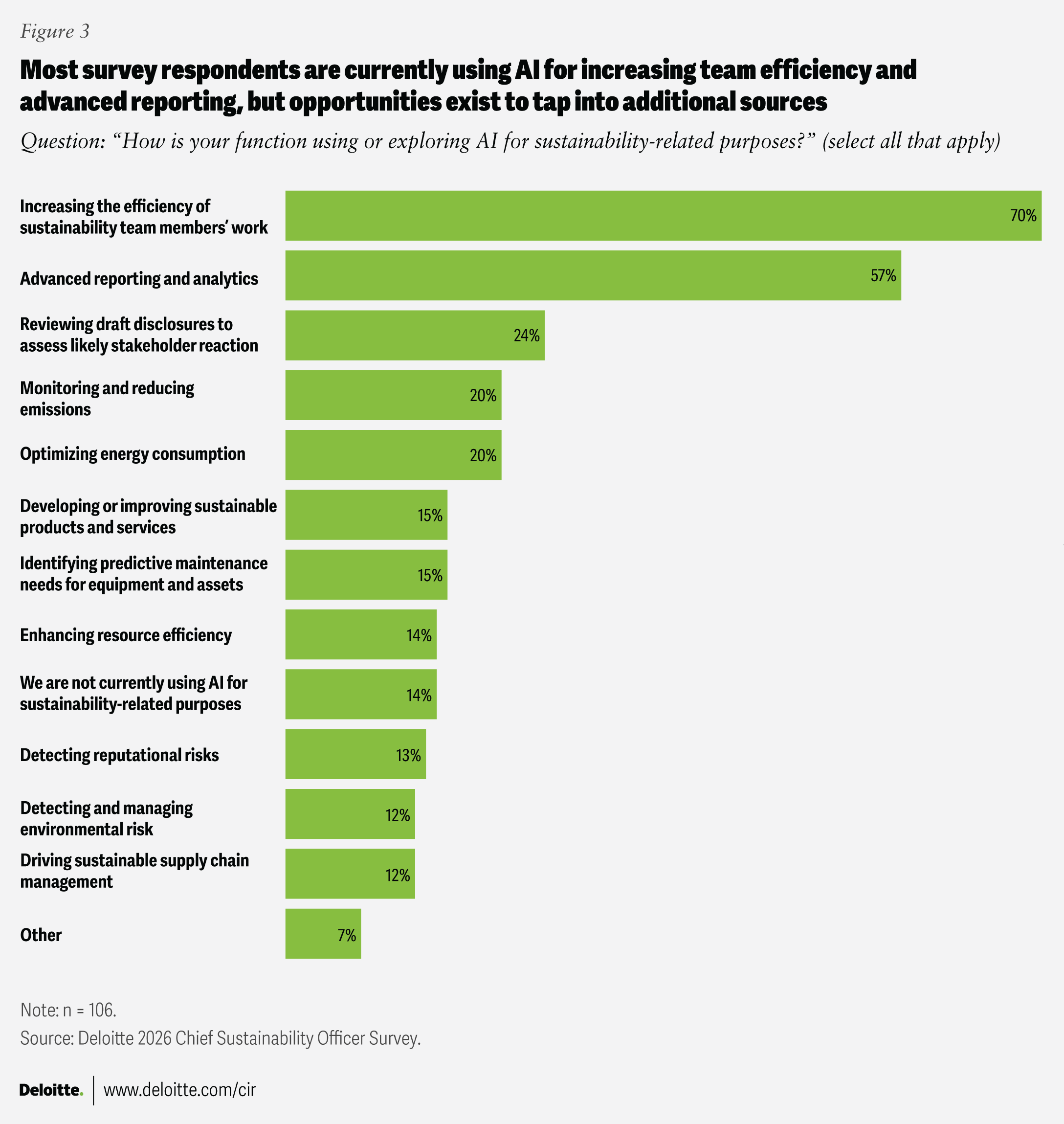
The contrast with more growth-oriented AI use cases is sharp. Only 15% of surveyed CSOs say they are using or exploring AI to develop or improve sustainable products or services. Fewer respondents cite AI for sustainable supply chain management, environmental risk detection, resource efficiency, or product and service innovation than for reporting-related applications.
This does not necessarily mean the current technology agenda is misplaced, depending on how time saved is redeployed. Reporting, analytics, and disclosure are logical starting points when the broader environment is putting more pressure on data quality, controls, and compliance readiness. The opportunities for CSOs and the broader C-suite include harnessing efficiency gains and cost savings from technology to free up resources for more growth-oriented initiatives. Additionally, they should evaluate where technology can help sustainability contribute to product innovation, operating resilience, customer value, and new sources of enterprise growth.
“Only 15% of surveyed CSOs say they are using or exploring AI to develop or improve sustainable products or services. Fewer respondents cite AI for sustainable supply chain management, environmental risk detection, resource efficiency, or product and service innovation than for reporting related applications.”
Reporting readiness is the foundation, not the end state
Survey results show that 96% of CSOs say their company publishes a sustainability report or equivalent, and 76% expect to disclose more than what is mandatory in the near future. The same pattern shows up in public commitments. Eighty-nine percent of CSOs say their company has made public sustainability commitments, and 95% say their organization is at least partially on track to reach those goals.
But a company can have strong reporting processes and still fall short of using sustainability data to create maximum value. How can companies use sustainability data to shape decisions about capital allocation, product strategy, operating performance, or customer engagement?
Sustainability should be an enterprise issue, not only a CSO issue
If sustainability is expected to move beyond value protection, it cannot remain primarily a functional mandate. Today, sustainability teams are largely proficient at managing reporting, disclosure, compliance, and risk, but enterprise value creation likely requires prioritization across the business. The chief sustainability officer can coordinate, translate, highlight, and challenge, but growth-oriented sustainability also includes the chief financial officer connecting priorities to capital, the chief operating officer and product teams embedding sustainability into operations, commercial leaders connecting it to customers, and the chief executive officer clarifying where sustainability can be a source of enterprise advantage.
The survey suggests that many CSOs are close to enterprise leadership but not always positioned inside the core executive team. Only 18% of CSOs are on the executive or C-suite team; only 11% report directly to the CEO; and 85% report to only one C-suite member. Those reporting lines may provide access and accountability, but they can also limit cross-enterprise integration if sustainability priorities are filtered primarily through a single function or executive sponsor. Senior-leader ownership of sustainability also appears to be under pressure. In 2025, 56% of CSOs said their company’s senior leaders “own” or “adopt” sustainability goals; in the current survey, that figure declined to 39%.
The CSO remains important, but the mandate cannot sit with the CSO alone. The broader C-suite should define where sustainability can protect value, where it can create value, and which leaders are accountable for translating that agenda into business performance.
Closing the value creation gap
Today, sustainability is often connected to enterprise value through efficiency, compliance, risk reduction, and license to operate. Those are significant business outcomes, but they do not represent the full value creation agenda. For many organizations, the underdeveloped opportunity is to use sustainability more directly to shape products, services, markets, customer relationships, and new sources of revenue.3 By linking sustainability more explicitly to a full range of enterprise value creation opportunities, CSOs can materially contribute to company success, earn C-suite and board trust, and win greater latitude to pursue other parts of the sustainability agenda.
To achieve this, CSOs can consider three initial steps:
- Rebalance resourcing deliberately. With twice as many full-time employees working on reporting as on product innovation, CSOs should set explicit targets for redirecting a portion of headcount, budget, and management attention toward growth-oriented work, such as sustainable product development, customer-facing differentiation, and new market opportunities. Even modest reallocation, paired with efficiency gains in reporting from AI and automation, can free up meaningful capacity for value creation without requiring new budget.
- Redirect technology and AI investment toward growth use cases. Sustainability functions have built strong technology capabilities in analytics and reporting platforms; the opportunity now is to apply that same sophistication to product innovation, supply chain resilience, and customer engagement—areas where adoption currently lags far behind reporting-related applications. CSOs should actively look to pilot AI use cases tied to revenue and competitive differentiation, not just efficiency and compliance, and track them with rigor approaching that of disclosure metrics.
- Make sustainability an enterprisewide operating model issue rather than a single function’s mandate. Because only a small share of CSOs sit on the executive team or report directly to the CEO, sustainability priorities often depend on cross-functional buy-in that isn’t structurally guaranteed. CSOs should proactively build coalitions with the CFO to link sustainability to capital allocation decisions, with the COO to embed it into core operations, and with commercial leaders to connect it to customer value and growth strategy. Where senior leadership ownership has declined, as the survey suggests it has, CSOs have an opening to reengage the C-suite by reframing sustainability conversations around enterprise growth rather than risk mitigation alone.
by
Nathan Sloan
Christina Brodzik
Dan Goldenberg
David R. Novak
Janice Armbrust
Derek M. Pankratz
The authors would like to thank Nick Mahedy, Ellie Ryan, Hannah Rose Potter, Aditi Vashishtha, and Ireen Jose for their help in developing this article and the research from which this data was created.
Editorial (including production and copyediting): Rithu Thomas, Shyamili M, Anu Augustine, and Pubali Dey
Design: Molly Piersol and Manya Kuzemchenko
Cover image by: Manya Kuzemchenko
Knowledge services: Vanapalli Viswa Teja
Visit the Deloitte Center for Integrated Research
Access more insights on some of the most complex issues facing businesses today.