
Balancing growth, cost, and risk in enterprise energy strategy
Shifting from siloed decisions to a portfolio approach balancing growth, cost, and risk can help companies succeed in a challenging energy environment
Many companies increasingly see energy strategy as a core business capability that ties energy availability, reliability, and economics directly to enterprise-level outcomes.1 But robust energy strategies do more than enable faster but still siloed decisions that optimize for the cheapest power, fastest growth, or lowest risk. Effective strategies are those that evaluate opportunities across growth, cost, and risk simultaneously. By enabling a more portfolio-level perspective, this three-part approach can help clarify exposure, unlock competitive advantage, and support more deliberate trade-offs. Rather than encouraging fragmented decisions, such strategies help create opportunities by looking across all three lenses at once, balancing trade-offs across them.
A three-pronged approach to enterprise energy strategy
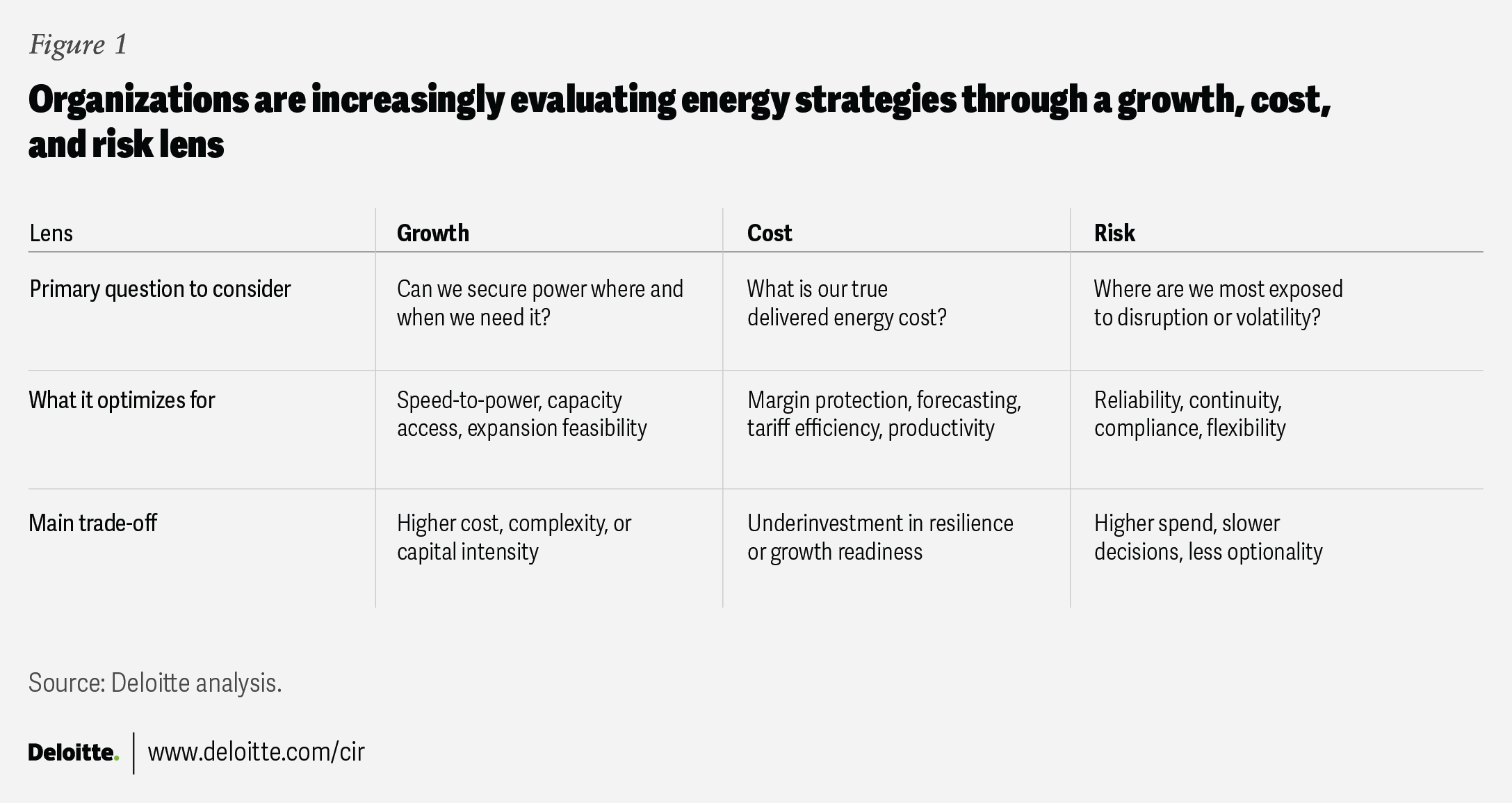
Approaching energy strategy through the lenses of growth, cost, and risk allows organizations to understand different sources of exposure, different sets of trade-offs, and different combinations of strategic levers. The challenge for leadership is in knowing which lens should lead in a given context, and how to balance it against the others (figure 1).
Growth lens: When growth is the priority, organizations tend to optimize for energy access and timing. Where power enables or constrains growth plans, decision-makers should know how quickly it can be secured and which types of infrastructure are available. Examples include hyperscalers and other large tech players looking to secure power for new data centers, with nontraditional approaches ranging from colocation with existing generation capacity to building net-new capacity (including behind-the-meter).2
Trade-off to note: Focusing on growth can increase cost exposure, execution complexity, and capital intensity.
Cost lens: Organizations focusing on cost tend to optimize around total delivered energy economics rather than just contract price. Approaches can include investing in energy efficiency, load shifting, and advance purchase agreements tailored to a company’s scope and profile.
Trade-off to note: A narrow focus on cost can leave organizations unprepared for reliability disruptions, capacity constraints, or timing demands that might accompany growth.
Risk lens: When organizations prioritize risk mitigation, they broaden the definition of performance to include reliability, outage costs, market volatility, long-term contract exposure, compliance risk, and governance over energy claims. Solutions vary with the types of risk, spanning redundancy and backup power to tighter oversight and external auditing about emissions impacts.
Trade-off to note: Some risk-mitigation choices can increase costs, slow decision-making, or limit flexibility.
Fueling smart energy decisions
An organization’s decision-makers should assess how energy generation, storage, and management support broader goals in the face of mounting pressure from grid bottlenecks, interconnection delays, price volatility, and competition for capacity. Disciplined portfolio design that factors in choices across the growth, cost, and risk lenses simultaneously can help. The aim is not to eliminate the trade-offs within them, but to choose them deliberately based on how they interconnect, aligning them with business priorities, capital plans, and risk tolerance.
A growth lens
Deloitte estimates that data center power demand could nearly quadruple from 47 GW in 2025 to more than 176 GW by 2035,3 which may further constrain grid capacity and reliability. In this era of tight supply, energy access can now be an enabler of growth—or if limited, a constraint. Growth locations that would otherwise be attractive might be nonviable if reliable, cost-efficient energy is not accessible there. In many markets, the assumption of abundant, on-demand power no longer holds. Energy constraints can impact growth and make energy a gating variable. These include grid congestion, interconnection backlogs, infrastructure lead times, evolving decarbonization requirements, and geopolitical tensions.
Rather than scaling purely in response to market opportunity, some organizations are aligning expansion plans to where capacity exists, how quickly it can be secured, and what level of certainty can be maintained over an asset’s life. This is especially true for large-load consumers: data centers, as well as a range of industrial and manufacturing operations.4
Energy strategies for growth
Decision-makers should determine where their organization can grow on schedule with dependable power—and what it would take to make the desired locations feasible. They can make energy a first-order input for:
- Site selection and development decisions
- Assessing electrification readiness
- Decisions around self-generation or captive supply
Doing so can support faster expansion, more credible schedules, and fewer late-stage redesigns.
Strategic levers to accelerate energy-led growth
To navigate energy constraints, organizations can consider a set of interconnected levers that reconfigure how and where growth occurs:
- Energy-led site selection: Location decisions are increasingly based on grid conditions rather than traditional factors such as labor or market proximity. Regions that would otherwise be considered suboptimal are now attractive if they have surplus capacity, underutilized transmission infrastructure, or faster permitting.
- Interconnection sequencing: Project pipelines are being reordered based on access to grid connections. In some cases, projects can advance simply because they hold a favorable position in interconnection queues or require fewer network upgrades.
- Self-generation and captive supply: Onsite and near-site generation and storage emerge as options to bypass grid constraints and secure dedicated capacity. The emphasis is shifting from cost efficiency to control over timelines and risk exposure.
- Storage as a timing mechanism: Intelligent energy storage is used to manage timing mismatches between supply and demand. This can help organizations mitigate intermittency, stabilize operations, and reduce dependence on grid reliability at critical times.
- Fuel switching and hybrid energy systems: To enhance resiliency, flexible energy architectures that combine grid power, captive generation, backup systems, and multiple fuels are an option. But it’s important to note that these configurations can also introduce operational and regulatory complexity.
Navigating costs
Cost is a major factor when evaluating corporate energy strategy. One reason is the speed at which commercial electricity prices are growing. The median compound annual growth rate of electricity prices is now 5.9%, nearly double the standard 3% annual escalator for utility budgeting.5
Demand charges and other components that drive energy costs are becoming a larger cost driver that cannot be solved with traditional contracts. A recent study found that for 37% of the facilities analyzed, demand charges comprised more than 30% of the total bill.6 Within the United States, there is a 7x variation in blended commercial electricity rates across markets. As an extreme example of price fluctuations between markets, commercial buildings in San Diego pay 64% to 70% more for electricity than those in Long Beach.7 These cities are only 100 miles apart, have similar climates, and are both served by investor-owned utilities regulated by the California Public Utilities Commission, yet their average rates are significantly different.
Recognizing the scope of energy-related costs is also a challenge. Some organizations may risk making energy cost decisions that focus only on unit price optimization through contracts, such as power purchase agreements or other procurement strategies. This approach doesn’t capture their real cost exposure. Under conditions of stressed and volatile energy systems, cost should be reframed as total cost of ownership.
Energy strategies for cost management
Leading organizations look beyond how energy is purchased. They account for how it’s stored, consumed, and taxed, as well as how it interacts with overall operations.
Viewing energy through a total cost of ownership lens can help unlock the following benefits:
- Lower energy intensity through efficiency and load optimization
- Better tariff outcomes from smarter rate selection and demand shaping
- Stronger margin protection from reducing exposure to peak pricing and curtailment risk
- Better cost forecasting that improves budget accuracy and investment decisions
Overall, some organizations appear to be making energy cost decisions based on their unique operational needs. To address growing demand charges, for example, hyperscale data centers are increasingly shifting nonessential compute workloads to remote regions during local peak-demand periods. This reduces peak charges, eases grid constraints, and improves overall energy efficiency.8 Similarly, European food processor Rupp Austria GmbH reduced energy costs by nearly 18% by reshaping when it consumed energy, shifting its refrigeration loads to lower-price periods (rather than changing where it got energy from).9
Strategic levers to lower energy costs
When organizations view energy costs as a strategic variable, they can use internal levers to drive higher efficiency and bring down per-unit costs:
- Demand monitoring and visibility: Advanced monitoring systems could enable granular tracking of energy use across operations.
- Load shaping and demand flexibility: Instead of treating demand as fixed variable, companies should actively make the load profiles dynamic.
- Integrated energy management: Integrate energy usage across grid supply, onsite generation, and storage.
- Process and asset optimization: Embed energy efficiency into operational design and equipment.
Navigating risk
As energy systems become more volatile and less predictable, risk is no longer confined to occasional outages or price fluctuations. Reliability events, extreme weather, grid instability, regulatory shifts, and long-term contract exposure are increasing the frequency and magnitude of disruption. The average length of the longest US power outages increased more than 60% between 2022 and 2025.10 With cost estimates ranging from US$300,000 per hour to upwards of US$5 million,11 the implications are clear: Energy risk is a balance sheet issue.
Risk includes a broad set of exposures tied to energy:
- Physical risks such as outages and infrastructure failures
- Market risks such as price volatility and contract exposure
- Social and compliance risks tied to community buy-in, evolving disclosure requirements, and energy claim scrutiny
Energy strategies for mitigating risk
When risk is a priority, organizations optimize for dependable energy access and flexibility. Decision-makers look for ways to minimize exposure to disruption and build reliability and resiliency into their energy system without overcommitting capital or flexibility.
That might mean a diversified energy supply, redundancy built into critical operations, and stronger governance over energy decisions and reporting. The result is greater operational continuity, reduced exposure to market shocks, avoided downtime, and improved confidence in long-term planning.
Strategic levers to mitigate risk
To support a strategic focus on risk, organizations are making decisions to support purposeful diversification. Levers include:
- Geographic diversification: Some organizations are spreading operations and energy sourcing across multiple regions to reduce exposure to localized grid constraints, regulatory changes, or extreme weather events. This reduces single-point-of-failure risk but can increase operational complexity.
- Resilience planning and redundancy: Critical sites are incorporating backup generation, microgrids, and storage-backed systems to ensure continuity during outages. The focus is shifting from compliance-level backup to business-continuity-level resilience.
- Storage and supply diversification: Some organizations are increasingly using energy storage and demand flexibility to hedge against intermittency, peak pricing, and grid instability, gaining operational flexibility but requiring new capabilities to optimize. At the same time, diversifying energy sources can help manage risks and price volatility across any single energy type.
- Governance and risk management integration: Energy is being elevated into enterprise risk frameworks, with clearer ownership, scenario planning, and integration into capital allocation decisions. This helps align energy exposure with broader risk tolerance but often requires operating changes.
- Community engagement and co-benefits: To ensure social license to operate, especially for projects with large load requirements or significant local impacts, organizations should engage early and often with local communities. This can encompass transparency and communication—often non-negotiable requirements—as well as more significant steps like community benefit agreements and commitments to offset electricity price impacts.12
Putting it all together: Evaluating trade-offs
The three-lens framework makes trade-offs visible, but it doesn’t eliminate them. A decision that improves speed-to-power may increase capital needs. A strategy that reduces near-term cost may leave the organization less prepared for reliability events or future expansion. A risk-led posture may improve continuity while limiting flexibility. The point of developing an enterprise energy strategy is to make those trade-offs explicit and align them with business priorities rather than let them emerge by default.
Making energy strategy an enterprise strategy
For leadership teams, the question is whether the organization is managing energy intentionally enough to support growth, protect margins, and reduce exposure. In many organizations, energy decisions still sit across procurement, facilities, operations, sustainability, and finance with no single enterprise view. That operating model is becoming more challenging as power availability, cost volatility, and reliability pressures intensify. Energy now belongs on the C-suite agenda for the same reason other strategic inputs do: It can constrain growth, reshape returns, and create enterprise-level risk.
In some ways, enterprise energy strategy is no different than other flavors of corporate strategy, and familiar frameworks, like the strategic choice cascade,13 can serve as helpful guides. To move from fragmented decisions to enterprise energy strategy, leadership teams can start with the five steps in the cascade:
- What is our winning aspiration? Use scenario analysis to assess exposure across all three lenses. Develop scenarios that explore how company performance and priorities, energy market dynamics, and broader economic trends might intersect. Sensitivity modeling and regional footprint reviews can be used to understand where growth, cost, and risk pressures are most acute today and how they could evolve.
- Where will we play? Set priorities at the portfolio level and start early. Evaluate trade-offs across sites, business units, and time horizons rather than optimizing for isolated cases. Bring energy into capital allocation, expansion planning, and site selection before commitments are locked in.
- How will we win? Think expansively about the full range of approaches to managing energy. Enterprises may have a wide range of levers at their disposal, including some such as partial self-generation and storage that might previously have been unavailable or uneconomic.
- What capabilities must we have? Assess the organization’s resources and skillsets to identify gaps. Some approaches benefit from specialized expertise and deep experience with often highly technical aspects of energy markets, systems, and technologies. Consider whether it makes sense to build or buy where particular capabilities are needed.
- What management systems do we need? Clarify ownership and decision rights. Define who leads, who informs, and how energy decisions connect across finance, operations, procurement, sustainability, and strategy.
Taking this integrated approach can turn energy from a constraint into an opportunity—a strategic lever for scaling operations, protecting margins, and strengthening resilience.
By
John Mennel
Geoff Tuff
Robert Bui
Mitchell Cook
The authors would like to thank Derek Pankratz, David Novak, Nirmal Kujur, Alura Vincent, and Aditi Vashishtha for their help in developing this article.
Editorial (including production and copyediting): Rithu Thomas, Shyamili M, Anu Augustine, and Cintia Cheong
Design: Molly Piersol and Natalie Pfaff
Cover image by: Pooja Lnu
Knowledge services: Agni Wagh
Visit the Deloitte Center for Integrated Research
Access more insights on some of the most complex issues facing businesses today.